Industry 4.0 through the lenses of technology, strategy, and organization
A compilation of case study evidence
DOI:
https://doi.org/10.14267/VEZTUD.2020.11.02Keywords:
Industry 4.0, strategy, organization, Industry 4.0 technologies, digital transformationAbstract
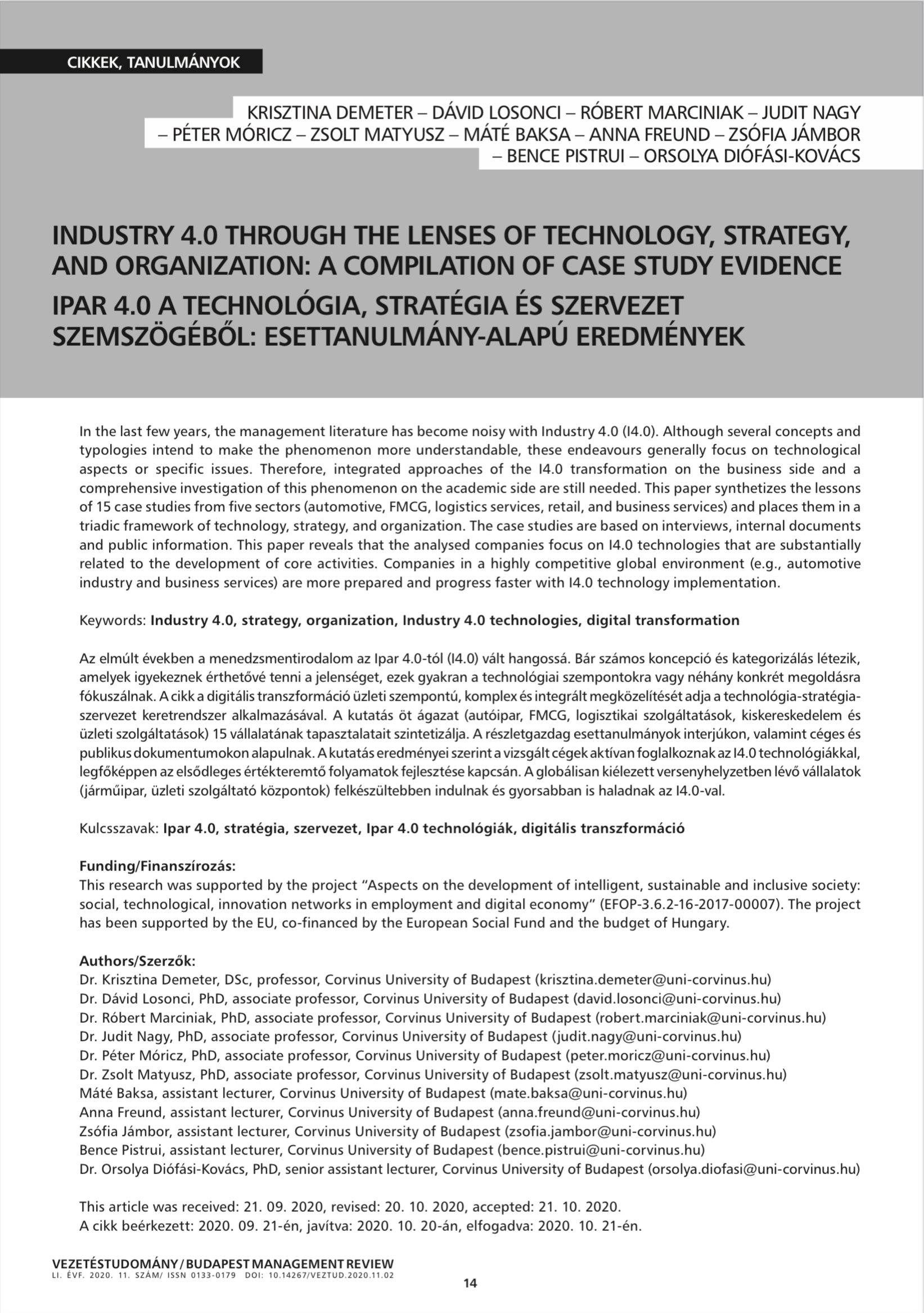
In the last few years, the management literature has become noisy with Industry 4.0 (I4.0). Although several concepts and typologies intend to make the phenomenon more understandable, these endeavours generally focus on technological aspects or specific issues. Therefore, integrated approaches of the I4.0 transformation on the business side and a comprehensive investigation of this phenomenon on the academic side are still needed. This paper synthetizes the lessons of 15 case studies from five sectors (automotive, FMCG, logistics services, retail, and business services) and places them in a triadic framework of technology, strategy, and organization. The case studies are based on interviews, internal documents and public information. This paper reveals that the analysed companies focus on I4.0 technologies that are substantially related to the development of core activities. Companies in a highly competitive global environment (e.g., automotive industry and business services) are more prepared and progress faster with I4.0 technology implementation.
Downloads
References
Agostini, L., & Filippini, R. (2019). Organizational and managerial challenges in the path toward Industry 4.0. European Journal of Innovation Management, 22(3), 406–421. https://doi.org/10.1108/EJIM-02-2018-0030
Andrews, K. R. (1987). The concept of corporate strategy (3rd ed.). Homewood, Illinois: Irwin.
Asatiani, A., & Penttinen, E. (2016). Turning robotic process automation into commercial success – Case OpusCapita. Journal of Information Technology Teaching Cases, 6(2), 67–74. https://doi.org/10.1057/jittc.2016.5
Azuma, R. T. (1997). A Survey of Augmented Reality. Presence: Teleoperators and Virtual Environments, 6(4), 355–385. https://doi.org/10.1162/pres.1997.6.4.355
Brettel, M., Friederichsen, N., Keller, M., & Rosenberg, M. (2014). How Virtualization, Decentralization and Network Building Change the Manufacturing Landscape: An Industry 4.0 Perspective. International Journal of Information and Communication Engineering, 8(1), 37–44. Retrieved from https://publications.waset.org/9997144/pdf
Chen, H., Chiang, R. H. L., & Storey, V. C. (2012). Business Intelligence and Analytics: From Big Data to Big Impact. MIS Quarterly, 36(4), 1165–1188. https://doi.org/10.2307/41703503
Culot, G., Nassimbeni, G., Orzes, G., & Sartor, M. (2020). Behind the definition of Industry 4.0: Analysis and open questions. International Journal of Production Economics, 226. https://doi.org/10.1016/j.ijpe.2020.107617
Dalenogare, L. S., Benitez, G. B., Ayala, N. F., & Frank, A. G. (2018). The expected contribution of Industry 4.0 technologies for industrial performance. International Journal of Production Economics, 204(July), 383–394. https://doi.org/10.1016/j.ijpe.2018.08.019
Daubner, R., & Lips, T. (2017). Digitalization. Stuttgart: Horváth & Partners.
Davis-Peccoud, J., Baculard, L.-P., Caimi, G., & Straehle, O. (2018). Organizing for a Digital World. London, UK: Bain & Company.
Demeter, K., & Losonci, D. (2020). Business and technological perspectives of Industry 4.0: A framework for thinking with case illustration. Vezetéstudomány, 51(5), 2–14. https://doi.org/10.14267/VEZTUD.2020.05.01
Demeter, K., Losonci, D., Szász, L., & Rácz, B.-G. (2020). Magyarországi gyártóegységek ipar 4.0 gyakorlatának elemzése: Technológia, stratégia, szervezet. Vezetéstudomány / Budapest Management Review, 51(4), 2–14. https://doi.org/10.14267/VEZTUD.2020.04.01
Dirican, C. (2015). The Impacts of Robotics, Artificial Intelligence On Business and Economics. Procedia - Social and Behavioral Sciences, 195, 564–573. https://doi.org/10.1016/j.sbspro.2015.06.134
Eurofound. (2018). Game changing technologies: Exploring the impact on production processes and work. Luxembourg: Publications Office of the European Union. Retrieved from https://www.eurofound.europa.eu/sites/default/files/ef_publication/field_ef_document/fomeef18001en.pdf
Ghobakhloo, M. (2018). The future of manufacturingindustry: a strategic roadmap toward Industry 4.0. Journal of Manufacturing Technology Management, 29(6), 910–936. https://doi.org/10.1108/JMTM-02-2018-0057
Gilbert, J. T. (1994). Choosing an Innovation Strategy: Theory and Practice. Business Horizons, 37(6), 16–22. https://doi.org/10.1016/S0007-6813(05)80240-X
Hammond, N. (2017). The importance of the blockchain: The second generation of the internet. Retrieved August 11, 2019, from https://econsultancy.com/theimportance-of-the-blockchain-the-second-generationof-the-internet/
Herbert, L. (2017). Digital Transformation: Build your organization’s future for the innovation age. London, UK: Bloomsbury Business.
Hermann, M., Pentek, T., & Otto, B. (2016). Design Principles for Industrie 4.0 Scenarios. In 49th Hawaii International Conference on System Sciences (HICSS). IEEE. https://doi.org/10.1109/HICSS.2016.488
Horváth, D., & Szabó, R. Z. (2019). Driving forces and barriers of Industry 4.0: Do multinational and small and medium-sized companies have equal opportunities? Technological Forecasting and Social Change, 146(October 2018), 119–132. https://doi.org/10.1016/j.techfore.2019.05.021
Iansiti, M., & Lakhani, K. R. (2017). The Truth About Blockchain. Harvard Business Review, 95(1), 118–127. Jordan, M. I., & Mitchell, T. M. (2015). Machine learning: Trends, perspectives, and prospects. Science, 349(6245), 255–260. https://doi.org/10.1126/science.aaa8415
Kane, G. C., Palmer, D., Phillips, A. N., Kiron, D., & Buckley, N. (2015). Strategy, not technology, drives digital transformation. MIT Sloan Management Review. Retrieved from https://sloanreview.mit.edu/projects/strategy-drives-digital-transformation/
Kane, G. C., Palmer, D., Phillips, A. N., Kiron, D., & Buckley, N. (2016). Aligning the Organization for its Digital Future. MIT Sloan Management Review, 58(1), 3–26.
Keszey, T., & Tóth, R. Z. (2020). Ipar 4.0 az autóiparban: A fehér- és kékgalléros munkavállalók technológiaelfogadási aggályai. Vezetéstudomány / Budapest Management Review, 51(6), 69–80. https://doi.org/10.14267/VEZTUD.2020.06.07
Lacity, M. C., Willcocks, L., & Craig, A. (2015). Robotic Process Automation at Telefónica O2. The Outsourcing Unit Working Reasearch Paper Series, Paper 15- 0. Retrieved from http://eprints.lse.ac.uk/64516/1/OUWRPS_15_02_published.pdf
Lee, J., Kao, H. A., & Yang, S. (2014). Service innovation and smart analytics for Industry 4.0 and big data environment. Procedia CIRP, 16, 3–8. https://doi.org/10.1016/j.procir.2014.02.001
López-Gómez, C., McFarlane, D., O’Sullivan, E., & Velu, C. (2018). The practical impact of digital manufacturing: Results from recent international experience. Cambridge, UK. Retrieved from https://www.ifm.eng.cam.ac.uk/insights/digital-manufacturing/thepractical-impact-of-digital-manufacturing:-resultsfrom-recent-international-experience/
Lorenz, M., Rüßmann, M., Waldner, M., Engel, P.,Harnisch, M., Gerbert, P., & Justus, J. (2015). Industry 4.0: The Future of Productivity and Growth in Manufacturing Industries. Retrieved from https://w w w.bcg.com /publications/2015/engineered _products_ project_business_industry _4_future_productivity_growth_manufacturing_industries
Mintzberg, H. (1977). Strategy formulation as a historical process. International Studies of Management & Organization, 7(2), 28–40.
Monostori, L. (2014). Cyber-physical production systems: Roots, expectations and R&D challenges. Procedia CIRP, 17, 9–13. https://doi.org/10.1016/j.procir.2014.03.115
Prause, G. (2015). Sustainable business models and structures for Industry 4.0. Journal of Security & Sustainability Issues, 5(2), 159–169. https://doi.org/10.9770/jssi.2015.5.2(3)
Renjen, P. (2019). How leaders are navigating the Fourth Industrial Revolution. Deloitte Review, 24(1), 39–43. Retrieved from https://hbr.org/sponsored/2019/03/how-leaders-are-navigating-the-fourth-industrialrevolution
Soliman, W. (2014). A Contingency Model of the Critical Determinants for Adopting Mobile Crowdsourcing Brokerages. London, UK. https://doi.org/10.13140/2.1.5121.1845
Wang, S., Wan, J., Li, D., & Zhang, C. (2016). Implementing Smart Factory of Industrie 4.0: An Outlook. International Journal of Distributed Sensor Networks, 12(1). https://doi.org/10.1155/2016/3159805
World Economic Forum (2019). Fourth Industrial Revolution Beacons of Technology and Innovation in Manufacturing. Geneva. Retrieved from http://www3.weforum.org/docs/WEF_4IR_Beacons_of_Technology_and_Innovation_in_Manufacturing_report_2019.pdf
Downloads
Published
Issue
Section
License
Copyright (c) 2020 Vezetéstudomány / Budapest Management Review

This work is licensed under a Creative Commons Attribution 4.0 International License.
Authors assign copyright to Vezetéstudomány / Budapest Management Review. Authors are responsible for permission to reproduce copyright material from other sources.
How to Cite