Beágyazottsági dimenziók modellezése a vállalkozói kudarcok kontextusában
DOI:
https://doi.org/10.14267/VEZTUD.2025.09.01Kulcsszavak:
vállalkozói kudarc, társadalmi beágyazottság, kontextus, keretrendszerAbsztrakt
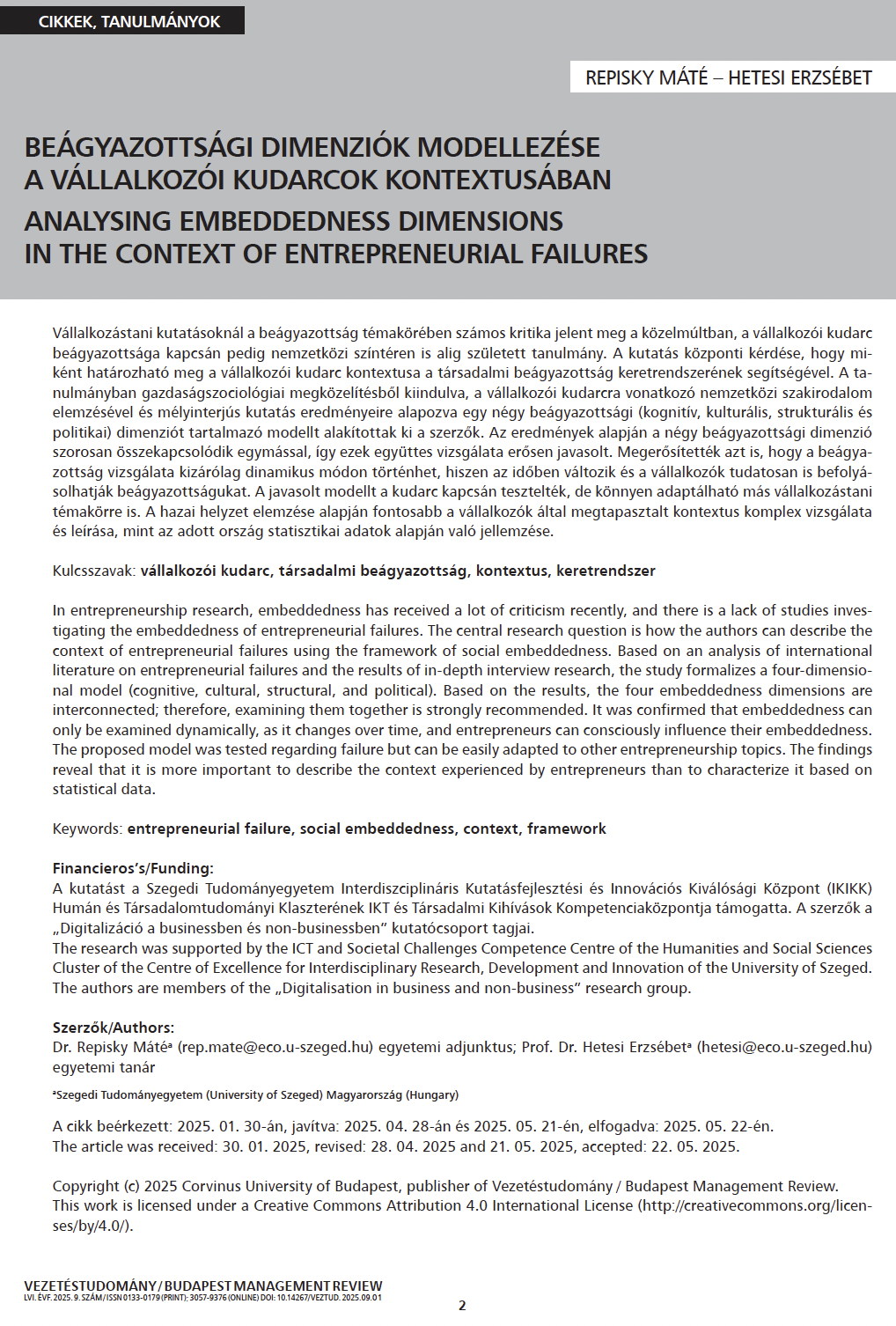
Vállalkozástani kutatásoknál a beágyazottság témakörében számos kritika jelent meg a közelmúltban, a vállalkozói kudarc beágyazottsága kapcsán pedig nemzetközi színtéren is alig született tanulmány. A kutatás központi kérdése, hogy miként határozható meg a vállalkozói kudarc kontextusa a társadalmi beágyazottság keretrendszerének segítségével. A tanulmányban gazdaságszociológiai megközelítésből kiindulva, a vállalkozói kudarcra vonatkozó nemzetközi szakirodalom elemzésével és mélyinterjús kutatás eredményeire alapozva egy négy beágyazottsági (kognitív, kulturális, strukturális és politikai) dimenziót tartalmazó modellt alakítottak ki a szerzők. Az eredmények alapján a négy beágyazottsági dimenzió szorosan összekapcsolódik egymással, így ezek együttes vizsgálata erősen javasolt. Megerősítették azt is, hogy a beágyazottság vizsgálata kizárólag dinamikus módon történhet, hiszen az időben változik és a vállalkozók tudatosan is befolyásolhatják beágyazottságukat. A javasolt modellt a kudarc kapcsán tesztelték, de könnyen adaptálható más vállalkozástani témakörre is. A hazai helyzet elemzése alapján fontosabb a vállalkozók által megtapasztalt kontextus komplex vizsgálata és leírása, mint az adott ország statisztikai adatok alapján való jellemzése.
Downloads
Hivatkozások
Agárdi, I., & Török, Á. (2020). Társadalmi vállalkozók kapcsolati beágyazottsága és szerepe a társadalmi hatás kiterjesztésében. Vezetéstudomány, 51(12), 2–16. https://doi.org/10.14267/VEZTUD.2020.12.01
Aldrich, H.E., & Cliff, J.E. (2003). The pervasive effects of family on entrepreneurship: Toward a family embeddedness perspective. Journal of Business Venturing, 18(5), 573-596. https://doi.org/10.4337/9781035305759.00029
Aldrich, H.E., & Fiol, C.M. (1994). Fools rush in? The institutional context of industry creation. Academy of Management Review, 19(4), 645-670. https://doi.org/10.2307/258740
Alshareef, S. (2022). Does location matter? Unpacking the dynamic relationship between the spatial context and embeddedness in women’s entrepreneurship. Entrepreneurship & Regional Development, 34(3-4), 294- 318. https://doi.org/10.1080/08985626.2022.2047798
Atsan, N. (2016). Failure experiences of entrepreneurs: causes and learning outcomes. Procedia – Social and Behavioral Sciences, 235, 435-442. https://doi.org/10.1016/j.sbspro.2016.11.054
Autio, E., Kenney, M., Mustar, P., Siegel, D., & Wright, M. (2014). Entrepreneurial innovation: The importance of context. Research Policy, 43(7), 1097-1108. https://doi.org/10.1016/j.respol.2014.01.015
Baker, T., & Welter, F. (2020). Contextualizing Entrepreneurship Theory. Routledge. https://doi.org/10.4324/9781351110631
Beckert, J. (2003). Economic sociology and embeddedness: how shall we conceptualize economic action? Journal of Economic Issues, 37(3), 769-787. https://doi.org/10.1080/00213624.2003.11506613
Beckert, J. (2017). Beyond Embeddedness: Economic Sociology as a Historical Theory of Society – Interview with Jens Beckert. https://www.mpifg.de/788734/2017-02-interview-beckert
Byrne, O., & Shepherd, D.A. (2015). Different strokes for different folks: Entrepreneurial narratives of emotion, cognition, and making sense of business failure. Entrepreneurship Theory and Practice, 39(2), 375-405. https://doi.org/10.1111/etap.12046
Cardon, M.S., Stevens, C.E., & Potter, D.R. (2011). Misfortunes or mistakes?: Cultural sensemaking of entrepreneurial failure. Journal of Business Venturing, 26(1), 79-92. https://doi.org/10.1016/j.jbusvent.2009.06.004
Coase, R.H. (1960). The problem of social cost. The Journal of Law and Economics, 3, 1–44. https://doi.org/10.1086/466560
Cope, J. (2011). Entrepreneurial learning from failure: An interpretative phenomenological analysis. Journal of Business Venturing, 26(6), 604-623. https://doi.org/10.1016/j.jbusvent.2010.06.002
Corner, P.D., Singh, S., & Pavlovich, K. (2017). Entrepreneurial resilience and venture failure. International Small Business Journal, 35(6), 687-708. https://doi.org/10.1177/0266242616685604
Cotterill, K. (2012). A comparative study of entrepreneurs’ attitudes to failure in technology ventures. International Journal of Innovation Science, 4(2), 101-116. https://doi.org/10.1260/1757-2223.4.2.101
Csákné Filep J., Szennay Á., & Timár G. (2024). Opportunities, motivation, environment – entrepreneurship in Hungary – Global Entrepreneurship Monitor – National report – Hungary 2023-2024. BGE. https://budapestlab.hu/wp-content/uploads/2024/10/GEMBGE_national_report_2023_2024_eng.pdf
Doreian, P., & Conti, N. (2012). Social context, spatial structure and social network structure. Social Networks, 34(1), 32-46. https://doi.org/10.1016/j.socnet.2010.09.002
Durkheim, É. (1994). Social facts. In Martin, M., & McIntyre, L.C. (Eds.), Readings in the Philosophy of Social Science (pp. 433-440). MIT Press.
Earl, P.E. (2005). Economics and psychology in the twenty- first century. Cambridge Journal of Economics, 29(6), 909-926. https://doi.org/10.1093/cje/bei077
Etzioni, A. (1988). The Moral Dimension. The Free Press.
Etzioni, A., & Lawrence, P.R. (eds.) (1991). Socio-Economics. Toward a New Synthesis. Sharpe, Inc.
Európai Bizottság (2012). Entrepreneurship in the EU and beyond (Flash Eurobarometer 354). http://ec.europa.eu/public_opinion/flash/fl_354_en.pdf
Granovetter, M., & Swedberg, R. (1992). The Sociology of Economic Life. Westview Press.
Granovetter, M. (2005). The impact of social structure on economic outcomes. Journal of Economic Perspectives, 19(1), 33-50. https://doi.org/10.1257/0895330053147958
Guerrero, M., & Espinoza-Benavides, J. (2021). Does entrepreneurship ecosystem influence business re-entries after failure? International Entrepreneurship and Management Journal, 17(1), 211-227. https://doi.org/10.1007/s11365-020-00694-7
Harima, A. (2022). Theorizing disembedding and re-embedding: Resource mobilization in refugee entrepreneurship. Entrepreneurship & Regional Development, 34(3-4), 269-293. https://doi.org/10.1080/08985626.2022.2047799
He, V.F., Sirén, C., Singh, S., Solomon, G., & von Krogh, G. (2018). Keep calm and carry on: Emotion regulation in entrepreneurs’ learning from failure. Entrepreneurship Theory and Practice, 42(4), 605-630. https://doi.org/10.1177/1042258718783428
He, V.F., & Krähenmann, G. (2021). (Not) learning from failure? The heavy toll of stigma on entrepreneurs. In Work Life After Failure?: How Employees Bounce Back, Learn, and Recover from Work-Related Setbacks (pp. 143-171). Emerald Publishing Limited.
Hite, J.M. (2003). Patterns of multidimensionality among embedded network ties: a typology of relational embeddedness in emerging entrepreneurial firms. Strategic Organization, 1(1), 9-49. https://doi.org/10.1177/1476127003001001217
Hofstede, G. (2015). Dimension data matrix. https://geerthofstede.com/research-and-vsm/dimension-data-matrix/
Hwang, K., & Choi, J. (2021). How do failed entrepreneurs cope with their prior failure when they seek subsequent re-entry into serial entrepreneurship? Failed entrepreneurs’ optimism and defensive pessimism and coping humor as a moderator. International Journal of Environmental Research and Public Health, 18(13), 7021. https://doi.org/10.3390/ijerph18137021
Jack, S.L., & Anderson, A.R. (2002). The effects of embeddedness on the entrepreneurial process. Journal of Business Venturing, 17(5), 467-487. https://doi.org/10.1016/s0883-9026(01)00076-3
Jenkins, A., & Wiklund, J. (2012). A risky decision or an informed choice: Re-entry after firm failure. Frontiers of Entrepreneurship Research, 32(6), Article 5.
Jenkins, A.S., Wiklund, J., & Brundin, E. (2014). Individual responses to firm failure: Appraisals, grief, and the influence of prior failure experience. Journal of Business Venturing, 29(1), 17-33. https://doi.org/10.1016/j.jbusvent.2012.10.006
Khelil, N. (2016). The many faces of entrepreneurial failure: Insights from an empirical taxonomy. Journal of Business Venturing, 31(1), 72-94. https://doi.org/10.1016/j.jbusvent.2015.08.001
Klimas, P., Czakon, W., Kraus, S., Kailer, N., & Maalaoui, A. (2021). Entrepreneurial failure: a synthesis and conceptual framework of its effects. European Management Review, 18(1), 167-182. https://doi.org/10.1111/emre.12426
Kloosterman, R., Van Der Leun, J., & Rath, J. (1999). Mixed embeddedness:(in) formal economic activities and immigrant businesses in the Netherlands. International Journal of Urban and Regional Research, 23(2), 252-266. https://doi.org/10.1111/1468-2427.00194
KSH (2022). 1.2.4. Vállalkozások demográfiája és struktúrája (2006–2018). https://www.ksh.hu/thm/1/indi1_2_4.html
Korsgaard, S., Ferguson, R., & Gaddefors, J. (2015). The best of both worlds: how rural entrepreneurs use placial embeddedness and strategic networks to create opportunities. Entrepreneurship & Regional Development, 27(9-10), 574-598. https://doi.org/10.1080/08985626.2015.1085100
Landier, A. (2005). Entrepreneurship and the Stigma of Failure. SSRN Electronic Journal, 850446. https://doi.org/10.2139/ssrn.850446
Lea, S.E.G., Tarpy, R.M., & Webley, P. (1987). The individual in the economy: A textbook of economic psychology. Cambridge University Press.
Loewenstein, G. (2000). Emotions in economic theory and economic behavior. American Economic Review, 90(2), 426-432. https://doi.org/10.1257/aer.90.2.426
McGrath, R.G. (1999). Falling forward: Real options reasoning and entrepreneurial failure. Academy of Management Review, 24(1), 13-30. https://doi.org/10.5465/amr.1999.1580438
Moroz, P.W., & Hindle, K. (2012). Entrepreneurship as a process: Toward harmonizing multiple perspectives. Entrepreneurship Theory and Practice, 36(4), 781-818. https://doi.org/10.1111/j.1540-6520.2011.00452.x
North, D.C. (1989). Institutions and economic growth: An historical introduction. World Development, 17(9), 1319–1332. https://doi.org/10.1016/0305-750x(89)90075-2
Parkinson, C., Nowak, V., Howorth, C., & Southern, A. (2020). Multipartite attitudes to enterprise: A comparative study of young people and place. International Small Business Journal, 38(4), 293-317. https://doi.org/10.1177/0266242619892829
Polanyi, K. (2001 [1944]). The Great Transformation: The Political and Economic Origins of Our Time. Beacon Press.
Rabin, M. (1998). Psychology and economics. Journal of Economic Literature, 36(1), 11-46. https://econweb.ucsd.edu/~jandreon/Econ264/papers/Rabin%-2520JEL%25201998.pdf
Repisky, M. (2023). A categorization of the consequences of entrepreneurial failure: Validated in Hungary. Vezetéstudomány, 54(5), 2-17. https://doi.org/10.14267/veztud.2023.05.01
Reynolds, P.D., Miller, B., & Maki, W.R. (1995). Explaining regional variation in business births and deaths: US 1976–88. Small Business Economics, 7, 389-407. https://doi.org/10.1007/bf01302739
Riar, F.J., Bican, P.M., & Fischer, J. (2021). It wasn’t me: Entrepreneurial failure attribution and learning from failure. International Journal of Entrepreneurial Venturing, 13(2), 113-136. https://doi.org/10.1504/ijev.2021.114385
Shepherd, D.A. (2003). Learning from business failure: Propositions of grief recovery for the self-employed. Academy of Management Review, 28(2), 318-328. https://doi.org/10.2307/30040715
Shepherd, D.A., & Haynie, J.M. (2011). Venture failure, stigma, and impression management: A self‐verification, self‐determination view. Strategic Entrepreneurship Journal, 5(2), 178-197. https://doi.org/10.1002/sej.113
Shepherd, D.A., Wiklund, J., & Haynie, J.M. (2009). Moving forward: Balancing the financial and emotional costs of business failure. Journal of Business Venturing, 24(2), 134-148. https://doi.org/10.1016/j.jbusvent.2007.10.002
Silver, L.S. (2015). A social-cognitive model of entrepreneurship failure: Beyond attributional style. Archives of Business Research, 3(4), 55-62. https://doi.org/10.14738/abr.34.1306
Simmons, S.A., Wiklund, J., & Levie, J. (2014). Stigma and business failure: implications for entrepreneurs’ career choices. Small Business Economics, 42, 485- 505. https://doi.org/10.1007/s11187-013-9519-3
Singh, S., Corner, P., & Pavlovich, K. (2007). Coping with entrepreneurial failure. Journal of Management & Organization, 13(4), 331-344. https://doi.org/10.5172/jmo.2007.13.4.331
Singh, S., Corner, P.D., & Pavlovich, K. (2015). Failed, not finished: A narrative approach to understanding venture failure stigmatization. Journal of Business Venturing, 30(1), 150-166. https://doi.org/10.1016/j.jbusvent.2014.07.005
Szántó, Z. (1994). A gazdaság társadalmi beágyazottsága – Megjegyzések a gazdaságszociológia és a szocioökonómia újabb irodalmáról. Szociológiai Szemle, 3, 141-145. https://www.epa.hu/05000/05067/00011/pdf/EPA05067_szocszemle_1994_03_141-146.pdf
Szerb L., & Kocsis-Kisantal O. (2008). Vállalkozói kultúra Magyarországon két napilap tükrében. Közgazdasági Szemle, 55(3), 243–261. http://www.epa.hu/00000/00017/00146/pdf/04mhszerb-kocsis-kisantal.pdf
Thaler, R. & Sunstein, C. (2008). Nudge: Improving Decisions about Health, Wealth and Happiness. Penguin Books. Thorton, P.H. (1999). The Sociology of Entrepreneurship. Annual Review of Sociology, 25, 19-46. https://doi.org/10.1146/annurev.soc.25.1.19
Tversky, A., & Kahneman, D. (1986). Rational choice and the framing of decisions. The Journal of Business, 59(4), S251-S278. https://doi.org/10.1086/296365
Ucbasaran, D., Shepherd, D.A., Lockett, A., & Lyon, S.J. (2013). Life after business failure: The process and consequences of business failure for entrepreneurs. Journal of Management, 39(1), 163-202. https://doi.org/10.1177/0149206312457823
Varga, K. (2008). Hofstede és a magyar szociológia. In Hofstede, G. & Hofstede, G.J. (Eds.), Kultúrák és szervezetek. Az elme szoftvere (pp. 11-28). Pécs: VHE Kft.
Virágh, E.A., & Szepesi, B. (2022). Vállalkozók reprezentációja a főáramú online médiában Magyarországon. Szociológiai Szemle, 32(3), 24-56. https://doi.org/10.51624/SzocSzemle.2022.3.2
Virágh, E.A., & Tímár, G. (2024). What is success? – Concepts and perspectives in the Hungarian startup context. Vezetéstudomány, 55(11), 41-52. https://doi.org/10.14267/veztud.2024.11.04
Wadhwani, R.D. (2016). Historical methods for contextualizing entrepreneurship research. In Welter, F., & Gartner, W. (Eds), A research agenda for entrepreneurship and context (pp. 134-145). Edward Elgar Publishing. https://doi.org/10.4337/9781784716844.00015
Wakkee, I., Dorrestein, F., & Englis, P. (2014). The stigmatization of bankrupt entrepreneurs in Dutch newspapers. Journal of Small Business & Entrepreneurship, 27(4), 369-391. https://doi.org/10.1080/08276331.2015.1017869
Weber, M., & Swedberg, R. (eds.) (1999). Essays in economic sociology. Princeton University Press.
Welter, F. (2011). Contextualizing entrepreneurship – conceptual challenges and ways forward. Entrepreneurship Theory and Practice, 35(1), 165-184. https://doi.org/10.1111/j.1540-6520.2010.00427.x
Welter, F., & Baker, T. (2021). Moving contexts onto new roads: Clues from other disciplines. Entrepreneurship Theory and Practice, 45(5), 1154-1175. https://doi.org/10.1177/1042258720930996
Widiawan, K., & Igel, B. (2023). Why can some entrepreneurs restart after businesses failure while others fail for good? – The case of Chinese business owners in Indonesia. Journal of General Management, 48(2), 210-221. https://doi.org/10.1177/03063070221081824
Wiesenfeld, B.M., Wurthmann, K.A., & Hambrick, D.C. (2008). The stigmatization and devaluation of elites associated with corporate failures: A process model. Academy of Management Review, 33(1), 231-251. https://doi.org/10.5465/amr.2008.27752771
Wigren-Kristoferson, C., Brundin, E., Hellerstedt, K., Stevenson, A., & Aggestam, M. (2022). Rethinking embeddedness: a review and research agenda. Entrepreneurship & Regional Development, 34(1-2), 32-56. https://doi.org/10.1080/08985626.2021.2021298
Wigren-Kristofersen, C., Korsgaard, S., Brundin, E., Hellerstedt, K., Agnete Alsos, G., & Grande, J. (2019). Entrepreneurship and embeddedness: dynamic, processual and multi-layered perspectives. Entrepreneurship & Regional Development (31)9– 10, 1011–1015. https://doi.org/10.1080/08985626.2019.1656868
Williams, T.A., Thorgren, S., & Lindh, I. (2020). Rising from failure, staying down, or more of the same? An inductive study of entrepreneurial reentry. Academy of Management Discoveries, 6(4), 631-662. https://doi.org/10.5465/amd.2018.0047
Yamakawa, Y., & Cardon, M.S. (2015). Causal ascriptions and perceived learning from entrepreneurial failure. Small Business Economics, 44, 797-820. https://doi.org/10.1007/s11187-014-9623-z
Yamakawa, Y., Peng, M.W., & Deeds, D.L. (2015). Rising from the ashes: Cognitive determinants of venture growth after entrepreneurial failure. Entrepreneurship Theory and Practice, 39(2), 209-236. https://doi.org/10.1111/etap.12047
Zahra, S.A., & Wright, M. (2011). Entrepreneurship’s next act. Academy of Management Perspectives, 25(4), 67-83. https://www.jstor.org/stable/23208294
Zahra, S.A., Wright, M., & Abdelgawad, S.G. (2014). Contextualization and the advancement of entrepreneurship research. International Small Business Journal, 32(5), 479-500. https://doi.org/10.1177/0266242613519807
Zhao, H., & Wibowo, A. (2021). Entrepreneurship resilience: can psychological traits of entrepreneurial intention support overcoming entrepreneurial failure? Frontiers in Psychology, 12, 707803. https://doi.org/10.3389/fpsyg.2021.707803
Zukin, S. & DiMaggio, P. (1990). Structures of Capital: The Social Organization of the Economy. Cambridge University Press.
Letöltések
Megjelent
Folyóirat szám
Rovat
License
Copyright (c) 2025 Corvinus University of Budapest, publisher of Vezetéstudomány / Budapest Management Review

This work is licensed under a Creative Commons Attribution 4.0 International License.
Authors assign copyright to Vezetéstudomány / Budapest Management Review. Authors are responsible for permission to reproduce copyright material from other sources.
Hogyan kell idézni