Assessing the consequences of digitalization
Validating a scale for measuring workplace technostress in Hungary
DOI:
https://doi.org/10.14267/VEZTUD.2026.01.01Keywords:
technostress, work-related stress, scale validationAbstract
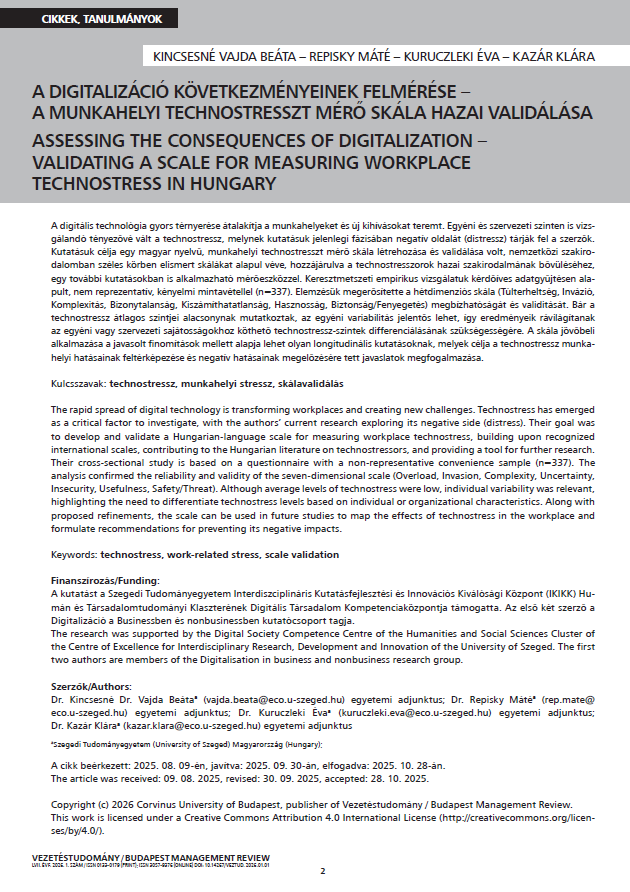
The rapid spread of digital technology is transforming workplaces and creating new challenges. Technostress has emerged as a critical factor to investigate, with the authors’ current research exploring its negative side (distress). Their goal was to develop and validate a Hungarian-language scale for measuring workplace technostress, building upon recognized international scales, contributing to the Hungarian literature on technostressors, and providing a tool for further research. Their cross-sectional study is based on a questionnaire with a non-representative convenience sample (n=337). The analysis confirmed the reliability and validity of the seven-dimensional scale (Overload, Invasion, Complexity, Uncertainty, Insecurity, Usefulness, Safety/Threat). Although average levels of technostress were low, individual variability was relevant, highlighting the need to differentiate technostress levels based on individual or organizational characteristics. Along with proposed refinements, the scale can be used in future studies to map the effects of technostress in the workplace and formulate recommendations for preventing its negative impacts.
Downloads
References
Arenas, A., Sanclemente, F.J., Terán-Tinedo, V., & Di Marco, D. (2023). Spanish Validation of the Technostress Creators Scale. Psichotema, 35(1), 98-108. https://doi.org/10.7334/psicothema2022.198
Bencsik, A. (2024). Tudásmenedzsment elméletben és gyakorlatban. Akadémiai Kiadó. https://doi.org/10.1556/9789636640187
Bencsik, A., & Juhász, T. (2023). The impact of technostress on organizational functioning. Problems and Perspectives in Management, 21(1), 230-241. https://doi.org/10.21511/ppm.21(1).2023.20
Berger, M., Schäfer, R., Schmidt, M., Regal, C., & Gimpel, H. (2023). How to prevent technostress at the digital workplace: a delphi study. Journal of Business Economics, 94(7-8), 1051-1113. https://doi.org/10.1007/s11573-023-01159-3
Bernburg, M., Gebhardt, J.S., Groneberg, D.A., & Mache, S. (2025). Impact of Digitalization in Dentistry on Technostress, Mental Health, and Job Satisfaction: A Quantitative Study. Healthcare, 13(1), 72. https://doi.org/10.3390/healthcare13010072
Biggs, A., Brough, P., & Drummond, S. (2017). Lazarus and Folkman’s Psychological Stress and Coping Theory. In Cooper, C.L., & Quick, J.C. (Eds.), The Handbook of Stress and Health (pp. 349-364). Wiley Blackwell. https://doi.org/10.1002/9781118993811.ch21
Buzás, B., Simon, A.C., Kiss, O.E., & Faragó, K. (2025). Navigating the digital landscape: unraveling the interplay of challenge and hindrance components of technostress on employee voice behavior. Frontiers in Psychology, 16, 1434275. https://doi.org/10.3389/fpsyg.2025.1434275
Choi, Y. (2023). Exploring the impact of technostress on work behaviors: Empirical evidence and interventions for enhanced workplace well-being. Information Development, 02666669231206763. https://doi.org/10.1177/02666669231206763
Cooper, C.L., Dewe, P.J., & O’Driscoll, M.P. (2001). Organizational Stress. A Review and Critique of Theory, Research, and Applications. Sage Publications Inc. https://doi.org/10.4135/9781452231235
Cuadrado, D., Otero, I., Martínez, A., París, T. & Moscoso, S. (2024). Predicting technostress: the big five model of personality and subjective well-being. Plos One, 19(11), e0313247. https://doi.org/10.1371/journal.pone.0313247
Derks, D., ten Brummelhuis, L.L., Zecic, D., & Bakker, A.B. (2014). Switching on and off…: Does smartphone use obstruct the possibility to engage in recovery activities? European Journal of Work and Organizational Psychology, 23(1), 80-90. https://doi.org/10.1080/1359432X.2012.711013
Edwards, J.R., Caplan, R.D., & Van Harrison, R. (1998). Person-Environment Fit Theory: Theoretical Foundations, empirical evidence, and directions for further research. In C.L. Cooper (Ed.), Theories of organizational stress (pp. 28-67). Oxford University Press. https://doi.org/10.1093/oso/9780198522799.003.0003
Fischer, T., Reuter, M., & Riedl, R. (2021). The Digital Stressors Scale: Development and Validation of a New Survey Instrument to Measure Digital Stress Perceptions in the Workplace Context. Frontiers in Psychology, 12, 607598. https://doi.org/10.3389/fpsyg.2021.607598
Hair, J.F., Hult, G.T.M., Ringle, C., & Sarstedt, M. (2017). A Primer on Partial Least Squares Structural Equation Modeling (PLS-SEM) (2nd e dition). SAGE P ublications. Hair, J.F., Black, W.C., Babin, B.J., & Anderson, R.E. (2009). Multivariate Data Analysis (7th edition). Prentice Hall.
Harris, K.J., Harris, R.B., Valle, M., Carlson, J.R., Carlson, D.S., Zivnuska, S., … & Wiley, B. (2021). Technostress and the entitled employee: impacts on work and family. Information Technology & People, 35(3), 1073-1095. https://doi.org/10.1108/itp-07-2019-0348
Ioannou, A. (2023). Mindfulness and technostress in the workplace: a qualitative approach. Frontiers in Psychology, 14, 1252187. https://doi.org/10.3389/fpsyg.2023.1252187
Jungst, M. (2022). Effect of Technological Insecurity on Performance Through Emotional Exhaustion: A Moderated Mediation Approach. International Journal of Technology and Human Interaction (IJTHI), 18(1), 1-15. https://doi.org/10.4018/IJTHI.300282
Kaltenegger, H.C., Becker, L., Rohleder, N., Nowak, D., Quartucci, C., & Weigl, M. (2023). Associations of technostressors at work with burnout symptoms and chronic low-grade inflammation: a cross-sectional analysis in hospital employees. International Archives of Occupational and Environmental Health, 96(6), 839-856. https://doi.org/10.1007/s00420-023-01967-8
Kim, D.G. & Lee, C.W. (2021). Exploring the Roles of Self-Efficacy and Technical Support in the Relationship between Techno-Stress and Counter-Productivity. Sustainability, 13, 4349. https:// doi.org/10.3390/su13084349
Kincsesné Vajda, B. (2023). Technológiával könnyebb, de milyen áron? – A Technostressz jelenségének vizsgálata, különös tekintettel a felsőoktatás fogyasztóira. In Révész, B., & Gyulai, Zs. (Eds.), Reziliens Marketing – Válaszok változó kihívásokra ((pp. 174-184). Szegedi Tudományegyetem Gazdaságtudományi Kar. https://doi.org/10.62561/EMOK-2023-14
Li, L., & Wang, X. (2020). Technostress inhibitors and creators and their impacts on university teachers’ work performance in higher education. Cognition, Technology & Work, 23, 315-330. https://doi.org/10.1007/s10111-020-00625-0
Maier, C., Laumer, S., Tarafdar, M., Mattke, J., Reis, L., & Weitzel, T. (2021). Challenge and Hindrance IS Use Stressors and Appraisals: Explaining Contrarian Associations in Post-Acceptance IS Use Behavior. Journal of the Association for Information Systems, 22(6), 1590- 1624. https://doi.org/10.17705/1jais.00709
Marchiori, D.M., Mainardes, E.W., & Rodrigues, R.G. (2018). Do Individual Characteristics Influence the Types of Technostress Reported by Workers? International Journal of Human-Computer Interaction, 35(3), 218-230. https://doi.org/10.1080/10447318.2018.1449713
Matt, C., Hess, T., & Benlian, A. (2015). Digital Transformation Strategies. Business & Information Systems Engineering, 57, 339-343. https://doi.org/10.1007/s12599-015-0401-5
Meyer, S., & Tisch, A. (2023). Exploring the relationship between techno-unreliability at work and burnout. Journal of Occupational & Environmental Medicine, 66(3), 185-191. https://doi.org/10.1097/jom.0000000000003008
Molino, M., Ingusci, E., Signore, F., Manuti, A., Giancaspro, M.L., Russo, V., … & Cortese, C. G. (2020). Wellbeing costs of technology use during covid-19 remote working: an investigation using the italian translation of the technostress creators scale. Sustainability, 12(15), 5911. https://doi.org/10.3390/su12155911
Mustika, M.D., Handoko, A.M., Mamoen, H.A., Siahaan, D.U., & Yasyfin, A. (2021). Your gadgets, stress, and performance: the influence of technostress on individual satisfaction and performance. Psychological Research on Urban Society, 4(2), 18. https://doi.org/10.7454/proust.v4i2.113
Nastjuk, I., Trang, S., Grummeck-Braamt, J.V., Adam, M.T.P., & Tarafdar, M. (2023). Integrating and synthesising technostress research: a meta-analysis on technostress creators, outcomes, and IS usage contexts. European Journal of Information Systems, 33(3), 361-382. https://doi.org/10.1080/0960085X.2022.2154712
Nimrod, G. (2018). Technostress: measuring a new threat to well-being in later life. Aging & Mental Health, 22(8) 1080-1087. https://doi.org/10.1080/13607863.2017.1334037
Pfaltzgraf, D., & Insch, G.S. (2021). Technological illiteracy in an increasingly technological world: methods to help employees create with rather than simply consume technology. Development and Learning in Organizations: An International Journal, 35(6), 4-6. https://doi.org/10.1108/dlo-12-2020-0235
Pflügner, K., Maier, C., Mattke, J., & Weitzel, T. (2021). Personality Profiles that Put Users at Risk of Perceiving Technostress. Business & Information Systems Engineering, 63, 389-402. https://doi.org/10.1007/s12599-020-00668-7
Ragsdale, J.M., & Hoover, C.S. (2016). Cell phones during nonwork time: A source of job demands and resources. Computers in Human Behavior, 57, 54-60. https://doi.org/10.1016/j.chb.2015.12.017
Ragu-Nathan, T.S., Tarafdar, M., Ragu-Nathan, B., & Tu, Q. (2008). The Consequences of Technostress for End Users in Organizations: Conceptual Development and Empirical Validation. Information Systems Research, 19(4), 417-433. https://doi.org/10.1287/isre.1070.0165
Ringle, C.M., Sarstedt, M., & Straub, D.W. (2012). A critical look at the use of PLS-SEM in MIS Quarterly. MIS Quarterly, 36(1), 3-14. https://doi.org/10.2307/41410402
Ringle, C.M., Wende, S., & Becker, J.M. (2024). SmartPLS 4. SmartPLS. Bönningstedt. https://www.smartpls.com
Rohwer, E., Flöther, J.C., Harth, V., & Mache, S. (2022). Overcoming the “Dark Side” of Technology – A Scoping Review on Preventing and Coping with Work-Related Technostress. International Journal of Environmental Research and Public Health, 19(6), 3625. https://doi.org/10.3390/ijerph19063625
Ross, P., & Maynard, K. (2021). Towards a 4th industrial revolution. Intelligent Buildings International, 13(3), 159-161. https://doi.org/10.1080/17508975.2021.1873625
Salazar-Concha, C., Ficapal-Cusí, P., Boada-Grau, J., & Camacho, L.J. (2021). Analyzing the evolution of technostress: A science mapping approach. Heliyon, 7, e06726. https://doi.org/10.1016/j.heliyon.2021.e06726
Sarker, S., Xiao, X., Sarker, S., & Ahuja, M. (2012). Managing Employees’ Use of Mobile Technologies to Minimize Work-Life Balance Impacts. MIS Quarterly Executive, 11(4), 143-157. https://aisel.aisnet.org/misqe/vol11/iss4/4
Sevic, A., Foldnes, N., & Brønnick, K. (2024). Measuring digital stress in Norway: translation and validation of the digital stressors scale. Frontiers in Psychology, 15. https://doi.org/10.3389/fpsyg.2024.1297194
Sharma, S., & Gupta, B. (2022). Investigating the role of technostress, cognitive appraisal and coping strategies on students’ learning performance in higher education: a multidimensional transactional theory of stress approach. Information Technology & People, 36(2), 626-660. https://doi.org/10.1108/itp-06-2021-0505
Simon, A.Cs., Pachner, O.Cs., & Kiss, O.E. (2024). Digitális kihívások: a technostressz megjelenése és kapcsolata a szervezeti pszichoszociális tényezőkkel magyar irodai munkavállalóknál. Magyar Pszichológiai Szemle, 79(4), 757-776 https://doi.org/10.1556/0016.2024.00097
Simon, A.C., Buzás, B., Rosta-Filep, O., Faragó, K., Pachner, O.C., & Kiss, O.E. (2024). The indirect impact of the technostress subfactors on the satisfaction and desire to work from home. Frontiers in Psychology, 15, 1417916. https://doi.org/10.3389/fpsyg.2024.1417916
Smoroň, J., Schraggerová, M., Rošková, E., & Urukovičová, N. (2023). Verification of the stability of the technostress questionnaire and technostress in relation to personality facets. Psychológia Práce a Organizácie. https://doi.org/10.33542/ppo-0265-7-09
Skog, D.A., Wimelius, H., & Sandberg, J. (2018). Digital Disruption. Business & Information Systems Engineering, 60, 431-437. https://doi.org/10.1007/s12599-018-0550-4
Srivastava, S.C., Chandra, S., & Shirish, A. (2015). Technostress creators and job outcomes: theorising the moderating influence of personality traits. Information Systems Journal, 25(4), 355-401. https://doi.org/10.1111/isj.12067
Suh, A., & Lee, J. (2017). Understanding teleworkers’ technostress and its influence on job satisfaction. Internet Research, 27(1), 140-159. https://doi.org/10.1108/IntR-06-2015-0181
Szilas, R.F. (2014). A szervezeti igazságosság hatása a munkahelyi stressz kialakulásának folyamatára. Munkaügyi Szemle, 58(1), 56-65. https://www.munkaugyiszemle.hu/szervezeti-igazsagossag-hatasa-munkahelyi-stressz-kialakulasanak-folyamatara
Szombathelyi, Cs. (2015), Techno-stressz: az információs technológia negatív humán következménye. Munkaügyi Szemle, 59(2), 26-33. https://www.munkaugyiszemle.hu/techno-stressz-az-informacios-technologia-negativ-human-kovetkezmenyei
Tarafdar, M., Cooper, C.L., & Stich, J.F. (2019). The technostress trifecta: techno eustress, techno distress and design: Theoretical directions and an agenda for research. Information Systems Journal, 29, 6-42. https://doi.org/10.1111/isj.12169
Tarafdar, M., Pullins, E.B., & Ragu‐Nathan, T.S. (2014). Technostress: negative effect on performance and possible mitigations. Information Systems Journal, 25(2), 103-132. https://doi.org/10.1111/isj.12042
Tarafdar, M., Tu, Q., Ragu-Nathan, B.S. & Ragu-Nathan, T.S. (2007). The Impact of Technostress on Role Stress and Productivity. Journal of Management Systems, 24(1), 301-328. https://doi.org/10.2753/MIS0742-1222240109
Trenerry, B., Chng, S., Wang, Y., Suhaila, Z.S., Lim, S.S., Lu, H.Y., & Oh, P.H. (2021). Preparing Workplaces for Digital Transformation: An Integrative Review and Framework of Multi-Level Factors. Frontiers in Psychology, 12, 620766. https://doi.org/10.3389/fpsyg.2021.620766
Yim, M. (2014). Understanding the technostress: an individual difference investigation. Journal of Digital Convergence, 12(3), 17-27. https://doi.org/10.14400/jdc.2014.12.3.17
Wang, X., Tan, S.C., & Li, L. (2020). Measuring university students’ technostress in technology-enhanced learning: scale development and validation. Australasian Journal of Educational Technology, 36(4), 96-112. https://doi.org/10.14742/ajet.5329
Wirth, T., Kraft, J., Marquardt, B., Harth, V., & Mache, S. (2024). Indicators of technostress, their association with burnout and the moderating role of support offers among nurses in german hospitals: a cross-sectional study. BMJ Open, 14(7), e085705. https://doi.org/10.1136/bmjopen-2024-085705
Downloads
Published
Issue
Section
License
Copyright (c) 2026 Corvinus University of Budapest, publisher of Vezetéstudomány / Budapest Management Review

This work is licensed under a Creative Commons Attribution 4.0 International License.
Authors assign copyright to Vezetéstudomány / Budapest Management Review. Authors are responsible for permission to reproduce copyright material from other sources.
How to Cite