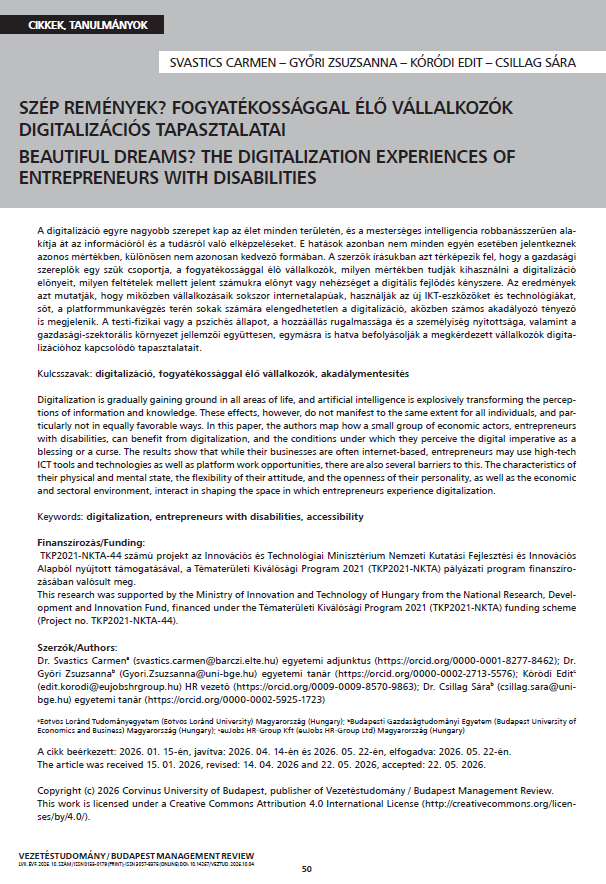
Szép remények? Fogyatékossággal élő vállalkozók digitalizációs tapasztalatai
DOI:
https://doi.org/10.14267/VEZTUD.2026.10.04Kulcsszavak:
digitalizáció, fogyatékossággal élő vállalkozók, akadálymentesítésAbsztrakt
A digitalizáció egyre nagyobb szerepet kap az élet minden területén, és a mesterséges intelligencia robbanásszerűen alakítja át az információról és a tudásról való elképzeléseket. E hatások azonban nem minden egyén esetében jelentkeznek azonos mértékben, különösen nem azonosan kedvező formában. A szerzők írásukban azt térképezik fel, hogy a gazdasági szereplők egy szűk csoportja, a fogyatékossággal élő vállalkozók, milyen mértékben tudják kihasználni a digitalizáció előnyeit, milyen feltételek mellett jelent számukra előnyt vagy nehézséget a digitális fejlődés kényszere. Az eredmények azt mutatják, hogy miközben vállalkozásaik sokszor internetalapúak, használják az új IKT-eszközöket és technológiákat, sőt, a platformmunkavégzés terén sokak számára elengedhetetlen a digitalizáció, aközben számos akadályozó tényező is megjelenik. A testi-fizikai vagy a pszichés állapot, a hozzáállás rugalmassága és a személyiség nyitottsága, valamint a gazdasági-szektorális környezet jellemzői együttesen, egymásra is hatva befolyásolják a megkérdezett vállalkozók digitalizációhoz kapcsolódó tapasztalatait.
Downloads
Hivatkozások
Alfredsson Ågren, K., Kjellberg, A., & Hemmingsson, H. (2020). Digital participation? Internet use among adolescents with and without intellectual disabilities: A comparative study. New Media & Society, 22(12), 2128–2145. https://doi.org/10.1177/1461444819888398
Ameri, M., Kruse, D., Park, S.R., Rodgers, Y., & Schur, L. (2023). Telework during the pandemic: Patterns, challenges, and opportunities for people with disabilities. Disability and Health Journal, 16(2), 101406. https://doi.org/10.1016/j.dhjo.2022.101406
Cooper, D.R., & Emory, C.W. (1995). Business Research Method. Irwin.
Creswell, J.W. (2003). Research Design: Qualitative, Quantitative, and Mixed Methods Approaches. SAGE Publications.
Csillag, S., Győri, Z., Kóródi, E., Svastics, C., & Hidegh, A. (2021). A magyar vállalkozási ökoszisztéma és a fogyatékossággal élő vállalkozók. Szociálpolitikai Szemle, 7(1), 25–50.
Csillag, S., Győri, Z., & Svastics, C. (2019). Long and winding road? Barriers and supporting factors as perceived by entrepreneurs with disabilities. Journal of Enterprising Communities: People and Places in the Global Economy, 13(1–2), 42–63. https://doi.org/https://doi.org/10.1108/JEC-11-2018-0097
Csillag, S., Győri, Z., & Svastics, C. (2020). Vaktában vállalkozni? Fogyatékossággal élő vállalkozók a hazai munkaerőpiacon. Vezetéstudomány, 51(4), 26-39. https://doi.org/https://doi.org/10.14267/VEZTUD.2020.04.03
Csillag, S., Svastics, C., Hidegh, A.L., & Győri, Z. (2025). Pushed to the Edge? Entrepreneurs with Disabilities and the Post-socialist Experience of Ableism. Journal of Business Ethics, 201, 817–838 https://doi.org/10.1007/s10551-025-05965-3
De La Roche, M., & Simović, V. (2023). Remote Work Opportunities for the Persons with Disabilities. Economic Analysis,56(2), 28–38. https://doi.org/10.28934/ea.23.56.2.pp28-38
Dobransky, K., & Hargittai, E. (2016). Unrealized potential: Exploring the digital disability divide. Poetics, 58, 18–28. https://doi.org/10.1016/j.poetic.2016.08.003
Duplaga, M. (2017). Digital divide among people with disabilities: Analysis of data from a nationwide study for determinants of Internet use and activities performed online. PLOS ONE, 12(6), e0179825. https://doi.org/10.1371/journal.pone.0179825
Egard, H., & Hansson, K. (2023). The digital society comes sneaking in. An emerging field and its disabling barriers. Disability & Society, 38(5), 761–775. https://doi.org/10.1080/09687599.2021.1960275
Giovanis, E., & Ozdamar, O. (2019). Accommodating Employees with Disabilities: The Role of Flexible Employment Schemes in Europe. SSRN Electronic Journal. https://doi.org/10.2139/ssrn.3441925
Goggin, G. (2017). Disability and Digital Inequalities: Rethinking Digital Divides with Disability Theory. In Theorizing Digital Divides (pp. 63-74.). Routledge.
Goggin, G., Ellis, K., & Hawkins, W. (2019). Disability at the centre of digital inclusion: Assessing a new moment in technology and rights. Communication Research and Practice, 5(3), 290–303. https://doi.org/10.1080/22041451.2019.1641061
Gregor, P., Sloan, D., & Newell, A.F. (2005). Disability and Technology: Building Barriers or Creating Opportunities? In Advances in Computers vol. 64 (pp. 283–346). Elsevier. https://doi.org/10.1016/S0065-2458(04)64007-1
Hachana, R. (2024). Shadows and lights: Disabled workers’ use of digital technologies in the workplace. Equality, Diversity and Inclusion: An International Journal, 44(8), 1066–1081. https://doi.org/10.1108/EDI-06-2024-0246
Halbach, T., Fuglerud, K.S., Fyhn, T., Kjæret, K., & Olsen, T. A. (2022). The Role of Technology for the Inclusion of People with Visual Impairments in the Workforce. In M. Antona, & C. Stephanidis (Eds.), Universal Access in Human- Computer Interaction. User and Context Diversity (pp. 466–478). Springer International Publishing. https://doi.org/10.1007/978-3-031-05039-8_34
Hesse, B.W. (1995). Curb cuts in the virtual community: Telework and persons with disabilities. In Proceedings of the Twenty-Eighth Hawaii International Conference on System Sciences (pp. 418–425). IEEE. https://doi.org/10.1109/HICSS.1995.375707
Hidegh, A.L., Svastics, C., Csillag, S., & Győri, Z. (2023). The intersectional identity work of entrepreneurs with disabilities: Constructing difference through disability, gender, and entrepreneurship. Culture and Organization, 29(3), 226-241. https://doi.org/10.1080/14759551.2023.2201006
Hidegh, A.L., Svastics, C., Győri, Z., & Csillag, S. (2022). The lived experience of freedom among entrepreneurs with disabilities. International Journal of Entrepreneurial Behavior & Research, 28(9), 357–375. https://doi.org/https://doi.org/10.1108/IJEBR-03-2022-0222
Lazić, M., Vukmirović, V., Banović, J., Simović, V., & Paunović, M. (2023). Digital Competences as a Precondition for an Inclusive Digital Economy—Is There a Gender Gap Among Persons with Disabilities in Serbia? JWEE, (1–2), 51–71. https://doi.org/10.28934/jwee23.12.pp51-71
McNaughton, D., Rackensperger, T., Dorn, D., & Wilson, N. (2014). „Home is at work and work is at home”: Telework and individuals who use augmentative and alternative communication. WORK: A Journal of Prevention, Assessment & Rehabilitation, 48(1), 117–126. https://doi.org/10.3233/WOR-141860
Menich, N. (2021). AT, GYSE, IKT, AAK… Az önálló életvitelt támogató-segítő eszközök és technológia – fogalmi tisztázás és helyzetkép. Fogyatékosság és Társadalom, 7(1), 181–193. https://doi.org/10.31287/FT.hu.2021.1.12
Mulfari, D., Celesti, A., Fazio, M., Villari, M., & Puliafito, A. (2015). Achieving Assistive Technology Systems Based on IoT Devices in Cloud Computing. EAI Endorsed Transactions on Cloud Systems, 1(1), e4. https://doi.org/10.4108/cs.1.1.e4
Phochai, T., Setthasuravich, P., Pukdeewut, A., & Wetchakama, S. (2024). Bridging the Digital Disability Divide: Determinants of Internet Use among Visually Impaired Individuals in Thailand. Disabilities, 4(3), Article 3. https://doi.org/10.3390/disabilities4030043
Roulstone, A. (2016). Disability and technology: An interdisciplinary and international approach. Palgrave Macmillan.
Silverman, D. (2008). Doing Qualitative Research: A Practical Handbook. SAGE.
Smith, E., Huff, S., & Layton, N. (2023). Funding for Digital Assistive Technology in Europe [Research Report]. Digital Assistive Technology Europe (DATEurope). https://dateurope.com/wp-content/uploads/2024/04/DATEurope-Report-Final.pdf
Svastics, C., Hidegh, A.L., Csillag, S., & Győri, Z. (2023). A fogyatékosság és a vállalkozói identitás kapcsolata az interszekcionalitás lencséjén keresztül. Vezetéstudomány, 54(10)29–39. https://doi.org/10.14267/VEZTUD.2023.10.03
Tamzini, K. (2024). Understanding the Relationship between Assistive Technologies and Disabled People’s Entrepreneurship. Jordan Journal of Business Administration, 20(2), 247-267. https://doi.org/10.35516/jjba.v20i2.2010
Tsatsou, P. (2022). Vulnerable people’s digital inclusion: Intersectionality patterns and associated lessons. Information, Communication & Society, 25(10), 1475–1494. https://doi.org/10.1080/1369118X.2021.1873402
Van Dijk, J., & Hacker, K. (2003). The Digital Divide as a Complex and Dynamic Phenomenon. The Information Society, 19(4), 315–326. https://doi.org/10.1080/01972240309487
Vicente, M.R., & López, A.J. (2010). A Multidimensional Analysis of the Disability Digital Divide: Some Evidence for Internet Use. The Information Society, 26(1), 48–64. https://doi.org/10.1080/01615440903423245
Letöltések
Megjelent
Folyóirat szám
Rovat
License
Copyright (c) 2026 Corvinus University of Budapest, publisher of Vezetéstudomány / Budapest Management Review

This work is licensed under a Creative Commons Attribution 4.0 International License.
Authors assign copyright to Vezetéstudomány / Budapest Management Review. Authors are responsible for permission to reproduce copyright material from other sources.
Hogyan kell idézni