Tanulni és tanulni hagyni?
Munkahelyi tanulás és tanulási környezet tudásintenzív középvállalatokban
DOI:
https://doi.org/10.14267/VEZTUD.2022.02.04Kulcsszavak:
munkahelyi tanulás, expanzív és korlátozó tanulási környezet, tudásintenzív középvállalat, HR-gyakorlatAbsztrakt
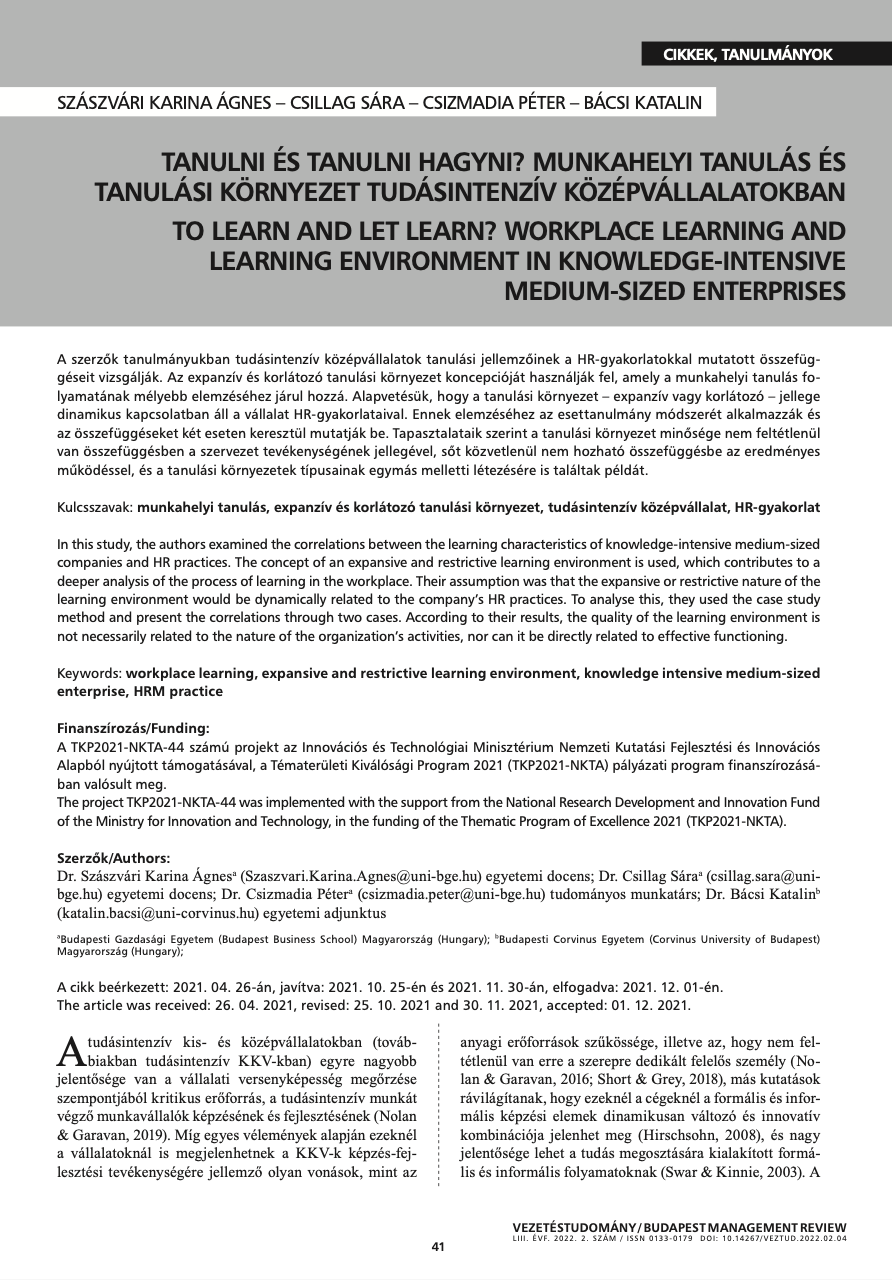
A szerzők tanulmányukban tudásintenzív középvállalatok tanulási jellemzőinek a HR-gyakorlatokkal mutatott összefüggéseit vizsgálják. Az expanzív és korlátozó tanulási környezet koncepcióját használják fel, amely a munkahelyi tanulás folyamatának mélyebb elemzéséhez járul hozzá. Alapvetésük, hogy a tanulási környezet – expanzív vagy korlátozó – jellege dinamikus kapcsolatban áll a vállalat HR-gyakorlataival. Ennek elemzéséhez az esettanulmány módszerét alkalmazzák és az összefüggéseket két eseten keresztül mutatják be. Tapasztalataik szerint a tanulási környezet minősége nem feltétlenül van összefüggésben a szervezet tevékenységének jellegével, sőt közvetlenül nem hozható összefüggésbe az eredményes működéssel, és a tanulási környezetek típusainak egymás melletti létezésére is találtak példát.
Downloads
Hivatkozások
Billett, S. (2001). Learning through work: workplace affordances and individual engagement. Journal of Workplace Learning, 13(5), 209-214. https://doi.org/10.1108/EUM0000000005548
Boyd, P., Smith, C. & Beyaztas, D. I. (2015). Evaluating academic workplaces: the hyper-expansive environment experienced by university lecturers in professional fields. International Journal for Academic Development, 20(1), 18-32. https://orcid.org/10.1080/1360144X.2014.948255
Bryman, A. (1992). Research methods and organization studies. London: Routledge.
Coetzer, A., Susomrith, P., & Ampofo, E. T. (2020). Opportunities to participate in formal and informal vocational learning activities and work-related outcomes in small professional services businesses. Journal of Vocational Education & Training, 72(1), 88-114. https://doi.org/10.1080/13636820.2019.1584637
Coetzer, A., Kock, H. & Wallo, A. (2017). Distinctive Characteristics of Small Businesses as Sites for Informal Learning. Human Resource Development Review, 16(2), 111–134. https://doi.org/10.1177/1534484317704291
Coetzer, A., Wallo. A. & Kock, H. (2019). The owner-manager’s role as a facilitator of informal learning in small businesses. Human Resource Development International, 22(5), 420-452. https://doi.org/10.1080/13678868.2019.1585695
Csillag, S., Csizmadia, P., Hidegh A. L. & Szászvári K. (2019) What makes small beautiful? Learning and development in small firms. Human Resource Development International, 22(5), 453-476. https://doi.org/10.1080/13678868.2019.1641351
Csillag, S., Csizmadia, P., Hidegh, A. L. & Szászvári, K. (2020). A kicsi szép? Tanulás és fejlődés a kisvállalkozásokban. Vezetéstudomány, 51(1), 2-15. https://doi.org/10.14267/VEZTUD.2020.01.01
Csizmadia, P. (2016). Munkahelyi tanulás és társas integráció. socio.hu: Társadalomtudományi Szemle, 6(1), 27-51. https://doi.org/10.18030/socio.hu.2016.1.27
Csontos, R. S., & Szabó, Zs. R. (2019). Hálózati tanulás – tanuló hálózatok. Vezetéstudomány, 50(1), 2-13. https://doi.org/10.14267/VEZTUD.2019.01.01
Detsimas, N., Coffey, V., Sadiqi, Z. & Li, M. (2016). Workplace training and generic and technical skill development in the Australian construction industry. Journal of Management Development, 35(4), 486-504. https://doi.org/10.1108/JMD-05-2015-0073
Dobák, M., Ferincz, A. & Hortoványi, L. (2014). A munkahelyi tanulás elősegítésének változásvezetési szempontjai. Magyar Tudomány, 175(12), 1458-1466.
Dobrai, K. & Farkas, F. (2009). Tudásintenzív üzleti szolgáltatások. Vezetéstudomány, 40(7-8), 56-66. https://doi.org/10.14267/VEZTUD.2009.07.06
Eisenhardt, K. (1989). Building Theories from Case Study Research. The Academy of Management Review, 14(4), 532-550. https://doi.org/10.2307/258557
Engeström, Y. (1987). Learning by expanding: an activity theoretical approach to developmental research. Helsinki: Orenta-Konsultit.
Engeström, Y. & Sannino, A. (2010). Studies of expansive learning: Foundations, findings and future challenges. Educational Research Review, 5(1), 1-24. https://doi.org/10.1016/j.edurev.2009.12.002
Fenwick, T. (2008). Understanding Relations of Individual Collective Learning in Work: A Review of Research. Management Learning, 39(3), 227-243. https://doi.org/10.1177/1350507608090875
Ferincz, A. (2019). A vállalkozó felső vezető hatása a szervezeti tanulásra (Doktori értekezés). Budapesti Corvinus Egyetem, Budapest.
Ferincz, A. & Hortoványi, L. (2014). Munkahelyi tanulást befolyásoló tényezők – humán-számítógép együttműködés vizsgálata. Vezetéstudomány, 45(10), 30-41. http://doi.org/10.14267/VEZTUD.2014.10.03
Fuller, A. & Unwin, L. (2003). Learning as apprentices in the contemporary UK workplace: creating and managing expansive and restrictive participation. Journal of Education and Work, 16(4), 407–426. https://doi.org/10.1080/1363908032000093012
Fuller, A. & Unwin, L. (2004). Expansive Learning Environments: Integrating Organizational and Personal Development. In Rainbird, H., Fuller, A. & Munro, A. (Eds.), Workplace Learning in Context (pp. 126–144). London: Routledge.
Fuller, A., Unwin, L., Felstead, A., Jewson, N. & Kakavelakis, K. (2007). Creating and using knowledge: an analysis of the differentiated nature of workplace learning environments. British Educational Research Journal, 33(5), 743-759. https://doi.org/10.1080/01411920701582397
Fuller, A., Laurie, I., & Unwin, L. (2011). Learning at work as a low grade worker: the case of hospital porters. London: Centre for Learning and Life Chances in Knowledge Economies and Societies, Institute of Education, University of London.
Gelei, A. (2002). A szervezeti tanulás interpretatív megközelítése: A szervezetfejlesztés esete (Doktori értekezés). Budapesti Corvinus Egyetem, Budapest.
Hennink, M. M., Kaiser, B. N., & Weber, M. B. (2019). What influences saturation? Estimating sample sizes in focus group research. Qualitative Health Research, 29(10), 1483–1496. https://doi.org/10.1177/1049732318821692
Hirschsohn, P. (2008). Regulating the ’Animal Spirits’ of Entrepreneurs?: Skills Development in South African Small and Medium Enterprises. International Small Business Journal, 26(2), 181–206. https://doi.org/10.1177/0266242607086573
Hortoványi, L. & Vastag, A. (2013). A munkahelyi tanulás lehetséges értelmezései. In Ferencz, Á. (szerk.), Környezettudatos gazdálkodás és Menedzsment, Gazdálkodás és Menedzsment Tudományos Konferencia, I-II kötet, Kecskeméti Főiskola, Kertészeti Főiskolai Kar (pp. 438-442). Kecskemét: Kecskeméti Főiskola.
Hu, H., Wu, J. & Shi, J. (2016). Strategic HRM and organisational learning in the Chinese private sector during second-pioneering. The International Journal of Human Resource Management, 27(16), 1813- 1832. https://doi.org/10.1080/09585192.2015.1075568
Huws, U. & Dahlmann, S. (2007). Quality standards for case studies in the European Foundation. Analytica
Social and Economic Research. Dublin: Eurofound. Joranli, I. (2018). Managing organisational knowledge through recruitment: searching and selecting embodied competencies. Journal of Knowledge Management, 22(1), 183-200. https://doi.org/10.1108/JKM-12-2016-0541
Kárpátiné, D. J., Vágány, J. & Fenyvesi, É. (2016). Fejlődünk, hogy fejlődhessünk? – avagy milyen önképzési módszereket részesítenek előnyben a mikro- és kisvállalkozások vezetői napjainkban Magyarországon? Vezetéstudomány, 47(12), 72-82. https://doi.org/10.14267/VEZTUD.2016.12.07
Khandekar, A. & Sharma, A. (2005). Organizational learning in Indian organizations: a strategic HRM perspective. Journal of Small Business and Enterprise Development, 12(2), 211-226. https://doi.org/10.1108/14626000510594610
Kitching, J. (2007). Regulating employment relations through workplace learning: a study of small employers. Human Resource Management Journal, 17(1), 42-57. https://doi.org/10.1111/j.1748-8583.2007.00019.x
Kuo, T. (2011). How to improve organizational performance through learning and knowledge? International Journal of Manpower, 32(5/6), 581-603. https://doi.org/10.1108/01437721111158215
Kvalshaugen, R., Hydle, K. M. & Brehmer, P. O. (2015). Innovative capabilities in international professional service firms: enabling trade-offs between past, present, and future service provision. Journal of Professions and Organization, 2(2), 148–167. https://doi.org/10.1093/jpo/jov005
Lam, A. & Lambermont-Ford, J.P. (2010). Knowledge sharing in organisational contexts: a motivation-based perspective. Journal of Knowledge Management, 14(1), 51-66. https://doi.org/10.1108/13673271011015561
Lave, J. & Wenger, E. (1990). Situated Learning: Legitimate Periperal Participation. Cambridge, UK: Cambridge University Press.
Lepak, D.P., Liao, H., Chung, Y. & Harden, E. (2006). A conceptual review of human resource management systems in strategic human resource management research. Research in Personnel and Human Resources Management, 25(1), 217-271. https://doi.org/10.1016/S0742-7301(06)25006-0
Lopez‐Cabrales, A., Pérez‐Luño, A. & Cabrera, R.V. (2009). Knowledge as a mediator between HRM practices and innovative activity. Human Resource Management: Published in Cooperation with the School of Business Administration, The University of Michigan and in alliance with the Society of Human Resources Management, 48(4), 485-503. https://doi.org/10.1002/hrm.20295
Lundvall, B. A. & Johnson, B. (1994). The Learning Economy. Journal of Industry Studies, 1(2), 23-42. https://doi.org/10.1080/13662719400000002
Macpherson, A. & Holt, R. (2007). Knowledge, learning and small firm growth: a systematic review of the evidence. Research Policy, 36(2), 172–192. https://doi.org/10.1016/j.respol.2006.10.001
Makó, Cs., Illéssy, M. & Csizmadia, P. (2013). The Knowledge Intensive Business Service Sector in Hungary in a Comparative Perspective. In Makó, Cs., Polónyi, I. & Szanyi, M. (szerk.), (2013). Organisational innovation and knowledge development: institutions, methodological foundations and empirical experiences (pp. 136-174). Budapest: Új Mandátum Könyvkiadó.
Manuti, A., Pastore, S., Scardigno, A. F., Giancaspro, M. L. & Morciano, D. (2015). Formal and Informal Learning in the Workplace: A Research Review. International Journal of Training and Development, 19(1), 1–17. https://doi.org/10.1111/ijtd.12044
Miles, I. (2005). Knowledge intensive business services: prospects and policies. Foresight, 7(6), 39-63. https://doi.org/10.1108/14636680510630939
Miles, M. B., & Huberman, A. M. (1994). Qualitative data analysis: An expanded sourcebook. Thousand Oaks: Sage.
Nolan, C. T. & Garavan, T. N. (2019). External and internal networks and access to HRD resources in small professional service firms. Human Resource Development International, 22(5), 477-503. https://doi.org/10.1080/13678868.2019.1625853
Nolan, C. T & Garavan, T. N. (2016). Human Resource Development in SMEs: A Systematic Review of the Literature. International Journal of Management Reviews, 18(1), 85–107. https://doi.org/10.1111/ijmr.12062
Poell, R. F. (2013). Workplace learning theories and practices. In Valentin, C., & Walton, J. (Eds.) (2013). Human Resource Development: Practices and Orthodoxies (pp. 19-32). London: Palgrave Macmillan.
Pridham, B. A., Deed, C. & Cox, P. (2013). Work- place-Based Practicum: Enabling Expansive Practic- es. Australian Journal of Teacher Education, 38(4), 49-65. https://doi.org/10.14221/ajte.2013v38n4.7
Salther, A. & Tether, B. (2006). Innovation in Services. Through the Looking Glass of Innovation Studies. Background paper for the AIM Grand Challenge on Service Science. Oxford.
Sebele-Mpofu, F. Y. (2020). Saturation controversy in qualitative research: Complexities and underlying assumptions. A literature review. Cogent Social Sciences, 6(1), https://doi.org/10.1080/23311886.2020.1838706
Sfard, A. (1988). On Two Metaphors for Learning and the Dangers of Choosing Just One. Educational Researcher, 27(2), 4-13. https://doi.org/10.2307/1176193
Short, H. J. & Gray, D. E. (2018). HRD in SMEs: A Research Agenda Whose Time Has Come. Human Resource Development Quarterly, 29(1), 7-13. https://doi.org/10.1002/hrdq.21305
Stake, R. E. (1994). Case Study: Composition and Performance. Bulletin of the Council for Research in Music Education, (122), 31-44. https://www.jstor.org/stable/40318653
Susomrith, P., Coetzer, A. & Ampofo, E. (2019). Training and development in small professional services firms. European Journal of Training and Development, 43(5/6), 517-535. https://doi.org/10.1108/EJTD-11-2018-0113
Swart, J. & Kinnie, N. (2003). Knowledge‐intensive firms: the influence of the client on HR systems. Human Resource Management Journal, 13(3), 37- 55. https://doi.org/10.1111/j.1748-8583.2003.tb00097.x
Szabó, Zs. R., Horváth, D. & Hortoványi, L. (2019). Hálózati tanulás az ipar 4.0 korában. Közgazdasági Szemle, 66(1), 72-94. https://doi.org/10.18414/KSZ.2019.1.72
Yin, R. K. (2004). The case study anthology. Thousand Oaks: Sage.
Letöltések
Megjelent
Folyóirat szám
Rovat
License
Copyright (c) 2022 Vezetéstudomány / Budapest Management Review

This work is licensed under a Creative Commons Attribution 4.0 International License.
Authors assign copyright to Vezetéstudomány / Budapest Management Review. Authors are responsible for permission to reproduce copyright material from other sources.
Hogyan kell idézni