A szervezeti megbízhatóság pszichológiai mikroalapjai biztonságkritikus ipari környezetekben
Érzelmi intelligencia, koherenciaérzés és reziliencia tapasztalt ipari munkavállalók körében
DOI:
https://doi.org/10.14267/VEZTUD.2026.11.03Kulcsszavak:
érzelmi intelligencia, reziliencia, koherenciaérzés, szervezeti megbízhatóság, biztonságkritikus ipari környezetAbsztrakt
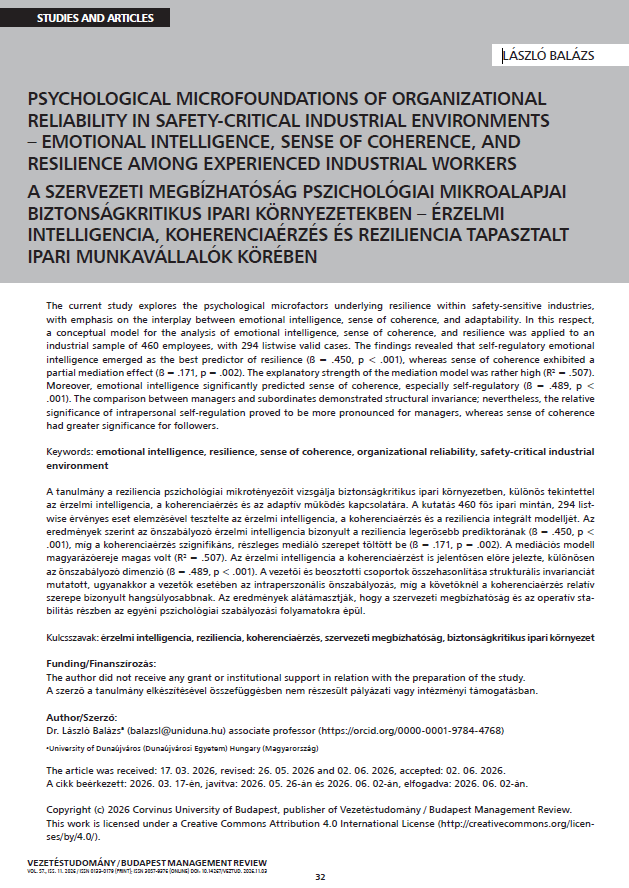
A tanulmány a reziliencia pszichológiai mikrotényezőit vizsgálja biztonságkritikus ipari környezetben, különös tekintettel az érzelmi intelligencia, a koherenciaérzés és az adaptív működés kapcsolatára. A kutatás 460 fős ipari mintán, 294 listwise érvényes eset elemzésével tesztelte az érzelmi intelligencia, a koherenciaérzés és a reziliencia integrált modelljét. Az eredmények szerint az önszabályozó érzelmi intelligencia bizonyult a reziliencia legerősebb prediktorának (ß = .450, p < .001), míg a koherenciaérzés szignifikáns, részleges mediáló szerepet töltött be (ß = .171, p = .002). A mediációs modell magyarázóereje magas volt (R² = .507). Az érzelmi intelligencia a koherenciaérzést is jelentősen előre jelezte, különösen az önszabályozó dimenzió (ß = .489, p < .001). A vezetői és beosztotti csoportok összehasonlítása strukturális invarianciát mutatott, ugyanakkor a vezetők esetében az intraperszonális önszabályozás, míg a követőknél a koherenciaérzés relatív szerepe bizonyult hangsúlyosabbnak. Az eredmények alátámasztják, hogy a szervezeti megbízhatóság és az operatív stabilitás részben az egyéni pszichológiai szabályozási folyamatokra épül.
Downloads
Hivatkozások
Antonovsky, A. (1987). Unraveling the mystery of health: How people manage stress and stay well. Jossey-Bass. Armstrong, A.R., Galligan, R.F., & Critchley, C.R. (2011). Emotional intelligence and psychological resilience to negative life events. Personality and Individual Differences, 51(3), 331–336. https://doi.org/10.1016/j.paid.2011.03.025
Bakker, A.B., & Demerouti, E. (2007). The Job Demands– Resources model: State of the art. Journal of Managerial Psychology, 22(3), 309–328. https://doi.org/10.1108/02683940710733115
Bakker, A.B., & Demerouti, E. (2017). Job Demands–Resources theory: Taking stock and looking forward. Journal of Occupational Health Psychology, 22(3), 273–285. https://doi.org/10.1037/ocp0000056
Balajti, I., Vokó, Z., Ádány, R., & Kósa, K. (2007). Validation of the Hungarian version of the Sense of Coherence scale (SOC-13). European Journal of Mental Health, 2(2), 147–161.
Balázs, L. (2014). A szervezeti kultúra és az érzelmi intelligencia kölcsönkapcsolatának vizsgálata az iskolában [Doktori értekezés]. Pécsi Tudományegyetem.
Balázs, L. (2020). Az érzelmi intelligencia és a kiégés kapcsolatának vizsgálata oktatóknál – Az érzelmiintelligencia- fejlesztés szerepe a szervezeti kultúra alakulásában. Vezetéstudomány, 51(12), 85–100. https://doi.org/10.14267/VEZTUD.2020.12.07
Bar-On, R. (1997). The Emotional Quotient Inventory (EQ-i): Technical manual. Multi-Health Systems.
Bar-On, R. (2006). The Bar-On model of emotional-social intelligence (ESI). Psicothema, 18(Suppl.), 13–25.
Beus, J.M., Payne, S.C., Bergman, M.E., & Arthur, W. (2010). Safety climate and injuries: An examination of theoretical and empirical relationships. Journal of Applied Psychology, 95(4), 713–727. https://doi.org/10.1037/a0019164
Bonanno, G.A. (2004). Loss, trauma, and human resilience. Have we underestimated the human capacity to thrive after extremely aversive events? American Psychologist, 59(1), 20–28. https://doi.org/10.1037/0003-066X.59.1.20
Bonanno, G.A., & Burton, C.L. (2013). Regulatory flexibility: An individual differences perspective on coping and emotion regulation. Perspectives on Psychological Science, 8(6), 591–612. https://doi.org/10.1177/1745691613504116
Campbell-Sills, L., & Stein, M.B. (2007). Psychometric analysis and refinement of the Connor–Davidson Resilience Scale (CD-RISC): Validation of a 10-item measure of resilience. Journal of Traumatic Stress, 20(6), 1019–1028. https://doi.org/10.1002/jts.20271
Clarke, S. (2010). An integrative model of safety climate: Linking psychological climate and work attitudes to individual safety outcomes using meta-analysis. Journal of Occupational and Organizational Psychology, 83(3), 553–578. https://doi.org/10.1348/096317909X452122
Connor, K.M., & Davidson, J.R.T. (2003). Development of a new resilience scale: The Connor–Davidson Resilience Scale (CD-RISC). Depression and Anxiety, 18(2), 76–82. https://doi.org/10.1002/da.10113
Côté, S. (2014). Emotional intelligence in organizations. Annual Review of Organizational Psychology and Organizational Behavior, 1, 459–488. https://doi.org/10.1146/annurev-orgpsych-031413-091233
Double, K.S., Pinkus, R.T., & MacCann, C. (2022). Emotionally intelligent people show more flexible regulation of emotions in daily life. Emotion, 22(2), 397–402. https://doi.org/10.1037/emo0001069
Duchek, S. (2020). Organizational resilience: A capability- based conceptualization. Business Research, 13, 215–246. https://doi.org/10.1007/s40685-019-0085-7
Dziuba, A., Krell-Roesch, J., Schmidt, S.C.E., Bös, K., & Woll, A. (2021). Association Between Sense of Coherence and Health Outcomes at 10 and 20 Years Follow-Up: A Population-Based Longitudinal Study in Germany. Frontiers in Public Health, 9, 739394. https://doi.org/10.3389/fpubh.2021.739394
Eriksson, M., & Lindström, B. (2006). Antonovsky’s sense of coherence scale and the relation with health: A systematic review. Journal of Epidemiology & Community Health, 60(5), 376–381. https://doi.org/10.1136/jech.2005.041616
Feldt, T., Kinnunen, U., & Mauno, S. (2000). A mediational model of sense of coherence in the work context: A one-year follow-up study. Journal of Organizational Behavior, 21(4), 461–476. https://doi.org/10.1002/(SICI)1099-1379(200006)21:4<461::AID-JOB11>3.0.CO;2-T
Gross, J.J. (2002), Emotion regulation: Affective, cognitive, and social consequences. Psychophysiology, 39, 281–291. https://doi.org/10.1017/S0048577201393198
Harms, P.D., & Credé, M. (2010). Emotional intelligence and transformational and transactional leadership: A meta-analysis. Journal of Leadership & Organizational Studies, 17(1), 5–17. https://doi.org/10.1177/1548051809350894
Hobfoll, S.E. (1989). Conservation of resources: A new attempt at conceptualizing stress. American Psychologist, 44(3), 513–524. https://doi.org/10.1037/0003-066X.44.3.513
Hollnagel, E. (2014). Safety-I and Safety-II: The Past and Future of Safety Management. CRC Press. https://doi.org/10.1201/9781315607511
Hollnagel, E., Woods, D.D., & Leveson, N. (2006). Resilience engineering: Concepts and precepts. Ashgate.
Járai, R., Vajda, D., Hargitai, R., Nagy, L., Csókási, K., & Kiss, E.Cs. (2015). A Connor–Davidson Reziliencia Kérdőív 10 itemes változatának jellemzői. Alkalmazott Pszichológia, 15(1), 129–136. https://doi.org/10.17627/ALKPSZICH.2015.1.129
Joseph, D.L., Jin, J., Newman, D.A., & O’Boyle, E.H., Jr. (2015). Why does self-reported emotional intelligence predict job performance? A meta-analytic investigation of mixed EI. Journal of Applied Psychology, 100(2), 298–342. https://doi.org/10.1037/a0037681
Kalisch, R., Müller, M.B., & Tüscher, O. (2015). A conceptual framework for the neurobiological study of resilience. Behavioral and Brain Sciences, 38, e92. https://doi.org/10.1017/S0140525X1400082X
Kun, B. (2011). Az érzelmi intelligencia és az emocionális és szociális kompetenciák szerepe a pszichoaktívszer- használatban [Doktori értekezés]. ELTE.
Lengnick-Hall, C.A., Beck, T.E., & Lengnick-Hall, M.L. (2011). Developing a capacity for organizational resilience through strategic human resource management. Human Resource Management Review, 21(3), 243–255. https://doi.org/10.1016/j.hrmr.2010.07.001
Luthar, S.S., Cicchetti, D., & Becker, B. (2000). The construct of resilience: A critical evaluation and guidelines for future work. Child Development, 71(3), 543–562. https://doi.org/10.1111/1467-8624.00164
Masten, A.S. (2001). Ordinary magic: Resilience processes in development. American Psychologist, 56(3), 227–238. https://doi.org/10.1037/0003-066X.56.3.227
Majoros, K. (2008). Koedukált sportolás. Partnerkapcsolat a versenytáncban [Doktori értekezés]. Semmelweis Egyetem.
Mayer, J.D., Salovey, P., & Caruso, D.R. (2008). Emotional intelligence: New ability or eclectic traits? American Psychologist, 63(6), 503–517. https://doi.org/10.1037/0003-066X.63.6.503
Miao, C., Humphrey, R.H., & Qian, S. (2017). A meta-analysis of emotional intelligence and work attitudes. Journal of Occupational and Organizational Psychology, 90(2), 177–202. https://doi.org/10.1111/joop.12167
Mittelmark, M.B., Bauer, G.F., Vaandrager, L., Pelikan, J.M., Sagy, S., Eriksson, M., Lindström, B., Meier Magistretti, C., & Espnes, G.A. (Eds.). (2022). The handbook of salutogenesis (2nd ed.). Springer Nature. https://doi.org/10.1007/978-3-030-79515-3
O’Boyle, E.H., Jr., Humphrey, R.H., Pollack, J.M., Hawver, T.H., & Story, P.A. (2011). The relation between emotional intelligence and job performance: A meta- analysis. Journal of Organizational Behavior, 32(5), 788–818. https://doi.org/10.1002/job.714
Patriarca, R., Bergström, J., Di Gravio, G., & Costantino, F. (2018). Resilience engineering: Current status of the research and future challenges. Safety Science, 102, 79–100. https://doi.org/10.1016/j.ssci.2017.10.005
Petrides, K.V. (2010). Trait emotional intelligence theory. Industrial and Organizational Psychology: Perspectives on Science and Practice, 3(2), 136–139. https://doi.org/10.1111/j.1754-9434.2010.01213.x
Reason, J. (1997). Managing the risks of organizational accidents. Ashgate.
Salovey, P., & Mayer, J. D. (1990). Emotional Intelligence. Imagination, Cognition and Personality, 9(3), 185-211. https://doi.org/10.2190/DUGG-P24E-52WK-6CDG
Schäfer, S.K., Becker, N., King, L., Horsch, A., & Michael, T. (2019). The relationship between sense of coherence and post-traumatic stress disorder: A meta-analysis. European Journal of Psychotraumatology, 10(1), 1562839. https://doi.org/10.1080/20008198.2018.1562839
Schneider, T.R., Lyons, J.B., & Khazon, S. (2013). Emotional intelligence and resilience. Personality and Individual Differences, 55(8), 909–914. https://doi.org/10.1016/j.paid.2013.07.460
Southwick, S.M., & Charney, D.S. (2012). The science of resilience: Implications for the prevention and treatment of depression. Science, 338(6103), 79–82. https://doi.org/10.1126/science.1222942
Ungar, M. (Ed.). (2021). Multisystemic resilience: Adaptation and transformation in contexts of change. Oxford University Press. https://doi.org/10.1093/oso/9780190095888.001.0001
Vogt, K., Hakanen, J.J., Jenny, G.J., & Bauer, G.F. (2016). Sense of coherence and the motivational process of the Job Demands–Resources model. Journal of Occupational Health Psychology, 21(2), 194–207. https://doi.org/10.1037/a0039899
Vogt, K., Jenny, G.J., & Bauer, G.F. (2013). Comprehensibility, manageability and meaningfulness at work : construct validity of a scale measuring work-related sense of coherence. South African Journal of Industrial Psychology, 39(1), 8pp. https://doi.org/10.4102/sajip.v39i1.1111
Vogus, T.J., & Sutcliffe, K.M. (2007). Organizational resilience: Towards a theory and research agenda. In Proceedings of the IEEE International Conference on Systems, Man and Cybernetics (pp. 3418–3422). IEEE. https://doi.org/10.1109/ICSMC.2007.4414160
Weick, K.E., & Sutcliffe, K.M. (2007). Managing the unexpected: Resilient performance in an age of uncertainty (2nd ed.). Jossey-Bass. Williams, T.A., Gruber, D.A., Sutcliffe, K.M., Shepherd, D.A., & Zhao, E.Y. (2017). Organizational response to adversity: Fusing crisis management and resilience research streams. Academy of Management Annals, 11(2), 733–769. https://doi.org/10.5465/annals.2015.0134
Woods, D.D. (2015). Four concepts for resilience and the implications for the future of resilience engineering. Reliability Engineering & System Safety, 141, 5–9. https://doi.org/10.1016/j.ress.2015.03.018
Xanthopoulou, D., Bakker, A.B., Demerouti, E., & Schaufeli, W.B. (2007). The role of personal resources in the Job Demands–Resources model. International Journal of Stress Management, 14(2), 121–141. https://doi.org/10.1037/1072-5245.14.2.121
Letöltések
Megjelent
Folyóirat szám
Rovat
License
Copyright (c) 2026 Corvinus University of Budapest, publisher of Vezetéstudomány / Budapest Management Review

This work is licensed under a Creative Commons Attribution 4.0 International License.
Authors assign copyright to Vezetéstudomány / Budapest Management Review. Authors are responsible for permission to reproduce copyright material from other sources.
Hogyan kell idézni