Psychological microfoundations of organizational reliability in safety-critical industrial environments
Emotional intelligence, sense of coherence, and resilience among experienced industrial workers
DOI:
https://doi.org/10.14267/VEZTUD.2026.11.03Keywords:
emotional intelligence, resilience, sense of coherence, organizational reliability, safety-critical industrial environmentAbstract
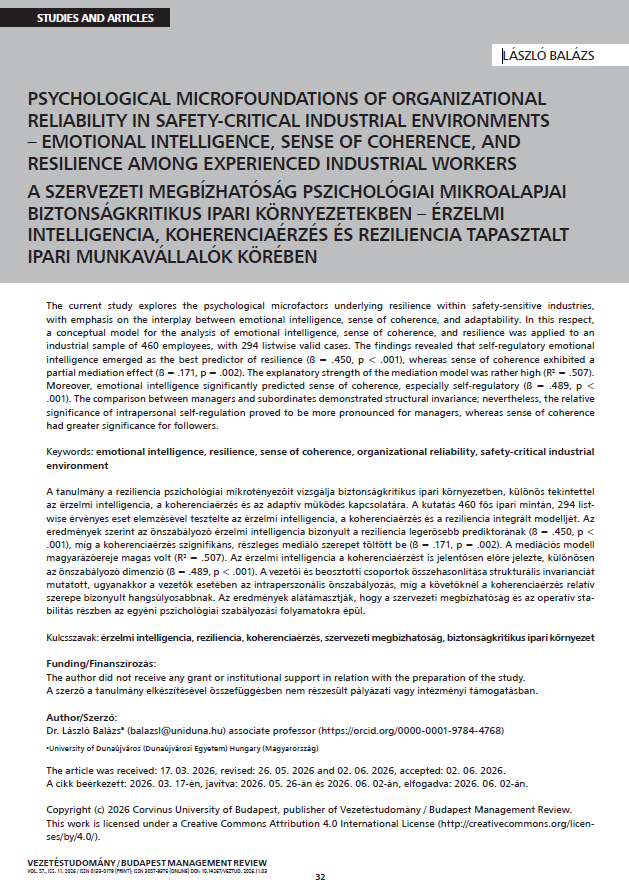
The current study explores the psychological microfactors underlying resilience within safety-sensitive industries, with emphasis on the interplay between emotional intelligence, sense of coherence, and adaptability. In this respect, a conceptual model for the analysis of emotional intelligence, sense of coherence, and resilience was applied to an industrial sample of 460 employees, with 294 listwise valid cases. The findings revealed that self-regulatory emotional intelligence emerged as the best predictor of resilience (ß = .450, p < .001), whereas sense of coherence exhibited a partial mediation effect (ß = .171, p = .002). The explanatory strength of the mediation model was rather high (R² = .507). Moreover, emotional intelligence significantly predicted sense of coherence, especially self-regulatory (ß = .489, p < .001). The comparison between managers and subordinates demonstrated structural invariance; nevertheless, the relative significance of intrapersonal self-regulation proved to be more pronounced for managers, whereas sense of coherence had greater significance for followers.
Downloads
References
Antonovsky, A. (1987). Unraveling the mystery of health: How people manage stress and stay well. Jossey-Bass. Armstrong, A.R., Galligan, R.F., & Critchley, C.R. (2011). Emotional intelligence and psychological resilience to negative life events. Personality and Individual Differences, 51(3), 331–336. https://doi.org/10.1016/j.paid.2011.03.025
Bakker, A.B., & Demerouti, E. (2007). The Job Demands– Resources model: State of the art. Journal of Managerial Psychology, 22(3), 309–328. https://doi.org/10.1108/02683940710733115
Bakker, A.B., & Demerouti, E. (2017). Job Demands–Resources theory: Taking stock and looking forward. Journal of Occupational Health Psychology, 22(3), 273–285. https://doi.org/10.1037/ocp0000056
Balajti, I., Vokó, Z., Ádány, R., & Kósa, K. (2007). Validation of the Hungarian version of the Sense of Coherence scale (SOC-13). European Journal of Mental Health, 2(2), 147–161.
Balázs, L. (2014). A szervezeti kultúra és az érzelmi intelligencia kölcsönkapcsolatának vizsgálata az iskolában [Doktori értekezés]. Pécsi Tudományegyetem.
Balázs, L. (2020). Az érzelmi intelligencia és a kiégés kapcsolatának vizsgálata oktatóknál – Az érzelmiintelligencia- fejlesztés szerepe a szervezeti kultúra alakulásában. Vezetéstudomány, 51(12), 85–100. https://doi.org/10.14267/VEZTUD.2020.12.07
Bar-On, R. (1997). The Emotional Quotient Inventory (EQ-i): Technical manual. Multi-Health Systems.
Bar-On, R. (2006). The Bar-On model of emotional-social intelligence (ESI). Psicothema, 18(Suppl.), 13–25.
Beus, J.M., Payne, S.C., Bergman, M.E., & Arthur, W. (2010). Safety climate and injuries: An examination of theoretical and empirical relationships. Journal of Applied Psychology, 95(4), 713–727. https://doi.org/10.1037/a0019164
Bonanno, G.A. (2004). Loss, trauma, and human resilience. Have we underestimated the human capacity to thrive after extremely aversive events? American Psychologist, 59(1), 20–28. https://doi.org/10.1037/0003-066X.59.1.20
Bonanno, G.A., & Burton, C.L. (2013). Regulatory flexibility: An individual differences perspective on coping and emotion regulation. Perspectives on Psychological Science, 8(6), 591–612. https://doi.org/10.1177/1745691613504116
Campbell-Sills, L., & Stein, M.B. (2007). Psychometric analysis and refinement of the Connor–Davidson Resilience Scale (CD-RISC): Validation of a 10-item measure of resilience. Journal of Traumatic Stress, 20(6), 1019–1028. https://doi.org/10.1002/jts.20271
Clarke, S. (2010). An integrative model of safety climate: Linking psychological climate and work attitudes to individual safety outcomes using meta-analysis. Journal of Occupational and Organizational Psychology, 83(3), 553–578. https://doi.org/10.1348/096317909X452122
Connor, K.M., & Davidson, J.R.T. (2003). Development of a new resilience scale: The Connor–Davidson Resilience Scale (CD-RISC). Depression and Anxiety, 18(2), 76–82. https://doi.org/10.1002/da.10113
Côté, S. (2014). Emotional intelligence in organizations. Annual Review of Organizational Psychology and Organizational Behavior, 1, 459–488. https://doi.org/10.1146/annurev-orgpsych-031413-091233
Double, K.S., Pinkus, R.T., & MacCann, C. (2022). Emotionally intelligent people show more flexible regulation of emotions in daily life. Emotion, 22(2), 397–402. https://doi.org/10.1037/emo0001069
Duchek, S. (2020). Organizational resilience: A capability- based conceptualization. Business Research, 13, 215–246. https://doi.org/10.1007/s40685-019-0085-7
Dziuba, A., Krell-Roesch, J., Schmidt, S.C.E., Bös, K., & Woll, A. (2021). Association Between Sense of Coherence and Health Outcomes at 10 and 20 Years Follow-Up: A Population-Based Longitudinal Study in Germany. Frontiers in Public Health, 9, 739394. https://doi.org/10.3389/fpubh.2021.739394
Eriksson, M., & Lindström, B. (2006). Antonovsky’s sense of coherence scale and the relation with health: A systematic review. Journal of Epidemiology & Community Health, 60(5), 376–381. https://doi.org/10.1136/jech.2005.041616
Feldt, T., Kinnunen, U., & Mauno, S. (2000). A mediational model of sense of coherence in the work context: A one-year follow-up study. Journal of Organizational Behavior, 21(4), 461–476. https://doi.org/10.1002/(SICI)1099-1379(200006)21:4<461::AID-JOB11>3.0.CO;2-T
Gross, J.J. (2002), Emotion regulation: Affective, cognitive, and social consequences. Psychophysiology, 39, 281–291. https://doi.org/10.1017/S0048577201393198
Harms, P.D., & Credé, M. (2010). Emotional intelligence and transformational and transactional leadership: A meta-analysis. Journal of Leadership & Organizational Studies, 17(1), 5–17. https://doi.org/10.1177/1548051809350894
Hobfoll, S.E. (1989). Conservation of resources: A new attempt at conceptualizing stress. American Psychologist, 44(3), 513–524. https://doi.org/10.1037/0003-066X.44.3.513
Hollnagel, E. (2014). Safety-I and Safety-II: The Past and Future of Safety Management. CRC Press. https://doi.org/10.1201/9781315607511
Hollnagel, E., Woods, D.D., & Leveson, N. (2006). Resilience engineering: Concepts and precepts. Ashgate.
Járai, R., Vajda, D., Hargitai, R., Nagy, L., Csókási, K., & Kiss, E.Cs. (2015). A Connor–Davidson Reziliencia Kérdőív 10 itemes változatának jellemzői. Alkalmazott Pszichológia, 15(1), 129–136. https://doi.org/10.17627/ALKPSZICH.2015.1.129
Joseph, D.L., Jin, J., Newman, D.A., & O’Boyle, E.H., Jr. (2015). Why does self-reported emotional intelligence predict job performance? A meta-analytic investigation of mixed EI. Journal of Applied Psychology, 100(2), 298–342. https://doi.org/10.1037/a0037681
Kalisch, R., Müller, M.B., & Tüscher, O. (2015). A conceptual framework for the neurobiological study of resilience. Behavioral and Brain Sciences, 38, e92. https://doi.org/10.1017/S0140525X1400082X
Kun, B. (2011). Az érzelmi intelligencia és az emocionális és szociális kompetenciák szerepe a pszichoaktívszer- használatban [Doktori értekezés]. ELTE.
Lengnick-Hall, C.A., Beck, T.E., & Lengnick-Hall, M.L. (2011). Developing a capacity for organizational resilience through strategic human resource management. Human Resource Management Review, 21(3), 243–255. https://doi.org/10.1016/j.hrmr.2010.07.001
Luthar, S.S., Cicchetti, D., & Becker, B. (2000). The construct of resilience: A critical evaluation and guidelines for future work. Child Development, 71(3), 543–562. https://doi.org/10.1111/1467-8624.00164
Masten, A.S. (2001). Ordinary magic: Resilience processes in development. American Psychologist, 56(3), 227–238. https://doi.org/10.1037/0003-066X.56.3.227
Majoros, K. (2008). Koedukált sportolás. Partnerkapcsolat a versenytáncban [Doktori értekezés]. Semmelweis Egyetem.
Mayer, J.D., Salovey, P., & Caruso, D.R. (2008). Emotional intelligence: New ability or eclectic traits? American Psychologist, 63(6), 503–517. https://doi.org/10.1037/0003-066X.63.6.503
Miao, C., Humphrey, R.H., & Qian, S. (2017). A meta-analysis of emotional intelligence and work attitudes. Journal of Occupational and Organizational Psychology, 90(2), 177–202. https://doi.org/10.1111/joop.12167
Mittelmark, M.B., Bauer, G.F., Vaandrager, L., Pelikan, J.M., Sagy, S., Eriksson, M., Lindström, B., Meier Magistretti, C., & Espnes, G.A. (Eds.). (2022). The handbook of salutogenesis (2nd ed.). Springer Nature. https://doi.org/10.1007/978-3-030-79515-3
O’Boyle, E.H., Jr., Humphrey, R.H., Pollack, J.M., Hawver, T.H., & Story, P.A. (2011). The relation between emotional intelligence and job performance: A meta- analysis. Journal of Organizational Behavior, 32(5), 788–818. https://doi.org/10.1002/job.714
Patriarca, R., Bergström, J., Di Gravio, G., & Costantino, F. (2018). Resilience engineering: Current status of the research and future challenges. Safety Science, 102, 79–100. https://doi.org/10.1016/j.ssci.2017.10.005
Petrides, K.V. (2010). Trait emotional intelligence theory. Industrial and Organizational Psychology: Perspectives on Science and Practice, 3(2), 136–139. https://doi.org/10.1111/j.1754-9434.2010.01213.x
Reason, J. (1997). Managing the risks of organizational accidents. Ashgate.
Salovey, P., & Mayer, J. D. (1990). Emotional Intelligence. Imagination, Cognition and Personality, 9(3), 185-211. https://doi.org/10.2190/DUGG-P24E-52WK-6CDG
Schäfer, S.K., Becker, N., King, L., Horsch, A., & Michael, T. (2019). The relationship between sense of coherence and post-traumatic stress disorder: A meta-analysis. European Journal of Psychotraumatology, 10(1), 1562839. https://doi.org/10.1080/20008198.2018.1562839
Schneider, T.R., Lyons, J.B., & Khazon, S. (2013). Emotional intelligence and resilience. Personality and Individual Differences, 55(8), 909–914. https://doi.org/10.1016/j.paid.2013.07.460
Southwick, S.M., & Charney, D.S. (2012). The science of resilience: Implications for the prevention and treatment of depression. Science, 338(6103), 79–82. https://doi.org/10.1126/science.1222942
Ungar, M. (Ed.). (2021). Multisystemic resilience: Adaptation and transformation in contexts of change. Oxford University Press. https://doi.org/10.1093/oso/9780190095888.001.0001
Vogt, K., Hakanen, J.J., Jenny, G.J., & Bauer, G.F. (2016). Sense of coherence and the motivational process of the Job Demands–Resources model. Journal of Occupational Health Psychology, 21(2), 194–207. https://doi.org/10.1037/a0039899
Vogt, K., Jenny, G.J., & Bauer, G.F. (2013). Comprehensibility, manageability and meaningfulness at work : construct validity of a scale measuring work-related sense of coherence. South African Journal of Industrial Psychology, 39(1), 8pp. https://doi.org/10.4102/sajip.v39i1.1111
Vogus, T.J., & Sutcliffe, K.M. (2007). Organizational resilience: Towards a theory and research agenda. In Proceedings of the IEEE International Conference on Systems, Man and Cybernetics (pp. 3418–3422). IEEE. https://doi.org/10.1109/ICSMC.2007.4414160
Weick, K.E., & Sutcliffe, K.M. (2007). Managing the unexpected: Resilient performance in an age of uncertainty (2nd ed.). Jossey-Bass. Williams, T.A., Gruber, D.A., Sutcliffe, K.M., Shepherd, D.A., & Zhao, E.Y. (2017). Organizational response to adversity: Fusing crisis management and resilience research streams. Academy of Management Annals, 11(2), 733–769. https://doi.org/10.5465/annals.2015.0134
Woods, D.D. (2015). Four concepts for resilience and the implications for the future of resilience engineering. Reliability Engineering & System Safety, 141, 5–9. https://doi.org/10.1016/j.ress.2015.03.018
Xanthopoulou, D., Bakker, A.B., Demerouti, E., & Schaufeli, W.B. (2007). The role of personal resources in the Job Demands–Resources model. International Journal of Stress Management, 14(2), 121–141. https://doi.org/10.1037/1072-5245.14.2.121
Downloads
Published
Issue
Section
License
Copyright (c) 2026 Corvinus University of Budapest, publisher of Vezetéstudomány / Budapest Management Review

This work is licensed under a Creative Commons Attribution 4.0 International License.
Authors assign copyright to Vezetéstudomány / Budapest Management Review. Authors are responsible for permission to reproduce copyright material from other sources.
How to Cite