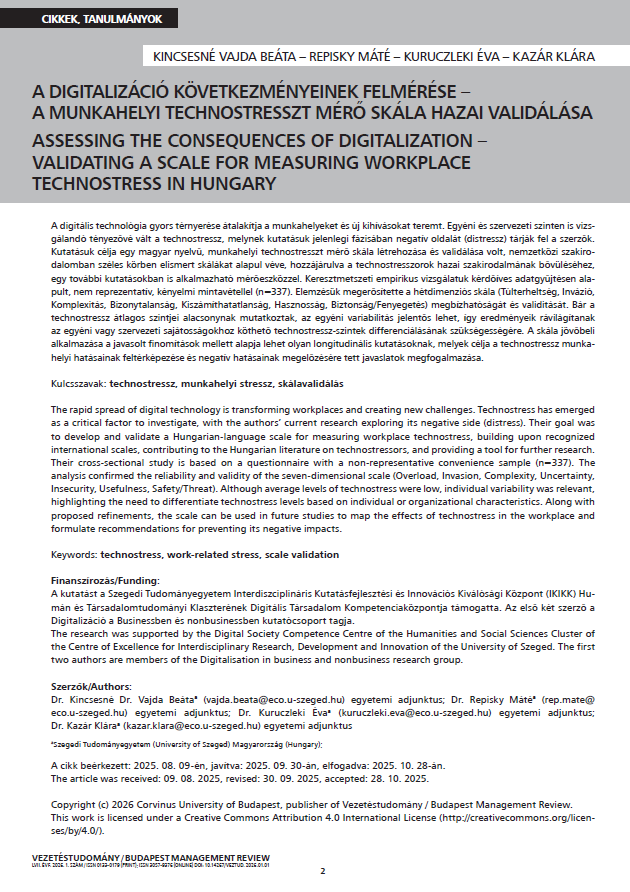
A digitalizáció következményeinek felmérése
A munkahelyi technostresszt mérő skála hazai validálása
DOI:
https://doi.org/10.14267/VEZTUD.2026.01.01Kulcsszavak:
technostressz, munkahelyi stressz, skála validálásAbsztrakt
A digitális technológia gyors térnyerése átalakítja a munkahelyeket és új kihívásokat teremt. Egyéni és szervezeti szinten is vizsgálandó tényezővé vált a technostressz, melynek kutatásuk jelenlegi fázisában negatív oldalát (distressz) tárják fel a szerzők. Kutatásuk célja egy magyar nyelvű, munkahelyi technostresszt mérő skála létrehozása és validálása volt, nemzetközi szakirodalomban széles körben elismert skálákat alapul véve, hozzájárulva a technostresszorok hazai szakirodalmának bővüléséhez, egy további kutatásokban is alkalmazható mérőeszközzel. Keresztmetszeti empirikus vizsgálatuk kérdőíves adatgyűjtésen alapult, nem reprezentatív, kényelmi mintavétellel (n=337). Elemzésük megerősítette a hétdimenziós skála (Túlterheltség, Invázió, Komplexitás, Bizonytalanság, Kiszámíthatatlanság, Hasznosság, Biztonság/Fenyegetés) megbízhatóságát és validitását. Bár a technostressz átlagos szintjei alacsonynak mutatkoztak, az egyéni variabilitás jelentős lehet, így eredményeik rávilágítanak az egyéni vagy szervezeti sajátosságokhoz köthető technostressz-szintek differenciálásának szükségességére. A skála jövőbeli alkalmazása a javasolt finomítások mellett alapja lehet olyan longitudinális kutatásoknak, melyek célja a technostressz munkahelyi hatásainak feltérképezése és negatív hatásainak megelőzésére tett javaslatok megfogalmazása.
Downloads
Hivatkozások
Arenas, A., Sanclemente, F.J., Terán-Tinedo, V., & Di Marco, D. (2023). Spanish Validation of the Technostress Creators Scale. Psichotema, 35(1), 98-108. https://doi.org/10.7334/psicothema2022.198
Bencsik, A. (2024). Tudásmenedzsment elméletben és gyakorlatban. Akadémiai Kiadó. https://doi.org/10.1556/9789636640187
Bencsik, A., & Juhász, T. (2023). The impact of technostress on organizational functioning. Problems and Perspectives in Management, 21(1), 230-241. https://doi.org/10.21511/ppm.21(1).2023.20
Berger, M., Schäfer, R., Schmidt, M., Regal, C., & Gimpel, H. (2023). How to prevent technostress at the digital workplace: a delphi study. Journal of Business Economics, 94(7-8), 1051-1113. https://doi.org/10.1007/s11573-023-01159-3
Bernburg, M., Gebhardt, J.S., Groneberg, D.A., & Mache, S. (2025). Impact of Digitalization in Dentistry on Technostress, Mental Health, and Job Satisfaction: A Quantitative Study. Healthcare, 13(1), 72. https://doi.org/10.3390/healthcare13010072
Biggs, A., Brough, P., & Drummond, S. (2017). Lazarus and Folkman’s Psychological Stress and Coping Theory. In Cooper, C.L., & Quick, J.C. (Eds.), The Handbook of Stress and Health (pp. 349-364). Wiley Blackwell. https://doi.org/10.1002/9781118993811.ch21
Buzás, B., Simon, A.C., Kiss, O.E., & Faragó, K. (2025). Navigating the digital landscape: unraveling the interplay of challenge and hindrance components of technostress on employee voice behavior. Frontiers in Psychology, 16, 1434275. https://doi.org/10.3389/fpsyg.2025.1434275
Choi, Y. (2023). Exploring the impact of technostress on work behaviors: Empirical evidence and interventions for enhanced workplace well-being. Information Development, 02666669231206763. https://doi.org/10.1177/02666669231206763
Cooper, C.L., Dewe, P.J., & O’Driscoll, M.P. (2001). Organizational Stress. A Review and Critique of Theory, Research, and Applications. Sage Publications Inc. https://doi.org/10.4135/9781452231235
Cuadrado, D., Otero, I., Martínez, A., París, T. & Moscoso, S. (2024). Predicting technostress: the big five model of personality and subjective well-being. Plos One, 19(11), e0313247. https://doi.org/10.1371/journal.pone.0313247
Derks, D., ten Brummelhuis, L.L., Zecic, D., & Bakker, A.B. (2014). Switching on and off…: Does smartphone use obstruct the possibility to engage in recovery activities? European Journal of Work and Organizational Psychology, 23(1), 80-90. https://doi.org/10.1080/1359432X.2012.711013
Edwards, J.R., Caplan, R.D., & Van Harrison, R. (1998). Person-Environment Fit Theory: Theoretical Foundations, empirical evidence, and directions for further research. In C.L. Cooper (Ed.), Theories of organizational stress (pp. 28-67). Oxford University Press. https://doi.org/10.1093/oso/9780198522799.003.0003
Fischer, T., Reuter, M., & Riedl, R. (2021). The Digital Stressors Scale: Development and Validation of a New Survey Instrument to Measure Digital Stress Perceptions in the Workplace Context. Frontiers in Psychology, 12, 607598. https://doi.org/10.3389/fpsyg.2021.607598
Hair, J.F., Hult, G.T.M., Ringle, C., & Sarstedt, M. (2017). A Primer on Partial Least Squares Structural Equation Modeling (PLS-SEM) (2nd e dition). SAGE P ublications. Hair, J.F., Black, W.C., Babin, B.J., & Anderson, R.E. (2009). Multivariate Data Analysis (7th edition). Prentice Hall.
Harris, K.J., Harris, R.B., Valle, M., Carlson, J.R., Carlson, D.S., Zivnuska, S., … & Wiley, B. (2021). Technostress and the entitled employee: impacts on work and family. Information Technology & People, 35(3), 1073-1095. https://doi.org/10.1108/itp-07-2019-0348
Ioannou, A. (2023). Mindfulness and technostress in the workplace: a qualitative approach. Frontiers in Psychology, 14, 1252187. https://doi.org/10.3389/fpsyg.2023.1252187
Jungst, M. (2022). Effect of Technological Insecurity on Performance Through Emotional Exhaustion: A Moderated Mediation Approach. International Journal of Technology and Human Interaction (IJTHI), 18(1), 1-15. https://doi.org/10.4018/IJTHI.300282
Kaltenegger, H.C., Becker, L., Rohleder, N., Nowak, D., Quartucci, C., & Weigl, M. (2023). Associations of technostressors at work with burnout symptoms and chronic low-grade inflammation: a cross-sectional analysis in hospital employees. International Archives of Occupational and Environmental Health, 96(6), 839-856. https://doi.org/10.1007/s00420-023-01967-8
Kim, D.G. & Lee, C.W. (2021). Exploring the Roles of Self-Efficacy and Technical Support in the Relationship between Techno-Stress and Counter-Productivity. Sustainability, 13, 4349. https:// doi.org/10.3390/su13084349
Kincsesné Vajda, B. (2023). Technológiával könnyebb, de milyen áron? – A Technostressz jelenségének vizsgálata, különös tekintettel a felsőoktatás fogyasztóira. In Révész, B., & Gyulai, Zs. (Eds.), Reziliens Marketing – Válaszok változó kihívásokra ((pp. 174-184). Szegedi Tudományegyetem Gazdaságtudományi Kar. https://doi.org/10.62561/EMOK-2023-14
Li, L., & Wang, X. (2020). Technostress inhibitors and creators and their impacts on university teachers’ work performance in higher education. Cognition, Technology & Work, 23, 315-330. https://doi.org/10.1007/s10111-020-00625-0
Maier, C., Laumer, S., Tarafdar, M., Mattke, J., Reis, L., & Weitzel, T. (2021). Challenge and Hindrance IS Use Stressors and Appraisals: Explaining Contrarian Associations in Post-Acceptance IS Use Behavior. Journal of the Association for Information Systems, 22(6), 1590- 1624. https://doi.org/10.17705/1jais.00709
Marchiori, D.M., Mainardes, E.W., & Rodrigues, R.G. (2018). Do Individual Characteristics Influence the Types of Technostress Reported by Workers? International Journal of Human-Computer Interaction, 35(3), 218-230. https://doi.org/10.1080/10447318.2018.1449713
Matt, C., Hess, T., & Benlian, A. (2015). Digital Transformation Strategies. Business & Information Systems Engineering, 57, 339-343. https://doi.org/10.1007/s12599-015-0401-5
Meyer, S., & Tisch, A. (2023). Exploring the relationship between techno-unreliability at work and burnout. Journal of Occupational & Environmental Medicine, 66(3), 185-191. https://doi.org/10.1097/jom.0000000000003008
Molino, M., Ingusci, E., Signore, F., Manuti, A., Giancaspro, M.L., Russo, V., … & Cortese, C. G. (2020). Wellbeing costs of technology use during covid-19 remote working: an investigation using the italian translation of the technostress creators scale. Sustainability, 12(15), 5911. https://doi.org/10.3390/su12155911
Mustika, M.D., Handoko, A.M., Mamoen, H.A., Siahaan, D.U., & Yasyfin, A. (2021). Your gadgets, stress, and performance: the influence of technostress on individual satisfaction and performance. Psychological Research on Urban Society, 4(2), 18. https://doi.org/10.7454/proust.v4i2.113
Nastjuk, I., Trang, S., Grummeck-Braamt, J.V., Adam, M.T.P., & Tarafdar, M. (2023). Integrating and synthesising technostress research: a meta-analysis on technostress creators, outcomes, and IS usage contexts. European Journal of Information Systems, 33(3), 361-382. https://doi.org/10.1080/0960085X.2022.2154712
Nimrod, G. (2018). Technostress: measuring a new threat to well-being in later life. Aging & Mental Health, 22(8) 1080-1087. https://doi.org/10.1080/13607863.2017.1334037
Pfaltzgraf, D., & Insch, G.S. (2021). Technological illiteracy in an increasingly technological world: methods to help employees create with rather than simply consume technology. Development and Learning in Organizations: An International Journal, 35(6), 4-6. https://doi.org/10.1108/dlo-12-2020-0235
Pflügner, K., Maier, C., Mattke, J., & Weitzel, T. (2021). Personality Profiles that Put Users at Risk of Perceiving Technostress. Business & Information Systems Engineering, 63, 389-402. https://doi.org/10.1007/s12599-020-00668-7
Ragsdale, J.M., & Hoover, C.S. (2016). Cell phones during nonwork time: A source of job demands and resources. Computers in Human Behavior, 57, 54-60. https://doi.org/10.1016/j.chb.2015.12.017
Ragu-Nathan, T.S., Tarafdar, M., Ragu-Nathan, B., & Tu, Q. (2008). The Consequences of Technostress for End Users in Organizations: Conceptual Development and Empirical Validation. Information Systems Research, 19(4), 417-433. https://doi.org/10.1287/isre.1070.0165
Ringle, C.M., Sarstedt, M., & Straub, D.W. (2012). A critical look at the use of PLS-SEM in MIS Quarterly. MIS Quarterly, 36(1), 3-14. https://doi.org/10.2307/41410402
Ringle, C.M., Wende, S., & Becker, J.M. (2024). SmartPLS 4. SmartPLS. Bönningstedt. https://www.smartpls.com
Rohwer, E., Flöther, J.C., Harth, V., & Mache, S. (2022). Overcoming the “Dark Side” of Technology – A Scoping Review on Preventing and Coping with Work-Related Technostress. International Journal of Environmental Research and Public Health, 19(6), 3625. https://doi.org/10.3390/ijerph19063625
Ross, P., & Maynard, K. (2021). Towards a 4th industrial revolution. Intelligent Buildings International, 13(3), 159-161. https://doi.org/10.1080/17508975.2021.1873625
Salazar-Concha, C., Ficapal-Cusí, P., Boada-Grau, J., & Camacho, L.J. (2021). Analyzing the evolution of technostress: A science mapping approach. Heliyon, 7, e06726. https://doi.org/10.1016/j.heliyon.2021.e06726
Sarker, S., Xiao, X., Sarker, S., & Ahuja, M. (2012). Managing Employees’ Use of Mobile Technologies to Minimize Work-Life Balance Impacts. MIS Quarterly Executive, 11(4), 143-157. https://aisel.aisnet.org/misqe/vol11/iss4/4
Sevic, A., Foldnes, N., & Brønnick, K. (2024). Measuring digital stress in Norway: translation and validation of the digital stressors scale. Frontiers in Psychology, 15. https://doi.org/10.3389/fpsyg.2024.1297194
Sharma, S., & Gupta, B. (2022). Investigating the role of technostress, cognitive appraisal and coping strategies on students’ learning performance in higher education: a multidimensional transactional theory of stress approach. Information Technology & People, 36(2), 626-660. https://doi.org/10.1108/itp-06-2021-0505
Simon, A.Cs., Pachner, O.Cs., & Kiss, O.E. (2024). Digitális kihívások: a technostressz megjelenése és kapcsolata a szervezeti pszichoszociális tényezőkkel magyar irodai munkavállalóknál. Magyar Pszichológiai Szemle, 79(4), 757-776 https://doi.org/10.1556/0016.2024.00097
Simon, A.C., Buzás, B., Rosta-Filep, O., Faragó, K., Pachner, O.C., & Kiss, O.E. (2024). The indirect impact of the technostress subfactors on the satisfaction and desire to work from home. Frontiers in Psychology, 15, 1417916. https://doi.org/10.3389/fpsyg.2024.1417916
Smoroň, J., Schraggerová, M., Rošková, E., & Urukovičová, N. (2023). Verification of the stability of the technostress questionnaire and technostress in relation to personality facets. Psychológia Práce a Organizácie. https://doi.org/10.33542/ppo-0265-7-09
Skog, D.A., Wimelius, H., & Sandberg, J. (2018). Digital Disruption. Business & Information Systems Engineering, 60, 431-437. https://doi.org/10.1007/s12599-018-0550-4
Srivastava, S.C., Chandra, S., & Shirish, A. (2015). Technostress creators and job outcomes: theorising the moderating influence of personality traits. Information Systems Journal, 25(4), 355-401. https://doi.org/10.1111/isj.12067
Suh, A., & Lee, J. (2017). Understanding teleworkers’ technostress and its influence on job satisfaction. Internet Research, 27(1), 140-159. https://doi.org/10.1108/IntR-06-2015-0181
Szilas, R.F. (2014). A szervezeti igazságosság hatása a munkahelyi stressz kialakulásának folyamatára. Munkaügyi Szemle, 58(1), 56-65. https://www.munkaugyiszemle.hu/szervezeti-igazsagossag-hatasa-munkahelyi-stressz-kialakulasanak-folyamatara
Szombathelyi, Cs. (2015), Techno-stressz: az információs technológia negatív humán következménye. Munkaügyi Szemle, 59(2), 26-33. https://www.munkaugyiszemle.hu/techno-stressz-az-informacios-technologia-negativ-human-kovetkezmenyei
Tarafdar, M., Cooper, C.L., & Stich, J.F. (2019). The technostress trifecta: techno eustress, techno distress and design: Theoretical directions and an agenda for research. Information Systems Journal, 29, 6-42. https://doi.org/10.1111/isj.12169
Tarafdar, M., Pullins, E.B., & Ragu‐Nathan, T.S. (2014). Technostress: negative effect on performance and possible mitigations. Information Systems Journal, 25(2), 103-132. https://doi.org/10.1111/isj.12042
Tarafdar, M., Tu, Q., Ragu-Nathan, B.S. & Ragu-Nathan, T.S. (2007). The Impact of Technostress on Role Stress and Productivity. Journal of Management Systems, 24(1), 301-328. https://doi.org/10.2753/MIS0742-1222240109
Trenerry, B., Chng, S., Wang, Y., Suhaila, Z.S., Lim, S.S., Lu, H.Y., & Oh, P.H. (2021). Preparing Workplaces for Digital Transformation: An Integrative Review and Framework of Multi-Level Factors. Frontiers in Psychology, 12, 620766. https://doi.org/10.3389/fpsyg.2021.620766
Yim, M. (2014). Understanding the technostress: an individual difference investigation. Journal of Digital Convergence, 12(3), 17-27. https://doi.org/10.14400/jdc.2014.12.3.17
Wang, X., Tan, S.C., & Li, L. (2020). Measuring university students’ technostress in technology-enhanced learning: scale development and validation. Australasian Journal of Educational Technology, 36(4), 96-112. https://doi.org/10.14742/ajet.5329
Wirth, T., Kraft, J., Marquardt, B., Harth, V., & Mache, S. (2024). Indicators of technostress, their association with burnout and the moderating role of support offers among nurses in german hospitals: a cross-sectional study. BMJ Open, 14(7), e085705. https://doi.org/10.1136/bmjopen-2024-085705
Letöltések
Megjelent
Folyóirat szám
Rovat
License
Copyright (c) 2026 Corvinus University of Budapest, publisher of Vezetéstudomány / Budapest Management Review

This work is licensed under a Creative Commons Attribution 4.0 International License.
Authors assign copyright to Vezetéstudomány / Budapest Management Review. Authors are responsible for permission to reproduce copyright material from other sources.
Hogyan kell idézni