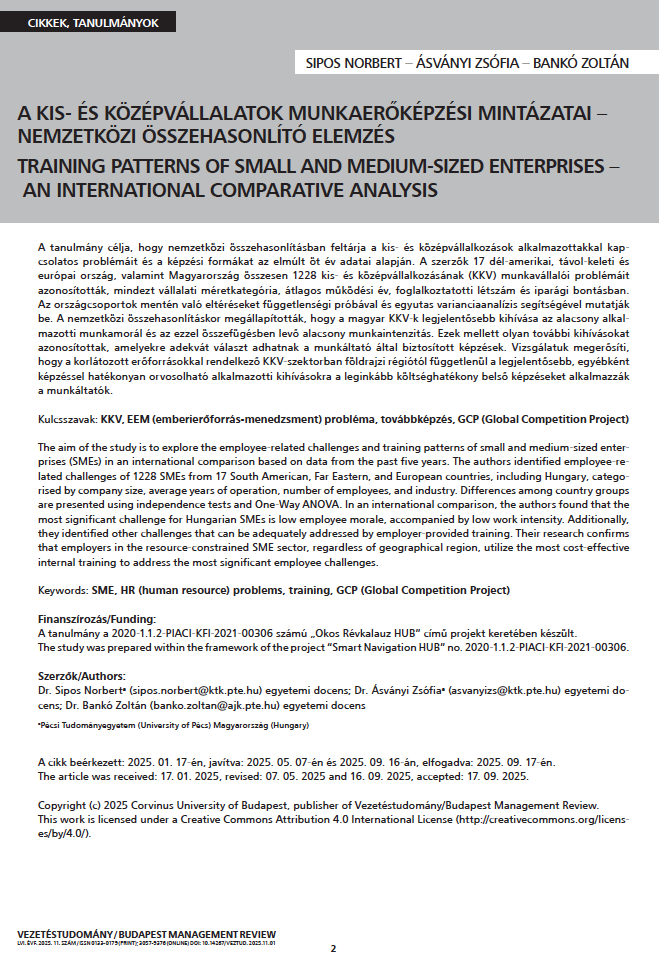
A kis- és középvállalatok munkaerőképzési mintázatai
Nemzetközi összehasonlító elemzés
DOI:
https://doi.org/10.14267/VEZTUD.2025.11.01Kulcsszavak:
KKV, EEM (emberierőforrás-menedzsment) probléma, továbbképzés, GCP (Global Competition Project)Absztrakt
A tanulmány célja, hogy nemzetközi összehasonlításban feltárja a kis- és középvállalkozások alkalmazottakkal kapcsolatos problémáit és a képzési formákat az elmúlt öt év adatai alapján. A szerzők 17 dél-amerikai, távol-keleti és európai ország, valamint Magyarország összesen 1228 kis- és középvállalkozásának (KKV) munkavállalói problémáit azonosították, mindezt vállalati méretkategória, átlagos működési év, foglalkoztatotti létszám és iparági bontásban. Az országcsoportok mentén való eltéréseket függetlenségi próbával és egyutas varianciaanalízis segítségével mutatják be. A nemzetközi összehasonlításkor megállapították, hogy a magyar KKV-k legjelentősebb kihívása az alacsony alkalmazotti munkamorál és az ezzel összefügésben levő alacsony munkaintenzitás. Ezek mellett olyan további kihívásokat azonosítottak, amelyekre adekvát választ adhatnak a munkáltató által biztosított képzések. Vizsgálatuk megerősíti, hogy a korlátozott erőforrásokkal rendelkező KKV-szektorban földrajzi régiótól függetlenül a legjelentősebb, egyébként képzéssel hatékonyan orvosolható alkalmazotti kihívásokra a leginkább költséghatékony belső képzéseket alkalmazzák a munkáltatók.
Downloads
Hivatkozások
Alizadeh Majd, A., Bell, R., Ali, S.a., Davoodi, A., & Nasirifar, A. (2024). The effect of job rotation on employee performance: the mediating role of HR strategy and training in the petrochemical industry. Industrial and Commercial Training, 56(2), 93–105. https://doi.org/10.1108/ict-10-2023-0074
Appelbaum, E., Bailey, T., Berg, P., & Kalleberg, A. L. (2000). Manufacturing advantage: Why high-performance work systems pay off. Cornell University Press.
Barney, J. (1991). Firm resources and sustained competitive advantage. Journal of Management, 17(1), 99–120. https://doi.org/10.1177/014920639101700108
Boxall, P., & Purcell, J. (2016). Strategy and human resource management (4th ed.). Palgrave Macmillan. https://doi.org/10.1108/00251740310479368
Brewster, C., Chung, C., & Sparrow, P. (2016). Globalizing human resource management (2nd ed.). Routledge. https://doi.org/10.4324/9781315668611
Cardon, M.S., & Stevens, C.E. (2004). Managing human resources in small organizations: What do we know? Human Resource Management Review, 14(3), 295–323. https://doi.org/10.1016/j.hrmr.2004.06.001
Coetzer, A., & Perry, M. (2008). Factors influencing employee learning in small businesses. Education + Training, 50(8/9), 648–660. https://doi.org/10.1108/00400910810917037
Douglas, T.J., & Ryman, J.A. (2003). Understanding competitive advantage in the general hospital industry: evaluating strategic competencies. Strategic Management Journal, 24(4), 333–347. https://doi.org/10.1002/smj.301
Edwards, P., & Ram, M. (2009). HRM in small firms: Respecting and regulating informality. In D.G. Collings & G. Wood (Eds.), Human resource management: A critical approach (pp. 524–537). Routledge. https://doi.org/10.4135/9780857021496.n31
Európai Parlament. (2023). Az Unió helyzete a KKV-k tekintetében. P9_TA(2023)0294.
Harney, B. (2021). Accommodating HRM in Small and Medium-Sized Enterprises (SMEs): A Critical Review. Economic and Business Review, 23(2), 72–85. https://doi.org/10.15458/2335-4216.1007
Harney, B., & Alkhalaf, H. (2020). A quarter-century review of HRM in small and medium-sized enterprises: Capturing what we know, exploring where we need to go. Human Resource Management, 59(1), 87–110. https://doi.org/10.1002/hrm.22010
Harney, B., Gilman, M., Mayson, S., & Raby, S. (2022). Advancing understanding of HRM in small and medium- sized enterprises (SMEs): critical questions and future prospects. The International Journal of Human Resource Management, 33(16), 3175–3196. https://doi.org/10.1080/09585192.2022.2109375
Harney, B., & Dundon, T. (2006). Capturing complexity: Developing an integrated approach to analysing HRM in SMEs. Human Resource Management Journal, 16(1), 48–73. https://doi.org/10.1111/j.1748-8583.2006.00004
Huselid, M.A. (1995). The impact of human resource management practices on turnover, productivity, and corporate financial performance. Academy of Management Journal, 38(3), 635–672. https://doi.org/10.2307/256741
Irwin, J.G., Hoffman, J.J., & Lamont, B.T. (1998). The effect of the acquisition of technological innovations on organizational performance: A resource-based view. Journal of Engineering and Technology Management, 15(1), 25–54. https://doi.org/10.1016/s0923-4748(97)00028-3
Karoliny, M., Farkas, F., & Poór, J. (2009). In focus: Hungarian and Central Eastern European characteristics of human resource management – An international comparative survey. Journal for East European Management Studies, 14(1), 9–47. https://doi.org/10.5771/0949-6181-2009-1-9
Lafuente, E., Leiva, J.C., Moreno-Gómez, J., & Szerb, L. (2020). A non-parametric analysis of competitiveness efficiency: The relevance of firm size and the configuration of competitive pillars. BRQ Business Research Quarterly. https://doi.org/10.1016/j.brq.2019.02.002
Lafuente, E., Szerb, L., & Rideg, A. (2020). A system dynamics approach for assessing SMEs’ competitiveness. Journal of Small Business and Enterprise Development, 27(4), 555–578. https://doi.org/10.1108/jsbed-06-2019-0204
Lederer, M., Schott, P., Huber, S., & Kurz, M. (2013). Strategic business process analysis: a procedure model to align business strategy with business process analysis methods. In H. Fischer & J. Schneeberger (Eds.), International Conference on Subject-Oriented Business Process Management (pp. 247–263). Springer.
Marsick, V.J., & Watkins, K.E. (2003). Demonstrating the value of an organization’s learning culture: The dimensions of the learning organization questionnaire. Advances in Developing Human Resources, 5(2), 132–151. https://doi.org/10.1177/1523422303005002002
OECD. (2023). OECD SME and Entrepreneurship Outlook 2023. https://doi.org/10.1787/342b8564-en
Paauwe, J., & Boselie, P. (2005). HRM and performance: What next? Human Resource Management Journal, 15(4), 68–83. https://doi.org/10.1111/j.1748-8583.2005.tb00296.x
Pituch, K.A., & Stevens, J.P. (2015). Applied multivariate statistics for the social sciences: Analyses with SAS and IBM’s SPSS. Routledge.
Poór, J., Juhász, T., Szabó, K., Kovács, I.É., Karoliny M., & Csetneki, Z. (2018). A külföldi tulajdonú vállalatok emberi erőforrás menedzselésének jellegzetességei és sajátos kontingenciafaktorai Kelet-Közép-Európában. Vezetéstudomány, 49(1), 40–52. https://doi.org/10.14267/VEZTUD.2018.01.05
Priem, R.L., & Butler, J.E. (2001). Is the Resource-Based “View” a Useful Perspective for Strategic Management Research? Academy of Management Review, 26(1), 22–40. https://doi.org/10.5465/amr.2001.4011928
SBA. (2008). A bizottság közleménye a tanácsnak, az európai parlamentnek, az európai gazdasági és szociális bizottságnak és a régiók bizottságának. „Gondolkozz előbb kicsiben!” Európai kisvállalkozói intézkedéscsomag: „Small Business Act” (COM(2008) 394 25 June 2008.
Storey, D.J. (2004). Exploring the link, among small firms, between management training and firm performance: A comparison between the UK and other OECD countries. International Journal of Human Resource Management, 15(1), 112–130. https://doi.org/10.1080/0958519032000157375
Szabó, D. (2020). Hogyan alkalmazkodik a közép-keletmagyarországi KKV-szektor HR-gyakorlata a munkaerőhiányhoz? Prosperitas, 7(2), 66–80. https://doi.org/10.31570/Prosp_2020_02_5
Szászvári, K.Á., Csillag, S., Csizmadia, P., & Bácsi, K. (2022). Tanulni és tanulni hagyni? Munkahelyi tanulás és tanulási környezet tudásintenzív középvállalatokban. Vezetéstudomány, 53(2), 41–54. https://doi.org/10.14267/VEZTUD.2022.02.04
Szerb, L., Csapi, V., Deutsch, N., Hornyák, M., Horváth, Á., Kruzslicz, F., Lányi, B., Márkus, G., Rácz, G., Rappai, G., Rideg, A., Szűcs, P.K., & Ulbert, J. (2014). Mennyire versenyképesek a magyar kisvállalatok? A magyar kisvállalatok (MKKV szektor) versenyképességének egyéni-vállalati szintű mérése és komplex vizsgálata. Marketing & Menedzsment, 48(Különszám), 3–21.
Turner, P. (2020). Employee Engagement in Contemporary Organizations. Palgrave Macmillan https://doi.org/10.1007/978-3-030-36387-1
Whitley, R. (1999). Divergent capitalisms: The social structuring and change of business systems. Oxford University Press. https://doi.org/10.1017/S0950017000310509
Letöltések
Megjelent
Folyóirat szám
Rovat
License
Copyright (c) 2025 Corvinus University of Budapest, publisher of Vezetéstudomány / Budapest Management Review

This work is licensed under a Creative Commons Attribution 4.0 International License.
Authors assign copyright to Vezetéstudomány / Budapest Management Review. Authors are responsible for permission to reproduce copyright material from other sources.
Hogyan kell idézni