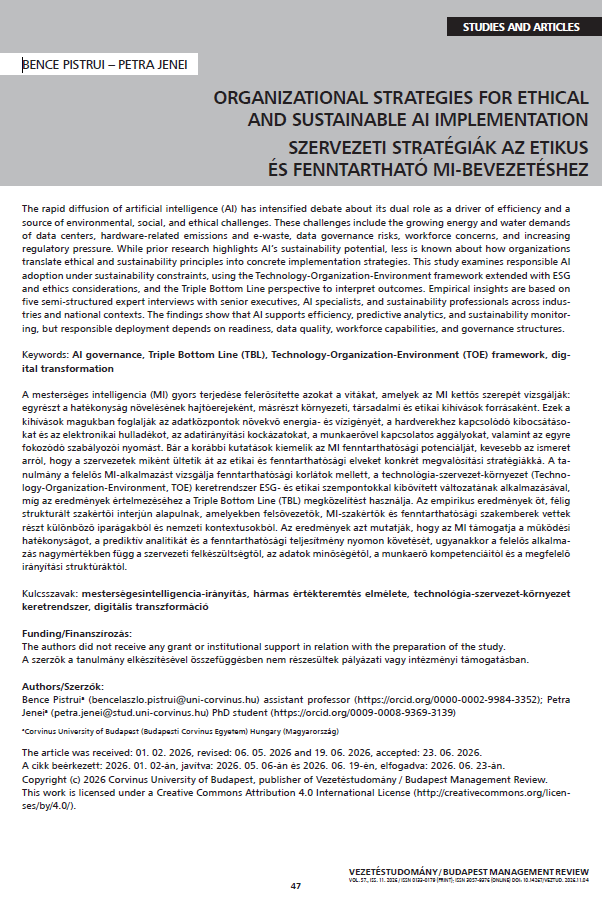
Szervezeti stratégiák az etikus és fenntartható MI-bevezetéshez
DOI:
https://doi.org/10.14267/VEZTUD.2026.11.04Kulcsszavak:
mesterségesintelligencia-irányítás, hármas értékteremtés elmélete, technológia-szervezet-környezet keretrendszer, digitális transzformációAbsztrakt
A mesterséges intelligencia (MI) gyors terjedése felerősítette azokat a vitákat, amelyek az MI kettős szerepét vizsgálják: egyrészt a hatékonyság növelésének hajtóerejeként, másrészt környezeti, társadalmi és etikai kihívások forrásaként. Ezek a kihívások magukban foglalják az adatközpontok növekvő energia- és vízigényét, a hardverekhez kapcsolódó kibocsátásokat és az elektronikai hulladékot, az adatirányítási kockázatokat, a munkaerővel kapcsolatos aggályokat, valamint az egyre fokozódó szabályozói nyomást. Bár a korábbi kutatások kiemelik az MI fenntarthatósági potenciálját, kevesebb az ismeret arról, hogy a szervezetek miként ültetik át az etikai és fenntarthatósági elveket konkrét megvalósítási stratégiákká. A tanulmány a felelős MI-alkalmazást vizsgálja fenntarthatósági korlátok mellett, a technológia-szervezet-környezet (Technology- Organization-Environment, TOE) keretrendszer ESG- és etikai szempontokkal kibővített változatának alkalmazásával, míg az eredmények értelmezéséhez a Triple Bottom Line (TBL) megközelítést használja. Az empirikus eredmények öt, félig strukturált szakértői interjún alapulnak, amelyekben felsővezetők, MI-szakértők és fenntarthatósági szakemberek vettek részt különböző iparágakból és nemzeti kontextusokból. Az eredmények azt mutatják, hogy az MI támogatja a működési hatékonyságot, a prediktív analitikát és a fenntarthatósági teljesítmény nyomon követését, ugyanakkor a felelős alkalmazás nagymértékben függ a szervezeti felkészültségtől, az adatok minőségétől, a munkaerő kompetenciáitól és a megfelelő irányítási struktúráktól.Downloads
Hivatkozások
Alharahsheh, H.H., & Pius, A. (2020). A review of key paradigms: positivism VS interpretivism. Global Academic Journal of Humanities and Social Sciences, 2, 39-43. https://doi.org/10.36348/gajhss.2020.v02i03.001
Alzoubi, Y.I., & Mishra, A. (2024). Green artificial intelligence initiatives: Potentials and challenges. Journal of Cleaner Production, 468, 143090. https://doi.org/10.1016/j.jclepro.2024.143090
Baker, J. (2012). The technology-organization-environment framework. In Y. K. Dwivedi, M. R. Wade, & S. L. Schneberger (Eds.), Information systems theory: Explaining and predicting our digital society (Vol. 1, pp. 231-245). Springer. https://doi.org/10.1007/978-1-4419-6108-2_12
Bauer, A., & Agárdi, I. (2020). Strategic implications of digitalization and the changing logic of value creation. Vezetéstudomány, 51(4), 23-35.
Baumgartner, M., Kopp, T., & Niever, M. (2025). Twin transition — A literature analysis of the relationship between two megatrends and the role of artificial intelligence. International Journal of Innovation Management, 29(05n06). https://doi.org/10.1142/s1363919625400110
Bokolo, A., Jr. (2024). Decentralized AIoT-based intelligence for sustainable energy prosumption in local energy communities: A citizen-centric prosumer approach. Cities, 152, 105198. https://doi.org/10.1016/j.cities.2024.105198
Chotisarna, N., & Phuthong, T. (2025). A bibliometric analysis insights into the intellectual dynamics of artificial intelligence for the micro, small, and medium enterprises. Cogent Business & Management, 12(1), 2491684. https://doi.org/10.1080/23311975.2025.2491684
Di Chiacchio, L., Al-Khateeb, H., Butt, U., & Yussof, S. (2026). AI legitimacy in energy: A model to improve corporate narratives on sustainability and responsibility. Technological Forecasting & Social Change, 222, 124378. https://doi.org/10.1016/j.techfore.2025.124378
Dwivedi, Y.K., Hughes, D.L., Ismagilova, E., Aarts, G., Coombs, C., Crick, T., … Williams, M. D. (2021). Artificial intelligence (AI): Multidisciplinary perspectives on emerging challenges, opportunities, and agenda for research. International Journal of Information Management, 57, 101994. https://doi.org/10.1016/j.ijinfomgt.2019.08.002
Eccles, R.G., Ioannou, I., & Serafeim, G. (2014). The impact of corporate sustainability on organizational processes and performance. Management Science, 60(11), 2835-2857. https://doi.org/10.1287/mnsc.2014.1984
El Saadani Gazar, O.A.E.K., Auda, H., & Youssif, A.A.A. (2024). The role of applying artificial intelligence in improving supply chain management and sustainability: Evidence from Egypt ports. International Journal of Mathematical, Engineering and Management Sciences, 9(5), 1145-1162. https://doi.org/10.33889/IJMEMS.2024.9.5.060
Floridi, L., Cowls, J., Beltrametti, M., Chatila, R., Chazerand, P., Dignum, V., … Vayena, E. (2018). AI4People— An ethical framework for a good AI society: Opportunities, risks, principles, and recommendations. Minds and Machines, 28(4), 689-707. https://doi.org/10.1007/s11023-018-9482-5
Fu, T., Qiu, Z., Yang, X., & Li, Z. (2024). Charting the digital route to net-zero: A framework for sustainable industry practices. Technological Forecasting & Social Change, 209, 123821. https://doi.org/10.1016/j.techfore.2024.123821
Gandía, J.a.G., Gavrila, S.G., De Lucas Ancillo, A., & Del Val Núñez, M.T. (2024). Towards sustainable business in the automation era: Exploring its transformative impact from top management and employee perspective. Technological Forecasting and Social Change, 210, 123908. https://doi.org/10.1016/j.techfore.2024.123908
Gillan, S.L., Koch, A., & Starks, L.T. (2021). Firms and social responsibility: A review of ESG and CSR research. Journal of Corporate Finance, 66, 101889. https://doi.org/10.1016/j.jcorpfin.2021.101889
Hordieiev, M., Nalyvaiko, N., Parkhomenko-Kutsevil, O., Molyboha, R., & Chabanov, A. (2025). The metamorphosis of global trade routes: Immediate challenges and advanced logistics techniques. Management (Montevideo), 3, 257. https://doi.org/10.62486/agma2025257
Jobin, A., Ienca, M., & Vayena, E. (2019). The global landscape of AI Ethics guidelines. Nature Machine Intelligence, 1(9), 389-399. https://doi.org/10.1038/s42256-019-0088-2
Jorzik, P., Antonio, J. L., Kanbach, D. K., Kallmuenzer, A., & Kraus, S. (2024). Sowing the seeds for sustainability: A business model innovation perspective on artificial intelligence in green technology startups. Technological Forecasting & Social Change, 208, 123653. https://doi.org/10.1016/j.techfore.2024.123653
Khan, A.N., Mehmood, K., & Ali, A. (2024). CSR impact: Leveraging artificial intelligence and process optimization for sustainability performance management. Corporate Social Responsibility and Environmental Management, 31(5), 4849-4861. https://doi.org/10.1002/csr.2832
Kibiswa, N. (2019). Directed Qualitative Content Analysis (DQLCA): a tool for conflict analysis. The Qualitative Report, 24(8), 2059-2079. https://doi.org/10.46743/2160-3715/2019.3778
Kittipanyangam, P., Tan, K.H., & Cavite, H.J. (2025). Future- ready AI: A framework for ethical and sustainable adoption. Technology in Society, 83, 102993. https://doi.org/10.1016/j.techsoc.2025.102993
Kupi, M. (2025). The impact of an artificial intelligence- based forecasting model on the development of sustainable tourism. Geojournal of Tourism and Geosites, 61(3), 1758-1766. https://doi.org/10.30892/gtg.61334-1544
Kusmendar, A.M.S.A., & Normasari, N.M.E. (2025). Exploring sustainable pathways: A systematic literature review of three pillars of sustainability applications. Sustainable Futures, 10, 100970. https://doi.org/10.1016/j.sftr.2025.100970
Kvale, S., & Brinkmann, S. (2015). InterViews: Learning the craft of qualitative research interviewing (3rd ed.). Sage Publications.
Litvinets, V. (2024). AI and Sustainability: Opportunities, Challenges, and Impact. Ernst & Young. https://www.ey.com/en_nl/insights/climate-change-sustainability-services/ai-and-sustainability-opportunities-challenges-and-impact
Luo, J., & Zhang, X. (2025). Corporate sustainability: An advanced driver of artificial intelligence. International Journal of Enterprise Information Systems, 20(1). https://doi.org/10.4018/IJEIS.387397
Monroy-Osorio, J.C. (2024). The impact of artificial intelligence on green technology cycles in China. Cleaner Logistics and Supply Chain, 13, 100191. https://doi.org/10.1016/j.clscn.2024.100191
Monsalve-Castro, C., Molina, R.I.R., Ortiz, E.J.F., & Polo, G.P.S. (2025). Artificial intelligence as a driver in adopting green innovation in the agricultural sector: evidence from an emerging economy. Cogent Business & Management, 12(1), 2575261. https://doi.org/10.1080/23311975.2025.2575261
Oliveira, T., & Martins, M. F. (2011). Literature review of information technology adoption models at firm level. Information & Management, 48(4-5), 110-121. https://doi.org/10.1016/j.im.2011.03.002
Pietrzak, P. (2025). How artificial intelligence can support the sustainable development of organizations? Findings from a literature review. Issues in Information Systems, 26(1), 296-307. https://doi.org/10.48009/1_iis_122
Podrecca, M., Culot, G., Tavassoli, S., & Orzes, G. (2024). Artificial intelligence for climate change: A patent analysis in the manufacturing sector. In IEEE Transactions on Engineering Management (vol. 71, pp. 15005- 15024). IEEE. https://doi.org/10.1109/TEM.2024.3469370
Porkodi, S., Tantravahi, V.V.P.K., & Tabash, B.K.H. (2025). Transforming sustainable and green supply chains with artificial intelligence: A strategic review and future research opportunities. International Journal of Production Management and Engineering, 13(2). https://doi.org/10.4995/ijpme.2025.22632
Rashid, A., Rasheed, R., Ngah, A.H., & Amirah, N.A. (2024). Unleashing the power of cloud adoption and artificial intelligence in optimizing resilience and sustainable manufacturing supply chain in the USA. Journal of Manufacturing Technology Management, 35(7), 1329-1353. https://doi.org/10.1108/JMTM-02-2024-0080
Rastogi, S., & Pandita, D. (2025). Driving entrepreneurial success: Navigating AI-driven transformation through workforce agility and sustainability. Journal of Innovation and Entrepreneurship, 14, 75. https://doi.org/10.1186/s13731-025-00554-0
Saunders, M., Lewis, P., & Thornhill, A. (2019). Research methods for business students (8th ed.). Pearson Education.
Senna, P.P., Barros, A.C., Roca, J.B., & Azevedo, A. (2023). Development of a digital maturity model for Industry 4.0 based on the technology-organization-environment framework. Computers & Industrial Engineering, 185, 109645. https://doi.org/10.1016/j.cie.2023.109645
Stilgoe, J., Owen, R., & Macnaghten, P. (2013). Developing a framework for responsible innovation. Research Policy, 42(9), 1568-1580. https://doi.org/10.1016/j.respol.2013.05.008
Szabó, Z.R., & Csontos, R. (2021). Sustainability and digitalization in corporate strategy. Vezetéstudomány, 52(3), 2-13.
Tornatzky, L. G., & Fleischer, M. (1990). The processes of technological innovation. Lexington Books.
Varga, J., & Csesznák, A. (2019). Digital transformation and corporate strategy in Hungary. Vezetéstudomány, 50(5), 2-13. https://www.epa.oszk.hu/05300/05345/00276/pdf/
Varriale, V., Cammarano, A., Michelino, F., & Caputo, M. (2026). Artificial intelligence in technology networks: A catalyst for achieving the SDGs. Technovation, 151, 103398. https://doi.org/10.1016/j.technovation.2025.103398
von Schomberg, R. (2013). A vision of responsible research and innovation. In R. Owen, J. Bessant, & M. Heintz (Eds.), Responsible innovation (pp. 51-74). Wiley. https://doi.org/10.1002/9781118551424.ch3
Xu, Z., Ni, G., & Hu, R. (2025). AI technology innovation, knowledge management and corporate environmental sustainability: Evidence from Chinese patent data. Technology in Society, 83, 102984. https://doi.org/10.1016/j.techsoc.2025.102984
Zhang, J. (2025). Artificial intelligence and green innovation: Investigating the effects of executive pay and firm age. Research in International Business and Finance, 77(PartB), 102953. https://doi.org/10.1016/j.ribaf.2025.102953
Letöltések
Megjelent
Folyóirat szám
Rovat
License
Copyright (c) 2026 Corvinus University of Budapest, publisher of Vezetéstudomány / Budapest Management Review

This work is licensed under a Creative Commons Attribution 4.0 International License.
Authors assign copyright to Vezetéstudomány / Budapest Management Review. Authors are responsible for permission to reproduce copyright material from other sources.
Hogyan kell idézni