Organizational strategies for ethical and sustainable AI implementation
DOI:
https://doi.org/10.14267/VEZTUD.2026.11.04Keywords:
AI governance, Triple Bottom Line (TBL), Technology-Organization-Environment (TOE) framework, digital transformationAbstract
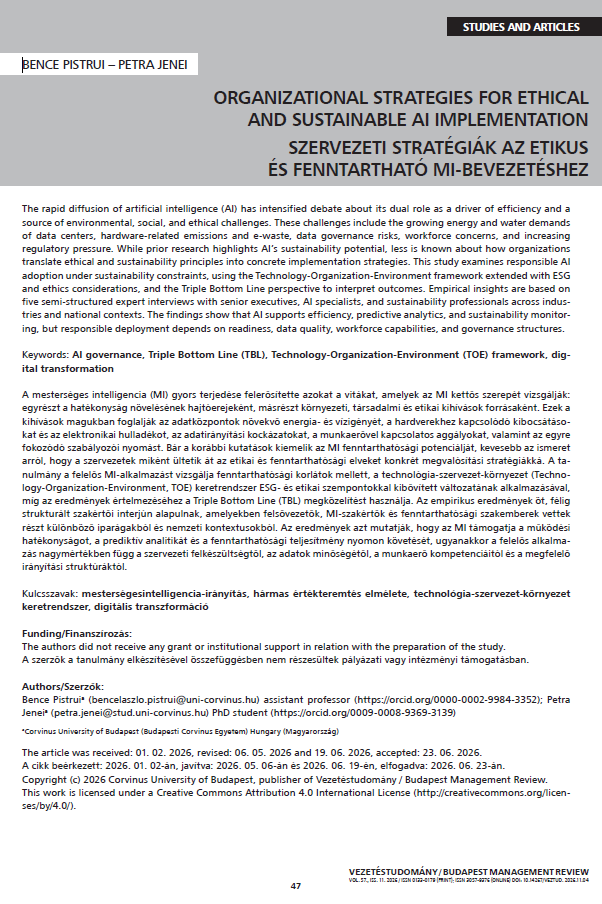
The rapid diffusion of artificial intelligence (AI) has intensified debate about its dual role as a driver of efficiency and a source of environmental, social, and ethical challenges. These challenges include the growing energy and water demands of data centers, hardware-related emissions and e-waste, data governance risks, workforce concerns, and increasing regulatory pressure. While prior research highlights AI’s sustainability potential, less is known about how organizations translate ethical and sustainability principles into concrete implementation strategies. This study examines responsible AI adoption under sustainability constraints, using the Technology-Organization-Environment framework extended with ESG and ethics considerations, and the Triple Bottom Line perspective to interpret outcomes. Empirical insights are based on five semi-structured expert interviews with senior executives, AI specialists, and sustainability professionals across industries and national contexts. The findings show that AI supports efficiency, predictive analytics, and sustainability monitoring, but responsible deployment depends on readiness, data quality, workforce capabilities, and governance structures.
Downloads
References
Alharahsheh, H.H., & Pius, A. (2020). A review of key paradigms: positivism VS interpretivism. Global Academic Journal of Humanities and Social Sciences, 2, 39-43. https://doi.org/10.36348/gajhss.2020.v02i03.001
Alzoubi, Y.I., & Mishra, A. (2024). Green artificial intelligence initiatives: Potentials and challenges. Journal of Cleaner Production, 468, 143090. https://doi.org/10.1016/j.jclepro.2024.143090
Baker, J. (2012). The technology-organization-environment framework. In Y. K. Dwivedi, M. R. Wade, & S. L. Schneberger (Eds.), Information systems theory: Explaining and predicting our digital society (Vol. 1, pp. 231-245). Springer. https://doi.org/10.1007/978-1-4419-6108-2_12
Bauer, A., & Agárdi, I. (2020). Strategic implications of digitalization and the changing logic of value creation. Vezetéstudomány, 51(4), 23-35.
Baumgartner, M., Kopp, T., & Niever, M. (2025). Twin transition — A literature analysis of the relationship between two megatrends and the role of artificial intelligence. International Journal of Innovation Management, 29(05n06). https://doi.org/10.1142/s1363919625400110
Bokolo, A., Jr. (2024). Decentralized AIoT-based intelligence for sustainable energy prosumption in local energy communities: A citizen-centric prosumer approach. Cities, 152, 105198. https://doi.org/10.1016/j.cities.2024.105198
Chotisarna, N., & Phuthong, T. (2025). A bibliometric analysis insights into the intellectual dynamics of artificial intelligence for the micro, small, and medium enterprises. Cogent Business & Management, 12(1), 2491684. https://doi.org/10.1080/23311975.2025.2491684
Di Chiacchio, L., Al-Khateeb, H., Butt, U., & Yussof, S. (2026). AI legitimacy in energy: A model to improve corporate narratives on sustainability and responsibility. Technological Forecasting & Social Change, 222, 124378. https://doi.org/10.1016/j.techfore.2025.124378
Dwivedi, Y.K., Hughes, D.L., Ismagilova, E., Aarts, G., Coombs, C., Crick, T., … Williams, M. D. (2021). Artificial intelligence (AI): Multidisciplinary perspectives on emerging challenges, opportunities, and agenda for research. International Journal of Information Management, 57, 101994. https://doi.org/10.1016/j.ijinfomgt.2019.08.002
Eccles, R.G., Ioannou, I., & Serafeim, G. (2014). The impact of corporate sustainability on organizational processes and performance. Management Science, 60(11), 2835-2857. https://doi.org/10.1287/mnsc.2014.1984
El Saadani Gazar, O.A.E.K., Auda, H., & Youssif, A.A.A. (2024). The role of applying artificial intelligence in improving supply chain management and sustainability: Evidence from Egypt ports. International Journal of Mathematical, Engineering and Management Sciences, 9(5), 1145-1162. https://doi.org/10.33889/IJMEMS.2024.9.5.060
Floridi, L., Cowls, J., Beltrametti, M., Chatila, R., Chazerand, P., Dignum, V., … Vayena, E. (2018). AI4People— An ethical framework for a good AI society: Opportunities, risks, principles, and recommendations. Minds and Machines, 28(4), 689-707. https://doi.org/10.1007/s11023-018-9482-5
Fu, T., Qiu, Z., Yang, X., & Li, Z. (2024). Charting the digital route to net-zero: A framework for sustainable industry practices. Technological Forecasting & Social Change, 209, 123821. https://doi.org/10.1016/j.techfore.2024.123821
Gandía, J.a.G., Gavrila, S.G., De Lucas Ancillo, A., & Del Val Núñez, M.T. (2024). Towards sustainable business in the automation era: Exploring its transformative impact from top management and employee perspective. Technological Forecasting and Social Change, 210, 123908. https://doi.org/10.1016/j.techfore.2024.123908
Gillan, S.L., Koch, A., & Starks, L.T. (2021). Firms and social responsibility: A review of ESG and CSR research. Journal of Corporate Finance, 66, 101889. https://doi.org/10.1016/j.jcorpfin.2021.101889
Hordieiev, M., Nalyvaiko, N., Parkhomenko-Kutsevil, O., Molyboha, R., & Chabanov, A. (2025). The metamorphosis of global trade routes: Immediate challenges and advanced logistics techniques. Management (Montevideo), 3, 257. https://doi.org/10.62486/agma2025257
Jobin, A., Ienca, M., & Vayena, E. (2019). The global landscape of AI Ethics guidelines. Nature Machine Intelligence, 1(9), 389-399. https://doi.org/10.1038/s42256-019-0088-2
Jorzik, P., Antonio, J. L., Kanbach, D. K., Kallmuenzer, A., & Kraus, S. (2024). Sowing the seeds for sustainability: A business model innovation perspective on artificial intelligence in green technology startups. Technological Forecasting & Social Change, 208, 123653. https://doi.org/10.1016/j.techfore.2024.123653
Khan, A.N., Mehmood, K., & Ali, A. (2024). CSR impact: Leveraging artificial intelligence and process optimization for sustainability performance management. Corporate Social Responsibility and Environmental Management, 31(5), 4849-4861. https://doi.org/10.1002/csr.2832
Kibiswa, N. (2019). Directed Qualitative Content Analysis (DQLCA): a tool for conflict analysis. The Qualitative Report, 24(8), 2059-2079. https://doi.org/10.46743/2160-3715/2019.3778
Kittipanyangam, P., Tan, K.H., & Cavite, H.J. (2025). Future- ready AI: A framework for ethical and sustainable adoption. Technology in Society, 83, 102993. https://doi.org/10.1016/j.techsoc.2025.102993
Kupi, M. (2025). The impact of an artificial intelligence- based forecasting model on the development of sustainable tourism. Geojournal of Tourism and Geosites, 61(3), 1758-1766. https://doi.org/10.30892/gtg.61334-1544
Kusmendar, A.M.S.A., & Normasari, N.M.E. (2025). Exploring sustainable pathways: A systematic literature review of three pillars of sustainability applications. Sustainable Futures, 10, 100970. https://doi.org/10.1016/j.sftr.2025.100970
Kvale, S., & Brinkmann, S. (2015). InterViews: Learning the craft of qualitative research interviewing (3rd ed.). Sage Publications.
Litvinets, V. (2024). AI and Sustainability: Opportunities, Challenges, and Impact. Ernst & Young. https://www.ey.com/en_nl/insights/climate-change-sustainability-services/ai-and-sustainability-opportunities-challenges-and-impact
Luo, J., & Zhang, X. (2025). Corporate sustainability: An advanced driver of artificial intelligence. International Journal of Enterprise Information Systems, 20(1). https://doi.org/10.4018/IJEIS.387397
Monroy-Osorio, J.C. (2024). The impact of artificial intelligence on green technology cycles in China. Cleaner Logistics and Supply Chain, 13, 100191. https://doi.org/10.1016/j.clscn.2024.100191
Monsalve-Castro, C., Molina, R.I.R., Ortiz, E.J.F., & Polo, G.P.S. (2025). Artificial intelligence as a driver in adopting green innovation in the agricultural sector: evidence from an emerging economy. Cogent Business & Management, 12(1), 2575261. https://doi.org/10.1080/23311975.2025.2575261
Oliveira, T., & Martins, M. F. (2011). Literature review of information technology adoption models at firm level. Information & Management, 48(4-5), 110-121. https://doi.org/10.1016/j.im.2011.03.002
Pietrzak, P. (2025). How artificial intelligence can support the sustainable development of organizations? Findings from a literature review. Issues in Information Systems, 26(1), 296-307. https://doi.org/10.48009/1_iis_122
Podrecca, M., Culot, G., Tavassoli, S., & Orzes, G. (2024). Artificial intelligence for climate change: A patent analysis in the manufacturing sector. In IEEE Transactions on Engineering Management (vol. 71, pp. 15005- 15024). IEEE. https://doi.org/10.1109/TEM.2024.3469370
Porkodi, S., Tantravahi, V.V.P.K., & Tabash, B.K.H. (2025). Transforming sustainable and green supply chains with artificial intelligence: A strategic review and future research opportunities. International Journal of Production Management and Engineering, 13(2). https://doi.org/10.4995/ijpme.2025.22632
Rashid, A., Rasheed, R., Ngah, A.H., & Amirah, N.A. (2024). Unleashing the power of cloud adoption and artificial intelligence in optimizing resilience and sustainable manufacturing supply chain in the USA. Journal of Manufacturing Technology Management, 35(7), 1329-1353. https://doi.org/10.1108/JMTM-02-2024-0080
Rastogi, S., & Pandita, D. (2025). Driving entrepreneurial success: Navigating AI-driven transformation through workforce agility and sustainability. Journal of Innovation and Entrepreneurship, 14, 75. https://doi.org/10.1186/s13731-025-00554-0
Saunders, M., Lewis, P., & Thornhill, A. (2019). Research methods for business students (8th ed.). Pearson Education.
Senna, P.P., Barros, A.C., Roca, J.B., & Azevedo, A. (2023). Development of a digital maturity model for Industry 4.0 based on the technology-organization-environment framework. Computers & Industrial Engineering, 185, 109645. https://doi.org/10.1016/j.cie.2023.109645
Stilgoe, J., Owen, R., & Macnaghten, P. (2013). Developing a framework for responsible innovation. Research Policy, 42(9), 1568-1580. https://doi.org/10.1016/j.respol.2013.05.008
Szabó, Z.R., & Csontos, R. (2021). Sustainability and digitalization in corporate strategy. Vezetéstudomány, 52(3), 2-13.
Tornatzky, L. G., & Fleischer, M. (1990). The processes of technological innovation. Lexington Books.
Varga, J., & Csesznák, A. (2019). Digital transformation and corporate strategy in Hungary. Vezetéstudomány, 50(5), 2-13. https://www.epa.oszk.hu/05300/05345/00276/pdf/
Varriale, V., Cammarano, A., Michelino, F., & Caputo, M. (2026). Artificial intelligence in technology networks: A catalyst for achieving the SDGs. Technovation, 151, 103398. https://doi.org/10.1016/j.technovation.2025.103398
von Schomberg, R. (2013). A vision of responsible research and innovation. In R. Owen, J. Bessant, & M. Heintz (Eds.), Responsible innovation (pp. 51-74). Wiley. https://doi.org/10.1002/9781118551424.ch3
Xu, Z., Ni, G., & Hu, R. (2025). AI technology innovation, knowledge management and corporate environmental sustainability: Evidence from Chinese patent data. Technology in Society, 83, 102984. https://doi.org/10.1016/j.techsoc.2025.102984
Zhang, J. (2025). Artificial intelligence and green innovation: Investigating the effects of executive pay and firm age. Research in International Business and Finance, 77(PartB), 102953. https://doi.org/10.1016/j.ribaf.2025.102953
Downloads
Published
Issue
Section
License
Copyright (c) 2026 Corvinus University of Budapest, publisher of Vezetéstudomány / Budapest Management Review

This work is licensed under a Creative Commons Attribution 4.0 International License.
Authors assign copyright to Vezetéstudomány / Budapest Management Review. Authors are responsible for permission to reproduce copyright material from other sources.
How to Cite