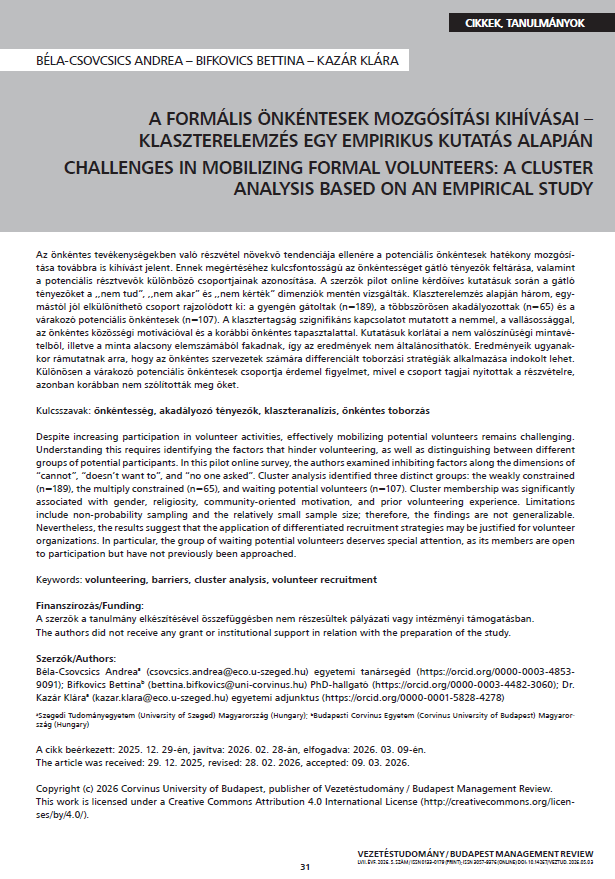
A formális önkéntesek mozgósítási kihívásai
Klaszterelemzés egy empirikus kutatás alapján
DOI:
https://doi.org/10.14267/VEZTUD.2026.05.03Kulcsszavak:
önkéntesség, akadályozó tényezők, klaszteranalízis, önkéntes toborzásAbsztrakt
Az önkéntes tevékenységekben való részvétel növekvő tendenciája ellenére a potenciális önkéntesek hatékony mozgósítása továbbra is kihívást jelent. Ennek megértéséhez kulcsfontosságú az önkéntességet gátló tényezők feltárása, valamint a potenciális résztvevők különböző csoportjainak azonosítása. A szerzők pilot online kérdőíves kutatásuk során a gátló tényezőket a ,,nem tud”, ,,nem akar” és ,,nem kérték” dimenziók mentén vizsgálták. Klaszterelemzés alapján három, egymástól jól elkülöníthető csoport rajzolódott ki: a gyengén gátoltak (n=189), a többszörösen akadályozottak (n=65) és a várakozó potenciális önkéntesek (n=107). A klasztertagság szignifikáns kapcsolatot mutatott a nemmel, a vallásossággal,az önkéntes közösségi motivációval és a korábbi önkéntes tapasztalattal. Kutatásuk korlátai a nem valószínűségi mintavételből, illetve a minta alacsony elemszámából fakadnak, így az eredmények nem általánosíthatók. Eredményeik ugyanakkor rámutatnak arra, hogy az önkéntes szervezetek számára differenciált toborzási stratégiák alkalmazása indokolt lehet. Különösen a várakozó potenciális önkéntesek csoportja érdemel figyelmet, mivel e csoport tagjai nyitottak a részvételre, azonban korábban nem szólították meg őket.
Downloads
Hivatkozások
Bakker, A.B., & Oerlemans, W.G.M. (2016). Momentary work happiness as a function of enduring burnout and work engagement. The Journal of Psychology: Interdisciplinary and Applied, 150(6), 755–778. https://doi.org/10.1080/00223980.2016.1182888
Bartal, A.M., Fényes, H., & Szalóczy, N. (2021). Az elkötelezettek, a csalódottak, a tapasztalatszerzők és akik megpróbálták – Az orvos- és egészségtudományi hallgatók COVID-19 járvány alatti önkéntességének vizsgálata. Önkéntes Szemle, 1(2), 5–35. https://doi.org/10.53585/OnkSzem.2021.2.
Bartal, A.M. (2023). Kihívás és/vagy lehetőség? – Szakirodalmi ajánlások az epizodikus önkéntesek toborzásához, foglalkoztatásához és megtartásához. Önkéntes Szemle, 3(1), 130-148. https://doi.org/10.53585/OnkSzem.2023.1.130-148
Bartal, A.M., Doner, L., Fényes, H., Nagy R., & Perpék, É. (2024). „Gúzsba kötve táncolni” – Helyzetkép a hazai önkéntes alszektorról az Önkéntes Szemle (2021-2023) tanulmányai és esettanulmányai alapján. Önkéntes Szemle, 4(1), 3–30. https://doi.org/10.53585/OnkSzem.2024.1.3-30
Béla-Csovcsics, A., & Kazár, K. (2025). Az önkéntes elégedettséget befolyásoló tényezők vizsgálata. Marketing & Menedzsment, 59(3), 15-26. https://doi.org/10.15170/MM.2025.59.03.02
Bennett, R., & Barkensjo, A. (2005). Internal Marketing, Negative Experiences, and Volunteers’ Commitment to Providing High-Quality Services in a UK Helping and Caring Charitable Organization. Voluntas, 16(3). https://doi.org/10.1007/s11266-005-7724-0
Bifkovics, B., & Béla-Csovcsics, A. (2025). Miért nem önkénteskedünk? Az akadályozó tényezők empirikus vizsgálata. Vezetéstudomány, 56(11), 28–40. https://doi.org/10.14267/VEZTUD.2025.11.03
Bifkovics, B., & Malota, E. (2024). Önkéntesség a szájreklám és a szervezetek kommunikációjának tükrében: Integratív szakirodalmi szintézis és javasolt kutatási irányok. Vezetéstudomány, 55(4), 63–76. https://doi.org/10.14267/VEZTUD.2024.04.05
Brudney, J.L., & Gazley, B. (2002). Testing the conventional wisdom regarding volunteer programs: A longitudinal analysis of the service corps of retired executives and the U.S. small business administration. Nonprofit and Voluntary Sector Quarterly, 31(4), 525–548. https://doi.org/10.1177/0899764002238099
Bussell, H., & Forbes, D. (2002). Understanding the volunteer market: the what, where, who and why of volunteering. Journal of Philanthropy and Marketing, 7(3), 244-257. https://doi.org/10.1002/nvsm.183
Cattan, M., Hogg, E., & Hardill, I. (2011). Improving quality of life in ageing populations: what can volunteering do? Maturitas, 70(4), 328-332. https://doi.org/10.1016/j.maturitas.2011.08.010
Clary, E.G., & Snyder, M. (1991). A functional analysis of altruism and prosocial behavior: The case of volunteerism. In M.S. Clark (Ed.), Prosocial behavior (pp. 19–148). Sage Publications, Inc.
Clary, E.G., Snyder, M., Ridge, R.D., Copeland, J., Stukas, A.A., Haugen, J., & Miene, P. (1998). Understanding and assessing the motivations of volunteers: A functional approach. Journal of Personality and Social Psychology, 74(6), 1516–1530. https://doi.org/10.1037/0022-3514.74.6.1516
Cruz, S., Ferreira, M.R., Borges, A., & Casais, B. (2023). Barriers to volunteering in the field of intellectual disability: a cluster analysis. International Review on Public and Nonprofit Marketing, 20, 341–366. https://doi.org/10.1007/s12208-022-00343-5
Czike, K., & Kuti, É. (2006). Önkéntesség, jótékonyság, társadalmi integráció. Nonprofit Kutatócsoport és Önkéntes Központ Alapítvány.
Damian, E. (2019). Formal Volunteering in Europe: Evidence Across Nations and Time. Cross-Cultural Research, 53(4), 385-409. https://doi.org/10.1177/1069397118802228
Davis, M.H., Mitchell, K.V., & Hall, J.A. (1999). Empathy, Expectations, and Situational Preferences: Personality Influences on Decision to Participate in Volunteer Helping
Behaviors. Journal of Personality, 67(3), 469– 503. https://doi.org/10.1111/14676494.00062
Dean, J. (2022). Informal Volunteering, Inequality, and Illegitimacy. Nonprofit and Voluntary Sector Quarterly,51(3), 527-544. https://doi.org/10.1177/08997640211034580
Einolf, C.J. (2010). Gender Differences in the Correlates of Volunteering and Charitable Giving. Nonprofit and Voluntary Sector Quarterly, 40(6), 1092-1112. https://doi.org/10.1177/0899764010385949
Enjolras, B. (2021). Explaining the Varieties of Volunteering in Europe: A Capability Approach. Voluntas, 32, 1187–1212. https://doi.org/10.1007/s11266-021-00347-5
Erlinghagen, M. (2010). Volunteering after retirement: evidence from German panel data. European Societies, 12(5), 603–625. https://doi.org/10.1080/14616691003716902
Fairley, S., Lee, Y., Green, B.C., & Kim, M.L. (2013). Considering Cultural Influences in Volunteer Satisfaction and Commitment. Event Management, 17(4), 337-348. https://doi.org/10.3727/152599513X13728763846492
Ganzevoort, W., & van den Born, R.J.G. (2023). The everyday reality of nature volunteering: an empirical exploration of reasons to stay and reasons to quit. Journal of Environmental Planning and Management, 68(1), 207–226. https://doi.org/10.1080/09640568.2023.2240953
Gesthuizen, M., & Scheepers, P. (2012). Educational Differences in Volunteering in Cross-National Perspective: Individual and Contextual Explanations: Individual and Contextual Explanations. Nonprofit and Voluntary Sector Quarterly, 41(1), 58-81. https://doi.org/10.1177/0899764010394203
Gil-Lacruz, A.I., Marcuello, C., & Saz-Gil, I. (2017). Individual and Social Factors in Volunteering Participation Rates in Europe. Cross-Cultural Research, 51(5), 464-490. https://doi.org/10.1177/1069397117694135
Ghose, T., & Kassam, M. (2014). Motivations to Volunteer Among College Students in India. Voluntas: International Journal of Voluntary and Nonprofit Organizations, 25(1), 28-45. https://doi.org/10.1007/s11266-012-9327-4
Grueter, C.C., Westlake, G., & Coall, D. (2020). Urban civility: City Dwellers are not less prososcial than their rural counterparts. Evolutionary Psychological Science, 6(1), 14–19. https://doi.org/10.1007/s40806-019-00206-z
Gyorgyovich, M., Menich, D., Simon, N., Kollár, D., & Szadorai, D. (2020). Önkéntesség Magyarországon 2018. Századvég Kiadó. https://budapesticivil.hu/arti-cle/nkentesseg-magyarorszagon-2018-szazadveg.pdf
Gyorgyovich, M. (2021). A formális és informális önkéntesség: Az Önkéntesség Magyarországon 2018. felvétel szerint. Önkéntes Szemle, 1(1), 21-38. https://doi.org/10.53585/OnkSzem.2021.1.21-38
Hidalgo, M. C., & Moreno, P. (2009). Organizational socialization of volunteers: the effect on their intention to remain. Journal of Community Psychology, 37(5), 594–601. https://doi.org/10.1002/jcop.20317
ILO. (2011). Manual on the measurement of volunteer work. https://www.ilo.org/publications/manual-measurement-volunteer-work
Innes, P.A., Jefferies, G., & Gates, T.G. (2024). Volunteering behavioral declines amid personal and organizational upheaval: Recruitment, retention, and barriers in Australia. Journal of Human Behavior in the Social Environment, 1–21. https://doi.org/10.1080/10911359.2024.2396032
Kaminski, A. (1996). A National Network for Men as Volunteers? Women’s Philanthropy, 4(June), 8–11.
Kang, S.C., Nesbit, R., & Brudney, J.L. (2020). Local Government Volunteer Use: A Resource Dependence and Transaction Costs Explanation. Public Administration Review, 82(5), 806-817. https://doi.org/10.1111/puar.13320
Kojima, M. (2024). Organizational or Individual? The Effect of Social Networks on Volunteer Activities in Japan. Voluntas, 35, 583–596. https://doi.org/10.1007/s11266-023-00623-6
Kovács, E. (2014). Többváltozós adatelemzés. Typotex Kiadó. Kraja, J., Xhakollari, L., Marku, M., & Fresku, E. (2025). Student Motivation for Volunteering: Demographic Factors, Gender Differences, and Inclusion in Study Program Curricula. The Open Nursing Journal, 19, e18744346400359. https://doi.org/10.2174/0118744346400359250612112558
Krajňáková, E., Šimkus, A., Pilinkiene, V., & Grabowska, M. (2018). Analysis of barriers in sports volunteering. Journal of International Studies, 11(4), 254–269. https://doi.org/10.14254/2071-8330.2018/11-4/18
KSH. (2020). Önkéntes munkát végző népesség demográfiai és egyéb jellemzők, illetve a végzett munka formális vagy informális volta szerint, 2020. IV. negyedév. https://www.ksh.hu/docs/hun/xstadat/xstadat_evkozi/e_onk_9_20_02.html
KSH. (2023). Önkéntes munkát végző népesség demográfiai és egyéb jellemzők, illetve a végzett munka formális vagy informális volta szerint, 2023. https://www.ksh.hu/docs/hun/xftp/mef-kieg/mef_23_h.xlsx
KSH. (2024). 23.1.1.5. Végzettek száma és aránya a nappali és a felnőttoktatásban. https://www.ksh.hu/stadat_ files/okt/hu/okt0005.html
KSH. (2025). 9.1.1.15. A nonprofit szektor főbb adatai szervezettípus és a Nonprofit Szervezetek Nemzetközi Osztályozási Rendszere (ICNPO) tevékenységi főcsoportok és csoportok szerint. https://www.ksh.hu/stadat_files/gsz/hu/gsz0069.html
Lancee, B., & Radl, J. (2014). Volunteering over the Life Course. Social Forces, 93(2), 833-862. https://doi.org/10.1093/sf/sou090
Lawton, R.N., Gramatki, I., Watt, W., & Fujiwara, D. (2021). Does Volunteering Make Us Happier, or Are Happier People More Likely to Volunteer? Addressing the Problem of Reverse Causality When Estimating the Wellbeing Impacts of Volunteering. Journal of Happiness Studies, 22, 599–624. https://doi.org/10.1007/s10902-020-00242-8
Lee, J., & Brudney, J.L. (2012). Participation in formal and informal volunteering: Implications for volunteer recruitment. Nonprofit Management and Leadership, 23(2), 159-180. https://doi.org/10.1002/nml.21060
Lee, J., Park, Y.J., & Kim, S.E. (2023). Volunteers and resource management competencies of nonprofit organizations during challenging times. Nonprofit Management and Leadership, 34(1), 107-129. https://doi.org/10.1002/nml.21562
Lim, C., & Wiertz, D. (2024). Civic Lessons That Last? Religiosity and Volunteering on the Way to Adulthood. American Sociological Review, 89(4), 684–707. https://doi.org/10.1177/00031224241258791
Low, N., Butt, S., Paine, A., & Smith, J. (2007). Helping out. A national survey of volunteering and charitable giving. http://www.ivr.org.uk/images/stories/Institute-of-Volunteering-Research/Migrated-Resources/Documents/H/OTS_Helping_Out.pdf
Luksyte, A., Dunlop, P.D., Holtrop, D., Gagné, M., Kragt, D., & Farid, H.M. (2021). The challenges of volunteering during the COVID-19 pandemic. Industrial and Organizational Psychology, 14(1–2), 286–289. https://doi.org/10.1017/iop.2021.62
Malhotra, N.K. (2017). Marketingkutatás. Akadémiai Kiadó. Manda, S., Abdelatif, N., Seabe, D., Millard, S., & Kamuruko, T. (2025). Global, regional, and national prevalence and determinants of volunteer work: a meta- analysis study using survey data. Frontiers in Sociology, 10, 1584761. https://doi.org/10.3389/fsoc.2025.1584761
McGehee, N.G., & Santos, C.A. (2005). Social Change, Discourse and Volunteer Tourism. Annals of Tourism Research, 32(3), 760-779. http://doi.org/10.1016/j.annals.2004.12.002
Meijs, L., Hendriks, P., & Dobreva, A. (2021). New trends in the development of volunteering in the European Union. https://www.eesc.europa.eu/sites/default/files/files/qe-09-22-294-en-n.pdf
Neely, A.R., Lengnick-Hall, M.L., & Evans, M.D. (2022). A process model of volunteer motivation. Human Resource Management Review, 32(4), 100879. https://doi.org/10.1016/j.hrmr.2021.100879
Nakamura, J.S., Gibson, C.B., Woodberry, R.D., Lee, M.T., Kim, Y.I., Shiba, K., Padgett, R.N., Johnson, B.R., & VanderWeele, T.J. (2025). Understanding who volunteers globally through an examination of demographic variation in volunteering across 22 countries. Scientific Reports, 15, 25299. https://doi.org/10.1038/s41598-025-05459-2
Niebuur, J., van Lente, L., Liefbroer, A.C., Steverink, N., & Smidt, N. (2018). Determinants of participation in voluntary work: a systematic review and meta-analysis of longitudinal cohort studies. BMC Public Health, 18, 1213. https://doi.org/10.1186/s12889-018-6077-2
OECD. (2024). Unleashing the potential of volunteering for local development, An international comparison of trends and tools. https://www.oecd.org/en/publica- tions/unleashing-the-potential-of-volunteering-for-lo-cal-development_deab71bd-en.html
Oswald, P.A. (2000). Subtle Sex Bias in Empathy and Helping Behavior. Psychological Reports, 87(2), 545– 551. https://doi.org/10.2466/pr0.2000.87.2.545
Paarlberg, L.E., Nesbit, R., Choi, S.Y., & Moss, R. (2022). The Rural/Urban Volunteering Divide. Voluntas, 33, 107–120. https://doi.org/10.1007/s11266-021-00401-2
Paxton, P., Reith, N.E., & Glanville, J.L. (2014). Volunteering and the Dimensions of Religiosity: A Cross-National Analysis. Review of Religious Research, 56(4). 597–625. https://doi.org/10.1007/s13644-014-0169-y
Plagnol, A.C., & Huppert, F.A. (2010). Happy to Help? Exploring the Factors Associated with Variations in Rates of Volunteering Across Europe. Social Indicators Research, 97(2), 157–176. https://doi.org/10.1007/s11205-009-9494-x
Sajtos, L., & Mitev, A. (2007). SPSS Kutatási és adatelemzési kézikönyv. Alinea Kiadó.
Simon, J., Berezvai, Zs., Kemény, I., Kun, Zs., & Pusztai, T. (2024). Kvantitatív elemzési módszerek: SPSS használata a kutatási gyakorlatban. Budapesti Corvinus Egyetem.
Smith, D.H., & Stebbins, R. (2016). Introduction. In D.H. Smith, R. Stebbins, & C. Rochester (Eds.), The Palgrave handbook of volunteering, civic participation, and nonprofit associations (pp. 1-20). Palgrave Macmillan. https://doi.org/10.1007/978-1-137-26317-9
Seah, B., Ho, B., Liaw, S.Y., Ang, E.N.K., & Lau, S.T. (2021). To Volunteer or Not? Perspectives towards Pre-Registered Nursing Students Volunteering Frontline during COVID-19 Pandemic to Ease Healthcare Workforce: A Qualitative Study. International Journal of Environmental Research and Public Health, 18(12), 6668. https://doi.org/10.3390/ijerph18126668
Snyder, M., & Omoto, A. M. (2008). Volunteerism: Social issues perspectives and social policy implications: Social issues and policy review. Social Issues and Policy Review, 2(1), 1–36. https://doi.org/10.1111/j.1751-2409.2008.00009.x
Storm, I. (2015). Religion, Inclusive Individualism, and Volunteering in Europe. Journal of Contemporary Religion, 30(2), 213–229. https://doi.org/10.1080/13537903.2015.1025542
Sundeen, R.A., Raskoff, S.A., & Garcia, M.C. (2007). Differences in perceived barriers to volunteering to formal organizations: Lack of time versus lack of interest. Nonprofit Management and Leadership, 17, 279–300. https://doi.org/10.1002/nml.150
Sundeen, R.A. (1988). Explaining Participation in Coproduction: A Study of Volunteers. Social Science Quarterly, 69(3), 547-568.
Susanti, R.D., Yudianto, K., Mulyana, A.M., & Amalia, I.N. (2023). A Systematic Scoping Review of Motivations and Barriers in COVID-19 Volunteering Among Health Students: The Potential for Future Pandemic Volunteers. Journal of Multidisciplinary Healthcare, 16, 1671–1681. https://doi.org/10.2147/JMDH.S411896
Taniguchi, H. (2006). Men’s and Women’s Volunteering: Gender Differences in the Effects of Employment and Family Characteristics. Nonprofit and Voluntary Sector Quarterly, 35(1), 83-101. https://doi.org/10.1177/0899764005282481
Taniguchi, H., & Marshall, G.A. (2016). Neighborhood Association Participation and Formal Volunteering in Japan. VOLUNTAS: International Journal of Voluntary and Nonprofit Organizations, 27(2), 695–723. https://doi.org/10.1007/s11266-015-9551-9
Thoits, P.A. (2001). Volunteer work and well-being. Journal of Health and Social Behavior, 42(2), 115–131. https://doi.org/10.2307/3090173
UN Volunteers. (2023). Volunteering Database. https://knowledge.unv.org/country/hungary
van Ingen, E., & Wilson, J. (2017). I Volunteer, Therefore I am? Factors Affecting Volunteer Role Identity. Nonprofit and Voluntary Sector Quarterly, 46(1), 29-46. https://doi.org/10.1177/0899764016659765
Voicu, B., & Voicu, M. (2009). Volunteers and volunteering in Central and Eastern Europe. Sociológia - Slovak Sociological Review, 41(6), 539-563.
Wang, L., Mook, L., & Handy, F. (2017). An empirical examination of formal and informal volunteering in Canada. Voluntas, 28, 139–161. https://doi.org/10.1007/s11266-016-9725-0
Warburton, J., & Crosier, T. (2001). Are we too busy to volunteer? The relationship between time and volunteering using the 1997 ABS time use data. Australian Journal of Social Issues, 36(4), 295-314. https://doi.org/10.1002/j.1839-4655.2001.tb01104.x
Willems, J., & Dury, S. (2017). Reasons for not volunteering: overcoming boundaries to attract volunteers. The Service Industries Journal, 37(11–12), 726–745. https://doi.org/10.1080/02642069.2017.1318381
Wilson, J. (2000). Volunteering. Annual Review of Sociology, 26(1), 215–240. https://doi.org/10.1146/annurev.soc.26.1.215
Wilson, J., & Musick, M. (1997). Who Cares? Toward an Integrated Theory of Volunteer Work. American Sociological Review, 62(5), 694–713. https://doi.org/10.2307/2657355
Wu, D.C., Fu, H., & Kang, M. (2018). Why volunteer teaching tourism? Empirical evidence from China. Asia Pacific Journal of Tourism Research, 23(2), 109–120. https://doi.org/10.1080/10941665.2017.1410191
Wymer, W.W. (1998). Youth development volunteers: Their motives, how they differ from other volunteers and correlates of involvement intensity. Journal of Nonprofit and Voluntary Sector Marketing, 3(4), 321– 336. https://doi.org/10.1002/nvsm.6090030406
Wymer, W. (2011). The implications of sex differences on volunteer preferences. Voluntas: International Journal of Voluntary and Nonprofit Organizations, 22, 831–851. https://doi.org/10.1007/s11266-010-9174-0
Wymer, W.W., & Samu, S. (2002). Volunteer Service as Symbolic Consumption: Gender and Occupational Differences in Volunteering. Journal of Marketing Management, 18(9-10), 971–989. https://doi.org/10.1362/0267257012930358
Zwirner, E., & Raihani, N. (2020). Neighbourhood wealth, not urbanicity, predicts prosociality towards strangers. Proceedings of the Royal Society B: Biological Sciences, 287(1936), 20201359. https://doi.org/10.1098/rspb.2020.1359
Letöltések
Megjelent
Folyóirat szám
Rovat
License
Copyright (c) 2026 Corvinus University of Budapest, publisher of Vezetéstudomány / Budapest Management Review

This work is licensed under a Creative Commons Attribution 4.0 International License.
Authors assign copyright to Vezetéstudomány / Budapest Management Review. Authors are responsible for permission to reproduce copyright material from other sources.
Hogyan kell idézni