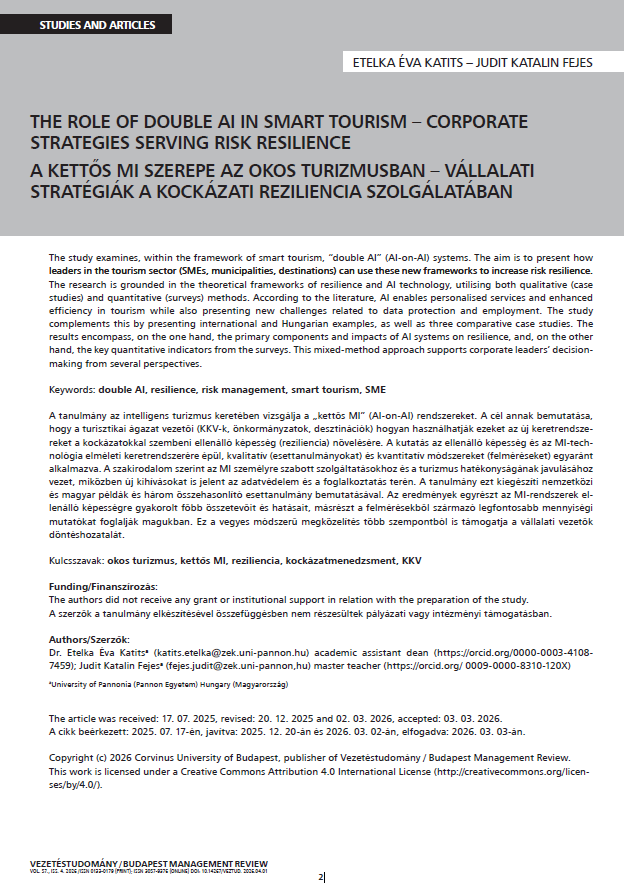
A kettős MI szerepe az okos turizmusban
Vállalati stratégiák a kockázati reziliencia szolgálatában
DOI:
https://doi.org/10.14267/VEZTUD.2026.04.01Kulcsszavak:
okos turizmus, kettős MI, reziliencia, kockázatmenedzsment, KKVAbsztrakt
A tanulmány az intelligens turizmus keretében vizsgálja a „kettős MI” (AI-on-AI) rendszereket. A cél annak bemutatása, hogy a turisztikai ágazat vezetői (KKV-k, önkormányzatok, desztinációk) hogyan használhatják ezeket az új keretrendszereket a kockázatokkal szembeni ellenálló képesség (reziliencia) növelésére. A kutatás az ellenálló képesség és az MI-technológia elméleti keretrendszerére épül, kvalitatív (esettanulmányokat) és kvantitatív módszereket (felméréseket) egyaránt alkalmazva. A szakirodalom szerint az MI személyre szabott szolgáltatásokhoz és a turizmus hatékonyságának javulásához vezet, miközben új kihívásokat is jelent az adatvédelem és a foglalkoztatás terén. A tanulmány ezt kiegészíti nemzetközi és magyar példák és három összehasonlító esettanulmány bemutatásával. Az eredmények egyrészt az MI-rendszerek ellenálló képességre gyakorolt főbb összetevőit és hatásait, másrészt a felmérésekből származó legfontosabb mennyiségi mutatókat foglalják magukban. Ez a vegyes módszerű megközelítés több szempontból is támogatja a vállalati vezetők döntéshozatalát.
Downloads
Hivatkozások
Arbulú, I., Razumova, M., Rey-Maquieira, J., & Sastre, F. (2021). Measuring risks and vulnerability of tourism to the COVID-19 crisis in the context of extreme uncertainty: The case of the Balearic Islands. Tourism Management Perspectives, 39, 100857. https://doi.org/10.1016/j.tmp.2021.100857
Bakıcı T., Almirall E., & Wareham J. (2013). A smart city initiative: the case of Barcelona. Journal of the Knowledge Economy, 4(2), 135–148. https://doi.org/10.1007/s13132-012-0084-9
Barcelona Smart City (2013). http://ndc.hust.edu.cn/barcelona_smart_city.pdf
Bradley, A.P. (1997). The use of the area under the ROC curve in the evaluation of machine learning algorithms. Pattern Recognition, 30(7), 1145–1159. https://doi.org/10.1016/S0031-3203(96)00142-2
Chatterjee, S., & Byun, Y.C. (2023). A synthetic data generation technique to enhance the prediction accuracy of electric vehicle demand. Sensors, 23(2), 594. https://doi.org/10.3390/s23020594
Cogno, N., Bauer, R. & Durante, M. (2024). Mechanistic model of radiotherapy-induced lung fibrosis using coupled 3D agent-based and Monte Carlo. Simulations. Communications Medicine, 4, 16. https://doi.org/10.1038/s43856-024-00442-w
Fawcett, T. (2006). An introduction to ROC analysis. Pattern Recognition Letters, 27(8), 861–874. https://doi.org/10.1016/j.patrec.2005.10.010
Florido-Benítez, L. (2024). The use of digital twins to address future challenges for smart tourist destinations. Platforms, 2(4), 234–254. https://doi.org/10.3390/platforms2040016
Flyvbjerg, B. (2011). Case study methodology. In Denzin, N.K. & Lincoln, Y.S. (Eds.), The SAGE handbook of qualitative research (4th ed., pp. 301–316). SAGE Publications.
Ghaderi, Z., Beal, L., Hall, C.M., Zaman, M., Ahmad Rather, R., & Mat Som, A.P. (2024). Cybersecurity and smart tourist destinations resilience. Tourism Recreation Research, 25(7), 1622-1638. https://doi.org/10.1080/02508281.2024.2434791
Hsieh, S.C. (2021). Tourism demand forecasting based on an LSTM network and its variants. Algorithms, 14(8), 243. https://doi.org/10.3390/a14080243
Huang, G., Xu, C., Sun, X., & Zhang, S. (2020). ROC and AUC with applications in AI prediction reliability. Journal of Artificial Intelligence Research, 69, 1-23. https://doi.org/10.1613/jair.1.11234
Kantabutra, S., & Ketprapakorn, N. (2021). Toward an Organizational Theory of Resilience: An Interim Struggle. Sustainability, 13(23), 13137. https://doi.org/10.3390/su132313137
Kar, D., Nguyen, T.H., Fang, F., Brown, M., Sinha, A., Tambe, M., & Jiang, A.X. (2018). Trends and applications in Stackelberg security games. In Başar, T., Zaccour, G. (eds.) Handbook of dynamic game theory (pp. 1223–1269). Springer. https://doi.org/10.1007/978-3-319-44374-4_27
Katits, E. (2024). Vállalati turnaround pénzügyek a fordulatkezelési kutatások tükrében és a fenntartható gazdálkodás érdekében. Akadémiai Kiadó. https://doi.org/10.1556/9789636640811
Központi Statisztikai Hivatal. (2024). Turizmus-vendéglátás adatok és elemzések, 2023–2024. https://www.ksh.hu/kereses?q=turizmus
Luo, Y., Li, Y., Wang, G., & Ye, Q. (2021). Agent-based modeling and simulation of tourism market recovery strategy after COVID-19 in Yunnan, China. Sustainability, 13(21), 11750. https://doi.org/10.3390/su132111750
Magyar Turisztikai Ügynökség. (2024). Nemzeti Turizmusfejlesztési Stratégia 2030. https://mtu.gov.hu/
Matei, N.A., García-León, D., Dosio, A., Batista e Silva, F., Ribeiro Barranco, R., Císcar Martínez, J.C. (2023). Regional impact of climate change on European tourism demand. The Joint Research Centre: EU Science Hub, 40. https://doi.org/10.2760/899611
MBRSC and SpaceData to develop advanced digital twin solutions (2025a). https://www.broadcastprome.com/news/satellite/mbrsc-and-spacedata-to-develop-advanced-digital-twin-solutions/#:~:text=On%20Earth%2C%20SpaceData%20will%20build,challenges%20while%20promoting%20sustainable%20growth
Mohammed Bin Rashid Space Centre (MBRSC). (2025b). MBRSC signs MoU with SpaceData to advance digital twin technology for UAE’s space and economic initiatives [Press release]. https://www.mbrsc.ae/news/mbrsc-signs-mou-with-spacedata-to-advance-digital-twin-technology-for-uaes-space-and-economic-initiatives/
Muschelli, J. (2019). ROC and AUC with a binary predictor: a potentially misleading metric. Journal of Classification, 37(4), 696-708. https://doi.org/10.1007/s00357-019-09345-1
Nicholls, S., Amelung B., & Student J. (2016). Agent-based modeling: A powerful tool for tourism researchers. Journal of Travel Research, 56(1), 3–15. https://doi.org/10.1177/0047287515620490
OECD. (2024a). OECD Tourism Trends and Policies 2024. OECD Publishing. https://doi.org/10.1787/80885d8b-en.
OECD. (2024b). Artificial intelligence and tourism: G7/ OECD policy. OECD Tourism Papers, 2024/02. OECD Publishing, 39. http://dx.doi.org/10.1787/3f9a4d8d-en
Page, M.J., McKenzie, J.E., Bossuyt, P.M. Boutron, I., Hoffmann, T.C., Mulrow, C.D., Shamseer. L., Tetzlaff, J.M., Akl, E.A., Brennan, S.E., Chou, R., Glanville, J., Grimshaw, J.M., Hróbjartsson, A., Lalu, M.M., Li, T., Loder, E.W., Mayo-Wilson, E., McDonald, S., McGuinness, L.A., Stewart, L.A., Thomas, J., Tricco, A.C., Welch, V.A., Whiting, P., & Moher, D. (2021). The PRISMA 2020 Statement: an Updated Guideline for Reporting Systematic Reviews. Systematic Review, 89, 1–11. https://doi.org/10.1186/s13643-021-01626-4
Pai, P.F., Hong W.C., & Lin C.S. (2005). Forecasting tourism demand using a multifactor support vector machine model. Lecture Notes in Computer Science (CIS 2005), 3801, 512–519. https://doi.org/10.1007/11596448_75
Pavlik, M., & Michalski, G. (2025). Monte Carlo simulations for resolving verifiability paradoxes in Forecast risk management and corporate treasury applications. International Journal of Financial Studies, 13(2), 49. https://doi.org/10.3390/ijfs13020049
Petrevska, B. (2017). Predicting tourism demand by A.R.I.M.A. models. Economic Research-Ekonomska Istraživanja, 30(1), 939–950. https://doi.org/10.1080/1331677X.2017.1314822
Reichstein, M., Benson, V., Blunk, J., Camps-Valls, G., Creutzig, F., Fearnley, C.J., Han, B., Kornhuber, K., Rahaman, N., Schölkopf, B., Tárraga, J.M., Vinuesa, R., Dall, K., Denzler, J., Frank, D., Martini, G., Nganga, N., Maddix, D.C., & Weldemariam, K. (2025). Early warning of complex climate risk with integrated artificial intelligence. Nature Communications, 16, 2564. https://doi.org/10.1038/s41467-025-57640-w
Ruiz-Martín, C. (2018). A framework to study the resilience of organisations: a case study of a nuclear emergency plan [Thesis paper]. Carleton University, 267. https://carleton.scholaris.ca/server/api/core/bitstreams/d65b2a33-a27e-426d-8c4b-46ea4b3dcaef/content
Singh, N. (2022). Developing Business Risk Resilience through Risk Management Infrastructure: The Moderating Role of Big Data Analytics. Information Systems Management, 39(1), 34–52. https://doi.org/10.1080/10580530.2020.1833386
Song, N., & Zhang, Y. (2025). Exploring the relationship between tourism development and environmental pollution using an LSTM-based time series model. Frontiers in Environmental Science, 3, 1576039. https://doi.org/10.3389/fenvs.2025.1576039
Song, D. & Chen, H. (2025). Artificial intelligence as a Catalyst for sustainable tourism: A case study from China. Systems, 13(5), 333. https://doi.org/10.3390/systems13050333
Statista Research Department. (2024). Tourism and Travel – Hungary: AI and digitalization. https://www.statista.com/search/?q=tourism%20hungary
Sun, Y.Y., Faturay, F., Lenzen, M., Gössling, S., & Higham, J. (2024). Drivers of global tourism carbon emissions. Nature Communications, 15, 10384. https://doi.org/10.1038/s41467-024-54582-7
Suanpang, P., & Pothipassa, P. (2024). Integrating generative AI and IoT for sustainable smart tourism destinations. Sustainability, 16(17), 7435. https://doi.org/10.3390/su16177435
Tanaka, K., Higashide, T., Kinkyo, T. & Hamori, S. (2025). A multi-stage financial distress early warning system: Analyzing corporate insolvency with random forest. Journal of Risk and Financial Management, 18(4), 195. https://doi.org/10.3390/jrfm18040195
TechTarget (2025). What is the ISO 31000 Risk Management standard? https://www.techtarget.com/searchsecurity/definition/ISO-31000-Risk-Management#:~:text=ISO%2031000%20provides%20a%20framework,a%20consistent%20and%20structured%20approach
Tian, Y., & Tang, X. (2025). The use of artificial neural network algorithms to enhance tourism economic efficiency under information and communication technology. Scientific Reports, 15, 8988. https://doi.org/10.1038/s41598-025-94268-8
Viglia, G., Adler, S.J., Lancelot-Miltgen, C., & Sarstedt, M. (2024). The use of synthetic data in tourism. Annals of Tourism Research, 108(C), 103819. https://doi.org./10.1016/j.annals.2024.103819
Vinuesa, R., Azizpour, H., Leite, I., Balaam, M., Dignum, V., Domisch, S., Felländer, A., Langhans, S.D., Tegmark, M., & Nerini, F.F. (2020). The role of artificial intelligence in achieving the Sustainable Development Goals. Nature Communications, 11(1), 233. https://doi.org/10.1038/s41467-019-14108-y
Wallinger, S., Grundner, L., Majic, I., & Lampoltshammer, T.J. (2023). Agent-based modelling for sustainable tourism. In Ferrer-Rosell, B., Massimo, D., & Berezina, K. (Eds.), Information and Communication Technologies in Tourism 2023. ENTER 2023. Springer Proceedings in Business and Economics (pp. 355–360). Springer. https://doi.org/10.1007/978-3-031-25752-0_40
Wang, S., Wang, Q., Cui, Q., & Tan, L. (2025). Artificial intelligence in tourism: A systematic literature review and future research agenda. Sustainability, 7(20), 9080. https://doi.org/10.3390/su17209080
World Meteorological Organization (WMO). (2025). AI for early warnings: Experts unite with calls to build resilience and protect development gains. https://wmo.int/media/news/ai-early-warnings-experts-unite-calls-build-resilience-and-protect-development-gains#:~:text=New%20York%20%E2%80%94%20With%20just,lives%20and%20protect%20development%20gains
World Travel & Tourism Concil (WTTC). (2024). Travel & Tourism set to Break All Records in 2024. https://wttc.org/news/travel-and-tourism-set-to-break-all-records-in-2024-reveals-wttc#:~:text=Despite%20economic%20uncertainties%20and%20geopolitical,role%20in%20the%20global%20economy
Zahedi, J., Salehi, M., & Moradi, M. (2023). Identifying and classifying the financial resilience measurement indices using intuitive fuzzy DEMATEL. Benchmarking: An International Journal, 30(4), 1300–1321. https://doi.org/10.1108/BIJ-07-2021-0395
Zakhary, A., Atiya, A.F., El-Shishiny, H., El-Gayar, N. (2009). Forecasting hotel arrivals and occupancy using Monte Carlo simulation. Journal of Revenue and Pricing Management, 10, 344–366. https://doi.org/10.1057/rpm.2009.42
Zhang, M., Li, J., Pan, B., & Zhang, G. (2018). Weekly hotel occupancy forecasting of a tourism destination. Sustainability, 10(12), 4351. https://doi.org/10.3390/su10124351
Zhang, Y., Tan, W.H., & Zeng, Z. (2025). Tourism demand forecasting based on a hybrid temporal neural network model for sustainable tourism. Sustainability, 17(5), 2210. https://doi.org/10.3390/su17052210
Zheng, S., & Zhang, Z. (2023). Adaptive tourism forecasting using hybrid artificial intelligence model: a case study of Xi’an international tourist arrivals. PeerJ Computer Science, 9, e1573. https://doi.org/10.7717/peerj-cs.1573
Letöltések
Megjelent
Folyóirat szám
Rovat
License
Copyright (c) 2026 Corvinus University of Budapest, publisher of Vezetéstudomány / Budapest Management Review

This work is licensed under a Creative Commons Attribution 4.0 International License.
Authors assign copyright to Vezetéstudomány / Budapest Management Review. Authors are responsible for permission to reproduce copyright material from other sources.
Hogyan kell idézni