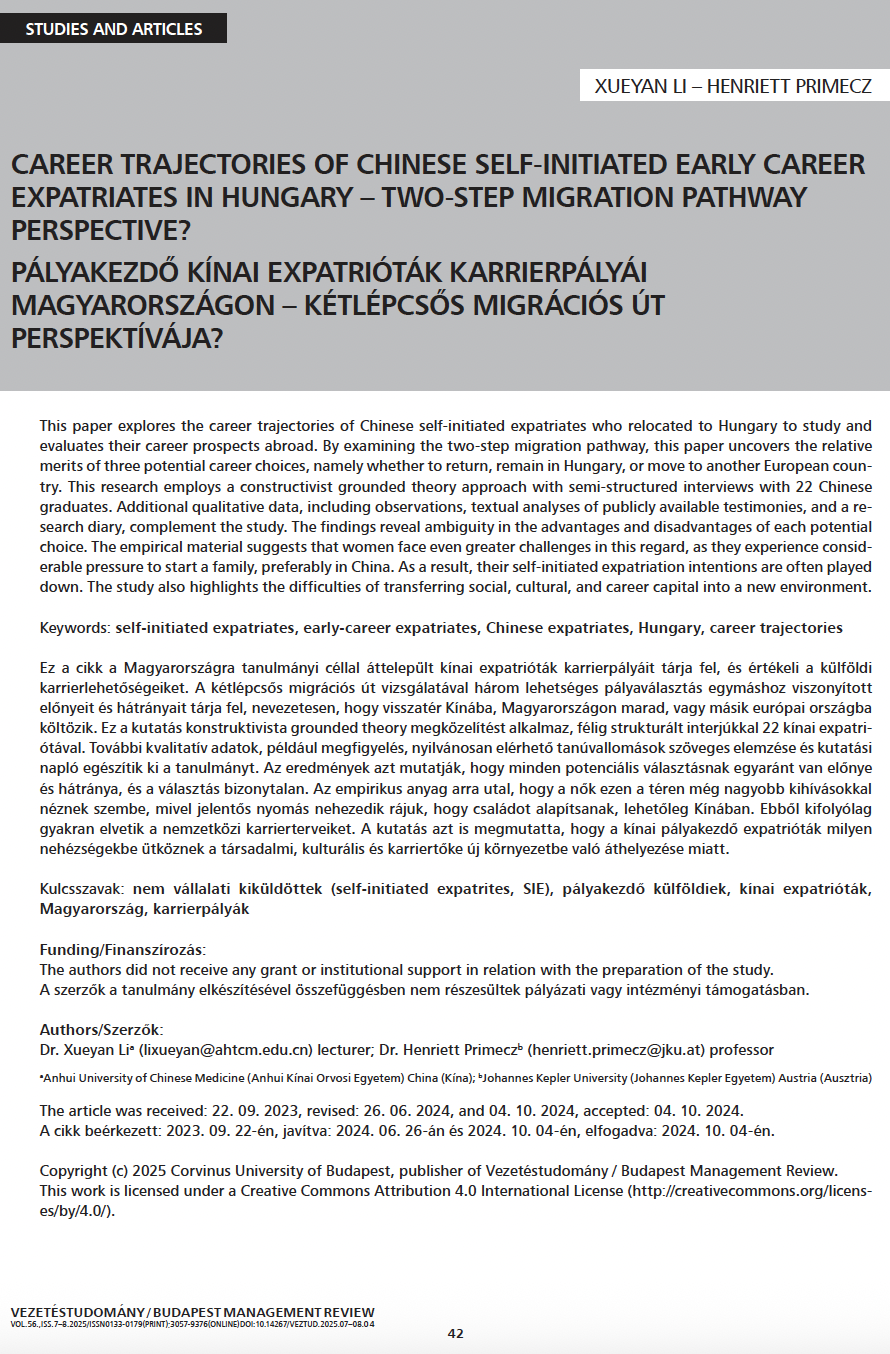
Pályakezdő kínai expatrióták karrierpályái Magyarországon
Kétlépcsős migrációs út perspektívája?
DOI:
https://doi.org/10.14267/VEZTUD.2025.07-08.04Kulcsszavak:
nem vállalati kiküldöttek (self-initiated expatrites, SIE), pályakezdő külföldiek, kínai expatrióták, Magyarország, karrierpályákAbsztrakt
Ez a cikk a Magyarországra tanulmányi céllal áttelepült kínai expatrióták karrierpályáit tárja fel, és értékeli a külföldi karrierlehetőségeiket. A kétlépcsős migrációs út vizsgálatával három lehetséges pályaválasztás egymáshoz viszonyított előnyeit és hátrányait tárja fel, nevezetesen, hogy visszatér Kínába, Magyarországon marad, vagy másik európai országba költözik. Ez a kutatás konstruktivista grounded theory megközelítést alkalmaz, félig strukturált interjúkkal 22 kínai expatriótával. További kvalitatív adatok, például megfigyelés, nyilvánosan elérhető tanúvallomások szöveges elemzése és kutatási napló egészítik ki a tanulmányt. Az eredmények azt mutatják, hogy minden potenciális választásnak egyaránt van előnye és hátránya, és a választás bizonytalan. Az empirikus anyag arra utal, hogy a nők ezen a téren még nagyobb kihívásokkal néznek szembe, mivel jelentős nyomás nehezedik rájuk, hogy családot alapítsanak, lehetőleg Kínában. Ebből kifolyólag gyakran elvetik a nemzetközi karrierterveiket. A kutatás azt is megmutatta, hogy a kínai pályakezdő expatrióták milyen nehézségekbe ütköznek a társadalmi, kulturális és karriertőke új környezetbe való áthelyezése miatt.
Downloads
Hivatkozások
Abimbola, S., Amazan, R., Vizintin, P., Howie, L., Cumming, R., & Negin, J. (2016). Australian higher education scholarships as tools for international development and diplomacy in Africa. Australian Journal of International Affairs, 70(2), 105–120. https://doi.org/10.1080/10357718.2015.1119230
Al Ariss, A. & Özbilgin, M. (2010). Understanding self-initiated expatriates. Career experiences of Lebanese self-initiated expatriates in France. Thunderbird International Business Review, 52(4), 275–285. https://doi.org/10.1002/tie.20355
Al Ariss, A. (2012). Migration or self-initiated expatriation? Questioning terminology in international management studies. In Andresen, M., Al Ariss, A., Walther, M., & Wolff, K. (Eds.), Self-Initiated Expatriation: Mastering the Dynamics (pp. 235-241). Routledge.
Al Ariss, A., & Crowley-Henry, M. (2013). Self-initiated expatriation and migration in the management literature: Present theorizations and future research directions. Career Development International, 18(1), 78–96. https://doi.org/10.1108/13620431311305962
Andresen, M., & Biemann, T. (2012). Career concepts of self-initiated and assigned expatriates: a theoretical analysis based on coupling and configuration. In Andresen, M., Al Ariss, A., & Walther, M. (Eds.), Self-Initiated Expatriation: Individual, Organizational, and National Perspectives (pp. 105-121). Routledge.
Andresen, M., Bergdolt, F., Dickmann, M., & Margenfeld, J. (2014). Addressing international mobility confusion: Developing definitions and differentiations for self-initiated and assigned expatriates as well as migrants. The International Journal of Human Resource Management, 25(16), 2295–2318. https://doi.org/10.1080/09585192.2013.877058
Bamberger, A. (2020). Accumulating cosmopolitan and ethnic identity capital through international student mobility. Studies in Higher Education, 45(7), 1367–1379. https://doi.org/10.1080/03075079.2019.1597037
Beck, F., & Gaspar, S. (2023). In pursuit of a ‘good enough life’: Chinese ‘educational exiles’ in Lisbon and Budapest. Journal of Ethnic and Migration Studies, 50(16), 4070-4088. https://doi.org/10.1080/1369183X.2023.2245156
Beck, F., & Nyíri, P. (2022). It’s all for the child: the discontents of middle-class Chinese parenting and migration to Europe. The China Quarterly, 251, 1–22. https://doi.org/10.1017/S0305741022000169
Becker, G.S. (1964). Human Capital. Columbia University Press.
Bourdieu, P., & Wacquant, L.J.D. (1992). An Invitation to Reflexive Sociology. University of Chicago Press.
Bozionelos, N., Bozionelos, G., Kostopoulos, K., Shyong, C.H., Baruch, Y., & Zhou, W. (2015). International graduate students’ perceptions and interest in international careers. The International Journal of Human Resource Management, 26(11), 1428–1451. https://doi.org/10.1080/09585192.2014.935457
Briscoe, D., Schuler, R.S., & Claus, L. (2009). International Human Resource Management (3rd ed.). Routledge.
Carr, S.C., Inkson, K. & Thorn, K. (2005). From global careers to talent flow: reinterpreting brain drain. Journal of World Business, 40(4), 386–398. https://doi.org/10.1016/j.jwb.2005.08.006
Cerdin, J.L., & Selmer, J. (2014). Who is a self-initiated expatriate? Towards conceptual clarity of a common notion. The International Journal of Human Resource Management, 25(9), 1281-1301. https://doi.org/10.1080/09585192.2013.863793
Charmaz, K., (2006). Constructing Grounded Theory: A Practical Guide Through Qualitative Analysis. Sage.
Charmaz, K. (2020). With constructivist grounded theory you can’t hide’: social justice research and critical inquiry in the public sphere. Qualitative Inquiry, 26(2), 165–176. https://doi.org/10.1177/1077800419879081
Chellaraj, G., Maskus, K.E., & Mattoo, A. (2008). The contribution of international graduate students to US innovation. Review of International Economics, 16(3), 444–446. https://doi.org/10.1111/j.1467-9396.2007.00714.x
Crowley-Henry, M. (2012). Re-conceptualizing the career development of self-initiated expatriates: rivers not ladders. Journal Management Development, 31(2), 130–141. https://doi.org/10.1108/02621711211199476
Daloz, J.P. (2013). Rethinking Social Distinction. Palgrave Macmillan.
DiMaggio, P. (1982). Cultural capital and school success: the impact of status culture participation on U.S. high school students’ grades. American Sociological Review, 47(2), 189–201. https://doi.org/10.2307/2094962
Doherty, N. (2013). Understanding the self-initiated expatriate. A review and directions for future research. International Journal of Management Reviews, 15(4), 447–469. https://doi.org/10.1111/ijmr.12005
Doherty, N., & Dickmann, M. (2012). Self-initiated expatriation: drivers, employment expertise and career outcomes. In Andresen, M., Al Ariss, A., Walther, M., & Wolff, K. (Eds.), Self-Initiated Expatriation: Individual, Organizational and National Perspectives (pp. 122-142). Routledge.
Donald, W.E., Ashleigh, M.J., & Baruch, Y. (2018). Students’ perceptions of education and employability: Facilitating career transition from higher education into the labor market. Career Development International, 23(5), 513–540. https://doi.org/10.1108/CDI-09-2017-0171
Dorsch, M., Suutari, V., & Brewster, C. (2012). Research on self-initiated expatriation: history and future directions. In Andresen, M., Al Ariss, A., & Walther, M. (Eds.), Self-Initiated Expatriation: Individual, Organizational, and National Perspectives (pp. 42-56). Routledge.
Dustmann, C., Fadlon, I., & Weiss, Y. (2011). Return migration, human capital accumulation and the brain drain. Journal of Development Economics, 95(1), 58-67. https://doi.org/10.1016/j.jdeveco.2010.04.006
Farivar, F., Coffey, J., & Cameron, R. (2019). International graduates and the change of initial career mobility intentions. Personnel Review, 48(4), 1061–1078. https://doi.org/10.1108/PR-01-2017-0007
Finaccord (2014). Global Expatriates: Size, Segmentation and Forecast for the Worldwide Market. Finaccord Ltd.
Ghauri, P., & Gronhaug, K. (2010). Research Methods in Business Studies (4th ed.). Financial Times Press.
Hao, J., Wen, W., & Welch, A. (2016). When sojourners return: Employment opportunities and challenges facing highskilled Chinese returnees. Asian and Pacific Migration Journal, 25(1), 22–40. https://doi.org/10.1177/0117196815621806
Hawthorne, L. (2010). How valuable is “two-step migration”? Labor market outcomes for international student migrants to Australia. Asian and Pacific Migration Journal, 19(1), 5-36. https://doi.org/10.1177/011719681001900102
Howe-Walsh, L., & Schyns, B. (2010). Self-initiated expatriation: implications for HRM. The International Journal of Human Resource Management, 21(2), 260–273. https://doi.org/10.1080/09585190903509571
Hungarian Central Statistical Office (2022). The International Students Number in Hungary. http://statinfo.ksh.hu/Statinfo/haViewer.jsp
Hussain, T., & Deery, S. (2018). Why do self-initiated expatriates quit their jobs: The role of job embeddedness and shocks in explaining turnover intentions. International Business Review, 27(1), 281–288. https://doi.org/10.1016/j.ibusrev.2017.08.002
Israel, E., & Cohen, N. (2022). Between cosmopolitanism and parochialism: return migration of early-career Israeli academics. Comparative Migration Studies, 10(1), 1-27. https://doi.org/10.1186/s40878-022-00316-x
Jonbekova, D., Kim, T., Kerimkulova, S., Ruby, A., & Sparks, J. (2021). Employment of international education graduates: Issues of economy and resistance to change. Higher Education Quarterly, 75(4), 618– 633. https://doi.org/10.1111/hequ.12321
Kanstrén, K., & Suutari, V. (2021). Development of career capital during expatriation: Partners’ perspectives. Career Development International, 26(6), 824–849. https://doi.org/10.1108/CDI-12-2020-0314
Kaur, S., & Sidhu, G.K. (2009). A qualitative study of postgraduate students’ learning experiences in Malaysia. International Education Studies, 2(3), 47–56. https://eric.ed.gov/?id=EJ1065708
Kohonen, E. (2005). Developing global leaders through international assignments: an identity construction perspective. Personnel Review, 34(1), 22–36. https://doi.org/10.1108/00483480510571860
Kraimer, M.L., Shaffer, M.A., & Bolino, M.C. (2009). The influence of expatriate and repatriate experiences on career advancement and repatriate retention. Human Resource Management, 48(1), 27-47. https://doi.org/10.1002/hrm.20265
Li, X. (2020). Chinese students choosing Hungarian tertiary education. East Asia: International Quarterly, 37(4), 317-330. https://doi.org/10.1007/s12140-020-09333-y
Li, X., & Primecz, H. (2021). The future plans and dilemmas of Chinese students studying in Hungary. Society and Economy, 43(4), 374–390. https://doi.org/10.1556/204.2021.00015
Li, X., & Primecz, H. (2023). A qualitative exploration of the socioeconomic status and motivations of Chinese students in Hungary. Intersections, EEJSP, 9(1), 79–100. https://doi.org/10.17356/ieejsp.v9i1.814
Li, X., Primecz, H., & Paget, A.L. (2023). Understanding the early career self-initiated expatriation. A review and directions for future research. Vezetéstudomány/ Budapest Management Review, 54(5), 18-30. https://doi.org/10.14267/VEZTUD.2023.05.02
Lincoln, Y., Lynham, S., & Guba, E. (2017). Paradigmatic controversies, contradictions, and emerging confluences. In Denzin, N.K., & Lincoln, Y. S. (Eds.), The Sage Handbook of Qualitative Research (pp. 75-112). SAGE.
McNulty, Y., & Brewster, C. (2017). Theorizing the meaning( s) of ‘expatriate’: establishing boundary conditions for business expatriates. International Journal of Human Resource Management, 28(1), 27–61. https://doi.org/10.1080/09585192.2016.1243567
Modise, O.M. (2016). Career workshops as a non-traditional research model for enhanced relationships between higher education and the labour market. International Journal of Training and Development, 20(2), 152–163. https://doi.org/10.1111/ijtd.12076
Nachatar Singh, J.K. (2020). Challenges in obtaining employment in China: Lived experiences of Australian Chinese graduates. Australian Journal of Career Development, 29(3), 153-163. https://doi.org/10.1177/1038416220947085
Nahapiet, J., & Ghoshal, S. (1998). Social capital, intellectual capital, and the organizational advantage. Academy of Management Review, 23(2), 242-266. https://doi.org//10.2307/259373
O’Kane, P., Smith, A., & Lerman, M. (2021). Building transparency and trustworthiness in inductive research through computer-aided qualitative data analysis software. Organizational Research Methods, 24(1), 104-139. https://doi.org//10.1177/1094428119865016
Pereira, V., Malik, A., Howe-Walsh, L., Munjal, S., & Hirekhan, M. (2016). Managing yopatriates: a longitudinal study of generation Y expatriates in an Indian multi-national corporation. Journal of International Management, 23(2), 151-165. https://doi.org/10.1016/j.intman.2016.11.002
Pham, T. (2020). Reconceptualising employability of returnees: What really matters and strategic navigating approaches. Higher Education, 81, 1329-1345. https://doi.org/10.1007/s10734-020-00614-2
Primecz, H. (2020). Positivist, constructivist and critical approaches to international human resource management and some future directions. German Journal of Human Resource Management, 34(2), 124-147. https://doi.org/10.1177/2397002220909069
Primecz, H., & Li, X. (2022a). Magyarországon tanuló kínai hallgatók társadalmi háttere és belépési nehézségei (Social background and entry difficulties of Chinese students studying in Hungary). Educatio, 30(4), 713-721. https://doi.org/10.1556/2063.30.2021.4.12
Primecz, H., & Li, X. (2022b). Kínai hallgatók nehézségei magyarországi tanulmányaik alatt és után (Chinese students’ difficulties during and after studying in Hungary). Educatio, 32(2), 294-302. https://doi.org/10.1556/2063.31.2022.2.9
Richardson, J., O’Neil, D.A., & Thorn, K. (2021). Exploring careers through a qualitative lens: an investigation and invitation. Career Development International, 27(1), 99-112. https://doi.org/10.1108/CDI-08-2021-0197
Scurry, T., Rodriguez, J.K., & Bailouni, S. (2013). Narratives of identity of self-initiated expatriates in Qatar. Career Development International, 18(1), 12-33. https://doi.org/10.1108/13620431311305926
Selmer, J., & Lauring, J. (2010). Self‐initiated academic expatriates: Inherent demographics and reasons to expatriate. European Management Review, 7(3), 169-179. https://doi.org/10.1057/emr.2010.15
Seok-Young, O., & Jang, K. (2021). Self-initiated expatriate adjustment: South Korean workers in Vietnam. Career Development International, 26(1), 16-43. https://doi.org/10.1108/CDI-09-2019-0212
Shaffer, M., Kraimer, M.L., Chen, Y.P., & Bolino, M.C. (2012). Choices, challenges, and career consequences of global work experiences: a review and future Agenda. Journal of Management, 38(4), 1282-1327. https://doi.org/10.1177/0149206312441834
Sullivan, S., & Mainiero, L. (2007). The changing nature of gender roles, alpha/beta careers and work-life issues: theory-driven implications for human resource management. Career Development International, 12(3), 238-263. https://doi.org/10.1108/13620430710745881
Suutari, V., Brewster, C., Mäkelä, L., Dickmann, M., &Tornikoski, C., (2018). The effect of international work experience on the career success of expatriates: a comparison of assigned and self-initiated expatriates. Human Resource Management, 57(1), 37-54. https://doi.org/10.1002/hrm.21827
Symon, G., Cassell, C., & Johnson, P. (2018). Evaluative practices in qualitative management research: a critical review. International Journal of Management Reviews, 20(01), 134-154. https://doi.org/10.1111/ijmr.12120
Tharenou, P. (2003). The initial development of receptivity to working abroad: self-initiated international work opportunities in young graduate employees. Journal of Occupational and Organisational Psychology, 76(4), 489-515. https://doi.org/10.1348/096317903322591604
Tharenou, P. (2015). Researching expatriate types: The quest for rigorous methodological approaches. Human Resource Management Journal, 25(2), 149-165. https://doi.org/10.1111/1748-8583.12070
Tharenou, P., & Caulfifield, N. (2010). Will I stay or will I go? Explaining repatriation by self-initiated expatriates. Academy of Management Journal, 53(5), 1009- 1028. https://doi.org/10.5465/amj.2010.54533183
United Nations. (2013). Demographic Yearbook 2012. United Nations Statistics Division.
Waxin, M.F., & Brewster, C. (2020). The impact of host country characteristics on self-initiated expatriates’ career success. In Brewster, C., Sparrow, P., & Vernon, G. (Eds.), The Handbook of Research on Expatriate Management and Leadership (pp. 50-62). Routledge.
Wechtler, H. (2018). Life if elsewhere: a diary study of female self-initiated expatriates’ motivations to work abroad. Career Development International, 23(3), 291-311. https://doi.org/10.1108/cdi-06-2017-0103
Wiers-Jenssen, J. (2007). Does higher education attained abroad lead to international jobs? Journal of Studies in International Education, 12(2), 101-130. https://doi.org/10.1177/1028315307307656
Wong, Y., Wang, T., & Xu, Y. (2015). Poverty and quality of life of Chinese children: From the perspective of deprivation: Child poverty and quality of life. International Journal of Social Welfare, 24(3), 236-247. https://doi.org/10.1111/ijsw.12115
Wu, S., Zhou, S., Huang, M., & Chen, W. (2020). Employment prospects of graduates from Sino-foreign cooperative universities in China. Journal of Studies in International Education, 26(1), 1-23. https://doi.org/10.1177/1028315320957433
Yao, C., Thorn, K., & Doherty, N. (2014). Boundarylessness as a dynamic construct: The case of Chinese early career expatriates. Career Development International, 19(6), 683-699. https://doi.org/10.1108/CDI-11-2013-0142
Letöltések
Megjelent
Folyóirat szám
Rovat
License
Copyright (c) 2025 Corvinus University of Budapest, publisher of Vezetéstudomány / Budapest Management Review

This work is licensed under a Creative Commons Attribution 4.0 International License.
Authors assign copyright to Vezetéstudomány / Budapest Management Review. Authors are responsible for permission to reproduce copyright material from other sources.
Hogyan kell idézni