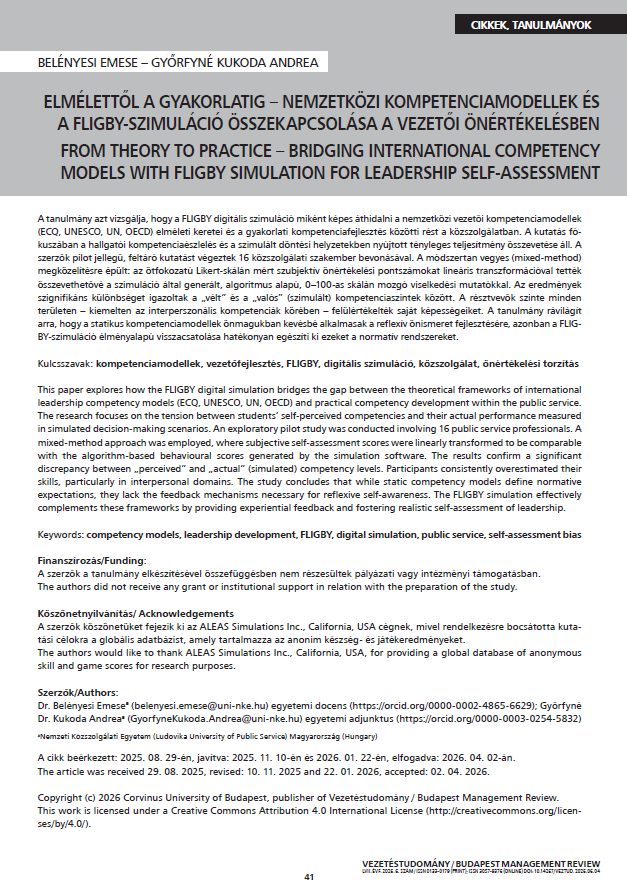
From theory to practice – Bridging international competency models with Fligby simulation for leadership self-assessment
DOI:
https://doi.org/10.14267/VEZTUD.2026.06.04Keywords:
competency models, leadership development, FLIGBY, digital simulation, public service, self-assessment biasAbstract
This paper explores how the FLIGBY digital simulation bridges the gap between the theoretical frameworks of international leadership competency models (ECQ, UNESCO, UN, OECD) and practical competency development within the public service. The research focuses on the tension between students’ self-perceived competencies and their actual performance measured in simulated decision-making scenarios. An exploratory pilot study was conducted involving 16 public service professionals. A mixed-method approach was employed, where subjective self-assessment scores were linearly transformed to be comparable with the algorithm-based behavioural scores generated by the simulation software. The results confirm a significant discrepancy between „perceived” and „actual” (simulated) competency levels. Participants consistently overestimated their skills, particularly in interpersonal domains. The study concludes that while static competency models define normative expectations, they lack the feedback mechanisms necessary for reflexive self-awareness. The FLIGBY simulation effectively complements these frameworks by providing experiential feedback and fostering realistic self-assessment of leadership.
Downloads
References
Almeida, F. & Buzády, Z. (2019). Learning Entrepreneurship in Higher Education Through Flow Theory and FLIGBY Game. International Journal of Virtual and Personal Learning Environments (IJVPLE), 9(1), 1-15. https://doi.org/10.4018/IJVPLE.2019010101
Argyris, C. (1991). Teaching Smart People How to Learn. Harvard Business Review, 4(2), 4-15. https://coronorcal.org/wp-content/uploads/2018/01/chris_argyris_learning.pdf
Bolden, R., Morgen, W., & Linacre, N. (2016). Leadership Paradoxes, Rethinking Leadership for an Uncertain World. Routledge. https://doi.org/10.4324/9781315751283
Boyatzis, R.E. (2008). Competencies in the 21st century. Journal of Management Development, 27(1), 5–12. https://doi.org/10.1108/02621710810840730
Buzady, Z., Wimmer, A., Csesznak, A., & Szentesi, P. (2024). Exploring flow-promoting management and leadership skills via serious gaming. Interactive Learning Environments, 32(2), 757–771. https://doi.org/10.1080/10494820.2022.2098775
Csíkszentmihályi, M. (2003). Good Business: Leadership, Flow, and the Making of Meaning. Penguin Books. https://books.google.hu/books?hl=hu&lr=&id=PkMEWBdln2MC&oi=fnd&pg=PR5&dq=%E2%80%A2%09Cs%C3%ADkszent-mih%C3%A1lyi,+M.+(2014).+Good+Busi-ness:+Leadership,+Flow,+and+the+Making+of+Meaning.+Penguin.&ots=h_j5D_mqn9&sig=uQbt67rc-FQ_jItVB6aFszrVHyY&redir_esc=y#v=onepage&q&f=false
Czeily, T. (2024). Játékosítás a toborzásban – Egy diszkrét választási kísérlet eredményei. Vezetéstudomány, 55(4), 2–16. https://doi.org/10.14267/VEZTUD.2024.04.01
Egységes közszolgálati vezetői kompetenciák rendszere, EKVK (2019). https://cdn.kormany.hu/uploads/document/a/ad/adc/adc385e8352a298b12e3294f-56c602a68974e382.pdf
Fernandez, S., & Moldogaziev, T. (2013). Employee Empowerment and Job Satisfaction in the U.S. Federal Bureaucracy: A Self-Determination Theory Perspective. The American Review of Public Administration, 45(4), 375-401. https://doi.org/10.1177/0275074013507478
Gerson, D. (2020). Leadership for a high performing civil service: Towards senior civil service systems in OECD countries. OECD Working Papers on Public Governance, No. 40, OECD Publishing. https://doi.org/10.1787/ed8235c8-en
Illiash, T. (2013). Constructing an integrated model of public-sector leadership competencies [Doctoral dissertation]. Rutgers University. Rutgers University Community Repository. https://doi.org/doi:10.7282/T3XS5T07
Krenyácz, É., & Alotaiby, R.A.M. (2022). Vezetői kompetenciák elemzése a szervezeti változásokra való felkészültség alapján. Vezetéstudomány, 53(10), 2–15. https://doi.org/10.14267/VEZTUD.2022.10.05
Kruger, J., & Dunning, D. (1999). Unskilled and unaware of it: How difficulties in recognizing one’s own incompetence lead to inflated self-assessments. Journal of Personality and Social Psychology, 77(6), 1121–1134. https://doi.org/10.1037/0022-3514.77.6.1121
López-Serrano, M.J., García-Carrión, R., McGowan, S., & Paredes, J. (2025). Teaching soft skills in higher education through serious games: Validation of the Compete! gamification. Smart Learning Environments, 12, 49. https://doi.org/10.1186/s40561-025-00401-5
McGowan, N., López-Serrano, A., & Burgos, D. (2023). Serious Games and Soft Skills in Higher Education: A Case Study of the Design of Compete!. Electronics, 12(6), 1432. https://doi.org/10.3390/electronics12061432
OECD (2019). Recommendation of the Council on OECD Legal Instruments Public Service Leadership and Capability. OECD/LEGAL/0445. https://web-archive.oecd.org/2019-07-17/526235-recommendation-on-public-service-leadership-and-capability-en.pdf
OECD (2020). Recommendation on Public Service Leadership and Capability. https://one.oecd.org/document/GOV/PGC/PEM(2020)8/en/pdf
OECD (2021). Public Employment and Management 2021: The Future of the Public Service. OECD Publishing. https://doi.org/10.1787/5f5c9a9f-en
OECD (2023). Core Competency Framework. Human Resource Management. OECD Publishing. https://www.oecd.org/en/about/careers/apply/core-competency-framework.html
Olejniczak, K., Newcomer, K.E., & Meijer, S.A. (2020). Advancing Evaluation Practice With Serious Games. American Journal of Evaluation, 41(3), 339-366. https://doi.org/10.1177/1098214020905897
Office of Personnel Management (2017). Executive Core Qualifications (ECQs). https://www.opm.gov/policy-data-oversight/senior-executive-service/executive-core-qualifications/
Sándor, T. (2014). Vezetőfejlesztés hatékonyan. Vezetéstudomány, 45(12), 73–84. https://doi.org/10.14267/VEZTUD.2014.12.07
Siewiorek, A., Saarinen, E., Lainema, T., & Lehtinen, E. (2012). Learning leadership skills in a simulated business environment. Computers & Education, 58(1), 121–135. https://doi.org/10.1016/j.compedu.2011.08.016
Spencer, L.M., & Spencer, S.M. (1993). Competence at work: Models for superior performance. John Wiley & Sons. https://www.wiley.com/en-us/Competence+at+Work%3A+Models+for+Superior+Performance-p-9780471548096
United Nations Educational, Scientific and Cultural Organization (2016). UNESCO Competency Framework. https://unesdoc.unesco.org/ark:/48223/pf0000245056
United Nations (2010). Un Competency Development - A Practical Guide. Office of Human Resources Management. https://digitallibrary.un.org/record/700591/files/Un_competency_development_guide.pdf
United Nations. (2019). Competencies for the future. https://careers.un.org/lbw/attachments/competencies_booklet_en.pdf.
Van Wart, M. (2013). Lessons from leadership theory and the contemporary challenges of leaders. Public Administration Review, 73(4), 553–565. https://doi.org/10.1111/puar.12069
Downloads
Published
Issue
Section
License
Copyright (c) 2026 Corvinus University of Budapest, publisher of Vezetéstudomány / Budapest Management Review

This work is licensed under a Creative Commons Attribution 4.0 International License.
Authors assign copyright to Vezetéstudomány / Budapest Management Review. Authors are responsible for permission to reproduce copyright material from other sources.
How to Cite