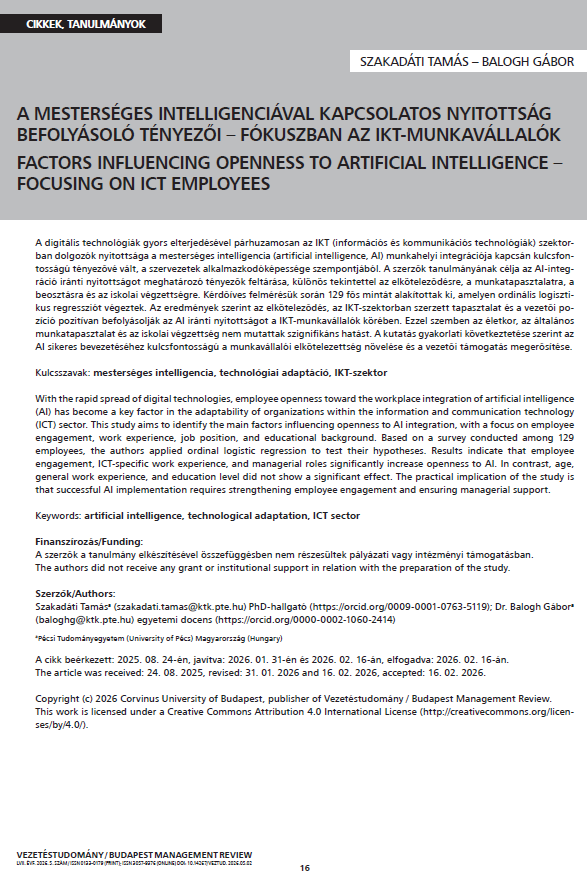
A mesterséges intelligenciával kapcsolatos nyitottság befolyásoló tényezői
Fókuszban az IKT-munkavállalók
DOI:
https://doi.org/10.14267/VEZTUD.2026.05.02Kulcsszavak:
mesterséges intelligencia, technológiai adaptáció, IKT-szektorAbsztrakt
A digitális technológiák gyors elterjedésével párhuzamosan az IKT (információs és kommunikációs technológiák) szektorban dolgozók nyitottsága a mesterséges intelligencia (artificial intelligence, AI) munkahelyi integrációja kapcsán kulcsfontosságú tényezővé vált, a szervezetek alkalmazkodóképessége szempontjából. A szerzők tanulmányának célja az AI-integráció iránti nyitottságot meghatározó tényezők feltárása, különös tekintettel az elköteleződésre, a munkatapasztalatra, a beosztásra és az iskolai végzettségre. Kérdőíves felmérésük során 129 fős mintát alakítottak ki, amelyen ordinális logisztikus regressziót végeztek. Az eredmények szerint az elköteleződés, az IKT-szektorban szerzett tapasztalat és a vezetői pozíció pozitívan befolyásolják az AI iránti nyitottságot a IKT-munkavállalók körében. Ezzel szemben az életkor, az általános munkatapasztalat és az iskolai végzettség nem mutattak szignifikáns hatást. A kutatás gyakorlati következtetése szerint az AI sikeres bevezetéséhez kulcsfontosságú a munkavállalói elkötelezettség növelése és a vezetői támogatás megerősítése.
Downloads
Hivatkozások
Bakker, A.B., & Demerouti, E. (2017). Job demands–resources theory: Taking stock and looking forward. Journal of Occupational Health Psychology, 22(3), 273–285. https://doi.org/10.1037/ocp0000056
Barney, J.B. (1991). Firm resources and sustained competitive advantage. Journal of Management, 17(1), 99–120. https://doi.org/10.1177/014920639101700108
Bergkvist, L., & Rossiter, J.R. (2007). The predictive validity of multiple-item versus single-item measures of the same constructs. Journal of Marketing Research, 44(2), 175–184. https://doi.org/10.1509/jmkr.44.2.175
Bharadwaj, A.S. (2000). A resource-based perspective on information technology capability and firm performance: An empirical investigation. MIS Quarterly, 24(1), 169–196. https://doi.org/10.2307/3250983
Borgulya, Á., & Kovács, É. (2021). A vállalaton belüli innováció-kommunikáció, mint a szervezeti kultúra része – a szakirodalom tükrében. Marketing & Menedzsment, 54(4), 63–75. https://doi.org/10.15170/MM.2020.54.04.05
Brown, S.A., Massey, A.P., Montoya-Weiss, M.M., & Burkman, J.R. (2002). Do I really have to? User acceptance of mandated technology. European Journal of Information Systems, 11(4), 283–295. https://doi.org/10.1057/palgrave.ejis.3000438
Compeau, D.R., & Higgins, C.A. (1995). Computer self-efficacy: Development of a measure and initial test. MIS Quarterly, 19(2), 189–211. https://doi.org/10.2307/249688
Chan, C.K.Y., & Lee, K.K.W. (2023). The AI generation gap: Are Gen Z students more interested in adopting generative AI such as ChatGPT in teaching and learning than their Gen X and Millennial generation teachers? Smart Learning Environments, 10(1), Article 60. https://doi.org/10.1186/s40561-023-00269-3
Chatterjee, S., Rana, N.P., Khorana, S., Mikalef, P., & Sharma, A. (2023). Assessing organizational users’ intentions and behavior to AI integrated CRM systems: A Meta UTAUT approach. Information Systems Frontiers, 25(4), 1299–1313. https://doi.org/10.1007/s10796-021-10181-1
Chelmis, C., & Prasanna, V.K. (2013). The role of organization hierarchy in technology adoption at the workplace. In J.G. Rokne & C. Faloutsos (Eds.), Advances in Social Networks Analysis and Mining 2013 (ASONAM ’13), Niagara, ON, Canada, August 25–29, 2013 (pp. 8–15). Association for Computing Machinery. https://doi.org/10.1145/2492517.2492566
Cheng, C.H., Li, M.H., Tang, B.J., & Cheng, Y.R. (2024). The impact of knowledge management and organizational learning promotion in small and medium enterprises on the implementation of Industry 4.0 and competitiveness. Administrative Sciences, 14(8), 161. https://doi.org/10.3390/admsci14080161
Choi, H. (2023). What drives the acceptance of AI technology? The role of expectations and experiences. arXiv preprint. https://doi.org/10.48550/arXiv.2306.13670
Choudhary, R., Shaik, Y.A., Yadav, P., & Rashid, A. (2024). Generational differences in technology behavior: A systematic literature review of Gen X, Gen Y, and Gen Z in the workplace. Journal of Infrastructure, Policy and Development, 8(9), Article 6755. https://doi.org/10.24294/jipd.v8i9.6755
Costa, P.T., & McCrae, R.R. (1992). Revised NEO Personality Inventory (NEO-PI-R) and NEO Five-Factor Inventory (NEO-FFI): Professional manual. Psychological Assessment Resources. https://doi.org/10.4135/9781849200479.n9
Davis, F.D. (1989). Perceived usefulness, perceived ease of use, and user acceptance of information technology. MIS Quarterly, 13(3), 319–340. https://doi.org/10.2307/249008
DeYoung, C.G. (2015). Openness/Intellect: A dimension of personality reflecting cognitive exploration. In M.L. Cooper & R.J. Larsen (Eds.), APA handbook of personality and social psychology: Personality processes and individual differences (Vol. 4, pp. 369–399). American Psychological Association. https://doi.org/10.1037/14343-017
Dwivedi, Y.K., Hughes, D.L., Baabdullah, A.M., Ribeiro- Navarrete, S., Giannakis, M., & Raman, R. (2021). Artificial intelligence (AI): Multidisciplinary perspectives on emerging challenges, opportunities, and agenda for research, practice and policy. International Journal of Information Management, 57, 101994. https://doi.org/10.1016/j.ijinfomgt.2019.08.002
Dwivedi, Y.K., Rana, N.P., Jeyaraj, A., Clement, M., & Williams, M.D. (2019). Re-examining the unified theory of acceptance and use of technology (UTAUT):Towards a revised theoretical model. Information Systems Frontiers, 21(3), 719–734. https://doi.org/10.1007/s10796-017-9774-y
Evans, D.S., & Schmalensee, R. (2010). Failure to launch: Critical mass in platform businesses. Review of Network Economics, 9(4), Article 1. https://doi.org/10.2202/1446-9022.1256
Gallup. (2021). State of the global workplace report. Gallup. https://www.gallup.com/workplace/349484/stateof- the-global-workplace.aspx
Goldberg, L.R. (1990). An alternative ‘description of personality’: The Big-Five factor structure. Journal of Personality and Social Psychology, 59(6), 1216–1229. https://doi.org/10.1037/0022-3514.59.6.1216
Guo, H., & Erdenebold, T. (2025). Factors influencing intention to adopt an AI chatbot for learning in higher education: An integrated PLS-SEM, IPMA, and ANN approach. Computers and Education: Artificial Intelligence, 9, Article 100477. https://doi.org/10.1016/j.caeai.2025.100477
Grecu, V., & Deneş, C. (2024). The role of organizational culture in driving innovation: A study of contemporary business practice. Acta Universitatis Cibiniensis. Technical Series, 76(1), 46–54. https://doi.org/10.2478/aucts-2024-0007
Grozdics, A.T., Girán, J., Uhrin, A., Balogh, G., Cakó, B., Cselik, B., & Borsos, Á. (2023). Working from home or back to the office? The impact of the recent turbulence on office work. Marketing & Menedzsment, 57(1), 25-35. https://doi.org/10.15170/MM.2023.57.01.03
Halász, Á., & Kenesei, Z. (2022). Technológiaelfogadás a felsőoktatásban – Az interakcióigény és az önszabályozás hatása az online tanulási szándékra. Vezetéstudomány, 53(7), 4–18. https://doi.org/10.14267/VEZTUD.2022.07.02
Hakanen, J.J., Perhoniemi, R., & Toppinen-Tanner, S. (2008). Positive gain spirals at work: From job resources to work engagement, personal initiative and workunit innovativeness. Journal of Vocational Behavior, 73(1), 78–91. https://doi.org/10.1016/j.jvb.2008.01.003
Johnston, A.C., & Warkentin, M. (2010). Fear appeals and information security behaviors: An empirical study. MIS Quarterly, 34(3), 549–566. https://doi.org/10.2307/25750691
Kahn, W.A. (1990). Psychological conditions of personal engagement and disengagement at work. Academy of Management Journal, 33(4), 692–724 https://www.jstor.org/stable/256287
Kenesei, Z., & Janecskó, E. (2015). Önkiszolgáló technológiák elfogadásának vizsgálata a szerepelmélet segítségével. Vezetéstudomány, 46(1), 2–19. https://doi.org/10.14267/VEZTUD.2015.01.01
Kenesei, Z., & Cserdi, Z. (2018). A kényszerített önkiszolgálás elfogadásának előzményei és következményei a BKK-automaták példáján keresztül. Vezetéstudomány, 49(12), 4–10. https://doi.org/10.14267/VEZTUD.2018.12.01
Keszey, T., & Zsukk, J. (2017). Az új technológiák fogyasztói elfogadása: A magyar és nemzetközi szakirodalom áttekintése és kritikai értékelése. Vezetéstudomány, 48(10), 38–47. https://doi.org/10.14267/VEZTUD.2017.10.05
Központi Statisztikai Hivatal. (2023). Az infokommunikációs szektor helyzete, 2023. KSH. https://www.ksh.hu/s/kiadvanyok/az-infokommunikacios-szektor-helyzete/
Lee, A.T., Ramasamy, R.K., & Subbarao, A. (2025). Understanding psychosocial barriers to healthcare technology adoption: A review of TAM Technology Acceptance Model and Unified Theory of Acceptance and Use of Technology and UTAUT frameworks. Healthcare, 13(3), 250. https://doi.org/10.3390/healthcare13030250
Liang, H., & Xue, Y. (2009). Avoidance of information technology threats: A theoretical perspective. MIS Quarterly, 33(1), 71–90. https://doi.org/10.2307/20650279
Macey, W. H., & Schneider, B. (2008). The meaning of employee engagement. Industrial and Organizational Psychology, 1(1), 3–30. https://doi.org/10.1111/j.1754-9434.2007.0002.x
Marangunić, N., & Granić, A. (2015). Technology acceptance model: A literature review from 1986 to 2013. Universal Access in the Information Society, 14(1), 81–95. https://doi.org/10.1007/s10209-014-0348-1
McIntyre, D.P., & Srinivasan, A. (2017). Networks, platforms, and strategy: Emerging views and next steps. Strategic Management Journal, 38(1), 141–160. https://doi.org/10.1002/smj.2596
Mikalef, P., & Gupta, M. (2021). Artificial intelligence capability: Conceptualization, measurement calibration, and empirical study on its impact on organizational creativity and firm performance. Information & Management, 58(3), 103434. https://doi.org/10.1016/j.im.2021.103434
Mohammad, S., Sağsan, M., & Şeşen, H. (2024). The impact of “learning organizations” on innovation: The mediating role of “employee resilience” and work engagement. SAGE Open, 14(4). https://doi.org/10.1177/21582440241289185
Munteanu, N. (2024). Peer influence on the adoption of artificial intelligence tools in the workplace [Master’s thesis, NOVA Information Management School]. RUN Repository. https://run.unl.pt/bitstream/10362/174328/1/TDDM3751.pdf
Murire, O.T. (2024). Artificial intelligence and its role in shaping organizational work practices and culture. Administrative Sciences, 14(12), 316. https://doi.org/10.3390/admsci14120316
Nikou, S., De Reuver, M., & Kanafi, M.M. (2022). Workplace literacy skills—how information and digital literacy affect adoption of digital technology. Journal of Documentation, 78(7), 371–391. https://doi.org/10.1108/JD-12-2021-0241
Olushola, T., & Abiola, J. (2017). The efficacy of technology acceptance model: A review of applicable theoretical models in information technology researches. Journal of Research in Business and Management, 4(11), 70–83. https://www.questjournals.org/jrbm/papers/vol4-issue11/J4117083.pdf
Prónay, Sz., Lukovics, M., Kovács, P., Majó, Z., Ujházi, T., Palatinus, Z., & Volosin, M. (2022). Pánik próbája a mérés: Avagy önvezető technológiák elfogadásának valós idejű vizsgálata neurotudományi mérésekkel. Vezetéstudomány, 53(7), 48–62. https://doi.org/10.14267/VEZTUD.2022.07.05
Ram, S., & Sheth, J.N. (1989). Consumer resistance to innovations: The marketing problem and its solutions. Journal of Consumer Marketing, 6(2), 5–14. https://doi.org/10.1108/EUM0000000002542
Rogers, E.M. (2003). Diffusion of innovations (5th ed.). Free Press.
Rogers, R.W. (1975). A protection motivation theory of fear appeals and attitude change. The Journal of Psychology, 91(1), 93–114. https://doi.org/10.1080/00223980.1975.9915803
Schaufeli, W.B., Salanova, M., González-Romá, V., & Bakker, A.B. (2002). The measurement of engagement and burnout: A two sample confirmatory factor analytic approach. Journal of Happiness Studies, 3(1), 71–92. https://doi.org/10.1023/A:1015630930326
Schepman, A., & Rodway, P. (2020). Initial validation of the General Attitudes towards Artificial Intelligence Scale (GAAIS). Computers in Human Behavior Reports, 1, 100014. https://doi.org/10.1016/j.chbr.2020.100014
Seibert, D., Godulla, A., & Wolf, C. (2021). Understanding how personality affects the acceptance of technology: A literature review. SSOAR. https://nbn-resolving.org/urn:nbn:de:0168-ssoar-75164-7
Senge, P., Schneider, F., & Wallace, D. (2015). Peter Senge on the 25th anniversary of The Fifth Discipline. Reflections, 14(3), 1–12.
Scheerder, A., van Deursen, A.J.A.M., & van Dijk, J.A.G.M. (2017). Determinants of Internet skills, uses and outcomes: A systematic review of the second- and third-level digital divide. Telematics and Informatics, 34(8), 1607–1624. https://doi.org/10.1016/j.tele.2017.07.007
Talke, K., & Heidenreich, S. (2014). How to overcome pro-change bias: Incorporating passive and active innovation resistance in innovation decision models. Journal of Product Innovation Management, 31(5), 894–907. https://doi.org/10.1111/jpim.12130
Ursavaş, Ö.F. (2022). Technology acceptance model: History, theory, and application. In Ö.F. Ursavaş (Ed.), Conducting technology acceptance research in education: Theory, models, implementation, and analysis (pp. 57–91). Springer International Publishing. https://doi.org/10.1007/978-3-031-10846-4_4
van Deursen, A.J.A.M., & van Dijk, J.A.G.M. (2011). Internet skills and the digital divide. New Media & Society, 13(6), 893–911. https://doi.org/10.1177/1461444810386774
Venkatesh, V., Morris, M.G., Davis, G.B., & Davis, F.D. (2003). User acceptance of information technology: Toward a unified view. MIS Quarterly, 27(3), 425–478. https://doi.org/10.2307/30036540
Venkatesh, V., Thong, J.Y.L., & Xu, X. (2012). Consumer acceptance and use of information technology: Extending the unified theory. MIS Quarterly, 36(1), 157– 178. https://www.jstor.org/stable/41410412
Wanous, J.P., Reichers, A.E., & Hudy, M.J. (1997). Overall job satisfaction: How good are single-item measures? Journal of Applied Psychology, 82(2), 247–252. https://doi.org/10.1037/0021-9010.82.2.247
Zhang, H., Li, B., Hu, B., & Ai, P. (2025). Exploring the role of personal innovativeness on purchase intention of artificial intelligence products: An investigation using social influence theory and value-based adoption model. International Journal of Human–Computer Interaction. Advance online publication. https://doi.org/10.1080/10447318.2025.2513037
Letöltések
Megjelent
Folyóirat szám
Rovat
License
Copyright (c) 2026 Corvinus University of Budapest, publisher of Vezetéstudomány / Budapest Management Review

This work is licensed under a Creative Commons Attribution 4.0 International License.
Authors assign copyright to Vezetéstudomány / Budapest Management Review. Authors are responsible for permission to reproduce copyright material from other sources.
Hogyan kell idézni