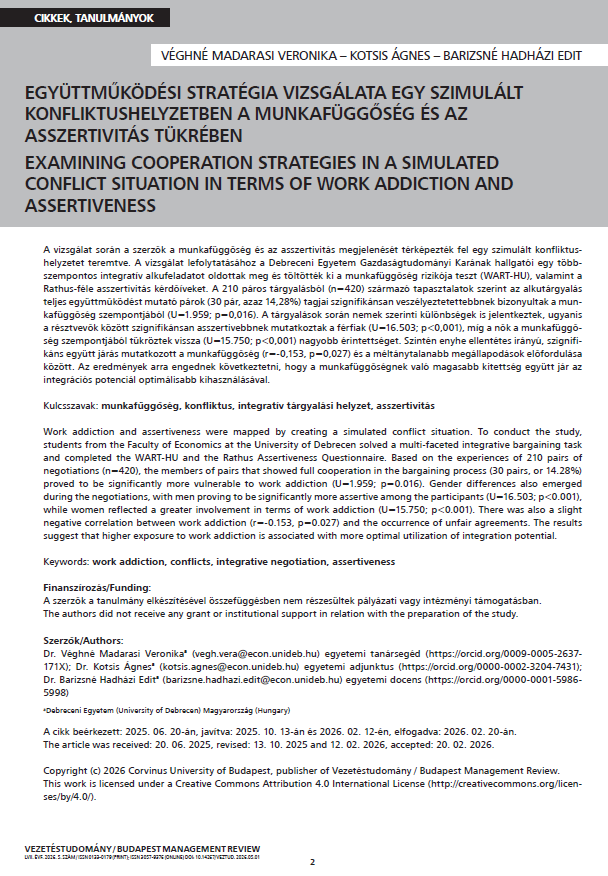
Examining cooperation strategies in a simulated conflict situation in terms of work addiction and assertiveness
DOI:
https://doi.org/10.14267/VEZTUD.2026.05.01Keywords:
work addiction, conflicts, integrative negotiation, assertivenessAbstract
Work addiction and assertiveness were mapped by creating a simulated conflict situation. To conduct the study, students from the Faculty of Economics at the University of Debrecen solved a multi-faceted integrative bargaining task and completed the WART-HU and the Rathus Assertiveness Questionnaire. Based on the experiences of 210 pairs of negotiations (n=420), the members of pairs that showed full cooperation in the bargaining process (30 pairs, or 14.28%) proved to be significantly more vulnerable to work addiction (U=1.959; p=0.016). Gender differences also emerged during the negotiations, with men proving to be significantly more assertive among the participants (U=16.503; p<0.001), while women reflected a greater involvement in terms of work addiction (U=15.750; p<0.001). There was also a slight negative correlation between work addiction (r=-0.153, p=0.027) and the occurrence of unfair agreements. The results suggest that higher exposure to work addiction is associated with more optimal utilization of integration potential.
Downloads
References
Aggrawal, S., & Magana, A.J. (2024). Teamwork conflict management training and conflict resolution practice via large language models. Future Internet, 16(5), 177. https://doi.org/10.3390/fi16050177
Alper, S., Tjosvold, D., & Law, K.S. (2000). Conflict management, efficacy, and performance in organizational teams. Personnel Psychology, 53(3), 625–642. https://doi.org/10.1111/j.1744-6570.2000.tb00216.x
Ames, D.R., & Flynn, F.J. (2007). What breaks a leader: The curvilinear relation between assertiveness and leadership. Journal of Personality and Social Psychology, 92(2), 307–324. https://doi.org/10.1037/0022-3514.92.2.307
Andreassen, C.S., Griffiths, M.D., Hetland, J., & Pallesen, S. (2012). Development of a work addiction scale. Scandinavian Journal of Psychology, 53(3), 265–272. https://doi.org/10.1111/j.1467-9450.2012.00947.x
Andreassen, C.S., Hetland, J., & Pallesen, S. (2010). The relationship between ‘workaholism’, basic needs satisfaction at work and personality. European Journal of Personality, 24(1), 3–17. https://doi.org/10.1002/per.737
Atroszko, P.A., Andreassen, C.S., Griffiths, M.D., & Pallesen, S. (2015). Study addiction—A new area of psychological study: Conceptualization, assessment, and preliminary empirical findings. Journal of Behavioral Addictions, 4(2), 75–84. https://doi.org/10.1556/2006.4.2015.007
Atroszko, P.A., Andreassen, C.S., Griffiths, M.D., & Pallesen, S. (2016). The relationship between study addiction and work addiction: A cross-cultural longitudinal study. Journal of Behavioral Addictions, 5(4), 708–714. https://doi.org/10.1556/2006.5.2016.076
Bakacsi, G. (2015). A szervezeti magatartás alapjai. Semmelweis Kiadó.
Bazerman, M.H., Curhan, J.R., Moore, D.A., & Valley, K.L. (2000). Negotiation. Annual Review of Psychology, 51(1), 279–314. https://doi.org/10.1146/annurev.psych.51.1.279
Benke, M. (2023). Konfliktus menedzsment elméletben és gyakorlatban Thomas Kilmann modellje alapján. Közép-Európai Közlemények, 16(2), 147–164. https://ojs.bibl.u-szeged.hu/index.php/vikekkek/article/view/44760
Bernáth, Á. (2014). Az elmeolvasás és az elmeolvasásra irányuló igény szerepe az egészséges felnőtt személyek társas viselkedésében (Doktori értekezés). Debreceni Egyetem. https://psycho.unideb.hu/munkatarsak/bernath_agnes/bernath_agnes_doktori.pdf
Bernáth, Á., & Kovács, J. (2015). Mentalizációra irányuló igény és együttműködés integratív alkutárgyalásban. Magyar Pszichológiai Szemle, 70(1), 233–247. https://doi.org/10.1556/0016.2015.70.1.14
Bodó, V., Horváth, Z., Paksi, B., Eisinger, A., Felvinczi, K., Demetrovics, Z., & Kun, B. (2024). Work addiction and personality organization: Results from a representative, three-wave longitudinal study. Comprehensive Psychiatry, 134, 152513. https://doi.org/10.1016/j.comppsych.2024.152513
Borbély, T.B., & Pecze, M. (2006). Munkafüggőség – a tiszteletben álló addikció elméleti háttere és attitűdvizsgálata (Doktori értekezés). https://doi.org/10.13140/2.1.2873.6803
Burke, R.J. (2009). Working to live or living to work: Should individuals and organizations care? Journal of Business Ethics, 84, 167–172. https://doi.org/10.1007/s10551-008-9703-6
Chamberlin, C.M., & Zhang, N. (2009). Workaholism, health, and self‐acceptance. Journal of Counseling & Development, 87(2), 159–169. https://doi.org/10.1002/j.1556-6678.2009.tb00563.x
Coleman, P.T. (2018). Ten major scientific contributions that promote a more just, peaceful, and sustainable world. Negotiation Journal, 34(1), 105–116. https://doi.org/10.1111/nejo.12216
De Dreu, C.K., Beersma, B., Steinel, W., & Van Kleef, G.A. (2007). The psychology of negotiation: Principles and basic processes. In A.W. Kruglanski & E.T. Higgins (Eds.), Social psychology: Handbook of basic principles (2nd ed.), (pp. 608–629). The Guilford Press.
Dudek, I., & Szpitalak, M. (2019). Gender differences in workaholism and work-related variables. Studia Humanistyczne AGH, 18(4), 59–76. https://doi.org/10.7494/human.2019.18.4.59
Elida-Tomita, T. (2010). The evolution of conflict as a behavior process within global organizational communication management. Annales Universitatis Apulensis: Series Oeconomica, 12(2), 721–728. https://doi.org/10.29302/oeconomica.2010.12.2.24
Ellemers, N. (2018). Gender stereotypes. Annual Review of Psychology, 69(1), 275–298. https://doi.org/10.1146/annurev-psych-122216-011719
Filep, R. (2025). A transzformációs vezetés kihívásai. Új Munkaügyi Szemle, 6(2), 25-33. https://doi.org/10.58269/umsz.2025.2.3
Fülöp, M. (2024). Konfliktusok és konfliktuskezelés az utóbbi 50 évben Morton Deutsch munkásságának tükrében. Magyar Pszichológiai Szemle, 79(2), 353– 359. https://doi.org/10.1556/0016.2024.00139
Gálos, K., & Vinkóczi, T. (2023). A konfliktuskezelés kulturális összehasonlításban. Vezetéstudomány, 54(3), 40–53. https://doi.org/10.14267/VEZTUD.2023.03.04
Ganji, F., Khani, F., Karimi, Z., & Rabiei, L. (2022). Effect of assertiveness program on the drug use tendency, mental health, and quality of life in clinical students of Shahrekord University of Medical Sciences. Journal of Education and Health Promotion, 11, 48. https://doi.org/10.4103/jehp.jehp_107_21
Gergely, É., & Pierog, A. (2016). Motivációs tényezők feltárása civil és profitorientált szervezeteknél. Gradus, 3(1), 368–373. https://real.mtak.hu/110388/1/2016_1_ECO_012_Gergely.pdf
Gergely, É., Madarász, T., & Pierog, A. (2017). A magas szintű teljesítményhez szükséges háttértényezők feltárása hallgatói mintán. Taylor, 9(1), 139–145. https://ojs.bibl.u-szeged.hu/index.php/taylor/article/view/13085/12941
Hadfield, S., & Hasson, G. (2012). Asszertivitás: Hogyan érvényesítsük sikeresen az érdekeinket? Scolar Kiadó.
Hajdu, F., & Barizsné Hadházi, E. (2020). Students’ assertive communication skills at University of Debrecen. The Annals of the University of Oradea, 29, 348–355. https://anale.steconomiceuoradea.ro/volume/2020/n1/033.pdf
Horváth, Z., Urbán, R., Kökönyei, G., & Demetrovics, Z. (2022). Kérdőíves módszerek a klinikai és egészségpszichológiai kutatásban és gyakorlatban. Medicina Könyvkiadó.
Interreg-IPA CBC Magyarország-Szerbia. (2018). Készség és kompetencia fejlesztő képzés tananyaga II. modul. Konfliktuskezelés, függőségek. Katház Közhasznú Nonprofit Kft.
Kasik, L. (2015). Személyközi problémák és megoldásuk. Gondolat Kiadó.
Kenyhercz, V., Frikker, G., Kaló, Z., Demetrovics, Z., & Kun, B. (2022). Dysfunctional family mechanisms, internalized parental values, and work addiction: A qualitative study. Sustainability, 14(16), 9940. https://doi.org/10.3390/su14169940
Kenyhercz, V., Mervó, B., Lehel, N., Demetrovics, Z., & Kun, B. (2024). Work addiction and social functioning: A systematic review and five meta-analyses. PLOS ONE, 19(6), e0303563. https://doi.org/10.1371/journal.pone.0303563
Killinger, B. (2006). Munkamániások: szalonképes szenvedélybetegek. Athenaeum Kiadó Kft.
Kilmann, R.H., & Thomas, K.W. (1977). Developing a forced-choice measure of conflict-handling behavior: The „MODE” instrument. Educational and Psychological Measurement, 37(2), 309–325. https://doi.org/10.1177/001316447703700204
Kotsis, Á., & Darnai, B. (2022). A felsőoktatási hallgatók munkával szembeni elvárásainak elemzése Kano-modell segítségével. Marketing & Menedzsment, 56(3), 43–53. https://doi.org/10.15170/mm.2022.56.03.04
Kovács, J., Pántya, J., Bernáth, Á., Máth, J., & Hidegkuti, I. (2012). “Has it been enough yet?”–Experimental study of an unreciprocated forgiving act and mentalizing ability influencing the chance for agreement in an escalating conflict. Magyar Pszichológiai Szemle, 67(4), 653–671. https://doi.org/10.1556/MPSzle.67.2012.4.2
Kun, B. (2022). Munkafüggők – Az önkizsákmányolás lélektana. Athenaeum Kiadó Kft.
Kun, B., Paksi, B., Eisinger, A., & Demetrovics, Z. (2024). A munkafüggőség és a technológiai függőségek kapcsolatának vizsgálata egy hazai reprezentatív, longitudinális kutatás tükrében. Magyar Pszichológiai Szemle, 79(4), 791–816. https://doi.org/10.1556/0016.2024.00092
Kun, B., Takacs, Z.K., Richman, M.J., Griffiths, M.D., & Demetrovics, Z. (2021). Work addiction and personality: A meta-analytic study. Journal of Behavioral Addictions, 9(4), 945–966. https://doi.org/10.1556/2006.2020.00097
Littman-Ovadia, H., Balducci, C., & Ben-Moshe, T. (2014). Psychometric properties of the Hebrew version of the Dutch Work Addiction Scale (DUWAS-10). The Journal of Psychology: Interdisciplinary and Applied, 148(3), 327–346. https://doi.org/10.1080/00223980.2013.801334
Maczák, V. (2022). Asszertivitás a mindennapokban: Az együttérző önérvényesítés zsebkönyve. Scolar Kiadó. Majos, A., Rákóczi, A., & Kun, B. (2022). Addiktív munkahelyek – a munkahelyi szervezet és a munkafüggőség kapcsolata. Alkalmazott Pszichológia, 22(3), 7–33. https://doi.org/10.17627/ALKPSZICH.2022.3.7
Mcilveene, T.R., Davis, M.M., & O’Sullivan, R. (2024). Work from home woes: How remote work can foster workaholism. California Management Review. Sage Publications, Inc. https://cmr.berkeley.edu/2024/03/work-from-home-woes-how-remote-work-can-fosterworkaholism/
McMillan, L.H., & O’Driscoll, M.P. (2006). Exploring new frontiers to generate an integrated definition of workaholism. In R.J. Burke (Ed.), Research companion to working time and work addiction (pp. 89–107). Edward Elgar Publishing Limited. https://doi.org/10.4337/9781847202833.00012
Meskó, N., Láng, A., Ferenczhalmy, R., Miklós, K., & Glöckner, B. (2013). Parental bonding and conflict management: Sex differences and sex roles. Mentálhigiéné és Pszichoszomatika, 14(1), 45–66. https://doi.org/10.1556/Mental.14.2013.1.3
Nádházy, Z. (2006). A konfliktusokról és feloldásuk lehetséges útjairól. Munkaügyi Szemle, (3), 19–22. https://www.munkaugyiszemle.hu/sites/default/files/Nadhazy_Zsolt.pdf
Ng, T.W., Sorensen, K.L., & Feldman, D.C. (2007). Dimensions, antecedents, and consequences of workaholism: A conceptual integration and extension. Journal of Organizational Behavior, 28(1), 111–136. https://doi.org/10.1002/job.424
Oates, W.E. (1968). On being a “Workaholic”: A serious jest. Pastoral Psychology, 19(8), 16–20. https://doi.org/10.1007/BF01785472
Omale, S.A., & Ojo, S.S. (2025). Assertive employees behaviour: A theoretical analysis of conflict management on firms productivities. International Journal of Asian Business and Management, 4(1), 69–80. https://doi.org/10.55927/ijabm.v4i1.11
Perczel, D., & Tringer, L. (1994). Az asszertív tréning alkalmazása a mentálhigiénés ellátásban. Psychiatria Hungarica, 9(6), 515–533.
Perczel-Forintos, D. (2018). Kérdőívek, becslőskálák a klinikai pszichológiában. Semmelweis Kiadó. Petersen, A.H. (2021). Jöttünk, láttunk, elegünk van. Athenaeum Kiadó.
Phelan, J.E., Moss-Racusin, C.A., & Rudman, L.A. (2008). Competent yet out in the cold: Shifting criteria for hiring reflect backlash toward agentic women. Psychology of Women Quarterly, 32(4), 406–413. https://doi.org/10.1111/j.1471-6402.2008.00454.x
Pintér, T. (2022). Az asszertivitás világa 1. Pintér Tamás.
Polonyi, T., Ujhelyiné Nagy, A., & Balajthy, D. (2022). Pszichológiai gyakorlatok 1. Kommunikáció, motiváció, problémamegoldás, megküzdés. Oriold és Társai Kiadó.
Porter, G. (1996). Organizational impact of workaholism: Suggestions for researching the negative outcomes of excessive work. Journal of Occupational Health Psychology, 1(1), 70–84. https://doi.org/10.1037/1076-8998.1.1.70
Pozveh, Z.A., & Saleh, Z. (2020). The role of social skills in the prevention of drug addiction in adolescents. Advanced Biomedical Research, 9(1), 41. https://doi.org/10.4103/abr.abr_99_20
Pruitt, D.G. (1981). Negotiation behavior. Academic Press.
Pruitt, D.G. (2012). A history of social conflict and negotiation research. In A.W. Kruglanski & W. Stroebe (Eds.), Handbook of the history of social psychology (pp. 431–452). Psychology Press.
Pruitt, D.G., & Rubin, J.Z. (1986). Social conflict: Escalation, impasse, and resolution. Addison-Wesley.
Rahim, A., & Bonoma, T.V. (1979). Managing organizational conflict: A model for diagnosis and intervention. Psychological Reports, 44(3_suppl), 1323–1344. https://doi.org/10.2466/pr0.1979.44.3c.1323
Rathus, S.A. (1973). A 30-item schedule for assessing assertive behavior. Behavior Therapy, 4(3), 398–406. https://doi.org/10.1016/S0005-7894(73)80120-0
Robinson, B.E., Post, P., & Khakee, J.F. (1992). Test-retest reliability of the Work Addiction Risk Test. Perceptual and Motor Skills, 74(3), 926. https://doi.org/10.2466/PMS.74.3.926-926
Rosenberg, M.B. (2023). A szavak ablakok vagy falak: Erőszakmentes – avagy együttműködő – kommunikáció. Agykontroll Kft.
Salmela-Aro, K., & Nurmi, J. (2007). Self-esteem during university studies predicts career characteristics 10 years later. Journal of Vocational Behavior, 70(3), 463–477. https://doi.org/10.1016/j.jvb.2007.01.006
Shaikh, O., Chai, V.E., Gelfand, M., Yang, D., & Bernstein, M.S. (2024). Rehearsal: Simulating conflict to teach conflict resolution. Conference on Human Factors in Computing Systems, 920, 1–20. https://doi.org/10.1145/3613904.3642159
Sheng, J., Zheng, G., Wang, H., & Xu, Z. (2025). Exploring the associations between work addiction, emotional intelligence, psychological detachment, and interpersonal conflicts in young employees. Frontiers in Public Health, 13, 1631122. https://doi.org/10.3389/fpubh.2025.1631122
Shimazu, A., Schaufeli, W.B., & Taris, T.W. (2010). How does workaholism affect worker health and performance? The mediating role of coping. International Journal of Behavioral Medicine, 17, 154–160. https://doi.org/10.1007/s12529-010-9077-x
Slabbert, A.D. (2004). Conflict management styles in traditional organisations. The Social Science Journal, 41(1), 83–92. https://doi.org/10.1016/j.soscij.2003.10.007
Snir, R., & Harpaz, I. (2012). Beyond workaholism: Towards a general model of heavy work investment. Human Resource Management Review, 22(3), 232–243. https://doi.org/10.1016/j.hrmr.2011.11.011
Szabó-Szentgróti, G., Gelencsér, M., Szabó-Szentgróti, E., & Berke, S. (2019). Generációs hatás a munkahelyi konfliktusokban. Vezetéstudomány, 50(4), 77–88. https://doi.org/10.14267/VEZTUD.2019.04.08
Szeles, S.A. (2021). A munkahelyi mentálhigiéné generációs jellemzői. Új Munkaügyi Szemle, 2(4), 91–98. https://real.mtak.hu/154634/
Szőts-Kováts, K., Bácsi, K., & Harmat, V. (2023). A munka jelentésének és értelemteliségének változása a jelentésadás folyamatán keresztül: Szisztematikus irodalmi áttekintés. Vezetéstudomány, 54(7–8), 121– 132. https://doi.org/10.14267/VEZTUD.2023.07-08.09
Tang, C.S. (2025). Work addiction, emotional dysregulation, addictive eating, and physical health among fulltime employees in the United States. Frontiers in Psychology, 16, 1532636. https://doi.org/10.3389/fpsyg.2025.1532636
Thompson, L.L., Wang, J., & Gunia, B.C. (2013). Negotiation. In J.M. Levine (Ed.), Group processes (pp. 55–84). Psychology Press.
Tranca, L., & Runcan, P. (2013). Communication and conflict in workaholic families. Revista de Asistenta Sociala, (2), 113–123.
Urbán, R., Kun, B., Mózes, T., Soltész, P., Paksi, B., Farkas, J., Kökönyei, G., Orosz, G., Maráz, A., & Felvinczi, K. (2019). A four-factor model of work addiction: The development of the Work Addiction Risk Test revised. European Addiction Research, 25(3), 145–160. https://doi.org/10.1159/000499672
Véghné Madarasi, V., & Barizsné Hadházi, E. (2024a). Munkafüggőség kutatása a menedzsment területén. Jelenkori Társadalmi és Gazdasági Folyamatok, 19(3–4), 47–62. https://doi.org/10.14232/jtgf.2024.3-4.47-62
Véghné Madarasi, V., & Barizsné Hadházi, E. (2024b). The role of leader in work addiction. International Journal of Engineering and Management Sciences, 9(4), 85–97. https://doi.org/10.21791/IJEMS.2024.030
Zaree Matin, H., & Jamshidi Kohsari, H. (2010). The survey of Iranian nurses’ workaholism based on gender difference. Organizational Culture Management, 8(21), 133–157.
Downloads
Published
Issue
Section
License
Copyright (c) 2026 Corvinus University of Budapest, publisher of Vezetéstudomány / Budapest Management Review

This work is licensed under a Creative Commons Attribution 4.0 International License.
Authors assign copyright to Vezetéstudomány / Budapest Management Review. Authors are responsible for permission to reproduce copyright material from other sources.
How to Cite