A megbízható és objektív publikációs teljesítménymérés szükségessége
A gazdálkodástudományok igénye a változásra és a tudomanymetria.com projekt
DOI:
https://doi.org/10.14267/VEZTUD.2021.12.04Kulcsszavak:
tudománymetria, gazdálkodástudományok, teljesítménymérés, kutatói kiválóság, Scopus-folyóiratcikkekAbsztrakt
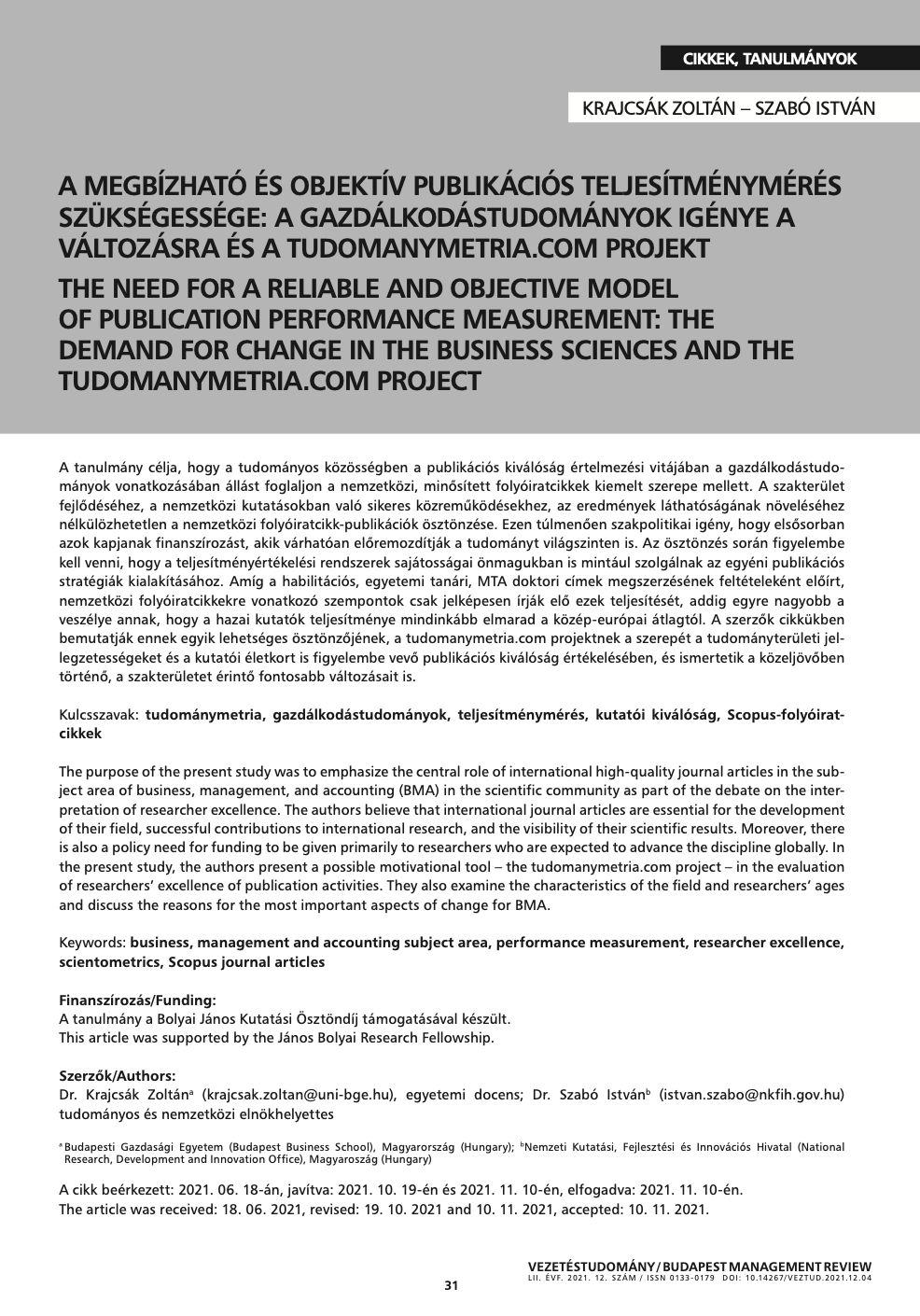
A tanulmány célja, hogy a tudományos közösségben a publikációs kiválóság értelmezési vitájában a gazdálkodástudományok vonatkozásában állást foglaljon a nemzetközi, minősített folyóiratcikkek kiemelt szerepe mellett. A szakterület fejlődéséhez, a nemzetközi kutatásokban való sikeres közreműködésekhez, az eredmények láthatóságának növeléséhez nélkülözhetetlen a nemzetközi folyóiratcikk-publikációk ösztönzése. Ezen túlmenően szakpolitikai igény, hogy elsősorban azok kapjanak finanszírozást, akik várhatóan előremozdítják a tudományt világszinten is. Az ösztönzés során figyelembe kell venni, hogy a teljesítményértékelési rendszerek sajátosságai önmagukban is mintául szolgálnak az egyéni publikációs stratégiák kialakításához. Amíg a habilitációs, egyetemi tanári, MTA doktori címek megszerzésének feltételeként előírt, nemzetközi folyóiratcikkekre vonatkozó szempontok csak jelképesen írják elő ezek teljesítését, addig egyre nagyobb a veszélye annak, hogy a hazai kutatók teljesítménye mindinkább elmarad a közép-európai átlagtól. A szerzők cikkükben bemutatják ennek egyik lehetséges ösztönzőjének, a tudomanymetria.com projektnek a szerepét a tudományterületi jellegzetességeket és kutatói életkort is figyelembe vevő publikációs kiválóság értékelésében, és ismertetik a közeljövőben történő, szakterületet érintő fontosabb változásokat is.
Downloads
Hivatkozások
Abramo, G., & D’Angelo, C. A. (2014). How do you define and measure research productivity? Scientometrics, 101, 11291144. https://doi.org/10.1007/s11192-0141269-8
Baas, J., Schotten, M., Plume, A., Côté, G., & Karimi, R. (2020). Scopus as a curated, highquality bibliometric data source for academic research in quantitative science studies. Quantitative Science Studies, 1(1), 377386. https://doi.org/10.1162/%20qss_a_00019
Bornmann, L., Wohlrabe, K., & de Moya Anegon, F. (2017). Calculating the excellence shift: How efficiently do institutions produce highly cited papers? Scientometrics, 112, 18591864. https://doi.org/10.1007/s1119201724463
Cagan, R. (2013). The San Francisco Declaration on Research Assessment. Disease Models & Mechanisms, 6(4), 869870. https://doi.org/10.1242/dmm.012955
Caminiti, C., Iezzi, E., Ghetti, C., De’ Angelis, G., & Ferrari, C. (2015). A method for measuring individual research productivity in hospitals: development and feasibility. BMC Health Services Research, 15(468), 18. https://doi.org/10.1186/s1291301511307
Dobos, I., Michalkó, G., & Sasvári, P. (2020). Messze még a híd? KeletKözépEurópa gazdaságtudományi kutatóinak összehasonlítása. Statisztikai Szemle, 98(8), 9811000. https://doi.org/10.20311/stat2020.8.hu0981
Dobos, I., & Sasvári, P. (2021). A QS World University Rankings 2021 vizsgálata a Scopus/SciValadatbázisok segítségével. Statisztikai Szemle, 99(9), 874900. https://doi.org/10.20311/stat2021.9.hu0874
Edwards, S. A., & McCarrey, M. W. (1973). Measuring the Performance of Researchers. Research Management, 16(1), 3441.
Elmore S. A. (2018). The Altmetric Attention Score: What Does It Mean and Why Should I Care? Toxicologic Pathology, 46(3), 252255. https://doi.org/10.1177/0192623318758294
Elzinga, A. (2012). Features of the current science policy regime: Viewed in historical perspective. Science and Public Policy, 39(4), 416428. https://doi.org/10.1093/scipol/scs046
Erfanmanesh, M. (2017). Status and quality of open access journals in Scopus. Collection Building, 36(4), 155162. https://doi.org/10.1108/CB0220170007
Erfanmanesh, M., Tahira, M., & Abrizah, A. (2017). The Publication Success of 102 Nations in Scopus and the Performance of Their ScopusIndexed Journals. Publishing Research Quarterly, 33(4), 421432. https://doi.org/10.1007/s1210901795405
ErnøKjølhede, E., & Hansson, F. (2011). Measuring research performance during a changing relationship between science and society. Research Evaluation, 20(2), 131143. https://doi.org/10.3152/095820211X12941371876544
Fang, F. C. & Casadevall, A. (2016). Research Funding: the Case for a Modified Lottery. mBio, 7(2), e0042216. https://doi.org/10.1128/mBio.0042216
Hammarfelt, B. (2017). Recognition and reward in the academy: Valuing publication oeuvres in biomedicine, economics and history. Aslib Journal of Information Management, 69(5), 607623. https://doi.org/10.1108/AJIM0120170006
Hirsch, J. E. (2005). An index to quantify an individual’s scientific research output. PNAS, 102(46), 1656972. https://doi.org/10.1073/pnas.0507655102
Győrffy, B., Csuka, Gy., Herman, P., & Török, Á. (2020a). Is there a golden age in publication activity?— An analysis of agerelated scholarly performance across all scientific disciplines. Scientometrics, 124, 10811097. https://doi.org/10.1007/s1119202003501w
Győrffy, B., Herman, P., & Szabó, I. (2020b). Research funding: past performance is a stronger predictor of future scientific output than reviewer scores. Journal of Informetrics, 14(3), 101050. https://doi.org/10.1016/j.joi.2020.101050
Győrffy, B., Nagy, A. M., Herman, P., & Török, Á. (2018). Factors influencing the scientific performance of Momentum grant holders: An evaluation of the first 117 research groups. Scientometrics, 117, 409426. https://doi.org/10.1007/s1119201828521
Henrekson, M., & Waldenström, D. (2011). How Should Research Performance Be Measured? A Study of Swedish Economists. The Manchester School, 79(6), 11391156. https://doi.org/10.1111/j.14679957.2010.02216.x
Hicks, D., Wouters, P., Waltman, L., de Rijcke, S., & Ra- fols, I. (2015). Bibliometrics: The Leiden Manifesto for research metrics. Nature, 520, 429431.
Kaplan, S. N., & Strömberg, P. (2004). Characteristics, Contracts, and Actions: Evidence from Venture Capitalist Analyses. The Journal of Finance, 59(5), 2177 2210. https://doi.org/10.1111/j.15406261.2004.00696.x
Krajcsák, Z. (2021). Researcher Performance in Scopus Articles (RPSA) as a New Scientometric Model of Scientific Output: Tested in Business Area of V4 Countries. Publications, 9(4), 50. https://doi.org/10.3390/publications9040050
Liu, W. (2020). Accuracy of funding information in Scopus: a comparative case study. Scientometrics, 124, 803811. https://doi.org/10.1007/s1119202003458w
Macháček, V., & Srholek, M. (2021). Predatory publishing in Scopus: evidence on crosscountry differences, Scientometrics, 126, 18971921. https://doi.org/10.1007/s11192020038524
MayoWilson, E., Li, T., Fusco, N., & Dickersin, K. (2018). Practical guidance for using multiple data sources in systematic reviews and meta‐analyses (with examples from the MUDS study). Research Synthesis Methods, 9, 212. https://doi.org/10.1002/jrsm.1277
Milat, A. J., Bauman, A. E., & Redman, S. (2015). A narrative review of research impact assessment models and methods. Health Research Policy and Systems, 13, 18. https://doi.org/10.1186/s1296101500031
Nair, P. K. R. (2005). How (not) to write research papers in agroforestry. Agroforestry Systems, 64, 516. https://doi.org/10.1007/s104570047592y
Nightingale, J. M., & Marshall, G. (2013). Reprint of “Citation analysis as a measure of article quality, journal influence and individual researcher performance”. Nurse Education in Practice, 13, 429436. https://doi.org/10.1016/j.nepr.2013.02.005
Van Noorden, R. (2020). Highly cited researcher banned from journal board for citation abuse. Nature, 578, 200201. https://doi.org/10.1038/d41586020003357
OECD (2015). Frascati Manual 2015: Guidelines for Collecting and Reporting Data on Research and Experimental Development. The Measurement of Scientific, Technological and Innovation Activities. Paris: OECD Publishing. https://doi.org/10.1787/9789264239012en
OECD (2021). Effective policies to foster high-risk/high-reward research. OECD Science, Technology and Industry Policy Papers. 112. Paris: OECD Publishing. https://doi.org/10.1787/06913b3ben
Ragone, A., Mirylenka, K., Casati, F., & Marchese, M. (2013). On peer review in computer science: analysis of its effectiveness and suggestions for improvement. Scientometrics, 97, 317356. https://doi.org/10.1007/s111920131002z
Sasvári, P., Teleki, B., & Urbanovics, A. (2021). A direkt finanszírozású publikációs modell lehetőségei Magyarországon. Pénzügyi Szemle, (1), 109130. https://doi.org/10.35551/PSZ_2021_1_6
Schmoch, U., Schubert, T., Jansen, D., Heidler, R., & von Görtz, R. (2010). How to use indicators to measure scientific performance: a balanced approach. Research Evaluation, 19(1), 218. https://doi.org/10.3152/095820210X492477
Sebrek, Sz. Sz. (2020). A magyar gazdasági felsőoktatás egy nyugati doktori fokozattal rendelkező itthon oktató nézőpontjából: Kitörési pontok beazonosítása és egy lehetséges cselekvési terv. Vezetéstudomány, 51(3), 5162. https://doi.org/10.14267/VEZTUD.2020.04.05
Seglen, P. O. (1997). Why the impact factor of journals should not be used for evaluating research. BMJ, 314(7079), 498502. https://doi.org/10.1136/bmj.314.7079.497
Seglen, P. O. (1998). Citation rates and journal impact factors are not suitable for evaluation of research. Acta Orthopaedica Scandinavica, 69(3), 224229. https://doi.org/10.3109/17453679809000920
Sinatra, R., Wang, D., Deville, P., Song, C., & Barabási, AL. (2016). Quantifying the evolution of individual scientific impact. Science, 354(6312), aaf5239. https://doi.org/10.1126/science.aaf5239
Tregoning, J. (2018). How will you judge me if not by impact factor? Nature, 558, 345. https://doi.org/10.1038/d41586018054675
tudomanymetria.com (2020). Information/Votes 2020. Van den Besselaar, P., & Sandström, U. (2019). Measuring researcher independence using bibliometric data: A proposal for a new performance indicator. PLoS ONE, 14(3), e0202712. https://doi.org/10.1371/journal.pone.0202712
Wellings, S., & Casselden, B. (2019). An exploration into the informationseeking behaviours of engineers and scientists. Journal of Librarianship and Information Science, 51(3), 789800. https://doi.org/10.1177/0961000617742466
Letöltések
Megjelent
Folyóirat szám
Rovat
License
Copyright (c) 2021 Vezetéstudomány / Budapest Management Review

This work is licensed under a Creative Commons Attribution 4.0 International License.
Authors assign copyright to Vezetéstudomány / Budapest Management Review. Authors are responsible for permission to reproduce copyright material from other sources.
Hogyan kell idézni