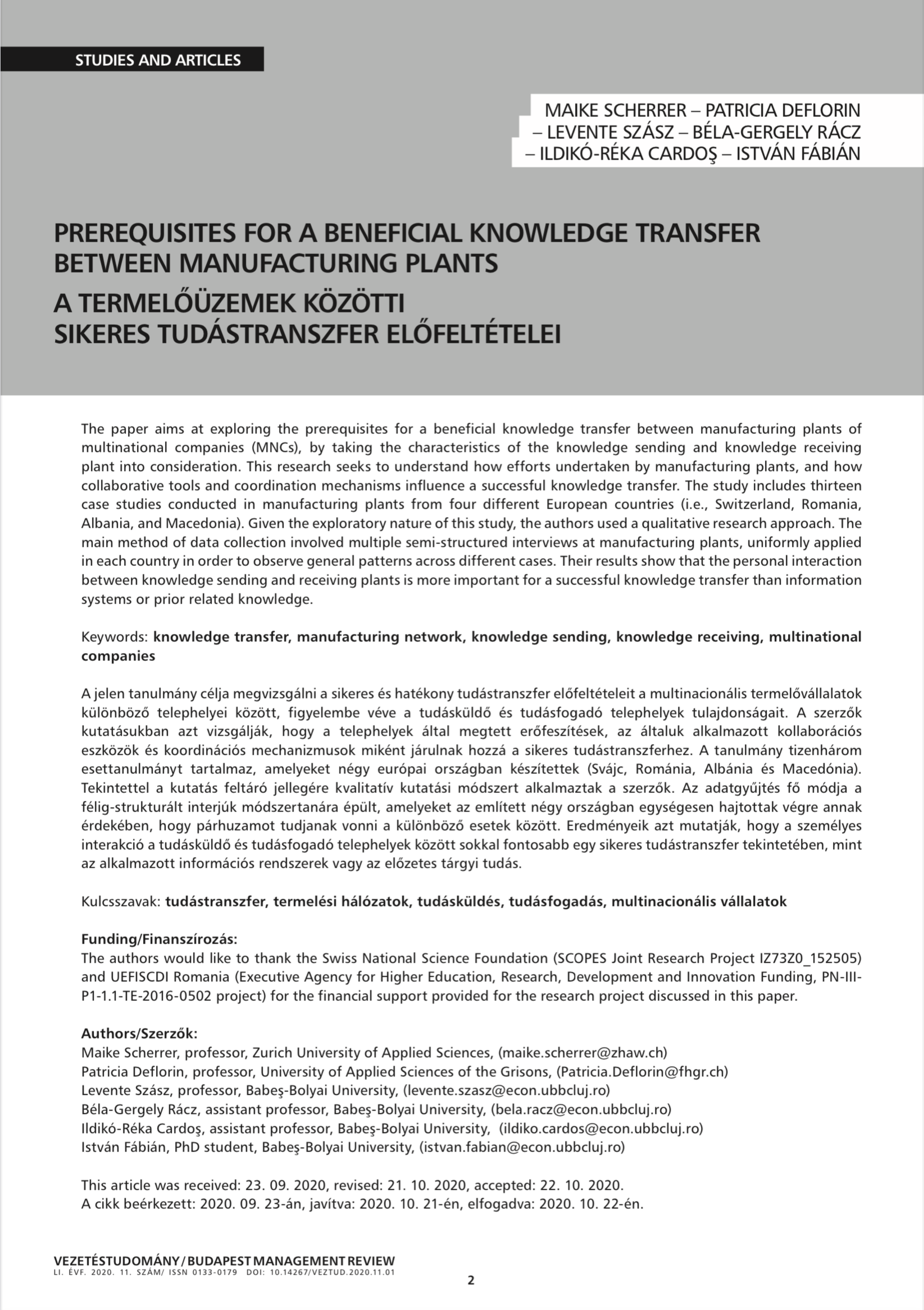
Prerequisites for a beneficial knowledge transfer between manufacturing plants
DOI:
https://doi.org/10.14267/VEZTUD.2020.11.01Kulcsszavak:
tudástranszfer, termelési hálózatok, tudásküldés, tudásfogadás, nemzetközi vállalatokAbsztrakt
A jelen tanulmány célja megvizsgálni a sikeres és hatékony tudástranszfer előfeltételeit a multinacionális termelővállalatok különböző telephelyei között, figyelembe véve a tudásküldő és tudásfogadó telephelyek tulajdonságait. A szerzők kutatásukban azt vizsgálják, hogy a telephelyek által megtett erőfeszítések, az általuk alkalmazott kollaborációs eszközök és koordinációs mechanizmusok miként járulnak hozzá a sikeres tudástranszferhez. A tanulmány tizenhárom esettanulmányt tartalmaz, amelyeket négy európai országban készítettek (Svájc, Románia, Albánia és Macedónia). Tekintettel a kutatás feltáró jellegére kvalitatív kutatási módszert alkalmaztak a szerzők. Az adatgyűjtés fő módja a félig-strukturált interjúk módszertanára épült, amelyeket az említett négy országban egységesen hajtottak végre annak érdekében, hogy párhuzamot tudjanak vonni a különböző esetek között. Eredményeik azt mutatják, hogy a személyes interakció a tudásküldő és tudásfogadó telephelyek között sokkal fontosabb egy sikeres tudástranszfer tekintetében, mint az alkalmazott információs rendszerek vagy az előzetes tárgyi tudás.
Downloads
Hivatkozások
Abell, P. M., Felin, T. & Foss, N. J. (2008). Building micro-foundations for the routines, capabilities, and performance links. Managerial and Decision Economics, 29(6), 489-502. https://doi.org/10.1002/mde1413
Adenfelt, M. & Lagerström, K. (2008). The development and sharing of knowledge by centres of excellence and transnational teams: A conceptual framework. Management International Review (MIR), 48(3), 319-338. https://doi.org/10.1007/s11575-008-0018-8
Alavi, M. & Leidner, D. E. (2001). Review: Knowledge management and knowledge management systems: Conceptual foundations and research issues. MIS Quarterly, 25(1), 107-136. https://doi.org/10.2307/3250961
Ambos, T. C., Ambos, B. & Schlegelmilch, B. B. (2006). Learning from foreign subsidiaries: An empirical investigation of headquarters’ benefits from reverse knowledge transfers. International Business Review, 15(3), 294-312. https://doi.org/10.1016/j.ibusrev.2006.01,002
Argote, L. & Ingram, P. (2000). Knowledge transfer: A basis for competitive advantage in firms. Organizational Behavior & Human Decision Processes, 82(1), 150- 169. https://doi.org/10.1006/obhd.2000.2893
Baksa, M. & Báder, N.(2020). A tudáskérés és tudásmegosztás feltételei – egy szervezeti tudáshálózat elemzése. Vezetéstudomány, 51(1), 32-45. https://doi.org/10.14267/VEZTUD.2020.01.03
Bell, G. G. & Zaheer, A. (2007). Geography, networks, and knowledge flow. Organization Science, 18(6), 955-972. https://doi.org/10.1006/obhd.2000.2893
Bigliardi, B., Ivo Dormio, A. & Galati, F. (2010). ICTs and knowledge management: An Italian case study of a construction company. Measuring Business Excellence, 14(3), 16-29. https://doi.org/10.1108/13683041011074182
Cohen, W. M., Levinthal, D. A. (1990). Absorptive capacity: a new perspective on learning and innovation. Administrative Science Quarterly, 35(1), 128-152. https://doi.org/10.2307/2393553
Darr, E. D. & Kurtzberg, T. R. (2000). An investigation of partner similarity dimensions on knowledge transfer. Organizational Behavior and Human Decision Processes, 82(1), 28-44. https://doi.org/10.1006/obhd.2000.2885
Demeter, Krisztina & Losonci, Dávid (2016). A lean tudás átadásának gyakorlatai multinacionális hálózatokban. Vezetéstudomány, 47(12), 61-71. https://doi.org/10.14267/VEZTUD.2016.12.06
Ding, X.-H., Liu, H. & Song, Y. (2013). Are internal knowledge transfer strategies double-edged swords? Journal of Knowledge Management, 17(1), 69-86. https://doi.org/10.1108/13673271311300769
Dunning, J. (2006). American investment in British manufacturing industry. London, New York: Routledge.
Dunning, J. H. (1993). Multinational Enterprises and the Global Economy. Reading, MA.: Addison- Wesley.
Dyer, J. H. & Nobeoka, K. (2000). Creating and managing a high-performance knowledge-sharing network: the Toyota case. Strategic Management Journal, 21, 345-367. https://doi.org/10.1002/(SICI)1097-0266(200003)21:3<345::AID-SMJ96>3.0.CO;2-N
Eisenhardt, K. M. (1989). Building theories from case study research. Academy of Management Review, 14(4), 532-550. https://doi.org/10.5465/amr.1989.4308385
Eisenhardt, K. M. & Graebner, M. E. (2007). Theory building from cases: Opportunities and challenges. Academy of Management Journal, 50(1), 25-32. https://doi.org/10.5465/amj.2007.24160888
Erden, Z., Klang, D., Sydler, R. & Von Krogh, G. (2014). Knowledge-flows and firm performance. Journal of Business Research, 67(1), 2777-2785. https://doi.org/10.1016/j.jbusres.2012.09.001
Ergün, E., & Avcı, Ü. (2018). Knowledge Sharing Self-Efficacy, Motivation and Sense of Community as Predictors of Knowledge Receiving and Giving Behaviors. Journal of Educational Technology & Society, 21(3), 60–73. Retrieved from https://www.jstor.org/stable/26458507
Feldmann, A. & Olhager, J. (2011). Distribution of manufacturing strategy decision-making in manufacturing networks. 18th International Annual EurOMA Conference. Cambridge, England.
Ferdows, K. (2006). Transfer of changing production know-how. Production & Operations Management, 15(1), 1-9. https://doi.org/10.1111/j.1937-5956.2006.tb00031.x
Foss, N. J., Husted, K. & Michailova, S. (2010). Governing knowledge sharing in organizations: Levels of analysis, governance mechanisms, and research directions. Journal of Management Studies, 47(3), 455-482. https://doi.org/10.1111/j.1467-6486.2009.00870.x
Foss, N. J. & Pedersen, T. (2002). Transferring knowledge in MNCs: The role of sources of subsidiary knowledge and organizational context. Journal of International Management, 8(1), 49-67. https://doi.org/10.1016/s1075-4253(01)00054-0
Golini, R., Deflorin, P. & Scherrer-Rathje, M. (2016). Exploiting the potential of manufacturing network embeddedness: An OM perspective. International Journal of Operations & Production Management, 36(12), 1741-1768. https://doi.org/10.1108/ijopm-11-2014-0559
Gupta, A. K. & Govindarajan, V. (2000). Knowledge flows within multinational corporations. Strategic Management Journal, 21(4), 473-496. https://doi.org/10.1002/(SICI)1097-0266(200003)21:3<345::AID-SMJ96>3.0.CO;2-N
Gupta, A. K., Tesluk, P. E. & Taylor, M. S. (2007). Innovation at and across multiple levels of analysis. Organization Science, 18(6), 885-897. https://doi.org/10.1287/orsc.1070.0337
Hayes, R. H. & Clark, K. B. (1985). Exploring the sources of productivity differences at the factory level. New York: Wiley.
Hayes, R. H. & Wheelwright, S. C. (1984). Restoring Our Competitive Edge: Competing Through Manufacturing. New York: John Wiley and Sons.
Kang, J., Rhee, M. & Kang, K. H. (2010). Revisiting knowledge transfer: Effects of knowledge characteristics on organizational effort for knowledge transfer. Expert Systems with Applications, 37(12), 8155-8160. https://doi.org/10.1016/j.eswa.2010.05.072
Kawai, N. & Strange, R. (2014). Subsidiary autonomy and performance in Japanese multinationals in Europe. International Business Review, 23(3), 504- 515. https://doi.org/10.1016/j.ibusrev.2013.08.012
Mahnke, V., Pedersen, T. & Venzin, M. (2005). The impact of knowledge management on mnc subsidiary performance: The role of absorptive capacity. Management International Review, 45(2), 101-119.
Maritan, C. A., Brush, T. H. & Karnani, A. G. (2004). Plant roles and decision autonomy in multiplant networks. Journal of Operations Management, 22(5), 489-503. https://doi.org/10.1016/j.jom.2004.05.007
Merton, R. K. (1968). Social theory and social structure. New York: The Free Press.
Minbaeva, D. B. (2007). Knowledge transfer in multinational corporations. Management International Review, 47(4), 567-593. https://doi.org/10.1007/s11575-007-0030-4.
Netland, T. H. & Aspelund, A. (2014). Multi-plant improvement programmes: A literature review and research agenda. International Journal of Operations & Production Management, 34(3), 390-418.https://doi.org/10.1108/ijopm-02-2012-0087
Pauleen, D. J., Rooney, D., & Holden, N. J. (2010). Practical wisdom and the development of crosscultural knowledge management: a global leadership perspective. European Journal of International Management, 4(4), 382-395. https://doi.org/10.1504/ejim.2010.033608
Phelps, C., Heidl, R. & Wadhwa, A. (2012). Knowledge, networks, and knowledge networks a review and research agenda. Journal of Management, 38(4), 1115-1166. https://doi.org/10.1177/0149206311432640
Roberts, J. (2000). From know-how to showhow? Questioning the role of information and communication technologies in knowledge transfer. Technology Analysis & Strategic Management, 12(4), 429-443. https://doi.org/10.1080/713698499
Rudberg, M. & West, B. M. (2008). Global operations strategy: Coordinating manufacturing networks. Omega, 36(1), 91-106. https://doi.org/10.1016/j.omega.2005.10.008
Rosenkopf, L., & Almeida, P. (2003). Overcoming local search through alliances and mobility. Management Science, 49(6), 751-766. https://doi.org/10.1287/ mnsc.49.6.751.16026
Rosenzweig, E. D. & Easton, G. S. (2010). Tradeoffs in manufacturing? A meta-analysis and critique of the literature. Production and Operations Management, 19(2), 127-141. https://doi.org/10.1111/j.1937-5956.2009.01072.x
Scherrer-Rathje, M. & Deflorin, P. (2017). Linking QFD and the manufacturing network strategy: Integrating the site and network perspectives. International Journal of Operations & Production Management, 37(2), 226-255. https://doi.org/10.1108/IJOPM-07-2014-0350
Scherrer, M. & Deflorin, P. (2017). Prerequisite for lateral knowledge flow in manufacturing networks. Journal of Manufacturing Technology Management, 28(3), 394-419. https://doi.org/10.1108/JMTM-10-2015-0090
Schoenherr, T. & Narasimhan, R. (2012). The fit between capabilities and priorities and its impact on performance improvement: Revisiting and extending the theory of production competence. International Journal of Production Research, 50(14), 3755-3775. https://doi.org/10.1080/00207543.2011.588266
Shi, Y. & Gregory, M. (1998). International manufacturing networks - to develop global competitive capabilities. Journal of Operations Management, 16(2), 195-214. https://doi.org/10.1016/S0272-6963(97)00038-7
Song, J. (2014). Subsidiary absorptive capacity and knoweldge transfer within multinational corporatinos. Journal of International Business Studies, 45, 73-84. https://doi.org/10.1057/jibs.2013.55
Stenius, M., Haukkala, A., Hankonen, N., & Ravaja, N. (2017). What Motivates Experts to Share? A Prospective Test of the Model of Knowledge-Sharing Motivation. Human Resource Management, 56(6), 871–885. https://doi.org/10.1002/hrm.21804
Szász, L., & Demeter, K. (2014). How do companies lose orders? A multi-country study of internal inconsistency in operations strategies. Operations Management Research, 7(3-4), 99-116. https://doi.org/10.1007/s12063-014-0091-z
Szász, L., Scherrer-Rathje, M. & Deflorin, P. (2016). Benefits of internal manufacturing network integration: The moderating effect of country context. International Journal of Operations & Production Management, 36(7), 757-780. https://doi.org/10.1108/IJOPM-05-2015-0265
Szász, L., Rácz, B.G., Scherrer, M. & Deflorin, P. (2019). Disseminative capabilities and manufacturing plant roles in the knowledge network of MNCs. International Journal of Production Economics, 208(Febr), 294-304. https://doi.org/10.1016/j.ijpe.2018.12.004
Szulanski, G. (1996). Exploring internal stickiness: Impediments to the transfer of best practice within the firm. Strategic Management Journal, 17(S2), 27-43. https://doi.org/10.1002/smj.4250171105
Szulanski, G. (2000). The process of knowledge transfer: A diachronic analysis of stickiness. Organizational Behavior and Human Decision Processes, 82(1), 9-27. https://doi.org/10.1006/obhd.2000.2884
Tran, Y., Mahnke, V. & Ambos, B. (2010). The effect of quantity, quality and timing of headquarters-initiated knowledge flows on subsidiary performance. Management International Review, 50(4), 493-511. https://doi.org/10.1007/s11575-010-0046-z
Tsai, W. & Ghoshal, S. (1998). Social capital and value creation: The role of intrafirm networks. Academy of Management Journal, 41(4), 464-476. https://doi.org/10.2307/257085
Tsai, W. (2002). Social Structure of “Coopetition” Within a Multiunit Organization: Coordination, Competition, and Intraorganizational Knowledge Sharing. Organization Science, 13(2), 179–190. https://doi.org/10.1287/orsc.13.2.179.536
Tseng, C.-H. (2015). Determinants of MNC’s knowledge inflows to subsidiaries: A perspective on internalization advantages. Management International Review, 55(1), 119-150. https://doi.org/10.1007/s11575-014-0230-7
Vereecke, A., Van Dierdonck, P. & De Meyer, A. (2006). A typology of plants in global manufacturing networks. Management Science, 52(11), 1737-1750. http://dx.doi.org/10.1287/mnsc.1060.0582
Voss, C., Tsikriktsis, N. & Frohlich, M. (2002). Case research in operations management. International Journal of Operations & Production Management, 22(2), 195-219. https://doi.org/10.1108/01443570210414329
Wang, P., Tong, T. W. & Koh, C. P. (2004). An integrated model of knowledge transfer from MNC parent to China subsidiary. Journal of World Business, 39(2), 168-182. https://doi.org/10.1016/j.jwb.2003.08.009
Yin, R.K. (1988). Case Study Research and Design Methods. Newbury Park: Sage.
Letöltések
Megjelent
Folyóirat szám
Rovat
License
Copyright (c) 2020 Vezetéstudomány / Budapest Management Review

This work is licensed under a Creative Commons Attribution 4.0 International License.
Authors assign copyright to Vezetéstudomány / Budapest Management Review. Authors are responsible for permission to reproduce copyright material from other sources.
Hogyan kell idézni