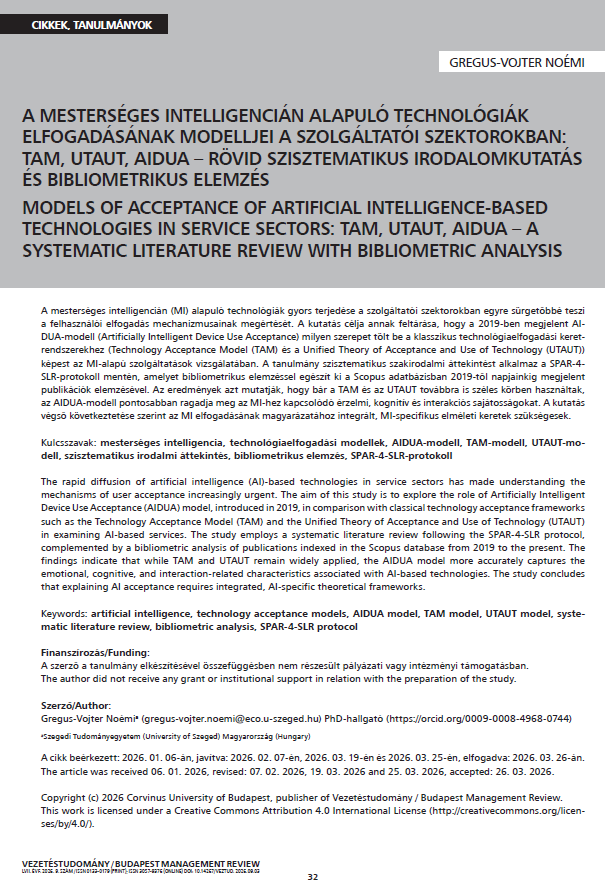
A mesterséges intelligencián alapuló technológiák elfogadásának modelljei a szolgáltatói szektorokban: TAM, UTAUT, AIDUA
Rövid szisztematikus irodalomkutatás és bibliometrikus elemzés
DOI:
https://doi.org/10.14267/VEZTUD.2026.09.03Kulcsszavak:
mesterséges intelligencia, technológiaelfogadási modellek, AIDUA modell, TAM modell, UTAUT modell, szisztematikus irodalmi áttekintés, bibliometrikus elemzés, SPAR-4-SLR-protokollAbsztrakt
A mesterséges intelligencián (MI) alapuló technológiák gyors terjedése a szolgáltatói szektorokban egyre sürgetőbbé teszi a felhasználói elfogadás mechanizmusainak megértését. A kutatás célja annak feltárása, hogy a 2019-ben megjelent AIDUA- modell (Artificially Intelligent Device Use Acceptance) milyen szerepet tölt be a klasszikus technológiaelfogadási keretrendszerekhez (Technology Acceptance Model (TAM) és a Unified Theory of Acceptance and Use of Technology (UTAUT)) képest az MI-alapú szolgáltatások vizsgálatában. A tanulmány szisztematikus szakirodalmi áttekintést alkalmaz a SPAR-4- SLR-protokoll mentén, amelyet bibliometrikus elemzéssel egészít ki a Scopus adatbázisban 2019-től napjainkig megjelent publikációk elemzésével. Az eredmények azt mutatják, hogy bár a TAM és az UTAUT továbbra is széles körben használtak, az AIDUA-modell pontosabban ragadja meg az MI-hez kapcsolódó érzelmi, kognitív és interakciós sajátosságokat. A kutatás végső következtetése szerint az MI elfogadásának magyarázatához integrált, MI-specifikus elméleti keretek szükségesek.Downloads
Hivatkozások
Az alábbiakban * jelöli azokat a forrásokat, amelyeket a szerző a szisztematikus irodalomelemzés eredményeként azonosított.//In the text below, the asterisk (*) indicates those sources which the author identified as a result of a systematic literature review.
*Begum, N., & Faisal, N., & Sobh, R., & Rana, N.P. (2025). From TAM to AIDUA and Beyond: Charting the Theoretical Frontiers of Service Robot Adoption in Hospitality. Journal of Global Information Management, 33(1), 1-27. https://doi.org/10.4018/JGIM.372420
Behl, A., & Jayawardena, N., & Pereira, V., & Islam, N., & Giudice M.D., & Choudrie, J. (2022). Gamification and e-learning for young learners: A systematic literature review, bibliometric analysis, and future research agenda. Technological Forecasting and Social Change, 176. https://doi.org/10.1016/j.techfore.2021.121445
*Chi, O. H., & Chi, C. G., & Gursoy, D., & Nunkoo, R. (2023). Customers’ acceptance of artificial intelligent service robots: The influence of trust and culture. International Journal of Information Management, 55, 416-424. https://doi.org/10.1016/j.jhtm.2023.05.005
*Choubey, V., & Chakraborty, D., & Joshi, Y. (2025). Human- robot trust dynamics: understanding tourist confidence in service robots in tourism & hospitality. Asia Pacific Journal of Tourism Research, 30(9), 1141-1156. https://doi.org/10.1080/10941665.2025.2486015
*Chow, C.S.K., & Zhan, G., & Wang, H., & He, M. (2023). Artificial intelligence (AI) adoption: An extended compensatory level of acceptance. Journal of Electronic Commerce Research, 24(1), 84-106.
*Dang, S., & Quach, S., & Roberts, R.E. (2025). Explanation of time perspectives in adopting AI service robots under different service settings. Journal of Retailing and Consumer Service, 82, 104109. https://doi.org/10.1016/j.jretconser.2024.104109
Davis, F. D. (1986). A Technology Acceptance Model for Empirically Testing New End-user information Systems: Theory and Results [Doctoral Dissertation]. MIT Sloan School of Management, Cambridge, MA.
Della Corte, V., & Sepe, F., & Gursoy, D., & Prisco, A. (2023). Role of trust in customer attitude and behaviour formation towards social service robots. International Journal of Hospitality Management, 114(2), 103587. https://doi.org/10.1016/j.ijhm.2023.103587
*Gieselmann, M., & Erdsiek, D., & Rost, V., & Sassenberg, K. (2025). Do managers accept artificial intelligence? Insights into the role of business area and AI functionality. Journal of Economic Psychology, 108(5), 102804. https://doi.org/10.1016/j.joep.2025.102804
*Gursoy, D., & Chi. H. O., & Lu, L., & Nunkoo, R. (2019). Consumers acceptance of artificially intelligent (AI) device use in service delivery. International Journal of Information Management, 49, 157-169. https://doi.org/10.1016/j.ijinfomgt.2019.03.008
*Ho, M.T., & Le, N.T.B., & Mantello, P., & Ho, M.T., & Ghotbi, N. (2023). Understanding the acceptance of emotional artificial intelligence in Japanese healthcare system: A cross-sectional survey of clinic visitors’ attitude. Technology in Society, 72(4), 102166. https://doi.org/10.1016/j.techsoc.2022.102166
*Jembere, S.T., & Revesai, Z. (2025). Personality-Driven AI Service Robot Acceptance in Hospitality: An Extended AIDUA Model Approach. Tourism and Hospitality, 6(4), 214. https://doi.org/10.3390/tourhosp6040214
*Jeong, D., & Kim, Y.D. (2025). Generational differences in AI adoption among fashion curation platform users. Fashion and Textiles, 12(1). https://doi.org/10.1186/s40691-025-00448-5
Jiang, P., & Niu, W., & Wang, Q., & Yuan, R., & Chen, K. (2024). Understanding Users’ Acceptance of Artificial Intelligence Applications: A Literature Review. Behavioral Sciences, 14(8), 671. https://doi.org/10.3390/bs14080671
Keszey, T., & Zsukk, J. (2017). Az új technológiák fogyasztói elfogadása. A magyar és nemzetközi szakirodalom áttekintése és kritikai értékelése. Vezetéstudomány, 48(10), 38-47. https://doi.org/10.14267/VEZTUD.2017.10.05
*Khan, A. N., & Jabeen, F., & Mehmood, K., & Ali Soomro, M., & Bresciani, S. (2023). Paving the way for technological innovation through adoption of artificial intelligence in conservative industries. Journal of Business Research, 165(10), 3-10. https://doi.org/10.1016/j.jbusres.2023.114019
*Khoso, A.K., & Honggang, W., & Darazi, M.A. (2026). Trust and attitude towards AI as pathways to creativity: a TAM Model study of EFL students’ digital literacy and AI acceptance. Humanities and Social Sciences Communications, 13(1), 1-19. https://doi.org/10.1057/s41599-025-06362-x
*Kim, J.H., & Kim, J., & Kim, C., & Kim, S. (2023). Do you trust ChatGPTs? Effect of the ethical and quality issues of generative AI on travel decision. Journal of Travel and Tourism Marketing, 40(9), 779-801. https://doi.org/10.1080/10548408.2023.2293006
*Kim, T., & Kim, M.J., & Promsivapallop, P. (2025). Investigating the influence of generative AI’s credibility and utility on travel consumer behaviour and recommendations through the lens of personal innovativeness. Current Issues in Tourism, 28(14), 2220-2224. https://doi.org/10.1080/13683500.2024.2364764
*Krügel, S., & Uhl, M. (2025). An international survey on risk distribution preferences for autonomous vehicles. Transportation Research Part A Policy and Practice, 201. https://doi.org/10.1016/j.tra.2025.104695
*Laksmidewi, D., & Efendi, & Wong, C.H. (2024). Determinants of consumers’s emotions and willingness to use artificial intelligence in Indonesia. Innovative Marketing, 20(4), 263-275. http://dx.doi.org/10.21511/ im.20(4).2024.22
*Lee, C.T., & Pan, L.Y. (2023). Smile to pay: predicting continuous usage intention toward contactless payment service in the post-COVID-19 era. International Journal of Bank Marketing, 41(2), 312-332. https://doi.org/10.1108/IJBM-03-2022-0130
*Li, H. (2025). Shedding light on new technology: How ambient luminance influences acceptance of AI technologies. International Journal of Hospitality Management, 127(5). https://doi.org/10.1016/j.ijhm.2025.104119
*Li, W., & Ding, H., & Gui, J., & Tank, Q. (2024). Patient acceptance of medical service robots in the medical intelligence era: an empirical study based on an extended AI device use acceptance model. Humanities and Social Sciences Communications, 11(1), 1-13. https://doi.org/10.1057/s41599-024-04028-8
*Lin, H., & Chi, O.H., & Gursoy, D. (2020). Antecendents of customers’ acceptance of artificially intelligent robotic device use in hospitality service. Journal of Hospitality Marketing and Management, 29(5), 530-549. https://doi.org/10.1080/19368623.2020.1685053
*Ling, H.C. (2025). AI-based E-commerce adoption by Taiwanese SMEs and its marketing performance expectancy. Journal of Strategy and Innovation, 36(2). https://doi.org/10.1016/j.jsinno.2025.200551
*Manzoor, S.R., & Ullah, R., & Khattak, A., & Ullah, M., & Han, H. (2024). Exploring tourist perceptions of artificial intelligence devices in the hotel industry: impact of industry 4.0. Journal of Travel and Tourism Marketing, 41(2), 272-291. https://doi.org/10.1080/10548408.2024.2310169
Nachtigall, C., & Kroehne, U., & Funke, F., & Steyer, R. (2003). (Why) Should We Use SEM? Pros and Cons of Structural Equation Modeling. Methods of Psychological Research Online, 8(2), 1-22. https://doi.org/10.23668/psycharchives.12783
*Oprea, S.V., & Nica, I., & Bara, A., & Georgescu, I.A. (2024). Are skepticism and moderation dominating attitudes toward AI-based technologies? American Journal of Economics and Sociology, 83(3), 567-607. https://doi.org/10.1111/ajes.12565
*Patterson, A., & Frydenberg, M., & Basma, L. (2024). Examining generative artificial intelligence adoption in academia: a UTAUT perspective. Issues in Information Systems, 25(3), 238-251. https://doi.org/10.48009/3_iis_2024_119
Paul, J., & Lim, W.M., & O’Cass, A., & Hao, A.W., & Bresciani, S. (2021). Scientific procedures and rationales for systematic literature reviews (SPAR-4-SLR). International Journal of Consumer Studies, 45(4), 1-16. https://doi.org/10.1111/ijcs.12695
*Peng, C., & van Doorn, J., & Eggers, F., & Wieringa, J.E. (2022). The effect of required warmth on consumer acceptance of artificial intelligence in service: The moderating role of AI-human collaboration. International Journal of Information Management, 66, 1-11. https://doi.org/10.1016/j.ijinfomgt.2022.102533
*Ribeiro, M.A., & Gursoy, D., & Chi, O.H. (2022). Customer Acceptance of Autonomous Vehicles in Travel and Tourism. Journal of Travel Research, 61(3), 620- 636. https://doi.org/10.1177/0047287521993578
*Roy, P., & Ramaprasad, B.S., & Chakraborty, M., & Prabhu, N., & Rao, S. (2024). Customer Acceptance of Use of Artificial Intelligence in Hospitality Service: An Indian Hospitality Sector Perspective. Global Business Review, 25(3), 832-851. https://doi.org/10.1177/0972150920939753
*Schiavo, G., & Businaro, S., & Zancanaro, M. (2024). Comprehension, apprehension, and acceptance: Understanding the influence of literacy and anxiety on acceptance of artificial intelligence. Technology in Society, 77(3). https://doi.org/10.1016/j.techsoc.2024.102537
* Shao, X., & Zhang, X., & Li, J., & Han, H. (2026). Left, right, and robotic: Political ideology’s influence on reactions to anthropomorphic AI service robots in hospitality through the lens of social response theory. International Journal of Hospitality Management, 134, 104578. https://doi.org/10.1016/j.ijhm.2026.104578
Siddaway, P.A., & Wood M.A., & Hedges, V.L. (2019). How to Do a Systematic Review: A Best Practice Guide for Conducting and Reporting Narrative Reviews, Meta-Analyses, and Meta-Syntheses. Annual Review Psychology, 70, 747-770. https://doi.org/10.1146/annurev-psych-010418-102803
*Smith, M., & Prabhakar, G., & Nisar, T.M., & Tseng, H.T. (2025). Adoption of AI by the HR function in the civil service. Employee Relations, 47(1), 104-126. https://doi.org/10.1108/ER-02-2024-0096
*Teng, Y.M., & Wu, K.S. (2025). The future of hotel check-ins: Evaluating generation Z’s acceptance of facial recognition technology using AIDUA-PMT model approach. Oeconomia Copernicana, 16(1), 39-78. https://doi.org/10.24136/oc.3235
*Turnadzic, T., & Pestek, A., & Cinjarevic, M. (2024).The role of social factors in the acceptance of artificial intelligence- based service: The example of the banking sector of Bosnia and Herzegovina. South East European Journal of Economics and Business, 19(1), 145- 158. https://doi.org/10.2478/jeb-2024-0010
Venkatesh, V., & Morris, M.G., & Davis, G.B., & Davis, F.D. (2003). User acceptance of information technology: Toward a unified view, MIS Quarterly, 27(3), 425-478. https://doi.org/10.2307/30036540
*Vitezić, V., & Perić, M. (2021). Artificial intelligence acceptance in services: connecting with Generation Z. The Service Industries Journal, 41(13-14), 926-946. https://doi.org/10.1080/02642069.2021.1974406
*Vitezić, V., & Perić, M. (2024). The role of digital skills in the acceptance of artificial intelligence. Journal of Business and Industrial Marketing, 39(7), 1546-1566. https://doi.org/10.1108/JBIM-04-2023-0210
*Vorobeva, D., & Costa Pinto, D., & António, N., & Mattila, A.S. (2024). The augmentation effect of artificial intelligence: can AI framing shape customer acceptance of AI-based service? Current Issues in Tourism, 27(10), 1551-1571. https://doi.org/10.1080/13683500.2023.2214353
*Wong, I.A., & Zhang, T., & Lin, Z.C., & Peng, Q. (2023). Hotel AI service: Are employees still needed? Journal of Hospitality and Tourism Management, 55, 416-424. https://doi.org/10.1016/j.jhtm.2023.05.005
*Yang, Q., & Lee, Y.C. (2024). Enhancing Financial Advisory Service with GenAI: Consumer Perceptions and Attitudes Through Service-Dominant Logic and Artificial Intelligence Device Use Acceptance Perspectives. Journal of Risk and Financial Management, 17(10), 470. https://doi.org/10.3390/jrfm17100470
Letöltések
Megjelent
Folyóirat szám
Rovat
License
Copyright (c) 2026 Corvinus University of Budapest, publisher of Vezetéstudomány / Budapest Management Review

This work is licensed under a Creative Commons Attribution 4.0 International License.
Authors assign copyright to Vezetéstudomány / Budapest Management Review. Authors are responsible for permission to reproduce copyright material from other sources.
Hogyan kell idézni