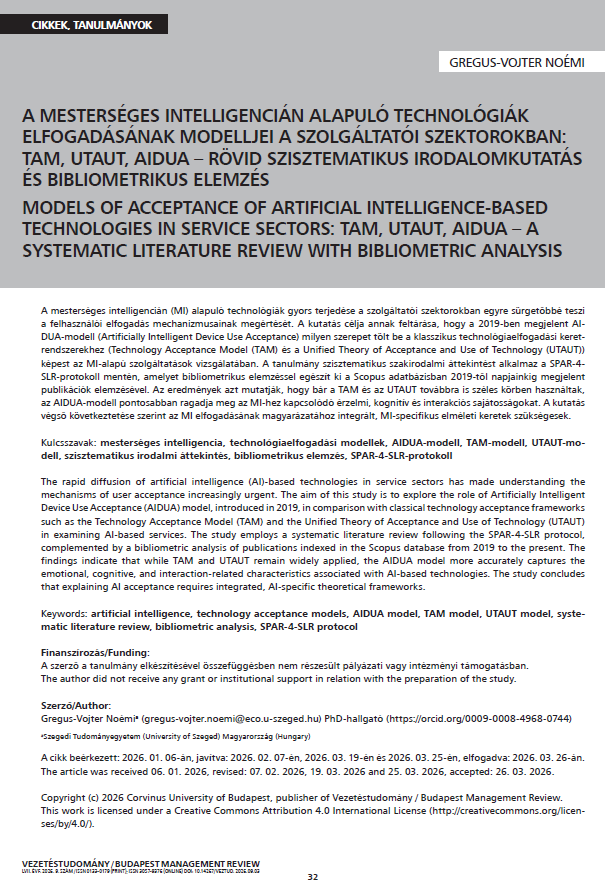
Models of acceptance of Artificial Intelligence-based technologies in service sectors: TAM, UTAUT, and AIUDA
A systematic literature review with bibliometric analysis
DOI:
https://doi.org/10.14267/VEZTUD.2026.09.03Keywords:
artificial intelligence, technology acceptance models, AIDUA model, TAM model, UTAUT model, systematic literature review, bibliometric analysis, SPAR-4-SLR protocolAbstract
The rapid diffusion of artificial intelligence (AI)-based technologies in service sectors has made understanding the mechanisms of user acceptance increasingly urgent. The aim of this study is to explore the role of Artificially Intelligent Device Use Acceptance (AIDUA) model, introduced in 2019, in comparison with classical technology acceptance frameworks such as the Technology Acceptance Model (TAM) and the Unified Theory of Acceptance and Use of Technology (UTAUT) in examining AI-based services. The study employs a systematic literature review following the SPAR-4-SLR protocol, complemented by a bibliometric analysis of publications indexed in the Scopus database from 2019 to the present. The findings indicate that while TAM and UTAUT remain widely applied, the AIDUA model more accurately captures the emotional, cognitive, and interaction-related characteristics associated with AI-based technologies. The study concludes that explaining AI acceptance requires integrated, AI-specific theoretical frameworks.
Downloads
References
Az alábbiakban * jelöli azokat a forrásokat, amelyeket a szerző a szisztematikus irodalomelemzés eredményeként azonosított.//In the text below, the asterisk (*) indicates those sources which the author identified as a result of a systematic literature review.
*Begum, N., & Faisal, N., & Sobh, R., & Rana, N.P. (2025). From TAM to AIDUA and Beyond: Charting the Theoretical Frontiers of Service Robot Adoption in Hospitality. Journal of Global Information Management, 33(1), 1-27. https://doi.org/10.4018/JGIM.372420
Behl, A., & Jayawardena, N., & Pereira, V., & Islam, N., & Giudice M.D., & Choudrie, J. (2022). Gamification and e-learning for young learners: A systematic literature review, bibliometric analysis, and future research agenda. Technological Forecasting and Social Change, 176. https://doi.org/10.1016/j.techfore.2021.121445
*Chi, O. H., & Chi, C. G., & Gursoy, D., & Nunkoo, R. (2023). Customers’ acceptance of artificial intelligent service robots: The influence of trust and culture. International Journal of Information Management, 55, 416-424. https://doi.org/10.1016/j.jhtm.2023.05.005
*Choubey, V., & Chakraborty, D., & Joshi, Y. (2025). Human- robot trust dynamics: understanding tourist confidence in service robots in tourism & hospitality. Asia Pacific Journal of Tourism Research, 30(9), 1141-1156. https://doi.org/10.1080/10941665.2025.2486015
*Chow, C.S.K., & Zhan, G., & Wang, H., & He, M. (2023). Artificial intelligence (AI) adoption: An extended compensatory level of acceptance. Journal of Electronic Commerce Research, 24(1), 84-106.
*Dang, S., & Quach, S., & Roberts, R.E. (2025). Explanation of time perspectives in adopting AI service robots under different service settings. Journal of Retailing and Consumer Service, 82, 104109. https://doi.org/10.1016/j.jretconser.2024.104109
Davis, F. D. (1986). A Technology Acceptance Model for Empirically Testing New End-user information Systems: Theory and Results [Doctoral Dissertation]. MIT Sloan School of Management, Cambridge, MA.
Della Corte, V., & Sepe, F., & Gursoy, D., & Prisco, A. (2023). Role of trust in customer attitude and behaviour formation towards social service robots. International Journal of Hospitality Management, 114(2), 103587. https://doi.org/10.1016/j.ijhm.2023.103587
*Gieselmann, M., & Erdsiek, D., & Rost, V., & Sassenberg, K. (2025). Do managers accept artificial intelligence? Insights into the role of business area and AI functionality. Journal of Economic Psychology, 108(5), 102804. https://doi.org/10.1016/j.joep.2025.102804
*Gursoy, D., & Chi. H. O., & Lu, L., & Nunkoo, R. (2019). Consumers acceptance of artificially intelligent (AI) device use in service delivery. International Journal of Information Management, 49, 157-169. https://doi.org/10.1016/j.ijinfomgt.2019.03.008
*Ho, M.T., & Le, N.T.B., & Mantello, P., & Ho, M.T., & Ghotbi, N. (2023). Understanding the acceptance of emotional artificial intelligence in Japanese healthcare system: A cross-sectional survey of clinic visitors’ attitude. Technology in Society, 72(4), 102166. https://doi.org/10.1016/j.techsoc.2022.102166
*Jembere, S.T., & Revesai, Z. (2025). Personality-Driven AI Service Robot Acceptance in Hospitality: An Extended AIDUA Model Approach. Tourism and Hospitality, 6(4), 214. https://doi.org/10.3390/tourhosp6040214
*Jeong, D., & Kim, Y.D. (2025). Generational differences in AI adoption among fashion curation platform users. Fashion and Textiles, 12(1). https://doi.org/10.1186/s40691-025-00448-5
Jiang, P., & Niu, W., & Wang, Q., & Yuan, R., & Chen, K. (2024). Understanding Users’ Acceptance of Artificial Intelligence Applications: A Literature Review. Behavioral Sciences, 14(8), 671. https://doi.org/10.3390/bs14080671
Keszey, T., & Zsukk, J. (2017). Az új technológiák fogyasztói elfogadása. A magyar és nemzetközi szakirodalom áttekintése és kritikai értékelése. Vezetéstudomány, 48(10), 38-47. https://doi.org/10.14267/VEZTUD.2017.10.05
*Khan, A. N., & Jabeen, F., & Mehmood, K., & Ali Soomro, M., & Bresciani, S. (2023). Paving the way for technological innovation through adoption of artificial intelligence in conservative industries. Journal of Business Research, 165(10), 3-10. https://doi.org/10.1016/j.jbusres.2023.114019
*Khoso, A.K., & Honggang, W., & Darazi, M.A. (2026). Trust and attitude towards AI as pathways to creativity: a TAM Model study of EFL students’ digital literacy and AI acceptance. Humanities and Social Sciences Communications, 13(1), 1-19. https://doi.org/10.1057/s41599-025-06362-x
*Kim, J.H., & Kim, J., & Kim, C., & Kim, S. (2023). Do you trust ChatGPTs? Effect of the ethical and quality issues of generative AI on travel decision. Journal of Travel and Tourism Marketing, 40(9), 779-801. https://doi.org/10.1080/10548408.2023.2293006
*Kim, T., & Kim, M.J., & Promsivapallop, P. (2025). Investigating the influence of generative AI’s credibility and utility on travel consumer behaviour and recommendations through the lens of personal innovativeness. Current Issues in Tourism, 28(14), 2220-2224. https://doi.org/10.1080/13683500.2024.2364764
*Krügel, S., & Uhl, M. (2025). An international survey on risk distribution preferences for autonomous vehicles. Transportation Research Part A Policy and Practice, 201. https://doi.org/10.1016/j.tra.2025.104695
*Laksmidewi, D., & Efendi, & Wong, C.H. (2024). Determinants of consumers’s emotions and willingness to use artificial intelligence in Indonesia. Innovative Marketing, 20(4), 263-275. http://dx.doi.org/10.21511/ im.20(4).2024.22
*Lee, C.T., & Pan, L.Y. (2023). Smile to pay: predicting continuous usage intention toward contactless payment service in the post-COVID-19 era. International Journal of Bank Marketing, 41(2), 312-332. https://doi.org/10.1108/IJBM-03-2022-0130
*Li, H. (2025). Shedding light on new technology: How ambient luminance influences acceptance of AI technologies. International Journal of Hospitality Management, 127(5). https://doi.org/10.1016/j.ijhm.2025.104119
*Li, W., & Ding, H., & Gui, J., & Tank, Q. (2024). Patient acceptance of medical service robots in the medical intelligence era: an empirical study based on an extended AI device use acceptance model. Humanities and Social Sciences Communications, 11(1), 1-13. https://doi.org/10.1057/s41599-024-04028-8
*Lin, H., & Chi, O.H., & Gursoy, D. (2020). Antecendents of customers’ acceptance of artificially intelligent robotic device use in hospitality service. Journal of Hospitality Marketing and Management, 29(5), 530-549. https://doi.org/10.1080/19368623.2020.1685053
*Ling, H.C. (2025). AI-based E-commerce adoption by Taiwanese SMEs and its marketing performance expectancy. Journal of Strategy and Innovation, 36(2). https://doi.org/10.1016/j.jsinno.2025.200551
*Manzoor, S.R., & Ullah, R., & Khattak, A., & Ullah, M., & Han, H. (2024). Exploring tourist perceptions of artificial intelligence devices in the hotel industry: impact of industry 4.0. Journal of Travel and Tourism Marketing, 41(2), 272-291. https://doi.org/10.1080/10548408.2024.2310169
Nachtigall, C., & Kroehne, U., & Funke, F., & Steyer, R. (2003). (Why) Should We Use SEM? Pros and Cons of Structural Equation Modeling. Methods of Psychological Research Online, 8(2), 1-22. https://doi.org/10.23668/psycharchives.12783
*Oprea, S.V., & Nica, I., & Bara, A., & Georgescu, I.A. (2024). Are skepticism and moderation dominating attitudes toward AI-based technologies? American Journal of Economics and Sociology, 83(3), 567-607. https://doi.org/10.1111/ajes.12565
*Patterson, A., & Frydenberg, M., & Basma, L. (2024). Examining generative artificial intelligence adoption in academia: a UTAUT perspective. Issues in Information Systems, 25(3), 238-251. https://doi.org/10.48009/3_iis_2024_119
Paul, J., & Lim, W.M., & O’Cass, A., & Hao, A.W., & Bresciani, S. (2021). Scientific procedures and rationales for systematic literature reviews (SPAR-4-SLR). International Journal of Consumer Studies, 45(4), 1-16. https://doi.org/10.1111/ijcs.12695
*Peng, C., & van Doorn, J., & Eggers, F., & Wieringa, J.E. (2022). The effect of required warmth on consumer acceptance of artificial intelligence in service: The moderating role of AI-human collaboration. International Journal of Information Management, 66, 1-11. https://doi.org/10.1016/j.ijinfomgt.2022.102533
*Ribeiro, M.A., & Gursoy, D., & Chi, O.H. (2022). Customer Acceptance of Autonomous Vehicles in Travel and Tourism. Journal of Travel Research, 61(3), 620- 636. https://doi.org/10.1177/0047287521993578
*Roy, P., & Ramaprasad, B.S., & Chakraborty, M., & Prabhu, N., & Rao, S. (2024). Customer Acceptance of Use of Artificial Intelligence in Hospitality Service: An Indian Hospitality Sector Perspective. Global Business Review, 25(3), 832-851. https://doi.org/10.1177/0972150920939753
*Schiavo, G., & Businaro, S., & Zancanaro, M. (2024). Comprehension, apprehension, and acceptance: Understanding the influence of literacy and anxiety on acceptance of artificial intelligence. Technology in Society, 77(3). https://doi.org/10.1016/j.techsoc.2024.102537
* Shao, X., & Zhang, X., & Li, J., & Han, H. (2026). Left, right, and robotic: Political ideology’s influence on reactions to anthropomorphic AI service robots in hospitality through the lens of social response theory. International Journal of Hospitality Management, 134, 104578. https://doi.org/10.1016/j.ijhm.2026.104578
Siddaway, P.A., & Wood M.A., & Hedges, V.L. (2019). How to Do a Systematic Review: A Best Practice Guide for Conducting and Reporting Narrative Reviews, Meta-Analyses, and Meta-Syntheses. Annual Review Psychology, 70, 747-770. https://doi.org/10.1146/annurev-psych-010418-102803
*Smith, M., & Prabhakar, G., & Nisar, T.M., & Tseng, H.T. (2025). Adoption of AI by the HR function in the civil service. Employee Relations, 47(1), 104-126. https://doi.org/10.1108/ER-02-2024-0096
*Teng, Y.M., & Wu, K.S. (2025). The future of hotel check-ins: Evaluating generation Z’s acceptance of facial recognition technology using AIDUA-PMT model approach. Oeconomia Copernicana, 16(1), 39-78. https://doi.org/10.24136/oc.3235
*Turnadzic, T., & Pestek, A., & Cinjarevic, M. (2024).The role of social factors in the acceptance of artificial intelligence- based service: The example of the banking sector of Bosnia and Herzegovina. South East European Journal of Economics and Business, 19(1), 145- 158. https://doi.org/10.2478/jeb-2024-0010
Venkatesh, V., & Morris, M.G., & Davis, G.B., & Davis, F.D. (2003). User acceptance of information technology: Toward a unified view, MIS Quarterly, 27(3), 425-478. https://doi.org/10.2307/30036540
*Vitezić, V., & Perić, M. (2021). Artificial intelligence acceptance in services: connecting with Generation Z. The Service Industries Journal, 41(13-14), 926-946. https://doi.org/10.1080/02642069.2021.1974406
*Vitezić, V., & Perić, M. (2024). The role of digital skills in the acceptance of artificial intelligence. Journal of Business and Industrial Marketing, 39(7), 1546-1566. https://doi.org/10.1108/JBIM-04-2023-0210
*Vorobeva, D., & Costa Pinto, D., & António, N., & Mattila, A.S. (2024). The augmentation effect of artificial intelligence: can AI framing shape customer acceptance of AI-based service? Current Issues in Tourism, 27(10), 1551-1571. https://doi.org/10.1080/13683500.2023.2214353
*Wong, I.A., & Zhang, T., & Lin, Z.C., & Peng, Q. (2023). Hotel AI service: Are employees still needed? Journal of Hospitality and Tourism Management, 55, 416-424. https://doi.org/10.1016/j.jhtm.2023.05.005
*Yang, Q., & Lee, Y.C. (2024). Enhancing Financial Advisory Service with GenAI: Consumer Perceptions and Attitudes Through Service-Dominant Logic and Artificial Intelligence Device Use Acceptance Perspectives. Journal of Risk and Financial Management, 17(10), 470. https://doi.org/10.3390/jrfm17100470
Downloads
Published
Issue
Section
License
Copyright (c) 2026 Corvinus University of Budapest, publisher of Vezetéstudomány / Budapest Management Review

This work is licensed under a Creative Commons Attribution 4.0 International License.
Authors assign copyright to Vezetéstudomány / Budapest Management Review. Authors are responsible for permission to reproduce copyright material from other sources.
How to Cite