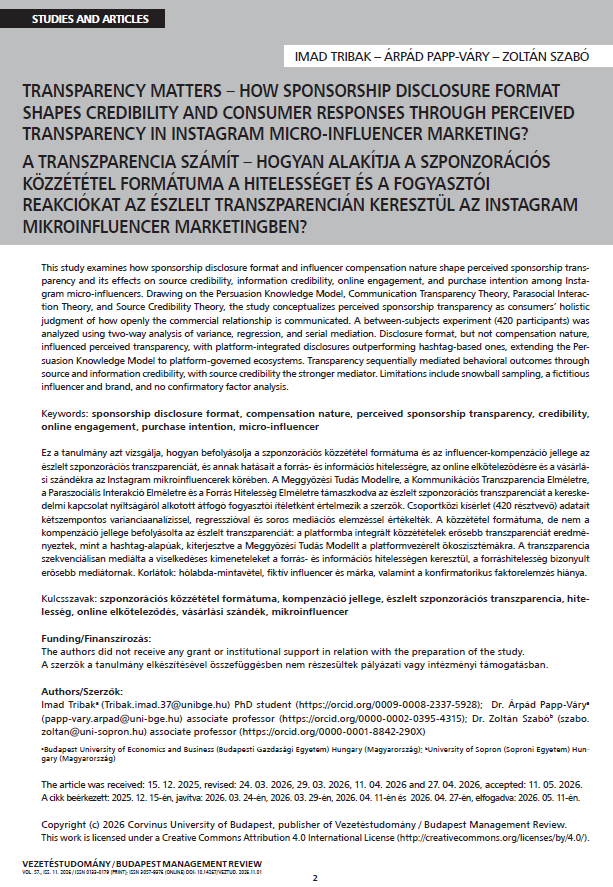
A transzparencia számít
Hogyan alakítja a szponzorációs közzététel formátuma a hitelességet és a fogyasztói reakciókat az észlelt transzparencián keresztül az Instagram mikroinfluencer marketingben?
DOI:
https://doi.org/10.14267/VEZTUD.2026.11.01Kulcsszavak:
szponzorációs közzététel formátuma, kompenzáció jellege, észlelt szponzorációs transzparencia, hitelesség, online elköteleződés, vásárlási szándék, mikroinfluencerAbsztrakt
Ez a tanulmány azt vizsgálja, hogyan befolyásolja a szponzorációs közzététel formátuma és az influencer-kompenzáció jellege az észlelt szponzorációs transzparenciát, és annak hatásait a forrás- és információs hitelességre, az online elköteleződésre és a vásárlási szándékra az Instagram mikroinfluencerek körében. A Meggyőzési Tudás Modellre, a Kommunikációs Transzparencia Elméletre, a Paraszociális Interakció Elméletre és a Forrás Hitelesség Elméletre támaszkodva az észlelt szponzorációs transzparenciát a kereskedelmi kapcsolat nyíltságáról alkotott átfogó fogyasztói ítéletként értelmezik a szerzők. Csoportközi kísérlet (420 résztvevő) adatait kétszempontos varianciaanalízissel, regresszióval és soros mediációs elemzéssel értékelték. A közzététel formátuma, de nem a kompenzáció jellege befolyásolta az észlelt transzparenciát: a platformba integrált közzétételek erősebb transzparenciát eredményeztek, mint a hashtag-alapúak, kiterjesztve a Meggyőzési Tudás Modellt a platformvezérelt ökoszisztémákra. A transzparencia szekvenciálisan mediálta a viselkedéses kimeneteleket a forrás- és információs hitelességen keresztül, a forráshitelesség bizonyult erősebb mediátornak. Korlátok: hólabda-mintavétel, fiktív influencer és márka, valamint a konfirmatorikus faktorelemzés hiánya.
Downloads
Hivatkozások
Aldlimi, T., Priporas, C., & Chang, S. (2025). Engagement in influencer marketing: A systematic review of key drivers, behaviors, and future research directions. Journal of Consumer Behaviour, 24(3), 1541-1566. https://doi.org/10.1002/cb.2485
Audrezet, A., de Kerviler, G., & Guidry Moulard, J. (2020). Authenticity under threat: When social media influencers need to go beyond self-presentation. Journal of Business Research, 117, 557-569. https://doi.org/10.1016/j.jbusres.2018.07.008
Baghel, D. (2023). The role of influencer authenticity and brand trust in shaping consumer behavior: Strategies to engage Generation Z. ShodhKosh: Journal of Visual and Performing Arts, 4(1), 1259-1271. https://doi.org/10.29121/shodhkosh.v4.i1.2023.3327
Balaban, D.C., Szambolics, J., & Chirică, M. (2022). Parasocial relations and social media influencers’ persuasive power: Exploring the moderating role of product involvement. Acta Psychologica, 230, 103731. https://doi.org/10.1016/j.actpsy.2022.103731
Boerman, S.C. (2020). The effects of the standardized Instagram disclosure for micro- and meso-influencers. Computers in Human Behavior, 103, 199-207. https://doi.org/10.1016/j.chb.2019.09.015
Boerman, S.C., & Müller, C.M. (2022). Understanding which cues people use to identify influencer marketing on Instagram: An eye-tracking study and experiment. International Journal of Advertising, 41(1), 6-29. https://doi.org/10.1080/02650487.2021.1986256
Boerman, S.C., Willemsen, L.M., & van der Aa, E.P. (2017). “This post is sponsored”: Effects of sponsorship disclosure on persuasion knowledge and electronic word of mouth in the context of Facebook. Journal of Interactive Marketing, 38, 82-92. https://doi.org/10.1016/j.intmar.2016.12.002
Breves, P., Amrehn, J., Heidenreich, A., Liebers, N., & Schramm, H. (2021). Blind trust? The importance and interplay of parasocial relationships and advertising disclosures in explaining influencers’ persuasive effects on their followers. International Journal of Advertising, 40(7), 1209-1229. https://doi.org/10.1080/02650487.2021.1881237
Bu, Y., Parkinson, J., & Thaichon, P. (2022). Influencer marketing: Sponsorship disclosure and value co-creation behaviour. Marketing Intelligence & Planning, 40(7), 854–870. https://doi.org/10.1108/MIP-09-2021-0310
Campbell, C., & Farrell, J.R. (2020). More than meets the eye: The functional components underlying influencer marketing. Business Horizons, 63(4), 469-479. https://doi.org/10.1016/j.bushor.2020.03.003
Cao, Z., & Belo, R. (2024). Effects of explicit sponsorship disclosure on user engagement in social media influencer marketing. MIS Quarterly, 48(1), 375-392. https://doi.org/10.25300/MISQ/2023/17944
Carpenter, C.C., & Bonin II, M. (2021). To win friends and influence people: Regulation and enforcement of influencer marketing after ten years of the Endorsement Guides. Vanderbilt Journal of Entertainment and Technology Law, 23(2), 253-312. https://scholarship.law.vanderbilt.edu/jetlaw/vol23/iss2/1
Carr, C.T., & Hayes, R.A. (2014). The effect of disclosure of third-party influence on an opinion leader’s credibility and electronic word of mouth in two-step flow. Journal of Interactive Advertising, 14(1), 38-50. https://doi.org/10.1080/15252019.2014.909296
Chen, J., Zhang, Y., Cai, H., Liu, L., Liao, M., & Fang, J. (2024). A comprehensive overview of micro-influencer marketing: Decoding the current landscape, impacts, and trends. Behavioral Sciences, 14(3), 243. https://doi.org/10.3390/bs14030243
Conde, R., & Casais, B. (2023). Micro, macro and mega- influencers on Instagram: The power of persuasion via the parasocial relationship. Journal of Business Research, 158, 113708. https://doi.org/10.1016/j.jbusres.2023.113708
Dabholkar, P.A., & Sheng, X. (2012). Consumer participation in using online recommendation agents: Effects on satisfaction, trust, and purchase intentions. The Service Industries Journal, 32(9), 1433-1449. https://doi.org/10.1080/02642069.2011.624596
De Cicco, R., Iacobucci, S., & Pagliaro, S. (2021). The effect of influencer-product fit on advertising recognition and the role of an enhanced disclosure in increasing sponsorship transparency. International Journal of Advertising, 40(5), 733-759. https://doi.org/10.1080/02650487.2020.1801198
De Jans, S., Cauberghe, V., & Hudders, L. (2018). How an advertising disclosure alerts young adolescents to sponsored vlogs: The moderating role of a peer-based advertising literacy intervention through an informational vlog. Journal of Advertising, 47(4), 309-325. https://doi.org/10.1080/00913367.2018.1539363
Demand Sage. (2026). Instagram statistics 2026: How many people use Instagram? Demand Sage. https://www.demandsage.com/instagram-statistics/
De Veirman, M., & Hudders, L. (2020). Disclosing sponsored Instagram posts: The role of material connection with the brand and message-sidedness when disclosing covert advertising. International Journal of Advertising, 39(1), 94-130. https://doi.org/10.1080/02650487.2019.1575108
Eisend, M., van Reijmersdal, E.A., Boerman, S.C., & Tarrahi, F. (2020). A meta-analysis of the effects of disclosing sponsored content. Journal of Advertising, 49(3), 344-366. https://doi.org/10.1080/00913367.2020.1765909
Eisend, M., & Tarrahi, F. (2022). Persuasion knowledge in the marketplace: A meta-analysis. Journal of Consumer Psychology, 32(1), 3-22. https://doi.org/10.1002/jcpy.1258
European Parliament. (2025). Report on the Protection of Minors Online, A10-0213/2025. European Parliament. https://www.europarl.europa.eu/doceo/document/A-10-2025-0213_EN.html
Evans, N.J., Phua, J., Lim, J., & Jun, H. (2017). Disclosing Instagram influencer advertising: The effects of disclosure language on advertising recognition, attitudes, and behavioural intent. Journal of Interactive Advertising, 17(2), 138-149. https://doi.org/10.1080/15252019.2017.1366885
Evans, N.J., Wojdynski, B.W., & Hoy, M.G. (2019). Sponsorship transparency as a mediator of negative effects of covert ad recognition. International Journal of Advertising, 38(3), 364-382. https://doi.org/10.1080/02650487.2018.1474998
Friestad, M., & Wright, P. (1994). The persuasion knowledge model: How people cope with persuasion attempts. Journal of Consumer Research, 21(1), 1-31. https://doi.org/10.1086/209380
Giuffredi-Kähr, A., Petrova, A., & Malär, L. (2022). Sponsorship disclosure of influencers: A curse or a blessing? Journal of Interactive Marketing, 57(1), 18-34. https://doi.org/10.1177/10949968221075686
Hayes, A.F. (2022). Introduction to mediation, moderation, and conditional process analysis: A regression- based approach (3rd ed.). Guilford Press. https://www.guilford.com/books/Introduction-to-Mediation-Moderation-and-Conditional-Process-Analysis/Andrew-Hayes/9781462549030
Hernán, M.A., & Robins, J.M. (2020). Causal inference: What if. Chapman & Hall/CRC. https://www.miguelhernan.org/whatifbook/
Horton, D., & Wohl, R.R. (1956). Mass communication and para-social interaction: Observations on intimacy at a distance. Psychiatry, 19(3), 215–229. https://doi.org/10.1080/00332747.1956.11023049
Hovland, C.I., Janis, I.L., & Kelley, H.H. (1954). Communication and persuasion. Journal of Consulting Psychology, 18(2), 152. https://doi.org/10.1037/h0053111
Influencer Marketing Hub. (2025). Influencer Marketing Benchmark Report 2025. https://influencermarketinghub.com/influencer-marketing-benchmark-report/
Jamal, F.N., Othman, N.A., Saleh, R.C., Nurhanay, A.H., & Rohmah, W. (2021). Evaluating information credibility toward green marketing in Indonesia. The Journal of Asian Finance, Economics and Business, 8(2), 427-438. https://doi.org/10.13106/JAFEB.2021.VOL8.NO2.0427
Jhawar, V., Varshney, S., & Kumar, A. (2025). How does advertising disclosure on social media impact influencer avoidance, influencer switching and brand avoidance? Journal of Consumer Marketing, 42(1), 24-36. https://doi.org/10.1108/JCM-11-2023-6426
Jin, S.V., Muqaddam, A., & Ryu, E. (2019). Instafamous and social media influencer marketing. Marketing Intelligence & Planning, 37(5), 567-579. https://doi.org/10.1108/MIP-09-2018-0375
Johnson, T.J., & Kaye, B.K. (2015). Reasons to believe: Influence of credibility on motivations for using social networking sites. Computers in Human Behavior, 50, 544-555. https://doi.org/10.1016/j.chb.2015.04.002
Kay, S., Mulcahy, R., & Parkinson, J. (2020). When less is more: The impact of macro and micro social media influencers’ disclosure. Journal of Marketing Management, 36(3-4), 248-278. https://doi.org/10.1080/0267257X.2020.1718740
Karagür, Z., Becker, J.M., Klein, K., & Edeling, A. (2022). How, why, and when disclosure type matters for influencer marketing. International Journal of Research in Marketing, 39, 313-335. https://doi.org/10.1016/j.ijresmar.2021.09.006
Lee, S.S., Vollmer, B.T., Yue, C.A., & Johnson, B.K. (2021). Impartial endorsements: Influencer and celebrity declarations of non-sponsorship and honesty. Computers in Human Behavior, 122, 106858. https://doi.org/10.1016/j.chb.2021.106858
Liu, X., & Zheng, X. (2024). The persuasive power of social media influencers in brand credibility and purchase intention. Humanities and Social Sciences Communications, 11, 15. https://doi.org/10.1057/s41599-023-02512-1
Lou, C., & Yuan, S. (2019). Influencer marketing: How message value and credibility affect consumer trust of branded content on social media. Journal of Interactive Advertising, 19(1), 58-73. https://doi.org/10.1080/15252019.2018.1533501
Lou, C., Ma, W., & Feng, Y. (2021). A sponsorship disclosure is not enough? How advertising literacy intervention affects consumer reactions to sponsored influencer posts. Journal of Promotion Management, 27(2), 278-305. https://doi.org/10.1080/10496491.2020.1829771
Martínez-López, F.J., Anaya-Sánchez, R., Esteban-Millat, I., Torrez-Meruvia, H., D’Alessandro, S., & Miles, M. (2020). Influencer marketing: Brand control, commercial orientation and post credibility. Journal of Marketing Management, 36(17-18), 1805-1831. https://doi.org/10.1080/0267257X.2020.1806906
Men, L.R., Ping, H., & Yue, C.A. (2020). Examining the effects of organizational transparency on employee– organization relationships: The mediating role of trust. Public Relations Review, 46(2), 101880. https://doi.org/10.1016/j.pubrev.2020.101880
Metzger, M.J., & Flanagin, A.J. (2013). Credibility and trust of information in online environments: The use of cognitive heuristics. Journal of Pragmatics, 59, 210- 220. https://doi.org/10.1016/j.pragma.2013.07.012
Munnukka, J., Uusitalo, O., & Toivonen, H. (2016). Credibility of a peer endorser and advertising effectiveness. Journal of Consumer Marketing, 33(3), 182-192. https://doi.org/10.1108/JCM-11-2014-1221
Ohanian, R. (1990). Construction and validation of a scale to measure celebrity endorsers’ perceived expertise, trustworthiness, and attractiveness. Journal of Advertising, 19(3), 39-52. https://doi.org/10.1080/00913367.1990.10673191
Ou, M., & Ho, S.S. (2024). Factors associated with information credibility perceptions: A meta-analysis. Journalism & Mass Communication Quarterly, 101(2), 346-372. https://doi.org/10.1177/10776990231222556
Petty, R.E., & Cacioppo, J.T. (1986). Communication and persuasion: Central and peripheral routes to attitude change. Springer-Verlag. https://doi.org/10.1007/978-1-4612-4964-1
Rawlins, B.L. (2008). Measuring the relationship between organizational transparency and employee trust. Public Relations Journal, 2(2), 1-21. https://scholarsarchive.byu.edu/facpub/885/
Rubin, A.M., Perse, E.M., & Powell, R.A. (1985). Loneliness, parasocial interaction, and local television news viewing. Human Communication Research, 12(2), 155-180. https://doi.org/10.1111/j.1468-2958.1985.tb00071.x
Sárközi, D., & Szabó, Z. (2024). Evaluating the effectiveness of differentiated branding strategies for sustainable products utilizing recycled plastics in Hungary. Journal of Entrepreneurship, Business and Economics, 12(2), 109-135. https://scientificia.com/index.php/JEBE/article/view/2313731
Schouten, A.P., Janssen, L., & Verspaget, M. (2020). Celebrity vs. micro-influencer endorsements in advertising: The role of source credibility and perceived authenticity. International Journal of Advertising, 39(2), 258-281. https://doi.org/10.1080/02650487.2019.1634898
Sheng, J., Lee, Y.H., & Lan, H. (2023). Parasocial relationships with micro-influencers: Do sponsorship disclosure and electronic word-of-mouth disrupt? Internet Research, 34(3), 849-867. https://doi.org/10.1108/INTR-12-2021-0903
Statista. (2026). Global influencer marketing platform market size (Stat. No. 1036560). Statista. https://www.statista.com/statistics/1036560/global-influencer-marketing-platform-market-size/
Szabó, Z., Komáromi Gergely, A., & Széles, Z. (2014). The role of event marketing in case of the Buda Castle Wine Festival. In Proceedings of the 8th International Conference of the Academy of Wine Business Research (pp. 883–894). https://m2.mtmt.hu/gui2/?mode=browse¶ms=publication%3B2790336
Van Reijmersdal, E.A., Fransen, M.L., van Noort, G., Opree, S.J., Vandeberg, L., Reusch, S., van Lieshout, F., & Boerman, S.C. (2016). Effects of disclosing sponsored content in blogs: How the use of resistance strategies mediates effects on persuasion. American Behavioral Scientist, 60(12), 1458-1474. https://doi.org/10.1177/0002764216660141
Van Reijmersdal, E.A., Brussee, E., Evans, N.J., & Wojdynski, B.W. (2023). Disclosure-driven recognition of native advertising: A test of two competing mechanisms. Journal of Interactive Advertising, 23(1), 1-15. https://doi.org/10.1080/15252019.2022.2146991
Van Reijmersdal, E.A., Walet, M., & Gudmundsdóttir, A. (2024). Influencer marketing: Explaining the effects of influencer self-presentation strategies on brand responses through source credibility. Marketing Intelligence & Planning, 42(7), 1214-1233. https://doi.org/10.1108/MIP-03-2023-0125
Wojdynski, B.W., & Evans, N.J. (2016). Going native: Effects of disclosure position and language on the recognition and evaluation of online native advertising. Journal of Advertising, 45(2), 157-168. http://dx.doi.org/10.1080/00913367.2015.1115380
Wojdynski, B.W., Evans, N.J., & Hoy, M. G. (2018). Measuring sponsorship transparency in the age of native advertising. Journal of Consumer Affairs, 52(1), 115-137. https://doi.org/10.1111/joca.12144
Woodroof, P.J., Howie, K.M., Syrdal, H.A., & VanMeter, R. (2020). What’s done in the dark will be brought to the light: Effects of influencer transparency on product efficacy and purchase intentions. Journal of Product & Brand Management, 29(5), 675-688. https://doi.org/10.1108/JPBM-05-2019-2362
Xiao, M., Wang, R., & Chan-Olmsted, S. (2018). Factors affecting YouTube influencer marketing credibility: A heuristic-systematic model. Journal of Media Business Studies, 15(3), 188-213. https://doi.org/10.1080/16522354.2018.1501146
Xie, Q., & Feng, Y. (2023). How to strategically disclose sponsored content on Instagram? The synergy effects of two types of sponsorship disclosures in influencer marketing. International Journal of Advertising, 42(2), 317-343. https://doi.org/10.1080/02650487.2022.2071393
Yin, C., Sun, Y., Fang, Y., & Lim, K. (2018). Exploring the dual role of cognitive heuristics and the moderating effect of gender in microblog information credibility evaluation. Information Technology & People, 31(3), 741-769. https://doi.org/10.1108/ITP-12-2016-0300
Zhang, Y., & Szabó, Z. (2024). Digital transformation in the tourism industry: A comparative literature review. Advances in Economics, Management and Political Sciences, 72(1), 166-179. http://doi.org/10.54254/2754-1169/72/20240667
Letöltések
Megjelent
Folyóirat szám
Rovat
License
Copyright (c) 2026 Corvinus University of Budapest, publisher of Vezetéstudomány / Budapest Management Review

This work is licensed under a Creative Commons Attribution 4.0 International License.
Authors assign copyright to Vezetéstudomány / Budapest Management Review. Authors are responsible for permission to reproduce copyright material from other sources.
Hogyan kell idézni