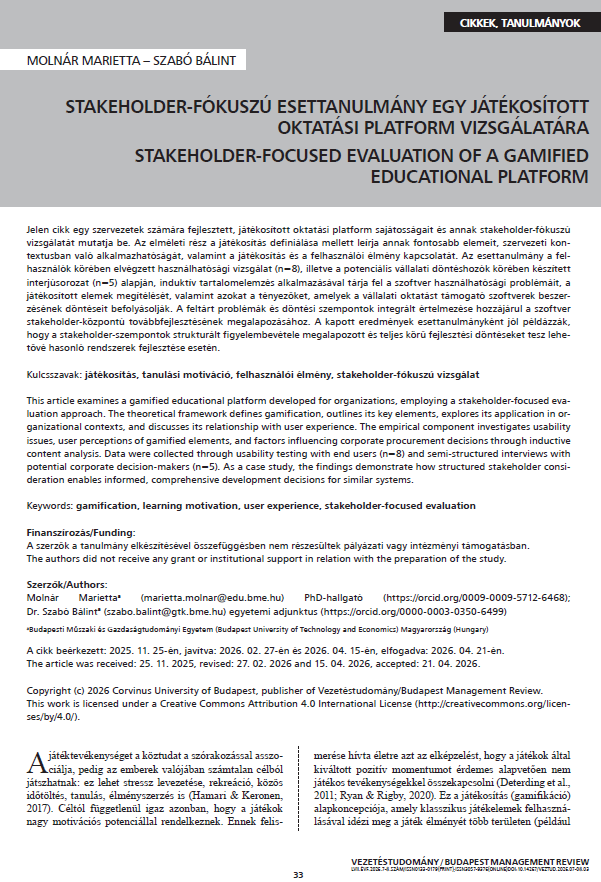
Stakeholder-fókuszú esettanulmány egy játékosított oktatási platform vizsgálatára
DOI:
https://doi.org/10.14267/VEZTUD.2026.07-08.03Kulcsszavak:
játékosítás, tanulási motiváció, felhasználói élmény, stakeholder-fókuszú vizsgálatAbsztrakt
Jelen cikk egy szervezetek számára fejlesztett, játékosított oktatási platform sajátosságait és annak stakeholder-fókuszú vizsgálatát mutatja be. Az elméleti rész a játékosítás definiálása mellett leírja annak fontosabb elemeit, szervezeti kontextusban való alkalmazhatóságát, valamint a játékosítás és a felhasználói élmény kapcsolatát. Az esettanulmány a felhasználók körében elvégzett használhatósági vizsgálat (n=8), illetve a potenciális vállalati döntéshozók körében készített interjúsorozat (n=5) alapján, induktív tartalomelemzés alkalmazásával tárja fel a szoftver használhatósági problémáit, a játékosított elemek megítélését, valamint azokat a tényezőket, amelyek a vállalati oktatást támogató szoftverek beszerzésének döntéseit befolyásolják. A feltárt problémák és döntési szempontok integrált értelmezése hozzájárul a szoftver stakeholder-központú továbbfejlesztésének megalapozásához. A kapott eredmények esettanulmányként jól példázzák, hogy a stakeholder-szempontok strukturált figyelembevétele megalapozott és teljes körű fejlesztési döntéseket tesz lehetővé hasonló rendszerek fejlesztése esetén.
Downloads
Hivatkozások
Alroobaea, R., & Mayhew, P.J. (2014). How many participants are really enough for usability studies? In 2014 Science and Information Conference (pp. 48-56). IEE Xplore. https://doi.org/10.1109/SAI.2014.6918171
Andrade, F.R.H., Mizoguchi, R., & Isotani, S. (2016). The bright and dark sides of gamification. In A. Micarelli, J. Stamper, & K. Panourgia (Eds.), Intelligent Tutoring Systems: 13th International Conference, ITS 2016, Zagreb, Croatia, June 7-10, 2016. Proceedings 13 (Vol. 9684, pp. 176-186). Springer. https://doi.org/10.1007/978-3-319-39583-8_17
Bangor, A., Kortum, P.T., & Miller, J.T. (2008). An empirical evaluation of the System Usability Scale. International Journal of Human-Computer Interaction, 24(6), 574-594. https://doi.org/10.1080/10447310802205776
Barnum, C.M. (2020). Usability testing essentials: Ready, set... test! Morgan Kaufmann.
Braun, V., & Clarke, V. (2006). Using thematic analysis in psychology. Qualitative Research in Psychology, 3(2), 77-101. https://doi.org/10.1191/1478088706qp063oa
Brooke, J. (1996). SUS – A quick and dirty usability scale. In P.W. Jordan, B. Thomas, B.A. Weerdmeester, & I.L. McClelland (Eds.), Usability Evaluation in Industry (pp. 189–194). Taylor & Francis.
Czeily, T., Czine, P., & Dajnoki, K. (2024). Játékosítás a toborzásban: Egy diszkrét választási kísérlet eredményei. Vezetéstudomány, 55(4), 2-16. https://doi.org/10.14267/VEZTUD.2024.04.01
Coulston, F., Lynch, F., & Vears, D.F. (2025). Collaborative coding in inductive content analysis: Why, when, and how to do it. Journal of Genetic Counseling, 34(3), e70030. https://doi.org/10.1002/jgc4.70030
Croucher, S.M., & Cronn-Mills, D. (2024). Understanding communication research methods. Routledge. https://doi.org/10.4324/9781003432173
Dahlstrøm, M.F. (2012). The role of interest in gamified persuasion: Examining the role of interest in effectiveness of gamified health campaigns. In M. Bang & E.L. Ragnemalm (Eds.), Persuasive Technology: Design for Health and Safety (pp. 180-192). Springer. https://doi.org/10.1007/978-3-642-31037-9_16
Dale, S. (2014). Gamification: Making work fun, or making fun of work? Business Information Review, 31(2), 82-90. https://doi.org/10.1177/0266382114538350
Deci, E.L., & Ryan, R.M. (2000). The „what” and „why” of goal pursuits: Human needs and the self-determination of behavior. Psychological Inquiry, 11(4), 227-268. https://doi.org/10.1207/S15327965PLI1104_01
Deterding, S. (2015). The lens of intrinsic skill atoms: A method for gameful design. Human-Computer Interaction, 30(3-4), 294-335. https://doi.org/10.1080/07370024.2014.993471
Deterding, S., Dixon, D., Khaled, R., & Nacke, L. (2011). From game design elements to gamefulness. In Proceedings of the 15th International Academic MindTrek Conference: Envisioning Future Media Environments (pp. 9-15). ACM. https://doi.org/10.1145/2181037.2181040
Ferreira, A.T., Araújo, A.M., Fernandes, S., & Miguel, I.C. (2017). Gamification in the workplace: A systematic literature review. In Á. Rocha, A.M. Correia, H. Adeli, L.P. Reis, & S. Costanzo (Eds.), Recent advances in information systems and technologies (pp. 283-292). Springer. https://doi.org/10.1007/978-3-319-56541-5_29
Freeman, R.E. (1984). Strategic management: A stakeholder approach. Pitman Publishing.
Gawer, A., & Cusumano, M.A. (2014). Industry platforms and ecosystem innovation. Journal of Product Innovation Management, 31(3), 417-433. https://doi.org/10.1111/jpim.12105
Hamari, J., & Keronen, L. (2017). Why do people play games? A meta-analysis. International Journal of Information Management, 37(3), 125-141. https://doi.org/10.1016/j.ijinfomgt.2017.01.006
Hamari, J., Koivisto, J., & Sarsa, H. (2014). Does gamification work? A literature review of empirical studies on gamification. In Proceedings of the Annual Hawaii International Conference on System Sciences (pp. 3025- 3034). IEEE Xplore. https://doi.org/10.1109/HICSS.2014.377
Herzig, P., Ameling, M., & Schill, A. (2015). Workplace psychology and gamification: Theory and application. In T. Reiners & L.C. Wood (Eds.), Gamification in education and business (pp. 451–471). Springer. https://doi.org/10.1007/978-3-319-10208-5_23
Hsu, C.L., & Chen, M.C. (2018). How does gamification improve user experience? An empirical investigation on the antecedences and consequences of user experience and its mediating role. Technological Forecasting and Social Change, 132, 118-129. https://doi.org/10.1016/j.techfore.2018.01.023
ISO. (2018). ISO 9241-11:2018 Ergonomics of human-system interaction — Part 11: Usability: Definitions and concepts. International Organization for Standardization. Koivisto, J., & Hamari, J. (2019). The rise of motivational information systems: A review of gamification research. International Journal of Information Management, 45, 191-210. https://doi.org/10.1016/j.ijinfomgt.2018.10.013
Kolbeinsson, A., Palmquist, A., Lindblom, J., & Jiménez Sánchez, J.L. (2021). To what extent is gamification an effective tool for onboarding users into a DHM tool? In A. Marcus & E. Rosenzweig (Eds.), Design, user experience, and usability: UX research and design (pp. 48-66). Springer. https://doi.org/10.1007/978-3-030-78221-4_4
Krath, J., Schürmann, L., & von Korflesch, H.F.O. (2021). Revealing the theoretical basis of gamification: A systematic review and analysis of theory in research on gamification, serious games and game-based learning. Computers in Human Behavior, 125, 106963. https://doi.org/10.1016/j.chb.2021.106963
Larson, K. (2020). Serious games and gamification in the corporate training environment: A literature review. TechTrends, 64(2), 319-328. https://doi.org/10.1007/s11528-019-00446-7
Law, E.L.C., Roto, V., Hassenzahl, M., Vermeeren, A.P.O.S., & Kort, J. (2009). Understanding, scoping and defining user experience. In Proceedings of the SIGCHI Conference on Human Factors in Computing Systems (pp. 719-728). ACM. https://doi.org/10.1145/1518701.1518813
Malaby, T.M. (2007). Beyond play: A new approach to games. Games and Culture, 2(2), 95-113. https://doi.org/10.1177/1555412007299434
Mitchell, R.K., Agle, B.R., & Wood, D.J. (1997). Toward a theory of stakeholder identification and salience: Defining the principle of who and what really counts. Academy of Management Review, 22(4), 853-886. https://doi.org/10.5465/amr.1997.9711022105
Nielsen, J. (1994). Severity ratings for usability problems. https://www.nngroup.com/articles/how-to-rate-the-severity-of-usability-problems/
Nielsen, J., & Loranger, H. (2006). Prioritizing web usability. New Riders.
Oravec, J.A. (2015). Gamification and multigamification in the workplace: Expanding the ludic dimensions of work and challenging the work/play dichotomy. Cyberpsychology, 9(3), Article 6. https://doi.org/10.5817/CP2015-3-6
Parker, G.G., Van Alstyne, M.W., & Choudary, S.P. (2016). Platform revolution: How networked markets are transforming the economy and how to make them work for you. W. W. Norton & Company.
Ryan, R.M., & Deci, E.L. (2000). When rewards compete with nature. In C. Sansone & J. M. Harackiewicz (Eds.), Intrinsic and extrinsic motivation: The search for optimal motivation and performance (pp. 13-54). Academic Press. https://doi.org/10.1016/B978-012619070-0/50024-6
Ryan, R.M., & Rigby, C.S. (2020). Motivational foundations of game-based learning. In J.L. Plass, R.E. Mayer, & B.D. Homer (Eds.), Handbook of game-based learning (pp. 153-176). MIT Press.
Sailer, M., Hense, J.U., Mayr, S.K., & Mandl, H. (2017). How gamification motivates: An experimental study of the effects of specific game design elements on psychological need satisfaction. Computers in Human Behavior, 69, 371-380. https://doi.org/10.1016/j.chb.2016.12.033
Sailer, M., & Homner, L. (2020). The gamification of learning: A meta-analysis. Educational Psychology Review, 32(1), 77-112. https://doi.org/10.1007/s10648-019-09498-w
Shneiderman, B., Plaisant, C., Cohen, M., Jacobs, S., Elmqvist, N., & Diakopoulos, N. (2009). Designing the user interface: Strategies for effective human-computer interaction (5th ed.). Pearson.
Spanellis, A., Pyrko, I., & Dörfler, V. (2022). Gamifying situated learning in organisations. Management Learning, 53(3), 525-546. https://doi.org/10.1177/13505076211038812
Steers, R.M., Mowday, R.T., & Shapiro, D.L. (2004). The future of work motivation theory. Academy of Management Review, 29(3), 379-387. https://doi.org/10.5465/amr.2004.13670978
Suh, A., Cheung, C.M.K., Ahuja, M., & Wagner, C. (2017). Gamification in the workplace: The central role of the aesthetic experience. Journal of Management Information Systems, 34(1), 268–305. https://doi.org/10.1080/07421222.2017.1297642
Sullivan, P., & Brown, K. (2024). B2B edtech purchasing decisions: The role of measurable outcomes. Journal of Business Research, 172, 114421. https://doi.org/10.1016/j.jbusres.2023.114421
Tarpataki, E., & Mikáczó, É. I. (2022). Lépések az élményalapú oktatás irányába: A játékosítás határmezsgyéjén a számvitel alapjai tárgy oktatásában. Vezetéstudomány, 53(12), 45-55. https://doi.org/10.14267/VEZTUD.2022.12.04
Thomas, D.R. (2006). A general inductive approach for analyzing qualitative evaluation data. American Journal of Evaluation, 27(2), 237-246. https://doi.org/10.1177/1098214005283748
Werbach, K., & Hunter, D. (2012). For the win: How game thinking can revolutionize your business. Wharton Digital Press.
Yu, T., & Wu, N. (2009). A review of study on the competing values framework. International Journal of Business and Management, 4(7), 37-42. https://doi.org/10.5539/ijbm.v4n7p37
Letöltések
Megjelent
Folyóirat szám
Rovat
License
Copyright (c) 2026 Corvinus University of Budapest, publisher of Vezetéstudomány / Budapest Management Review

This work is licensed under a Creative Commons Attribution 4.0 International License.
Authors assign copyright to Vezetéstudomány / Budapest Management Review. Authors are responsible for permission to reproduce copyright material from other sources.
Hogyan kell idézni