Az egyetem mint innovációs ökoszisztéma-orkesztrátor
Nemzetközi példák és magyar esettanulmányok
DOI:
https://doi.org/10.14267/VEZTUD.2026.07-08.05Kulcsszavak:
innovációs ökoszisztéma, orkesztrátor, technológiatranszfer, esettanulmány-megközelítésAbsztrakt
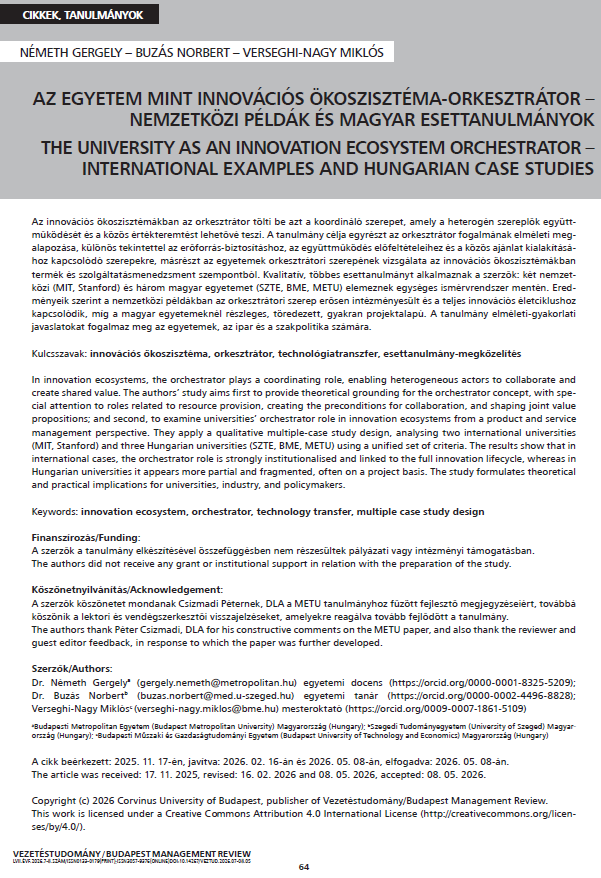
Az innovációs ökoszisztémákban az orkesztrátor tölti be azt a koordináló szerepet, amely a heterogén szereplők együttműködését és a közös értékteremtést lehetővé teszi. A tanulmány célja egyrészt az orkesztrátor fogalmának elméleti megalapozása, különös tekintettel az erőforrás-biztosításhoz, az együttműködés előfeltételeihez és a közös ajánlat kialakításához kapcsolódó szerepekre, másrészt az egyetemek orkesztrátori szerepének vizsgálata az innovációs ökoszisztémákban termék és szolgáltatásmenedzsment szempontból. Kvalitatív, többes esettanulmányt alkalmaznak a szerzők: két nemzetközi (MIT, Stanford) és három magyar egyetemet (SZTE, BME, METU) elemeznek egységes ismérvrendszer mentén. Eredményeik szerint a nemzetközi példákban az orkesztrátori szerep erősen intézményesült és a teljes innovációs életciklushoz kapcsolódik, míg a magyar egyetemeknél részleges, töredezett, gyakran projektalapú. A tanulmány elméleti-gyakorlati javaslatokat fogalmaz meg az egyetemek, az ipar és a szakpolitika számára.
Downloads
Hivatkozások
Abramo, G., & D’Angelo, C.A. (2022). Drivers of academic engagement in public–private research collaboration: An empirical study. The Journal of Technology Transfer, 47(6), 1861–1884. https://doi.org/10.1007/s10961-021-09884-z
Audretsch, D.B. (2014). From the entrepreneurial university to the university for the entrepreneurial society. The Journal of Technology Transfer, 39(3), 313–321. https://doi.org/10.1007/s10961-012-9288-1
Autio, E. (2022). Orchestrating ecosystems: A multi-layered framework. Innovation, 24(1), 96–109. https://doi.org/10.1080/14479338.2021.1919120
Baldwin, C.Y., Bogers, M.L., Kapoor, R., & West, J. (2024). Focusing the ecosystem lens on innovation studies. Research Policy, 53(3), 104949. https://doi.org/10.1016/j.respol.2023.104949
Batterink, M.H., Wubben, E.F.M., Klerkx, L., & Omta, S.W.F. (Onno). (2010). Orchestrating innovation networks: The case of innovation brokers in the agri-food sector. Entrepreneurship & Regional Development, 22(1), 47–76. https://doi.org/10.1080/08985620903220512
Belitski, M., & Sikorski, J. (2024). Three steps for universities to become entrepreneurial: A case study of entrepreneurial process and dynamic capabilities. The Journal of Technology Transfer, 49(6), 2035–2055. https://doi.org/10.1007/s10961-024-10099-1
Callaert, J., Landoni, P., Van Looy, B., & Verganti, R. (2015). Scientific yield from collaboration with industry: The relevance of researchers’ strategic approaches. Research Policy, 44(4), 990–998. https://doi.org/10.1016/j.respol.2015.02.003
Carayannis, E.G., & Campbell, D.F. (2010). Triple Helix, Quadruple Helix and Quintuple Helix and how do knowledge, innovation and the environment relate to each other? A proposed framework for a trans-disciplinary analysis of sustainable development and social ecology. International Journal of Social Ecology and Sustainable Development (IJSESD), 1(1), 41–69. https://doi.org/10.4018/978-1-4666-1586-1.ch004
Carayannis, E.G., Grigoroudis, E., Campbell, D.F.J., Meissner, D., & Stamati, D. (2018). ‘Mode 3’ universities and academic firms: Thinking beyond the box trans-disciplinarity and nonlinear innovation dynamics within coopetitive entrepreneurial ecosystems. International Journal of Technology Management, 77(1/2/3), 145. https://doi.org/10.1504/IJTM.2018.091714
Chesbrough, H., Vanhaverbeke, W., & West, J. (2006). Open innovation: Researching a new paradigm. Oxford University Press. Cobben, D., Ooms, W., Roijakkers, N., & Radziwon, A. (2022). Ecosystem types: A systematic review on boundaries and goals. Journal of Business Research, 142, 138–164. https://doi.org/10.1016/j.jbusres.2021.12.046
Eisenhardt, K.M., & Martin, J.A. (2017). Dynamic Capabilities: What Are They? In C. E. Helfat (Ed.), The SMS Blackwell Handbook of Organizational Capabilities (pp. 341–363). Wiley. https://doi.org/10.1002/9781405164054.ch21
Etzkowitz, H., & Leydesdorff, L. (2000). The dynamics of innovation: From National Systems and “Mode 2” to a Triple Helix of university–industry–government relations. Research Policy, 29(2), 109–123. https://doi.org/10.1016/S0048-7333(99)00055-4
Feld, B., & Hathaway, I. (2020). The startup community way: Evolving an entrepreneurial ecosystem. John Wiley & Sons.
Felin, T., & Foss, N. (2023). Microfoundations of ecosystems: The theory-led firm and capability growth. Strategic Organization, 21(2), 476–488. https://doi.org/10.1177/14761270231159391
Frølund, L., Murray, F., & Riedel, M. (2017). Engaging in regional innovation ecosystems: Six questions to get your university partnerships right. Working Paper. MIT Lab for Innovation Science and Policy. Furr, N., & Shipilov, A. (2018). Building the right ecosystem for innovation. MIT Sloan Management Review, 59(4), 59–64.
Gastaldi, L., & Corso, M. (2016). Academics as Orchestrators of Innovation Ecosystems: The Role of Knowledge Management. International Journal of Innovation and Technology Management, 13(05), 1640009. https://doi.org/10.1142/S0219877016400095
Granovetter, M. (1985). Economic Action and Social Structure: The Problem of Embeddedness. American Journal of Sociology, 91(3), 481–510. https://doi.org/10.1086/228311
Granstrand, O., & Holgersson, M. (2020). Innovation ecosystems: A conceptual review and a new definition. Technovation, 90, 102098. https://doi.org/10.1016/j.technovation.2019.102098
Gulati, R., Nohria, N., & Zaheer, A. (2000). Strategic networks. Strategic Management Journal, 21(3), 203–215. https://doi.org/10.1002/(SICI)1097-0266(200003)21:3%25253C203::AID-SMJ102%25253E3.0.CO;2-K
Gyurkovics, J., & Juhász, S. (2018). A szegedi biotechnológiai vállalkozások tudáshálózata–a Biopolisz jelene. Tér és Társadalom, 32(4), 167–184. https://doi.org/10.17649/TET.32.4.3033
Hambrick, D.C., Cho, T.S., & Chen, M.J. (1996). The influence of top management team heterogeneity on firms’ competitive moves. Administrative Science Quarterly, 41(4), 659–684. https://doi.org/10.2307/2393871
Heaton, S., Siegel, D.S., & Teece, D.J. (2019). Universities and innovation ecosystems: A dynamic capabilities perspective. Industrial and Corporate Change, 28(4), 921–939. https://doi.org/10.1093/icc/dtz038
Hurmelinna-Laukkanen, P., Möller, K., & Nätti, S. (2022). Orchestrating innovation networks: Alignment and orchestration profile approach. Journal of Business Research, 140, 170–188. https://doi.org/10.1016/j.jbusres.2021.11.084
Hurmelinna-Laukkanen, P., & Nätti, S. (2018). Orchestrator types, roles and capabilities–A framework for innovation networks. Industrial Marketing Management, 74, 65–78. https://doi.org/10.1016/j.indmarman.2017.09.020
Jacobides, M.G., Cennamo, C., & Gawer, A. (2018). Towards a theory of ecosystems. Strategic Management Journal, 39(8), 2255–2276. https://doi.org/10.1002/smj.2904
Kapoor, R. (2018). Ecosystems: Broadening the locus of value creation. Journal of Organization Design, 7(1), 12. https://doi.org/10.1186/s41469-018-0035-4
Kiss, M. (2000). BME Milleneumi Évkönyv. A Műegyetem rövid története 1782–2000. BME.
Lawler, E.E. (1988). Choosing an Involvement Strategy. Academy of Management Perspectives, 2(3), 197–204. https://doi.org/10.5465/ame.1988.4277254
Leon, G., & Martinez, R. (2016). Q&A. How Can a University Drive an Open Innovation Ecosystem? Technology Innovation Management Review, 6(7), 48–51. https://doi.org/ 10.22215/timreview/1004
Leslie, S.W., & Kargon, R.H. (1996). Selling Silicon Valley: Frederick Terman’s model for regional advantage. Business History Review, 70(4), 435–472. https://doi.org/10.2307/3117312
Lütjen, H., Schultz, C., Tietze, F., & Urmetzer, F. (2019). Managing ecosystems for service innovation: A dynamic capability view. Journal of Business Research, 104, 506–519. https://doi.org/10.1016/j.jbusres.2019.06.001
Machado, L., Faccin, K., & Bittencourt, B. A. (2025). Orchestration competence in innovation ecosystem. Innovation & Management Review, 22(3), 202–219. https://doi.org/10.1108/INMR-12-2023-0233
Mbitse, Y., Salomo, S., & Zu Knyphausen-Aufseß, D. (2024). Universities as Keystone Orchestrators during Innovation Ecosystem Nascence. Academy of Management Perspectives, 38(4), 512–533. https://doi.org/10.5465/amp.2023.0047
Michel, J.G., & Hambrick, D.C. (1992). Diversification Posture and Top Management Team Characteristics. Academy of Management Journal, 35(1), 9–37. https://doi.org/10.2307/256471
Miller, K., McAdam, R., & McAdam, M. (2018). A systematic literature review of university technology transfer from a quadruple helix perspective: Toward a research agenda. R&D Management, 48(1), 7–24. https://doi.org/10.1111/radm.12228
Moore, J. F. (1993). Predators and prey: A new ecology of competition. Harvard Business Review, 71(3), 75–86. https://hbr.org/1993/05/predators-and-prey-a-newecology-of-competition
Most Innovative Schools National Universities. (2025). https://www.usnews.com/best-colleges/rankings/national-universities/innovative?_sort=rank&_sortDirection=asc
Nambisan, S., & Sawhney, M. (2011). Orchestration Processes in Network-Centric Innovation: Evidence From the Field. Academy of Management Perspectives, 25(3), 40–57. https://doi.org/10.5465/amp.25.3.zol40
Németh, G., & Pintér, É. (2022). Az innováció természetrajza. In T. Stukovszky & P. Illyés (Eds.), A kis- és középvállalkozások innovációja (pp. 81–96). Akadémiai Kiadó.
Nohria, N., & Eccles, R.G. (1992). Networks and organizations: Structure, form, and action. Harvard School Press. https://cir.nii.ac.jp/crid/1130000794339745792
Powell, W. (2003). Neither market nor hierarchy. The Sociology of Organizations: Classic, Contemporary, and Critical Readings, 315(0), 104–117. https://web.stanford.edu/~woodyp/powell_neither.pdf
Pushpananthan, G., & Elmquist, M. (2022). Joining forces to create value: The emergence of an innovation ecosystem. Technovation, 115, 102453. https://doi.org/10.1016/j.technovation.2021.102453
Roehrich, J.K., Kalra, J., Squire, B., & Davies, A. (2023). Network orchestration in a large inter‐organizational project. Journal of Operations Management, 69(7), 1078–1099. https://doi.org/10.1002/joom.1237
Shipilov, A., & Gawer, A. (2020). Integrating Research on Interorganizational Networks and Ecosystems. Academy of Management Annals, 14(1), 92–121. https://doi.org/10.5465/annals.2018.0121
Tabas, A.M., Nätti, S., & Komulainen, H. (2023). Orchestrating in the entrepreneurial ecosystem–orchestrator roles and role-specific capabilities in the regional health technology ecosystem. Journal of Business & Industrial Marketing, 38(1), 223–234. https://doi.org/10.1108/JBIM-05-2021-0257
Tomassini, M., & Pestelacci, E. (2010). Coordination games on dynamical networks. Games, 1(3), 242–261. https://doi.org/10.3390/g1030242
Van Der Borgh, M., Cloodt, M., & Romme, A. G. L. (2012). Value creation by knowledge‐based ecosystems: Evidence from a field study. R&D Management, 42(2), 150–169. https://doi.org/10.1111/j.1467-9310.2011.00673.x
Letöltések
Megjelent
Folyóirat szám
Rovat
License
Copyright (c) 2026 Corvinus University of Budapest, publisher of Vezetéstudomány / Budapest Management Review

This work is licensed under a Creative Commons Attribution 4.0 International License.
Authors assign copyright to Vezetéstudomány / Budapest Management Review. Authors are responsible for permission to reproduce copyright material from other sources.
Hogyan kell idézni