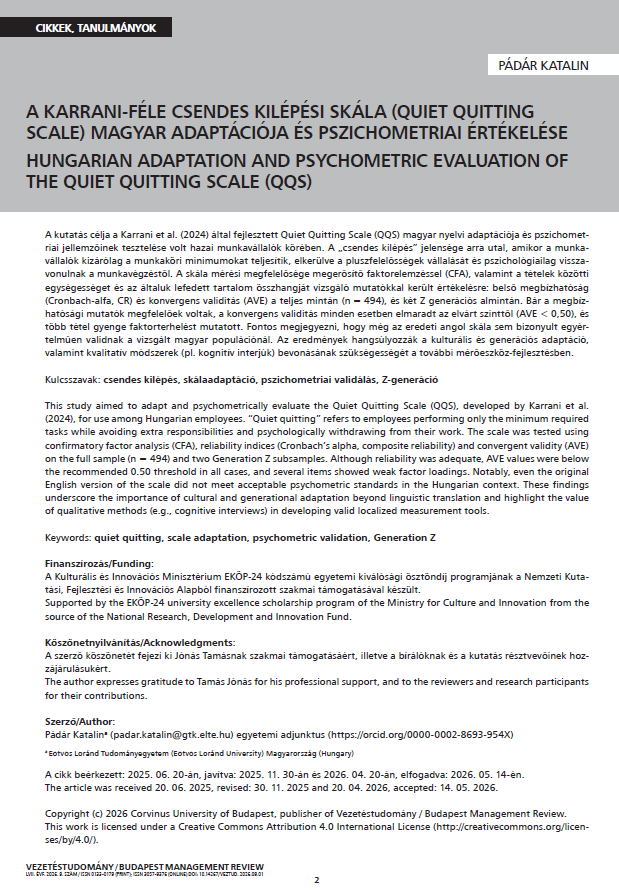
A Karrani-féle csendes kilépési skála (Quiet Quitting Scale) magyar adaptációja és pszichometriai értékelése
DOI:
https://doi.org/10.14267/VEZTUD.2026.09.01Kulcsszavak:
csendes kilépés, skálaadaptáció, pszichometriai validálás, Z-generációAbsztrakt
A kutatás célja a Karrani et al. (2024) által fejlesztett Quiet Quitting Scale (QQS) magyar nyelvi adaptációja és pszichometriai jellemzőinek tesztelése volt hazai munkavállalók körében. A „csendes kilépés” jelensége arra utal, amikor a munkavállalók kizárólag a munkaköri minimumokat teljesítik, elkerülve a pluszfelelősségek vállalását és pszichológiailag visszavonulnak a munkavégzéstől. A skála mérési megfelelősége megerősítő faktorelemzéssel (CFA), valamint a tételek közötti egységességet és az általuk lefedett tartalom összhangját vizsgáló mutatókkal került értékelésre: belső megbízhatóság (Cronbach-alfa, CR) és konvergens validitás (AVE) a teljes mintán (n = 494), és két Z generációs almintán. Bár a megbízhatósági mutatók megfelelőek voltak, a konvergens validitás minden esetben elmaradt az elvárt szinttől (AVE < 0,50), és több tétel gyenge faktorterhelést mutatott. Fontos megjegyezni, hogy még az eredeti angol skála sem bizonyult egyértelműen validnak a vizsgált magyar populációnál. Az eredmények hangsúlyozzák a kulturális és generációs adaptáció, valamint kvalitatív módszerek (pl. kognitív interjúk) bevonásának szükségességét a további mérőeszköz-fejlesztésben.
Downloads
Hivatkozások
Anand, A., Doll, J., & Ray, P. (2024). Drowning in silence: a scale development and validation of quiet quitting and quiet firing. International Journal of Organizational Analysis, 32(4), 721–743. https://doi.org/10.1108/IJOA-01-2023-3600
Arar, T., & Yurdakul, G. (2024). Increasing Danger in Business After the Pandemic: Adaptation of the Quiet Quitting Scale to Turkish. Istanbul Business Research, 53(3), 279–298. https://doi.org/10.26650/ibr.2024.53.1442717
Atalay, M., & Dağıstan, U. (2024). Quiet quitting: a new wine in an old bottle? Personnel Review, 53(4), 1059–1074. https://doi.org/10.1108/PR-02-2023-0122
Azeem, M.U., Bajwa, S.U., Shahzad, K., & Aslam, H. (2020). Psychological contract violation and turnover intention: the role of job dissatisfaction and work disengagement. Employee Relations, 42(6), 1291–1308. https://doi.org/10.1108/ER-09-2019-0372
Babbie, E. (2003). A társadalomtudományi kutatás gyakorlata (6., átdolg. kiadás). Balassi Kiadó.
Badru, A.F., Karadas, G., & Olugbade, O.A. (2024). Employee voice: the impact of high-performance work systems and organisational engagement climate. The Service Industries Journal, 44(7–8), 563–591. https://doi.org/10.1080/02642069.2022.2056163
Bagozzi, R.P., & Yi, Y. (1988). On the evaluation of structural equation models. Journal of the Academy of Marketing Science, 16(1), 74–94. https://doi.org/10.1007/BF02723327
Bani-Melhem, S., Zeffane, R., Abukhait, R., & Shamsudin, F. Mohd. (2021). Empowerment as a Pivotal Deterrent to Employee Silence: Evidence from the UAE Hotel Sector. Human Performance, 34(2), 107–125. https://doi.org/10.1080/08959285.2021.1890079
Beatty, P.C., & Willis, G.B. (2007). Research Synthesis: The Practice of Cognitive Interviewing. Public Opinion Quarterly, 71(2), 287–311. https://doi.org/10.1093/poq/nfm006
Behling, O., & Law, K. (2000). Translating Questionnaires and Other Research Instruments. SAGE Publications, Inc. https://doi.org/10.4135/9781412986373
Bentler, P.M., & Bonett, D.G. (1980). Significance tests and goodness of fit in the analysis of covariance structures. Psychological Bulletin, 88(3), 588–606. https://doi.org/10.1037/0033-2909.88.3.588
Bérubé, V., Maor, D., Mugayar-Baldochi, M., & Reich, A. (2022, December 12). European talent is ready to walk out the door. How should companies respond? McKinsey Quarterly. https://www.mckinsey.com/capabilities/people-and-organizational-performance/our-insights/european-talent-is-ready-to-walk-out-thedoor-how-should-companies-respond#/
Christian, J.S., & Ellis, A.P.J. (2014). The Crucial Role of Turnover Intentions in Transforming Moral Disengagement Into Deviant Behavior at Work. Journal of Business Ethics, 119(2), 193–208. https://doi.org/10.1007/s10551-013-1631-4
Cronbach, L.J. (1951). Coefficient Alpha and the Internal Structure of Tests. Psychometrika, 16(3), 297–334. https://doi.org/10.1007/BF02310555
Fan, X., Thompson, B., & Wang, L. (1999). Effects of sample size, estimation methods, and model specification on structural equation modeling fit indexes. Structural Equation Modeling: A Multidisciplinary Journal, 6(1), 56–83. https://doi.org/10.1080/10705519909540119
Field, A. (2013). Discovering Statistics Using IBM SPSS Statistics (4th edition). SAGE.
Formica, S., & Sfodera, F. (2022). The Great Resignation and Quiet Quitting paradigm shifts: An overview of current situation and future research directions. Journal of Hospitality Marketing & Management, 31(8), 899–907. https://doi.org/10.1080/19368623.2022.2136601
Fornell, C., & Larcker, D.F. (1981). Structural Equation Models with Unobservable Variables and Measurement Error: Algebra and Statistics. Journal of Marketing Research, 18(3), 382–388. https://doi.org/10.1177/002224378101800313
Frankó, L., & Erdélyi, A. (2024). A csendes kilépés jelensége és mérése – a Csendes Kilépés Kérdőív adaptálása magyar nyelvre. Magyar Pszichológiai Szemle, 79(3), 595–610. https://doi.org/10.1556/0016.2024.00117
Galanis, P., Katsiroumpa, A., Vraka, I., Siskou, O., Konstantakopoulou, O., Moisoglou, I., Gallos, P., & Kaitelidou, D. (2023). The quiet quitting scale: Development and initial validation. AIMS Public Health, 10(4), 828–848. https://doi.org/10.3934/publichealth.2023055
Gallup. (2024). State of the Global Workplace. https://www.gallup.com/workplace/349484/state-of-the-global-workplace.aspx#ite-645944
Hair, J.F., Anderson, R., Babin, B., & Black, W. (2013). Multivariate Data Analysis Pearson New International Edition. Pearson Deutschland. https://elibrary.pearson.de/book/99.150005/9781292035116
Hair, J.F., Risher, J.J., Sarstedt, M., & Ringle, C.M. (2019). When to use and how to report the results of PLSSEM. European Business Review, 31(1), 2–24. https://doi.org/10.1108/EBR-11-2018-0203
Hamilton, O., Jolles, D., & Lordan, G. (2023). Does the Tendency for “Quiet Quitting” Differ Across Generations? Evidence from the UK. SSRN Electronic Journal. https://doi.org/10.2139/ssrn.4488737
Hamouche, S., Koritos, C., & Papastathopoulos, A. (2023). Quiet quitting: relationship with other concepts and implications for tourism and hospitality. International Journal of Contemporary Hospitality Management, 35(12), 4297–4312. https://doi.org/10.1108/IJCHM-11-2022-1362
Harris, L.C. (2025). Commitment and Quiet Quitting: A Qualitative Longitudinal Study. Human Resource Management, 64(2), 565–582. https://doi.org/10.1002/hrm.22274
Hervé, J., & Oh, H. (2025). Quiet Quitting in Times of Uncertainty: Definition and Relationship With Perceived Control. Human Resource Management, 64(5), 1421–1456. https://doi.org/10.1002/hrm.22317
Ito, A. (2022, March 2). My company is not my family. Insider. https://www.businessinsider.com/overachievers-leaning-back-hustle-culture-coasting-employees-work
Jöreskog, K.G. (1971). Simultaneous Factor Analysis in Several Populations. Psychometrika, 36(4), 409–426. https://doi.org/10.1007/BF02291366
Kahn, W.A. (1990). Psychological Conditions of Personal Engagement and Disengagement at Work. Academy of Management Journal, 33(4), 692–724. https://doi.org/10.2307/256287
Karrani, M.A., Bani-Melhem, S., & Mohd-Shamsudin, F. (2024). Employee quiet quitting behaviours: conceptualization, measure development, and validation. Service Industries Journal, 44(3–4), 218–236. https://doi.org/10.1080/02642069.2023.2286604
Kim, K.T., & Sohn, Y.W. (2024). The Impact of Quiet Quitting on Turnover Intentions in the Era of Digital Transformation: The Mediating Roles of Job Satisfaction and Affective Commitment, and the Moderating Role of Psychological Safety. Systems, 12(11), 460. https://doi.org/10.3390/systems12110460
Konal Memiş, T., & Tabancalı, E. (2024). Teachers’ Silent Scream: Quiet Quitting. Research in Educational Administration and Leadership, 9(3), 372–412. https://doi.org/10.30828/real.1440040
Krenyácz, É., & Devecsery, Á. (2023). 60th Anniversary of Minnesota Satisfaction Questionnaire – Validation of an organizational satisfaction questionnaire in Hungarian adult sample. Statisztikai Szemle, 101(7), 571–588. https://doi.org/10.20311/stat2023.07.hu0571
Kruse, G.C., & MDiv, B.T.M. (2023). A Movement to Redefine our Relationship With Work. American Journal of Health Promotion, 37(4), 579–582. https://doi.org/10.1177/08901171231159711e
Leppelin, Z. (2022, July 25). On quiet quitting# workreform. [TikTok video].
Maden, C. (2014). Impact of fit, involvement, and tenure on job satisfaction and turnover intention. The Service Industries Journal, 34(14), 1113–1133. https://doi.org/10.1080/02642069.2014.939644
Meretei, B. (2017). Generációs különbségek a munkahelyen – szakirodalmi áttekintés. Vezetéstudomány, 48(10), 10–18. https://doi.org/10.14267/VEZTUD.2017.10.02
Meyer, J.P., & Allen, N. (1997). Commitment in the Workplace: Theory, Research, and Application. SAGE Publications, Inc. https://doi.org/10.4135/9781452231556
Meyer, J.P., & Allen, N.J. (1991). A three-component conceptualization of organizational commitment. Human Resource Management Review, 1(1), 61–89. https://doi.org/10.1016/1053-4822(91)90011-Z
Meyer, J.P., Stanley, D.J., Herscovitch, L., & Topolnytsky, L. (2002). Affective, continuance, and normative commitment to the organization: A meta-analysis of antecedents, correlates, and consequences. Journal of Vocational Behavior, 61(1), 20–52. https://doi.org/10.1006/jvbe.2001.1842
Molnár, T. (2017). Empirikus területi kutatások és módszerek. Akadémiai Kiadó. https://doi.org/10.1556/9789634540229
Morgado, F.F.R., Meireles, J.F.F., Neves, C.M., Amaral, A.C.S., & Ferreira, M.E.C. (2017). Scale development: Ten main limitations and recommendations to improve future research practices. Psicologia: Reflexao e Critica, 30(1), 1–20. https://doi.org/10.1186/s41155-016-0057-1
Mowday, R.T., Steers, R.M., & Porter, L.W. (1979). The measurement of organizational commitment. Journal of Vocational Behavior, 14(2), 224–247. https://doi.org/10.1016/0001-8791(79)90072-1
Nunnally, J.C. (1978). An Overview of Psychological Measurement. In Clinical Diagnosis of Mental Disorders (pp. 97–146). Springer US. https://doi.org/10.1007/978-1-4684-2490-4_4
Nunnally, J.C., & Bernstein, I. (1994). Psychometric Theory (3rd Edition). McGraw-Hill.
Özen, H., Korkmaz, M., Konucuk, E., Çeven, B., Sayar, N., Menşan, N.Ö., & Chan, T.C. (2024). Evaluation of Quiet Quitting: Is the Bell Ringing? Journal of Qualitative Research in Education, (38), 108–142. https://doi.org/10.14689/enad.38.1910
Pearce, K. (2022, September 12). What is “quiet quitting”? HUB. https://hub.jhu.edu/2022/09/12/what-isquiet-quitting/
Reise, S.P., Widaman, K.F., & Pugh, R.H. (1993). Confirmatory factor analysis and item response theory: Two approaches for exploring measurement invariance. Psychological Bulletin, 114(3), 552–566. https://doi.org/10.1037/0033-2909.114.3.552
Rodríguez-Montoya, C., De Castro Morel, R., & Frías- Rodríguez, D. (2025). Quiet quitting in the Dominican Republic: the employers’ perspective. Management Research: Journal of the Iberoamerican Academy of Management, 23(2), 185–202. https://doi.org/10.1108/MRJIAM-12-2023-1488
Rosseel, Y. (2012). lavaan: An R Package for Structural Equation Modeling. Journal of Statistical Software, 48(2). https://doi.org/10.18637/jss.v048.i02
Ryan, K., Gannon-Slater, N., & Culbertson, M.J. (2012). Improving Survey Methods With Cognitive Interviews in Small- and Medium-Scale Evaluations. American Journal of Evaluation, 33(3), 414–430. https://doi.org/10.1177/1098214012441499
Scheyett, A. (2022). Quiet Quitting. Social Work, 68(1), 5–7. https://doi.org/10.1093/sw/swac051
Serenko, A. (2024). The human capital management perspective on quiet quitting: recommendations for employees, managers, and national policymakers. Journal of Knowledge Management, 28(1), 27–43. https://doi.org/10.1108/JKM-10-2022-0792
Sheskin, D. J. (2020). Handbook of Parametric and Nonparametric Statistical Procedures (5th Edition). Chapman and Hall/CRC. https://doi.org/10.1201/9780429186196
Srivastava, S., & Saxena, A. (2025). Deciphering how workplace hazing evokes quiet quitting among Gen Z employees in the hotel industry. Journal of Hospitality and Tourism Insights. https://doi.org/10.1108/JHTI-10-2024-1133
Steiger, J.H. (2007). Understanding the limitations of global fit assessment in structural equation modeling. Personality and Individual Differences, 42(5), 893–898. https://doi.org/10.1016/j.paid.2006.09.017
Talukder, M.F., & Prieto, L. (2025). A “quiet quitting” scale: development and validation. International Journal of Organizational Analysis, 33(6), 1487–1510. https://doi.org/10.1108/IJOA-01-2024-4182
van de Vijver, F.J.R., & Leung, K. (1997). Methods and Data Analysis for Cross-Cultural Research. SAGE.
Wilcoxon, F. (1945). Individual Comparisons by Ranking Methods. Bulletin, 1(6), 80–83. https://doi.org/10.2307/3001968
Willis, G. B. (2015). Analysis of the Cognitive Interview in Questionnaire Design. Oxford University Press.
Worthington, R.L., & Whittaker, T.A. (2006). Scale Development Research. The Counseling Psychologist, 34(6), 806–838. https://doi.org/10.1177/0011000006288127
Xueyun, Z., Al Mamun, A., Masukujjaman, M., Rahman, M.K., Gao, J., & Yang, Q. (2023). Modelling the significance of organizational conditions on quiet quitting intention among Gen Z workforce in an emerging economy. Scientific Reports, 13(1), 15438. https://doi.org/10.1038/s41598-023-42591-3
Xueyun, Z., Yang, Q., & Al Mamun, A. (2024). Predicting the Quiet Quitting Intention Among the Generation Z Workforce in Hotel Industry. Journal of Quality Assurance in Hospitality & Tourism, 1–30. https://doi.org/10.1080/1528008X.2024.2393336
Letöltések
Megjelent
Folyóirat szám
Rovat
License
Copyright (c) 2026 Corvinus University of Budapest, publisher of Vezetéstudomány / Budapest Management Review

This work is licensed under a Creative Commons Attribution 4.0 International License.
Authors assign copyright to Vezetéstudomány / Budapest Management Review. Authors are responsible for permission to reproduce copyright material from other sources.
Hogyan kell idézni