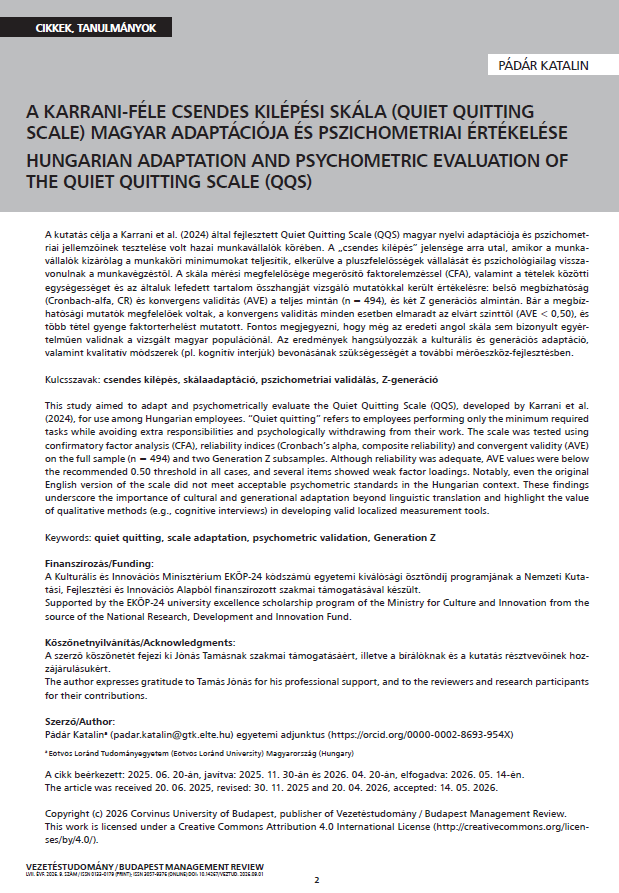
Hungarian adaptation and psychometric evaluation of the Quiet Quitting Scale (QQS)
DOI:
https://doi.org/10.14267/VEZTUD.2026.09.01Keywords:
quiet quitting, scale adaptation, psychometric validation, Generation ZAbstract
This study aimed to adapt and psychometrically evaluate the Quiet Quitting Scale (QQS), developed by Karrani et al. (2024), for use among Hungarian employees. “Quiet quitting” refers to employees performing only the minimum required tasks while avoiding extra responsibilities and psychologically withdrawing from their work. The scale was tested using confirmatory factor analysis (CFA), reliability indices (Cronbach’s alpha, composite reliability) and convergent validity (AVE) on the full sample (n = 494) and two Generation Z subsamples. Although reliability was adequate, AVE values were below the recommended 0.50 threshold in all cases, and several items showed weak factor loadings. Notably, even the original English version of the scale did not meet acceptable psychometric standards in the Hungarian context. These findings underscore the importance of cultural and generational adaptation beyond linguistic translation and highlight the value of qualitative methods (e.g., cognitive interviews) in developing valid localized measurement tools.
Downloads
References
Anand, A., Doll, J., & Ray, P. (2024). Drowning in silence: a scale development and validation of quiet quitting and quiet firing. International Journal of Organizational Analysis, 32(4), 721–743. https://doi.org/10.1108/IJOA-01-2023-3600
Arar, T., & Yurdakul, G. (2024). Increasing Danger in Business After the Pandemic: Adaptation of the Quiet Quitting Scale to Turkish. Istanbul Business Research, 53(3), 279–298. https://doi.org/10.26650/ibr.2024.53.1442717
Atalay, M., & Dağıstan, U. (2024). Quiet quitting: a new wine in an old bottle? Personnel Review, 53(4), 1059–1074. https://doi.org/10.1108/PR-02-2023-0122
Azeem, M.U., Bajwa, S.U., Shahzad, K., & Aslam, H. (2020). Psychological contract violation and turnover intention: the role of job dissatisfaction and work disengagement. Employee Relations, 42(6), 1291–1308. https://doi.org/10.1108/ER-09-2019-0372
Babbie, E. (2003). A társadalomtudományi kutatás gyakorlata (6., átdolg. kiadás). Balassi Kiadó.
Badru, A.F., Karadas, G., & Olugbade, O.A. (2024). Employee voice: the impact of high-performance work systems and organisational engagement climate. The Service Industries Journal, 44(7–8), 563–591. https://doi.org/10.1080/02642069.2022.2056163
Bagozzi, R.P., & Yi, Y. (1988). On the evaluation of structural equation models. Journal of the Academy of Marketing Science, 16(1), 74–94. https://doi.org/10.1007/BF02723327
Bani-Melhem, S., Zeffane, R., Abukhait, R., & Shamsudin, F. Mohd. (2021). Empowerment as a Pivotal Deterrent to Employee Silence: Evidence from the UAE Hotel Sector. Human Performance, 34(2), 107–125. https://doi.org/10.1080/08959285.2021.1890079
Beatty, P.C., & Willis, G.B. (2007). Research Synthesis: The Practice of Cognitive Interviewing. Public Opinion Quarterly, 71(2), 287–311. https://doi.org/10.1093/poq/nfm006
Behling, O., & Law, K. (2000). Translating Questionnaires and Other Research Instruments. SAGE Publications, Inc. https://doi.org/10.4135/9781412986373
Bentler, P.M., & Bonett, D.G. (1980). Significance tests and goodness of fit in the analysis of covariance structures. Psychological Bulletin, 88(3), 588–606. https://doi.org/10.1037/0033-2909.88.3.588
Bérubé, V., Maor, D., Mugayar-Baldochi, M., & Reich, A. (2022, December 12). European talent is ready to walk out the door. How should companies respond? McKinsey Quarterly. https://www.mckinsey.com/capabilities/people-and-organizational-performance/our-insights/european-talent-is-ready-to-walk-out-thedoor-how-should-companies-respond#/
Christian, J.S., & Ellis, A.P.J. (2014). The Crucial Role of Turnover Intentions in Transforming Moral Disengagement Into Deviant Behavior at Work. Journal of Business Ethics, 119(2), 193–208. https://doi.org/10.1007/s10551-013-1631-4
Cronbach, L.J. (1951). Coefficient Alpha and the Internal Structure of Tests. Psychometrika, 16(3), 297–334. https://doi.org/10.1007/BF02310555
Fan, X., Thompson, B., & Wang, L. (1999). Effects of sample size, estimation methods, and model specification on structural equation modeling fit indexes. Structural Equation Modeling: A Multidisciplinary Journal, 6(1), 56–83. https://doi.org/10.1080/10705519909540119
Field, A. (2013). Discovering Statistics Using IBM SPSS Statistics (4th edition). SAGE.
Formica, S., & Sfodera, F. (2022). The Great Resignation and Quiet Quitting paradigm shifts: An overview of current situation and future research directions. Journal of Hospitality Marketing & Management, 31(8), 899–907. https://doi.org/10.1080/19368623.2022.2136601
Fornell, C., & Larcker, D.F. (1981). Structural Equation Models with Unobservable Variables and Measurement Error: Algebra and Statistics. Journal of Marketing Research, 18(3), 382–388. https://doi.org/10.1177/002224378101800313
Frankó, L., & Erdélyi, A. (2024). A csendes kilépés jelensége és mérése – a Csendes Kilépés Kérdőív adaptálása magyar nyelvre. Magyar Pszichológiai Szemle, 79(3), 595–610. https://doi.org/10.1556/0016.2024.00117
Galanis, P., Katsiroumpa, A., Vraka, I., Siskou, O., Konstantakopoulou, O., Moisoglou, I., Gallos, P., & Kaitelidou, D. (2023). The quiet quitting scale: Development and initial validation. AIMS Public Health, 10(4), 828–848. https://doi.org/10.3934/publichealth.2023055
Gallup. (2024). State of the Global Workplace. https://www.gallup.com/workplace/349484/state-of-the-global-workplace.aspx#ite-645944
Hair, J.F., Anderson, R., Babin, B., & Black, W. (2013). Multivariate Data Analysis Pearson New International Edition. Pearson Deutschland. https://elibrary.pearson.de/book/99.150005/9781292035116
Hair, J.F., Risher, J.J., Sarstedt, M., & Ringle, C.M. (2019). When to use and how to report the results of PLSSEM. European Business Review, 31(1), 2–24. https://doi.org/10.1108/EBR-11-2018-0203
Hamilton, O., Jolles, D., & Lordan, G. (2023). Does the Tendency for “Quiet Quitting” Differ Across Generations? Evidence from the UK. SSRN Electronic Journal. https://doi.org/10.2139/ssrn.4488737
Hamouche, S., Koritos, C., & Papastathopoulos, A. (2023). Quiet quitting: relationship with other concepts and implications for tourism and hospitality. International Journal of Contemporary Hospitality Management, 35(12), 4297–4312. https://doi.org/10.1108/IJCHM-11-2022-1362
Harris, L.C. (2025). Commitment and Quiet Quitting: A Qualitative Longitudinal Study. Human Resource Management, 64(2), 565–582. https://doi.org/10.1002/hrm.22274
Hervé, J., & Oh, H. (2025). Quiet Quitting in Times of Uncertainty: Definition and Relationship With Perceived Control. Human Resource Management, 64(5), 1421–1456. https://doi.org/10.1002/hrm.22317
Ito, A. (2022, March 2). My company is not my family. Insider. https://www.businessinsider.com/overachievers-leaning-back-hustle-culture-coasting-employees-work
Jöreskog, K.G. (1971). Simultaneous Factor Analysis in Several Populations. Psychometrika, 36(4), 409–426. https://doi.org/10.1007/BF02291366
Kahn, W.A. (1990). Psychological Conditions of Personal Engagement and Disengagement at Work. Academy of Management Journal, 33(4), 692–724. https://doi.org/10.2307/256287
Karrani, M.A., Bani-Melhem, S., & Mohd-Shamsudin, F. (2024). Employee quiet quitting behaviours: conceptualization, measure development, and validation. Service Industries Journal, 44(3–4), 218–236. https://doi.org/10.1080/02642069.2023.2286604
Kim, K.T., & Sohn, Y.W. (2024). The Impact of Quiet Quitting on Turnover Intentions in the Era of Digital Transformation: The Mediating Roles of Job Satisfaction and Affective Commitment, and the Moderating Role of Psychological Safety. Systems, 12(11), 460. https://doi.org/10.3390/systems12110460
Konal Memiş, T., & Tabancalı, E. (2024). Teachers’ Silent Scream: Quiet Quitting. Research in Educational Administration and Leadership, 9(3), 372–412. https://doi.org/10.30828/real.1440040
Krenyácz, É., & Devecsery, Á. (2023). 60th Anniversary of Minnesota Satisfaction Questionnaire – Validation of an organizational satisfaction questionnaire in Hungarian adult sample. Statisztikai Szemle, 101(7), 571–588. https://doi.org/10.20311/stat2023.07.hu0571
Kruse, G.C., & MDiv, B.T.M. (2023). A Movement to Redefine our Relationship With Work. American Journal of Health Promotion, 37(4), 579–582. https://doi.org/10.1177/08901171231159711e
Leppelin, Z. (2022, July 25). On quiet quitting# workreform. [TikTok video].
Maden, C. (2014). Impact of fit, involvement, and tenure on job satisfaction and turnover intention. The Service Industries Journal, 34(14), 1113–1133. https://doi.org/10.1080/02642069.2014.939644
Meretei, B. (2017). Generációs különbségek a munkahelyen – szakirodalmi áttekintés. Vezetéstudomány, 48(10), 10–18. https://doi.org/10.14267/VEZTUD.2017.10.02
Meyer, J.P., & Allen, N. (1997). Commitment in the Workplace: Theory, Research, and Application. SAGE Publications, Inc. https://doi.org/10.4135/9781452231556
Meyer, J.P., & Allen, N.J. (1991). A three-component conceptualization of organizational commitment. Human Resource Management Review, 1(1), 61–89. https://doi.org/10.1016/1053-4822(91)90011-Z
Meyer, J.P., Stanley, D.J., Herscovitch, L., & Topolnytsky, L. (2002). Affective, continuance, and normative commitment to the organization: A meta-analysis of antecedents, correlates, and consequences. Journal of Vocational Behavior, 61(1), 20–52. https://doi.org/10.1006/jvbe.2001.1842
Molnár, T. (2017). Empirikus területi kutatások és módszerek. Akadémiai Kiadó. https://doi.org/10.1556/9789634540229
Morgado, F.F.R., Meireles, J.F.F., Neves, C.M., Amaral, A.C.S., & Ferreira, M.E.C. (2017). Scale development: Ten main limitations and recommendations to improve future research practices. Psicologia: Reflexao e Critica, 30(1), 1–20. https://doi.org/10.1186/s41155-016-0057-1
Mowday, R.T., Steers, R.M., & Porter, L.W. (1979). The measurement of organizational commitment. Journal of Vocational Behavior, 14(2), 224–247. https://doi.org/10.1016/0001-8791(79)90072-1
Nunnally, J.C. (1978). An Overview of Psychological Measurement. In Clinical Diagnosis of Mental Disorders (pp. 97–146). Springer US. https://doi.org/10.1007/978-1-4684-2490-4_4
Nunnally, J.C., & Bernstein, I. (1994). Psychometric Theory (3rd Edition). McGraw-Hill.
Özen, H., Korkmaz, M., Konucuk, E., Çeven, B., Sayar, N., Menşan, N.Ö., & Chan, T.C. (2024). Evaluation of Quiet Quitting: Is the Bell Ringing? Journal of Qualitative Research in Education, (38), 108–142. https://doi.org/10.14689/enad.38.1910
Pearce, K. (2022, September 12). What is “quiet quitting”? HUB. https://hub.jhu.edu/2022/09/12/what-isquiet-quitting/
Reise, S.P., Widaman, K.F., & Pugh, R.H. (1993). Confirmatory factor analysis and item response theory: Two approaches for exploring measurement invariance. Psychological Bulletin, 114(3), 552–566. https://doi.org/10.1037/0033-2909.114.3.552
Rodríguez-Montoya, C., De Castro Morel, R., & Frías- Rodríguez, D. (2025). Quiet quitting in the Dominican Republic: the employers’ perspective. Management Research: Journal of the Iberoamerican Academy of Management, 23(2), 185–202. https://doi.org/10.1108/MRJIAM-12-2023-1488
Rosseel, Y. (2012). lavaan: An R Package for Structural Equation Modeling. Journal of Statistical Software, 48(2). https://doi.org/10.18637/jss.v048.i02
Ryan, K., Gannon-Slater, N., & Culbertson, M.J. (2012). Improving Survey Methods With Cognitive Interviews in Small- and Medium-Scale Evaluations. American Journal of Evaluation, 33(3), 414–430. https://doi.org/10.1177/1098214012441499
Scheyett, A. (2022). Quiet Quitting. Social Work, 68(1), 5–7. https://doi.org/10.1093/sw/swac051
Serenko, A. (2024). The human capital management perspective on quiet quitting: recommendations for employees, managers, and national policymakers. Journal of Knowledge Management, 28(1), 27–43. https://doi.org/10.1108/JKM-10-2022-0792
Sheskin, D. J. (2020). Handbook of Parametric and Nonparametric Statistical Procedures (5th Edition). Chapman and Hall/CRC. https://doi.org/10.1201/9780429186196
Srivastava, S., & Saxena, A. (2025). Deciphering how workplace hazing evokes quiet quitting among Gen Z employees in the hotel industry. Journal of Hospitality and Tourism Insights. https://doi.org/10.1108/JHTI-10-2024-1133
Steiger, J.H. (2007). Understanding the limitations of global fit assessment in structural equation modeling. Personality and Individual Differences, 42(5), 893–898. https://doi.org/10.1016/j.paid.2006.09.017
Talukder, M.F., & Prieto, L. (2025). A “quiet quitting” scale: development and validation. International Journal of Organizational Analysis, 33(6), 1487–1510. https://doi.org/10.1108/IJOA-01-2024-4182
van de Vijver, F.J.R., & Leung, K. (1997). Methods and Data Analysis for Cross-Cultural Research. SAGE.
Wilcoxon, F. (1945). Individual Comparisons by Ranking Methods. Bulletin, 1(6), 80–83. https://doi.org/10.2307/3001968
Willis, G. B. (2015). Analysis of the Cognitive Interview in Questionnaire Design. Oxford University Press.
Worthington, R.L., & Whittaker, T.A. (2006). Scale Development Research. The Counseling Psychologist, 34(6), 806–838. https://doi.org/10.1177/0011000006288127
Xueyun, Z., Al Mamun, A., Masukujjaman, M., Rahman, M.K., Gao, J., & Yang, Q. (2023). Modelling the significance of organizational conditions on quiet quitting intention among Gen Z workforce in an emerging economy. Scientific Reports, 13(1), 15438. https://doi.org/10.1038/s41598-023-42591-3
Xueyun, Z., Yang, Q., & Al Mamun, A. (2024). Predicting the Quiet Quitting Intention Among the Generation Z Workforce in Hotel Industry. Journal of Quality Assurance in Hospitality & Tourism, 1–30. https://doi.org/10.1080/1528008X.2024.2393336
Downloads
Published
Issue
Section
License
Copyright (c) 2026 Corvinus University of Budapest, publisher of Vezetéstudomány / Budapest Management Review

This work is licensed under a Creative Commons Attribution 4.0 International License.
Authors assign copyright to Vezetéstudomány / Budapest Management Review. Authors are responsible for permission to reproduce copyright material from other sources.
How to Cite