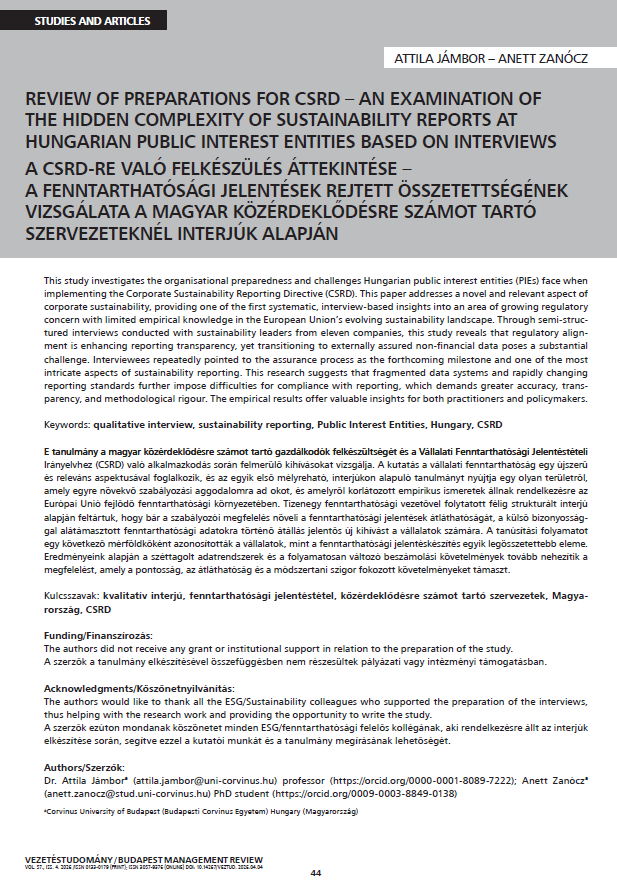
A CSRD-re való felkészülés áttekintése
A fenntarthatósági jelentések rejtett összetettségének vizsgálata a magyar közérdeklődésre számot tartó szervezeteknél interjúk alapján
DOI:
https://doi.org/10.14267/VEZTUD.2026.04.04Kulcsszavak:
kvalitatív interjú, fenntarthatósági jelentéstétel, közérdeklődésre számot tartó szervezetek, Magyarország, CSRDAbsztrakt
E tanulmány a magyar közérdeklődésre számot tartó gazdálkodók felkészültségét és a Vállalati Fenntarthatósági Jelentéstételi Irányelvhez (CSRD) való alkalmazkodás során felmerülő kihívásokat vizsgálja. A kutatás a vállalati fenntarthatóság egy újszerű és releváns aspektusával foglalkozik, és az egyik első mélyreható, interjúkon alapuló tanulmányt nyújtja egy olyan területről, amely egyre növekvő szabályozási aggodalomra ad okot, és amelyről korlátozott empirikus ismeretek állnak rendelkezésre az Európai Unió fejlődő fenntarthatósági környezetében. Tizenegy fenntarthatósági vezetővel folytatott félig strukturált interjú alapján feltártuk, hogy bár a szabályozói megfelelés növeli a fenntarthatósági jelentések átláthatóságát, a külső bizonyossággal alátámasztott fenntarthatósági adatokra történő átállás jelentős új kihívást a vállalatok számára. A tanúsítási folyamatot egy következő mérföldkőként azonosították a vállalatok, mint a fenntarthatósági jelentéskészítés egyik legösszetettebb eleme. Eredményeink alapján a széttagolt adatrendszerek és a folyamatosan változó beszámolási követelmények tovább nehezítik a megfelelést, amely a pontosság, az átláthatóság és a módszertani szigor fokozott követelményeket támaszt.
Downloads
Hivatkozások
Ahmad, H., Yaqub, M., & Lee, S.H. (2023). Environmental-, social-, and governance-related factors for business investment and sustainability: a scientometric review of global trends. Environment Development and Sustainability, 26(2), 2965. https://doi.org/10.1007/s10668-023-02921-x
Almaqtari, F.A., Elsheikh, T., Abdelkhair, F.Y.F., & Mazrou, Y.S.A. (2023). The impact of corporate environmental disclosure practices and board attributes on sustainability: Empirical evidence from Asia and Europe. Heliyon, 9(8), e18453. https://doi.org/10.1016/j.heliyon.2023.e18453
Amran, A., & Ooi, S.K. (2014). Sustainability reporting: Meeting stakeholder demands. Strategic Direction, 30(7), 38. https://doi.org/10.1108/sd-03-2014-0035
Asvanyi, K., Diofasi-Kovacs, O., Farkas, M., Harangozo, G., Jambor, A., Marton, A., Mihele, M. A., Nemes, Zs., Szabo, D., Trautmann, L., Zanocz, A., & Vilagos, E. (2024). ESG korkep 2024. A magyar vallalatok fenntarthatosaganak helyzete es kilatasai. Ifjusagi Vallalkozaselenkit. Egyesulet. https://www.uni-corvinus.hu/downloads/a6pd.1620m4c/esg-kiadvany-2024.pdf?utm_source=chatgpt.com
Barbosa, A. de S., Crispim, M.C., Silva, L.B. da, Morioka, S.N., & Souza, V.F. de. (2023). Integration of Environmental, Social, and Governance (ESG) criteria: Their impacts on corporate sustainability performance. Humanities and Social Sciences Communications, 10(1), Article 19. https://doi.org/10.1057/s41599-023-01919-0
Baumgartner, R.J., & Ebner]Karestinos, D. (2010). Corporate sustainability strategies: Sustainability profiles and maturity levels. Sustainable Development, 18(2), 76-89. https://doi.org/10.1002/sd.447
Bednarova, M., Klimko, R., & Rievajova, E. (2019). From Environmental Reporting to Environmental Performance. Sustainability, 11(9), 2549. https://doi.org/10.3390/su11092549
Benameur, K., Mostafa, M.M., Hassanein, A., Shariff, M.Z., & Al-Shattarat, W. (2023). Sustainability reporting scholarly research: a bibliometric review and a future research agenda. Management Review Quarterly, 74(2), 823-853. https://doi.org/10.1007/s11301-023-00319-7
Birt, J., Joshi, M., & Kend, M. (2017). Segment reporting in a developing economy: the Indian banking sector. Asian Review of Accounting, 25(1), 127. https://doi.org/10.1108/ara-06-2015-0064
Bruno, M., & Lagasio, V. (2021). An Overview of the European Policies on ESG in the Banking Sector. Sustainability, 13(22), 12641. https://doi.org/10.3390/su132212641
CIB Bank Zrt. (n.d.). Jelenteseink. https://www.cib.hu/Maganszemelyek/rolunk/fenntarthatosag/jelentesek.html
Cicchiello, A.F., Fellegara, A.M., Kazemikhasragh, A., & Monferra, S. (2021). Gender diversity on corporate boards: How Asian and African women contribute on sustainability reporting activity. Gender in Management: An International Journal, 36(7), 801-823. https://doi.org/10.1108/gm-05-2020-0147
DiCicco-Bloom, B., & Crabtree, B.F. (2006). The qualitative research interview. Medical Education, 40(4), 314-321. https://doi.org/10.1111/j.1365-2929.2006.02418.x
European Commission (2022). Directive (EU) 2022/2464 of the European Parliament and of the Council of 14 December 2022 on corporate sustainability reporting (Corporate Sustainability Reporting Directive). https://eur-lex.europa.eu/eli/dir/2022/2464/oj/eng
European Council (n.d.). Simplification: Council agrees position on the 'Stop-the-clock' mechanism to enhance EU competitiveness and provide legal certainty to businesses. https://www.consilium.europa.eu/en/press/press-releases/2025/03/26/simplification-council-agrees-position-on-the-stop-the-clock-mechanism-to-enhance-eu-competitiveness/
Hamann, R., Sewlal, A., Pariag-Maraye, N., Muthuri, J.N., Amaeshi, K., Nwagwu, I., & Soderbergh, J. (2022). Strengthening or Restricting? Explaining the Covid-19 Pandemic's Configurational Effects on Companies' Sustainability Strategies and Practices. Business & Society, 63(4), 774. https://doi.org/10.1177/00076503221134100
Hegedűs, S., Kardos, B., & Gy.ri, Z. (2023). Application of EU non-financial disclosure rules to Hungarian listed companies between 2019 and 2022. Vezetestudomany/Budapest Management Review, 54(12), 24.39. https://doi.org/10.14267/VEZTUD.2023.12.03
Hummel, K., & Jobst, D. (2024). An overview of corporate sustainability reporting legislation in the European Union. Accounting in Europe, 21(3), 320.355. https://doi.org/10.1080/17449480.2024.2312145
Hungary. (2015). 2015. evi LXXXV. torveny a konyvvizsgaloi tevekenysegr.l [Act LXXXV of 2015 on Audit Activities]. National Legislation Database. https://njt.hu/jogszabaly/2015-85-00-00
IAASA. (n.d.). Letter issued to Audit Committee Chairs regarding responsibilities of Audit Committees for compliance with the Corporate Sustainability Reporting Directive. https://iaasa.ie/publications/letter-issued-to-audit-committee-chairs-regarding-responsibilities-of-audit-committees-for-compliance-with-the-corporate-sustainability-reporting-directive/
Jain, K., & Tripathi, P.S. (2023). Mapping the environmental, social and governance literature: A bibliometric and content analysis. Journal of Strategy and Management, 16(3), 397.428. https://doi.org/10.1108/JSMA-05-2022-0092
Jambor, A., & Zanocz, A. (2023). The Diversity of Environmental, Social, and Governance Aspects in Sustainability: A Systematic Literature Review. Sustainability 15, 13958. https://doi.org/10.3390/su151813958
Katterbauer, K., Syed, H., Genç, S.Y., & Cleenewerck, L. (2022). Environmental Compliance and Financial Performance of Shariah-Compliant Enterprises – A Data-Driven Analysis. Revista de Gestão Social e Ambiental, 16(2), Article e025. https://doi.org/10.24857/rgsa.v16n2-025
Kim, S.W., & Li, Z. (2021). Understanding the Impact of ESG Practices in Corporate Finance. Sustainability, 13(7), 3746. https://doi.org/10.3390/su13073746
Lee, O., Joo, H., Choi, H., & Cheon, M. (2022). Proposing an Integrated Approach to Analyzing ESG Data via Machine Learning and Deep Learning Algorithms. Sustainability, 14(14), 8745. https://doi.org/10.3390/su14148745
Loganathan, T., Chan, Z.X., Hassan, F., Ong, Z.L., & Majid, H. A. (2022). Undocumented: An examination of legal identity and education provision for children in Malaysia. PLoS ONE, 17(2), e0263404. https://doi.org/10.1371/journal.pone.0263404
Longhurst, R. (2009). Interviews: In-Depth, Semi-Structured. In International Encyclopedia of Human Geography (pp. 580-584). Elsevier BV. https://doi.org/10.1016/b978-008044910-4.00458-2
Lozano, R., Fobbe, L., Carpenter, A., & Sammalisto, K. (2018). Analysing sustainability changes in seaports: Experiences from the Gävle Port Authority. Sustainable Development, 27(3), 409-420. https://doi.org/10.1002/sd.1913
Mariappanadar, S. (2025). Human Capital to Implement Corporate Sustainability Business Strategies for Common Good. Sustainability, 17(10), 4559. https://doi.org/10.3390/su17104559
Masud, Md.A.K., Nurunnabi, M., & Bae, S.M. (2018). The effects of corporate governance on environmental sustainability reporting: empirical evidence from South Asian countries. Asian Journal of Sustainability and Social Responsibility, 3(1), Article 3. https://doi.org/10.1186/s41180-018-0019-x
Mayer, R., & Reizingerné Ducsai, A. (2023). ESG: Credibility behind the scores – The reliability and transparency of ESG ratings. Prosperitas, 10(2), Article 41. https://doi.org/10.31570/prosp_2022_0041
McIntosh, M., & Morse, J.M. (2015). Situating and Constructing Diversity in Semi-Structured Interviews. Global Qualitative Nursing Research, 2, 2333393615597674. https://doi.org/10.1177/2333393615597674
Nagy, Zs., Huzsvai D., & Nagy J. (2025). Az Omnibusz javaslatcsomag fenntarthatósági jelentéstételi vonatkozásai. KPMG Magyarország. https://kpmg.com/hu/hu/home/tanulmanyok/2025/03/az-omnibusz-javaslatcsomag-fenntarthatosagi-jelentesteteli-vonatkozasai.html
Natow, R.S. (2019). The use of triangulation in qualitative studies employing elite interviews. Qualitative Research, 20(2), 160-173. https://doi.org/10.1177/1468794119830077
Nawangsari, L.C., & Sutawijaya, A.H. (2019). Green Human Resources Management for Business Sustainability in Banking Institutions. International Journal of Managerial Studies and Research, 7(9), 1-8. https://doi.org/10.20431/2349-0349.0709002
Nechita, E., Manea, C.L., Nichita, E.M., Irimescu, A.M., & Manea, D. (2020). Is Financial Information Influencing the Reporting on SDGs? Empirical Evidence from Central and Eastern European Chemical Companies. Sustainability, 12(21), Article 9231. https://doi.org/10.3390/su12219251
Niu, S., Park, B.I., & Jung, J.S. (2022). The Effects of Digital Leadership and ESG Management on Organizational Innovation and Sustainability. Sustainability, 14(23), 15639. https://doi.org/10.3390/su142315639
Oprean-Stan, C., Oncioiu, I., Iuga, I.C., & Stan, S.E. (2020). Impact of Sustainability Reporting and Inadequate Management of ESG Factors on Corporate Performance and Sustainable Growth. Sustainability, 12(20), 8536. https://doi.org/10.3390/su12208536
Papafloratos, T., & Fragidis, G. (2025). Corporate Social Responsibility (CSR), Sustainability and ESG Standards Used by ATHEX ESG Index Listed Companies. Preprints. https://doi.org/10.20944/preprints202502.1077.v1
Permatasari, P., & Gunawan, J. (2023). Sustainability policies for small medium enterprises: WHO are the actors? Cleaner and Responsible Consumption, 9, 100122. https://doi.org/10.1016/j.clrc.2023.100122
Porfírio, J., Felício, J.A., & Carrilho, T. (2023). Factors affecting digital transformation in banking. Journal of Business Research, 171, 114393. https://doi.org/10.1016/j.jbusres.2023.114393
Poulle, J.B., Kannan, A., Spitz, N., Kahn, S., & Sotiropoulou, A. (2024). Corporate Sustainability Reporting Directive. In EU Banking and Financial Regulation (pp. 648-653). Edward Elgar Publishing. https://doi.org/10.4337/9781035301959.00096
Pratihari, S.K., & Uzma, S.H. (2019). A survey on bankers’ perception of corporate social responsibility in India. Social Responsibility Journal, 16(2), 225-244. https://doi.org/10.1108/srj-11-2016-0198
Sharma, M., & Choubey, A. (2021). Green banking initiatives: a qualitative study on Indian banking sector. Environment Development and Sustainability, 24(1), 293-310. https://doi.org/10.1007/s10668-021-01426-9
Surman, V., & Böcskei, E. (2025). A KKV-k fenntartható fejlődési céljait befolyásoló tényezők – Gazdasági, környezeti és társadalmi hatások = Factors influencing SMEs’ sustainable development goals– economic, environmental, and social impacts. Vezetéstudomány – Budapest Management Review, 56(5). 13-24. https://doi.org/10.14267/VEZTUD.2025.05.02
Surman, V., & Böcskei, E. (2023) Fenntarthatóság a magyar kis- és középvállalati szektorban. Vezetéstudomány – Budapest Management Review, 54(10). 15-28. https://doi.org/10.14267/VEZTUD.2023.10.02
Taliento, M., & Netti, A. (2020). Corporate Social/ Environmental Responsibility and Value Creation: Reflections on a Modern Business Management Paradigm. Business Ethics and Leadership, 4(4), 123-131. https://doi.org/10.21272/bel.4(4).123-131.2020
Torre, M.L., Sabelfeld, S., Blomkvist, M., Tarquinio, L., & Dumay, J. (2018). Harmonising non-financial reporting regulation in Europe. Meditari Accountancy Research, 26(4), 598-621. https://doi.org/10.1108/medar-02-2018-0290
Tureta, C., Américo, B.L., & Clegg, S. (2021). Controversies as method for ANTi-history: An inquiry into public administration practices. Organization, 28(6), 1018-1037. https://doi.org/10.1177/13505084211015375
Yu, E.P., Luu, B.V., & Chen, C.H. (2020). Greenwashing in environmental, social and governance disclosures. Research in International Business and Finance, 52, 101192. https://doi.org/10.1016/j.ribaf.2020.101192
Zilahy, G. (2003). Organisational factors determining the implementation of cleaner production measures in the corporate sector. Journal of Cleaner Production, 12(4), 311-319. https://doi.org/10.1016/s0959-6526(03)00016-7
Letöltések
Megjelent
Folyóirat szám
Rovat
License
Copyright (c) 2026 Corvinus University of Budapest, publisher of Vezetéstudomány / Budapest Management Review

This work is licensed under a Creative Commons Attribution 4.0 International License.
Authors assign copyright to Vezetéstudomány / Budapest Management Review. Authors are responsible for permission to reproduce copyright material from other sources.
Hogyan kell idézni