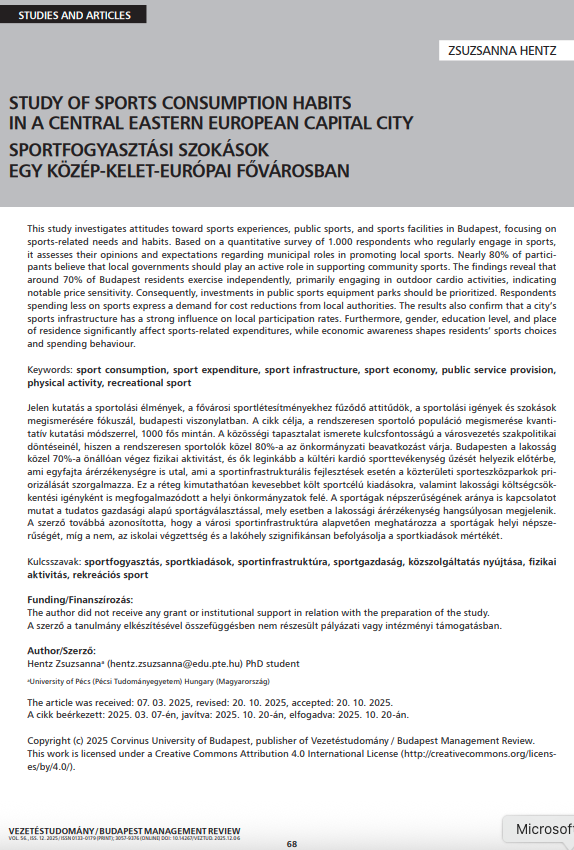
Sportfogyasztási szokások egy közép-kelet-európai fővárosban
DOI:
https://doi.org/10.14267/VEZTUD.2025.12.06Kulcsszavak:
sportfogyasztás, sportkiadások, sportinfrastruktúra, sportgazdaság, közszolgáltatás nyújtása, fizikai aktivitás, rekreációs sportAbsztrakt
Jelen kutatás a sportolási élmények, a fővárosi sportlétesítményekhez fűződő attitűdök, a sportolási igények és szokások megismerésére fókuszál, budapesti viszonylatban. A cikk célja, a rendszeresen sportoló populáció megismerése kvantitatív kutatási módszerrel, 1000 fős mintán. A közösségi tapasztalat ismerete kulcsfontosságú a városvezetés szakpolitikai döntéseinél, hiszen a rendszeresen sportolók közel 80%-a az önkormányzati beavatkozást várja. Budapesten a lakosság közel 70%-a önállóan végez fizikai aktivitást, és ők leginkább a kültéri kardió sporttevékenység űzését helyezik előtérbe, ami egyfajta árérzékenységre is utal, ami a sportinfrastrukturális fejlesztések esetén a közterületi sporteszközparkok priorizálását szorgalmazza. Ez a réteg kimutathatóan kevesebbet költ sportcélú kiadásokra, valamint lakossági költségcsökkentési igényként is megfogalmazódott a helyi önkormányzatok felé. A sportágak népszerűségének aránya is kapcsolatot mutat a tudatos gazdasági alapú sportágválasztással, mely esetben a lakossági árérzékenység hangsúlyosan megjelenik. A szerző továbbá azonosította, hogy a városi sportinfrastruktúra alapvetően meghatározza a sportágak helyi népszerűségét, míg a nem, az iskolai végzettség és a lakóhely szignifikánsan befolyásolja a sportkiadások mértékét.
Downloads
Hivatkozások
Ács, P., Hécz, R., Paár, D., & Stocker, M. (2011). A fittség (m)értéke: A fizikai inaktivitás nemzetgazdasági terhei Magyarországon. Közgazdasági Szemle, 58(7-8), 689-708. https://unipub.lib.uni-corvinus.hu/440/
Ács, P., Pongrác, A., Stocker, M., Kovács, A., Hoffbauer, M., Szabó, P., & Paár, D. (2020). A magyarországi fizikai inaktivitási terhek alakulásának összehasonlító elemzése, 2009–2017. Közgazdasági Szemle, 67(7-8), 809-830. https://doi.org/10.18414/KSZ.2020.7-8.809
Ács, P., Stocker, M., Füge, K., Paár, D., Oláh, A., & Kovács, A. (2016). Economic and public health benefits: The result of increased regular physical activity. European Journal of Integrative Medicine, 8(2 Suppl.), 8-12. https://doi.org/10.1016/j.eujim.2016.11.003
Cseh Statisztikai Hivatal. (2021). Sportolási szokások és infrastruktúra Prágában: A lakosság által használt sportlétesítmények és sportolási trendek. Cseh Statisztikai Hivatal. https://www.czso.cz/csu/sport_statistics
Csernák, A. (2023). A sport és a sportoló mint a területi tőke társadalmi, gazdasági eleme. Magyar Gazdaság és Társadalom, 45(4), 58-64. https://www.researchgate.net/publication/368387849_A_sport_es_a_sportolo_mint_a_teruleti_toke_tarsadalmi_gazdasagi_eleme
Csóka, L., & Törőcsik, M. (2018). Sportfogyasztás: A magyar lakosság sportolással, sportfogyasztással kapcsolatos magatartása, beállítódása – országosan reprezentatív személyes megkérdezés (n=2000) eredményei (Kézirat). EFOP-3.6.2-16-2017-003, Pécs, PTE KTK.
Csóka, L., Hegedüs, R., & Törőcsik, M. (2020). A sportfogyasztás öt fogyasztási területű modellje. In J. Temesi (Ed.), XVI. Gazdaságmodellezési Szakértői Konferencia: Előadások (pp. 58–65). Gazdaságmodellezési Társaság. Deloitte. (2025). 2025 global sports industry outlook. https://www.deloitte.com/us/en/insights/industry/technology/technology-media-telecom-outlooks/sports-industry-outlook.html
Dénes, F., & Misovicz, T. (1994). Bevezetés a sportökonómiába. Vezetéstudomány/Budapest Management Review, 25(3), 57-61.
Downward, P., & Riordan, J. (2007). Social interactions and the demand for sport: An economic analysis. Contemporary Economic Policy, 25(4), 518-537. https://doi.org/10.1111/j.1465-7287.2007.00071.x
Eakins, J. (2018). An analysis of the determinants of sports participation and time spent in different sporting contexts. Managing Sport and Leisure, 23(3), 157-173. https://doi.org/10.1080/23750472.2018.1527713
Eurobarometer (2022). Sport and physical activity. Publications Office of the EU. https://doi.org/10.2766/356346
Evans, A.B., Blackwell, J., Dolan, P., Fahlen, J., Hoekman, R., Lenneis, V., McNarry, G., Smith, M., & Wilcock, L. (2020). Sport in the face of the COVID-19 pandemic: Towards an agenda for research in the sociology of sport. European Journal for Sport and Society, 17(2), 85-95. https://doi.org/10.1080/16138171.2020.1765100
Fenyves, L. (2023). A COVID-19 hatása a sportolási szokásokra. Táplálkozásmarketing, 10(1), 55-61. https://doi.org/10.20494/TM/10/1/4
Fóris, Á. & Bérces, E. (2005). Sport, gazdaság, terminológia. Tudásmenedzsment, 6(2), 117-127. https://www.epa.hu/02700/02750/00012/pdf/EPA02750_tudasmenedzsment_2005_02_117-127.pdf
Gősi, Zs. (2019). A szabadidősport néhány gazdasági hatása [Some economic effects of leisure sport]. In Gősi, Zs., Boros, Sz., & Patakiné B.J. (Eds.), Sokszínű rekreáció [Multicolour recreation] (pp. 69-85). Eötvös Loránd Tudományegyetem Pedagógiai és Pszichológiai Kar. https://esi.ppk.elte.hu/media/42/df/72da1729016e69cf9df-9c6240a6855e8781b8acf5e217e3171292b86b304/ESI_SokszinuRekreacio201905.pdf
Hindley, D. (2018). “More Than Just a Run in the Park”: An exploration of parkrun as a shared leisure space. Leisure Sciences, 42(1), 85-105. https://doi.org/10.1080/01490400.2017.1410741
Horky, T. (2020). No sports, no spectators–no media, no money? The importance of spectators and broadcasting for professional sports during COVID-19. Soccer & Society, 22(1-2), 96-102. https://doi.org/10.1080/14660970.2020.1790358
Hovemann, G., & Wicker, P. (2009). Determinants of sport participation in the European Union. European Journal for Sport and Society, 6(1), 51-59. https://doi.org/10.1080/16138171.2009.11687827
Humphreys, B.R., & Ruseski, J.E. (2006). Economic determinants of participation in physical activity and sport (Working Paper No. 0613). International Association of Sports Economists.
Humphreys, B.R., & Ruseski, J.E. (2011). An economic analysis of participation and time spent in physical activity. Journal of Economic Analysis & Policy, 11(1), 1-38. https://doi.org/10.2202/1935-1682.2522
ISCA. (2025). Game, set, thrive: How grassroots sport serves up big wins for our health and wellbeing economy. International Sport and Culture Association. https://www.isca.org/news-detail/1395/Game-setthrive-how-grassroots-sport-serves-up-big-wins-forour-health-and-wellbeing-economy
Jeanes, R., Spaaij, R., Penney, D., & O’Connor, J. (2019). Managing informal sport participation: Tensions and opportunities. International Journal of Sport Policy and Politics, 11(1), 79-95. https://doi.org/10.1080/19406940.2018.1479285
Kokolakakis, T., CastellanosGarcía, P., & LeraLópez, F. (2017). Differences in formal and informal sports participation at regional level in England. International Journal of Sport Policy and Politics, 9(3), 491-514. https://doi.org/10.1080/19406940.2017.1287757
Kokolakakis, T., Lera-Lopez, F., & Panagouleas, T. (2011). Analysis of the determinants of sports participation in Spain and England. Applied Economics, 44(21), 2785-2798. https://doi.org/10.1080/00036846.2011.566204
Kosztin, N., & Balatoni, I. (2021). Magyarországi egyetemek hallgatóinak sportolási szokásai. Áttekintő irodalmi elemzés. Acta Medicinae et Sociologica, 12(33), 92-102. https://doi.org/10.19055/ams.2021.11/30/6
Kovács, T. (2010). Rekreáció: A rekreáció elmélete és módszertana. Fitness Kft.
Központi Statisztikai Hivatal (KSH). (2024). A 2024. decemberi infláció mértéke. https://www.ksh.hu/
Laczkó, T., & Stocker, M. (2020). Sportturizmus és a nemzetközi sportesemények megrendezése Magyarországon. Turizmus Bulletin, 20(2), 22-32. https://unipub.lib.uni-corvinus.hu/5972/1/TB%202020-02%20III.%20LaczkoT-StockerM.db9.pdf
Laczkó, T., Ács, P., Morvay-Sey, K., Cselik, B., & Stocker, M. (2023). The role of sports in the subjective psychological well-being of Hungarian adult population in three waves of the COVID-19 pandemic. International Journal of Environmental Research and Public Health, 20(1), Article 660. https://doi.org/10.3390/ijerph20010660
Leeds, M.A., Von Allmen, P., & Matheson, V.A. (2022). The economics of sports (7th ed.). Routledge. https://doi.org/10.4324/9781003317708
Lera-López, F., & Rapún-Gárate, M. (2007). The demand for sport: Sport consumption and participation models. Journal of Sport Management, 21(2), 103-122. https://doi.org/10.1123/jsm.21.1.103
Lera-López, F., & Rapún-Gárate, M. (2011). Determinants of sports participation and attendance: Differences and similarities. International Journal of Sports Marketing and Sponsorship, 12(1), 66-89. https://doi.org/10.1108/IJSMS‑12‑02‑2011‑B007
Muriel, X., Courel-Ibanez, J., Cerezuela-Espejo, V., & Pallarés, J.G. (2020). Training load and performance impairments in professional cyclists during COVID-19 lockdown. International Journal of Sports Physiology and Performance, 16(5), 735-738. https://doi.org/10.1123/ijspp.2020-0501
Muszbek, M. (2018). A hazai sport gazdasága, gazdagsága. Magyar Sporttudományi Társaság.
Mutz, M., & Gerke, M. (2021). Sport and exercise in times of self-quarantine: How Germans changed their behaviour at the beginning of the COVID-19 pandemic. International Review for the Sociology of Sport, 56(3), 305–316. https://doi.org/10.1177/1012690220934335
Müller-Frączek, I. (2020). Effect of the affluence of society on the development of sport. Journal of Physical Education and Sport, 20(suppl. 5), 3023-3029. https://doi.org/10.7752/jpes.2020.s5411
Müller-Frączek, I. (2021). Sports infrastructure vs. sport development in Poland. Journal of Physical Education and Sport, 21(Suppl. issue 2), Art 126, 1014-1020. https://doi.org/10.7752/jpes.2021.s2126
Nadolu, D. (2020). Sport and public policy in Romania. Case study: Timisoara. Baltic Journal of Health and Physical Activity, 12(SpecIss1), 30-35. https://doi.org/10.29359/BJHPA.12.Spec.Iss1.04
Nagy, P. (1995). A sport és a rekreáció közgazdaságtana: Oktatási segédanyag. BKE.
O’Connor, J.P., & Brown, T.D. (2007). Real Cyclists Don’t Race: Informal Affiliations of the Weekend Warrior. International Review for the Sociology of Sport, 42(1), 83-97. https://doi.org/10.1177/1012690207081831
Paár, D. (2010a). A magyar háztartások sportfogyasztásának gazdasági szempontú vizsgálata (Doktori értekezés). Soproni Egyetem. http://doktori.uni-sopron.hu/id/eprint/405/
Paár, D. (2010b). The income and price dependency of the Hungarian sport goods consumption. Periodica Polytechnica Social and Management Sciences, 19(1), 11-17. http://www.pp.bme.hu/so/article/view/1576/894
Paár, D. (2011). The income and price dependency of the Hungarian sport goods consumption. Periodica Polytechnica Social and Management Sciences, 19(1), 11-17. https://doi.org/10.3311/pp.so.2011‑1.02
Paár, D., Kovács, A., Stocker, M., Hoffbauer, M., Fazekas, A., Betlehem, J., Bergier, B., & Ács, P. (2021). Comparative analysis of sports consumption habits in Hungary, Poland and Germany. BMC Public Health, 21(Suppl 1), 1481-1489. https://doi.org/10.1186/s12889‑020‑09442‑6
Parnell, D., Widdop, P., Bond, A., & Wilson, R. (2020). COVID-19, networks and sport. Managing Sport and Leisure, 27(1-2), 78-84. https://doi.org/10.1080/23750472.2020.1750100
Pawlowski, T., & Breuer, C. (2012). Expenditure elasticities of the demand for leisure services. Applied Economics, 44(27), 3461-3477. https://doi.org/10.1080/00036846.2011.577021
Perényi, Sz. (2015). A szabadidősport társadalmi és gazdasági kérdései. Campus Kiadó.
Rathonyi, G., Kosa, K., Bacs, Z., Rathonyi-Odor, K., Fuzesi, I., Lengyel, P., & Bacsne Baba, E. (2021). Changes in workers’ physical activity and sedentary behavior during the COVID-19 pandemic. Sustainability, 13(17), 9524. https://doi.org/10.3390/su13179524
Romero-Blanco, C., Rodriguez-Almagro, J., Onieva-Zafra, M. D., et al. (2020). Physical activity and sedentary lifestyle in university students: Changes during confinement due to the COVID-19 pandemic. International Journal of Environmental Research and Public Health, 17(18), 6567. https://doi.org/10.3390/ijerph17186567
Sárközy, T. (2013). A sport, mint nemzetstratégiai ágazat. Mozgó Világ, 39(Június), 1-19. http://epa.oszk.hu/01300/01326/00151/pdf/EPA01326_mozgo_vilag_2013_06_6483.pdf
Sárközy, T. (2017) A sport mint nemzetstratégiai ágazat. Polgári Szemle, 13(4–6),143–159. https://doi.org/10.24307/psz.2017.1212
Skinner, J., & Smith, A.C.T. (2021). Introduction: Sport and COVID-19: Impacts and challenges for the future (Volume 1). European Sport Management Quarterly, 21(3), 323-332. https://doi.org/10.1080/16184742.2021.1925725
Stewart, B., Smith, A.C.T., & Nicholson, M. (2003). Sport consumption and the consumer experience. Sport Management Review, 6(3), 287-308. https://doi.org/10.1016/S1441-3523(03)70037-1
Stocker, M. (2013). Dematerializálódás szerepe az értékteremtésben. Vezetéstudomány/Budapest Management Review, 14(12), 44-53. https://unipub.lib.uni-corvinus.hu/1387/1/vt_2013n12p44.pdf
Stocker, M., & Ács, P. (2012). A sportolás növelésével elérhető gazdasági haszon mértéke. Magyar Sporttudományi Szemle, 13(3), 20-26. https://mstt.hu/MSSZ/MSSZ_201203.pdf
Stockwell, S., Trott, M., Tully, M., Shin, J., Barnett, Y., Butler, L., McDermott, D., Schuch, F., & Smith, L.. (2021). Changes in physical activity and sedentary behaviours from before to during the COVID-19 pandemic lockdown: a systematic review. BMJ Open Sport & Exercise Medicine, 7, e000960. https://doi.org/10.1136/bmjsem-2020-000960
Szabó, Á. (2011). Milyen értéket teremt a szabadidősport és mi a kapcsolata a versenyképességgel? Vezetéstudomány/ Budapest Management Review, 17(Különszám), 24-37. https://doi.org/10.14267/VEZTUD.2011.ksz.03
Szabó, Á. (2012). A magyar szabadidősport működésének vizsgálata: Piacok, értékteremtés, feladatok a szabadidősportban (PhD-értekezés). Budapesti Corvinus Egyetem, Vállalatgazdaságtan Intézet. https://phd.lib.uni-corvinus.hu/662
Szabó, Á., Máté, T., & Havran, Z. (2021). A szabadidősport gazdasági szerepe Közép‑Kelet‑Európában. Tér és Társadalom, 35(2), 125-149. https://doi.org/10.17649/TET.35.2.3293
Szabó, T., Stocker, M., Ács, P., Morvay-Sey, K., Pálvölgyi, Á., & Laczkó, T. (2020). Impact of COVID-19 on the physical activity and well-being of Hungarian athletes and sports professionals. Health Problems of Civilization, 14(3), 165-173. https://doi.org/10.5114/hpc.2020.98471
The Financial Times. (2024, September 21). Football clubs raise ticket prices amid inflation. The Financial Times. https://www.ft.com/content/b24a251b-148c-4d56-bdab-55265cadaff8
Widdop, P., King, N., Parnell, D., Cutts, D., & Millward, P. (2018). Austerity, policy and sport participation in England. International Journal of Sport Policy and Politics, 10(1), 7-24. https://doi.org/10.1080/19406940.2017.1348964
Letöltések
Megjelent
Folyóirat szám
Rovat
License
Copyright (c) 2025 Corvinus University of Budapest, publisher of Vezetéstudomány / Budapest Management Review

This work is licensed under a Creative Commons Attribution 4.0 International License.
Authors assign copyright to Vezetéstudomány / Budapest Management Review. Authors are responsible for permission to reproduce copyright material from other sources.
Hogyan kell idézni