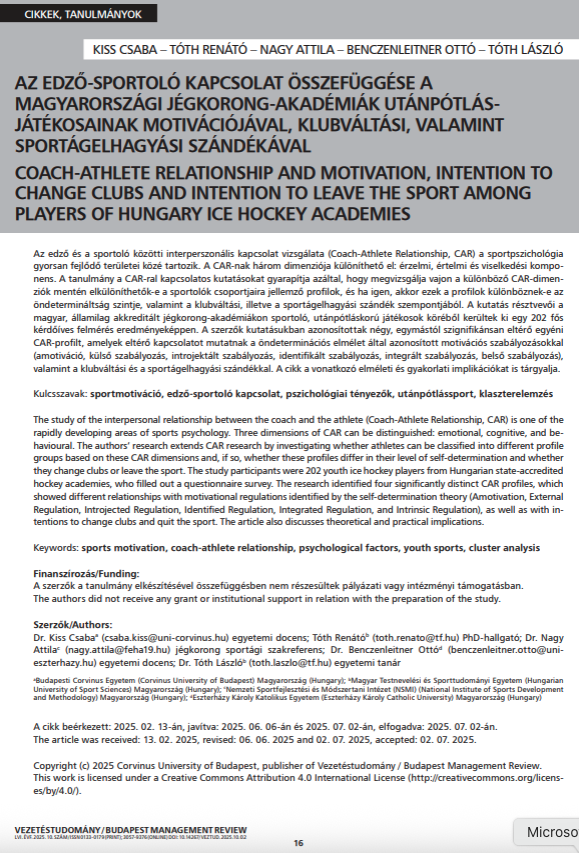
Az edző-sportoló kapcsolat összefüggése a magyarországi jégkorong-akadémiák utánpótlásjátékosainak motivációjával, klubváltási, valamint sportágelhagyási szándékával
DOI:
https://doi.org/10.14267/VEZTUD.2025.10.02Kulcsszavak:
sportmotiváció, edző-sportoló kapcsolat, pszichológiai tényezők, utánpótlássport, klaszterelemzésAbsztrakt
Az edző és a sportoló közötti interperszonális kapcsolat vizsgálata (Coach-Athlete Relationship, CAR) a sportpszichológia gyorsan fejlődő területei közé tartozik. A CAR-nak három dimenziója különíthető el: érzelmi, értelmi és viselkedési komponens. A tanulmány a CAR-ral kapcsolatos kutatásokat gyarapítja azáltal, hogy megvizsgálja vajon a különböző CAR-dimenziók mentén elkülöníthetők-e a sportolók csoportjaira jellemző profilok, és ha igen, akkor ezek a profilok különböznek-e az öndetermináltság szintje, valamint a klubváltási, illetve a sportágelhagyási szándék szempontjából. A kutatás résztvevői a magyar, államilag akkreditált jégkorong-akadémiákon sportoló, utánpótláskorú játékosok köréből kerültek ki egy 202 fős kérdőíves felmérés eredményeképpen. A szerzők kutatásukban azonosítottak négy, egymástól szignifikánsan eltérő egyéni CAR-profilt, amelyek eltérő kapcsolatot mutatnak a öndeterminációs elmélet által azonosított motivációs szabályozásokkal (a motiváció, külső szabályozás, introjektált szabályozás, identifikált szabályozás, integrált szabályozás, belső szabályozás), valamint a klubváltási és a sportágelhagyási szándékkal. A cikk a vonatkozó elméleti és gyakorlati implikációkat is tárgyalja.
Downloads
Hivatkozások
Adie, J.W., & Jowett, S. (2010). Meta‐Perceptions of the Coach–Athlete Relationship, Achievement Goals, and Intrinsic Motivation Among Sport Participants. Journal of Applied Social Psychology, 40(11), 2750–2773. https://doi.org/10.1111/j.1559-1816.2010.00679.x
Appleton, P.R., & Hill, A.P. (2012). Perfectionism and Athlete Burnout in Junior Elite Athletes: The Mediating Role of Motivation Regulations. Journal of Clinical Sport Psychology, 6(2), 129–145. https://doi.org/10.1123/jcsp.6.2.129
Bowers, D.G., & Seashore, S.E. (1966). Predicting Organizational Effectiveness With a Four-Factor Theory of Leadership. Administrative Science Quarterly, 11(2), 238. https://doi.org/10.2307/2391247
Chan, Y.H. (2003). Quantitative Data – Parametric & Non-parametric Tests. https://www.semanticscholar.org/paper/Quantitative-Data-%E2%80%93-Parametric-%26-Non-parametric-Chan/f45fb9e652d0186f5bce3bbd4c42547f1c29d9e2
Chelladurai, P. (1990). Leadership in sports: A review. International Journal of Sport Psychology, 21(4), 328–354.
Chelladurai, P., & Saleh, S. D. (1980). Dimensions of Leader Behavior in Sports: Development of a Leadership Scale. Journal of Sport Psychology, 2(1), 34–45. https://doi.org/10.1123/jsp.2.1.34
Choi, H., Jeong, Y., & Kim, S.K. (2020). The Relationship between Coaching Behavior and Athlete Burnout: Mediating Effects of Communication and the Coach–Athlete Relationship. International Journal of Environmental Research and Public Health, 17(22), 8618. https://doi.org/10.3390/ijerph17228618
Colarelli, S.M. (1984). Methods of communication and mediating processes in realistic job previews. Journal of Applied Psychology, 69(4), 633–642. https://doi.org/10.1037/0021-9010.69.4.633
Creswell, J.W. (2009). Research design: Qualitative, quantitative, and mixed methods approaches (3rd ed). Sage Publications, Inc.
Cumming, J., Hall, C., Harwood, C., & Gammage, K. (2002). Motivational orientations and imagery use: A goal profiling analysis. Journal of Sports Sciences, 20(2), 127–136. https://doi.org/10.1080/026404102317200837
Davis, L., Appleby, R., Davis, P., Wetherell, M., & Gustafsson, H. (2018). The role of coach-athlete relationship quality in team sport athletes’ psychophysiological exhaustion: Implications for physical and cognitive performance. Journal of Sports Sciences, 36(17), 1985–1992. https://doi.org/10.1080/02640414.2018.1429176
Deci, E.L., & Ryan, R.M. (2000). The ‘what’ and ‘why’ of goal pursuits: Human needs and the self-determination of behavior. Psychological Inquiry, 11(4), 227–268.
Durand-Bush, N., Baker, J., Van Den Berg, F., Richard, V., & Bloom, G. A. (2023). The Gold Medal Profile for Sport Psychology (GMP-SP). Journal of Applied Sport Psychology, 35(4), 547–570. https://doi.org/10.1080/10413200.2022.2055224
Field, A. (2005). Discovering statistics using SPSS (2nd ed). Sage Publications, Inc.
Freire, G.L.M., Contreira, A.R., De Moraes, J.F.V.N., De Oliveira, D.V., Fiorese, L., & Do Nascimento Junior, J.R.A. (2022). Coach-athlete relationship, team cohesion and motivation in Brazilian youth athletes: A cluster analysis. Human Movement, 24(3), 44–53. https://doi.org/10.5114/hm.2023.116531
Fűrész, D.I., & Takács, A. (2021). A magyar látványsport-támogatási rendszer hatása a verseny kiegyensúlyozottságára. Közgazdasági Szemle, 68(10), 1089–1108. https://doi.org/10.18414/KSZ.2021.10.1089
Géczi, G., Gurisatti, L., & Komlósi, L.I. (2022). Complex Ice Hockey Team Performance Model based on Expert Interviews. Physical Culture and Sport. Studies and Research, 95(1), 76–84. https://doi.org/10.2478/pcssr-2022-0013
Gencer, E. (2021). The Relationship between Self-Esteem, Satisfaction with Life and Coach-Athlete Relationship. Journal of Educational Issues, 6(2), 493. https://doi.org/10.5296/jei.v6i2.18028
Gillet, N., Berjot, S., Vallerand, R., Amoura, C., & Rosnet, E. (2012). Examining the Motivation-Performance Relationship in Competitive Sport: A Cluster-Analytic Approach. International Journal of Sport Psychology, 42, 79–102.
Gillet, N., Vallerand, R.J., & Rosnet, E. (2009). Motivational clusters and performance in a real-life setting. Motivation and Emotion, 33(1), 49–62. https://doi.org/10.1007/s11031-008-9115-z
Graen, G.B., & Uhl-Bien, M. (1995). Relationship-based approach to leadership: Development of leader-member exchange (LMX) theory of leadership over 25 years: Applying a multi-level multi-domain perspective. The Leadership Quarterly, 6(2), 219–247. https://doi.org/10.1016/1048-9843(95)90036-5
Gustafsson, H., Carlin, M., Podlog, L., Stenling, A., & Lindwall, M. (2018). Motivational profiles and burnout in elite athletes: A person-centered approach. Psychology of Sport and Exercise, 35, 118–125. https://doi.org/10.1016/j.psychsport.2017.11.009
Hair, J.F., Black, W.C., Babin, B.J., & Anderson, R.E. (2019). Multivariate data analysis (8th edition). Cengage. Harman, H. (1976). Modern factor analysis (3rd ed). The University of Chicago Press.
Hersey, P., & Blanchard, K.H. (1969). Managing Research and Development Personnel: An Application of Leadership Theory. Research Management, 12(5), 331–338. https://doi.org/10.1080/00345334.1969.11755973
Hodge, K., & Petlichkoff, L. (2000). Goal Profiles in Sport Motivation: A Cluster Analysis. Journal of Sport and Exercise Psychology, 22(3), 256–272. https://doi.org/10.1123/jsep.22.3.256
Hofmans, J., Wille, B., & Schreurs, B. (2020). Person-centered methods in vocational research. Journal of Vocational Behavior, 118, 103398. https://doi.org/10.1016/j.jvb.2020.103398
Howard, M.C., & Hoffman, M.E. (2018). Variable-Centered, Person-Centered, and Person-Specific Approaches: Where Theory Meets the Method. Organizational Research Methods, 21(4), 846–876. https://doi.org/10.1177/1094428117744021
Hu, L., & Bentler, P.M. (1999). Cutoff criteria for fit indexes in covariance structure analysis: Conventional criteria versus new alternatives. Structural Equation Modeling, 6(1), 1–55. https://doi.org/10.1080/10705519909540118
Jin, H., Kim, S., Love, A., Jin, Y., & Zhao, J. (2022). Effects of leadership style on coach-athlete relationship, athletes’ motivations, and athlete satisfaction. Frontiers in Psychology, 13, 1012953. https://doi.org/10.3389/fpsyg.2022.1012953
Jowett, S., & Ntoumanis, N. (2004). The Coach-Athlete Relationship Questionnaire (CART‐Q): Development and initial validation. Scandinavian Journal of Medicine & Science in Sports, 14(4), 245–257. https://doi.org/10.1111/j.1600-0838.2003.00338.x
Jowett, S., & Wylleman, P. (2006). Interpersonal relationships in sport and exercise settings: Crossing the chasm. Psychology of Sport and Exercise, 2, 119–123. https://doi.org/10.1016/j.psychsport.2005.08.001
Jowett, S. (2007). Interdependence Analysis and the 3+1Cs in the Coach-Athlete Relationship. In Social Psychology in Sport (pp. 15–27). Human Kinetics. https://doi.org/10.5040/9781492595878
Jowett, S., & Poczwardowski, A. (2007). Understanding the Coach-Athlete Relationship. In Social Psychology in Sport (pp. 3–14). Human Kinetics. https://doi.org/10.5040/9781492595878
Jowett, S., & Felton, L. (2014). Coach–Athlete relationships and attachment styles within sport teams. In Group dynamics in exercise and sport psychology (2nd ed) (pp. 73–90). Routledge/Taylor & Francis Group. https://doi.org/10.4324/9780203794937-5
Jowett, S. (2017). Coaching effectiveness: The coach–athlete relationship at its heart. Current Opinion in Psychology, 16, 154–158. https://doi.org/10.1016/j.copsyc.2017.05.006
Jowett, S. (2024). The coach-athlete relationship within a cross-boundary team of experts: A conceptual analysis. International Review of Sport and Exercise Psychology, 1–16. https://doi.org/10.1080/1750984X.2024.2416968
Kiss, C. (2014). A szervezeti elkötelezettség és a munka-család konfliktus összefüggései az ügyfélszolgálati munkában (Doktori értekezés). Budapesti Corvinus Egyetem. https://doi.org/10.14267/phd.2014058
Kiss, C., & Nagy, A. (2024). Motivation Profiles, Perceived Motivational Climate, Coping Perceptions and Anxiety Among Elite Young Ice Hockey Players. Physical Culture and Sport Studies and Research, 105(1), 65–81. https://doi.org/10.2478/pcssr-2024-0025
Kovács K., F. Földi R., & Gyömbér N. (2021). Az Edző-Sportoló Kapcsolat Kérdőív hazai adaptációja, a sportoló szemszögén keresztül. Magyar Sporttudományi Szemle, 22(90), 12-20. https://real.mtak.hu/158557/1/MSTT-Szemle-2021-2-honlapra-12-20.pdf
Lafrenière, M.A.K., Jowett, S., Vallerand, R.J., Donahue, E.G., & Lorimer, R. (2008). Passion in Sport: On the Quality of the Coach-Athlete Relationship. Journal of Sport and Exercise Psychology, 30(5), 541–560. https://doi.org/10.1123/jsep.30.5.541
LaVoi, N.M. (2007). Expanding the Interpersonal Dimension: Closeness in the Coach-Athlete Relationship. International Journal of Sports Science & Coaching, 2(4), 497–512. https://doi.org/10.1260/174795407783359696
Lee, A.S.Y., Standage, M., Hagger, M.S., & Chan, D.K.C. (2019). Sport injury prevention in-school and out-ofschool? A qualitative investigation of the trans-contextual model. PLOS ONE, 14(9), e0222015. https://doi.org/10.1371/journal.pone.0222015
Lee, S., Kwon, S., Jang, D., & Kwon, H. (2023). The effect of coach-athlete fit on the coach–athlete relationship in team sport: Role of trust in coach. International Journal of Sports Science & Coaching, 18(4), 986–993. https://doi.org/10.1177/17479541231164771
Lemyre, P.N., Hall, H.K., & Roberts, G.C. (2008). A social cognitive approach to burnout in elite athletes. Scandinavian Journal of Medicine & Science in Sports, 18(2), 221–234. https://doi.org/10.1111/j.1600-0838.2007.00671.x
Li, J., Chen, B., & Zhang, Y. (2021). Adopting Evaluative Conditioning to Improve Coach-Athlete Relationships. Frontiers in Psychology, 12, 751990. https://doi.org/10.3389/fpsyg.2021.751990
Likert, R. (1961). New patterns of management. McGraw- Hill.
Lorimer, R., & Jowett, S. (2010). The influence of role and gender in the empathic accuracy of coaches and athletes. Psychology of Sport and Exercise, 11(3), 206–211. https://doi.org/10.1016/j.psychsport.2009.12.001
Mageau, G.A., & Vallerand, R. J. (2003). The coach-athlete relationship: A motivational model. Journal of Sports Sciences, 21(11), 883–904. https://doi.org/10.1080/0264041031000140374
Massey, F.J. (1951). The Kolmogorov-Smirnov Test for Goodness of Fit. Journal of the American Statistical Association, 46(253), 68–78. https://doi.org/10.1080/01621459.1951.10500769
Maydeu-Olivares, A., & McArdle, J.J. (Eds.). (2005). Contemporary psychometrics. L. Erlbaum.
McGee, V., & DeFreese, J.D. (2019). The Coach-Athlete Relationship and Athlete Psychological Outcomes. Journal of Clinical Sport Psychology, 13(1), 152–174. https://doi.org/10.1123/jcsp.2018-0010
Mohd Kassim, A.F., Jamal, N.M.A., Syed Omar, S.S., Kamaruddin, H.K., Akmal Anuar, N., & Che Zakaria, M.S. (2024). Coach-athlete relationship, trust and confidence among team sport athletes. Malaysian Journal of Sport Science and Recreation, 20(1), Article 1. https://doi.org/10.24191/mjssr.v20i1.1094
Nicholls, A.R., Earle, K., Earle, F., & Madigan, D.J. (2017). Perceptions of the Coach–Athlete Relationship Predict the Attainment of Mastery Achievement Goals Six Months Later: A Two-Wave Longitudinal Study among F. A. Premier League Academy Soccer Players. Frontiers in Psychology, 8, 684. https://doi.org/10.3389/fpsyg.2017.00684
Nicholls, A.R., & Perry, J.L. (2016). Perceptions of Coach- Athlete Relationship Are More Important to Coaches than Athletes in Predicting Dyadic Coping and Stress Appraisals: An Actor–Partner Independence Mediation Model. Frontiers in Psychology, 7. https://doi.org/10.3389/fpsyg.2016.00447
Nunnally, J.C., & Bernstein, I.H. (1994). Psychometric Theory Vol. 3. McGraw-Hill.
Paic, R., Kajos, A., Meszler, B., & Prisztóka, G. (2018). A magyar nyelvű sportmotivációs skála (H-SMS) validációja és eredményei. Magyar Pszichológiai Szemle, 73(2), 159–182. https://doi.org/10.1556/0016.2018.002
Podsakoff, P.M., MacKenzie, S.B., Lee, J.Y., & Podsakoff, N.P. (2003). Common method biases in behavioral research: A critical review of the literature and recommended remedies. Journal of Applied Psychology, 88, 879–903. https://doi.org/10.1037/0021-9010.88.5.879
Raedeke, T.D. (1997). Is athlete burnout more than just stress? A sport commitment perspective. Journal of Sport & Exercise Psychology, 19(4), 396–417. https://doi.org/10.1123/jsep.19.4.396
Riemer, H. (2007). Multidimensional Model of Coach Leadership. In S. Jowett & D. Lavallee (Eds.), Social Psychology in Sport (pp. 55–73). Human Kinetics. https://doi.org/10.5040/9781492595878
Roberts, G.C., Nerstad, C.G.L., & Lemyre, P.N. (2018). Motivation in Sport and Performance. In Oxford Research Encyclopedia of Psychology. https://doi.org/10.1093/acrefore/9780190236557.013.150
Rottensteiner, C., Konttinen, N., & Laakso, L. (2015). Sustained Participation in Youth Sports Related to Coach-Athlete Relationship and Coach-Created Motivational Climate. International Sport Coaching Journal, 2(1), 29–38. https://doi.org/10.1123/iscj.2014-0060
Roux, V., Martinent, G., & Trouilloud, D. (2023). Temporal dynamics of the quality of the coach-athlete relationship over one season among adolescent handball players: A latent class analysis approach. International Journal of Sport and Exercise Psychology, 21(6), 1107–1124. https://doi.org/10.1080/1612197X.2022.2109185
Sajtos L., & Mitev A. (2007). SPSS kutatási és adatelemzési kézikönyv. Alinea Kiadó.
Schutz, R.W., & Gessaroli, M.E. (1993). Use, misuse, and disuse of psychometrics in sport psychology research. In R. Singer, M. Murphey, & L. Tennant (Eds.), Handbook of research on sport psychology (pp. 901–917). MacMillan.
Shapiro, S.S., & Wilk, M.B. (1965). An analysis of variance test for normality (complete samples). Biometrika, 52(3–4), 591–611. https://doi.org/10.1093/biomet/52.3-4.591
Shartle, C.L. (1979). Early Years of the Ohio State University Leadership Studies. Journal of Management, 5(2), 127–134. https://doi.org/10.1177/014920637900500203
Sorkkila, M., Tolvanen, A., Aunola, K., & Ryba, T.V. (2019). The role of resilience in student-athletes’ sport and school burnout and dropout: A longitudinal person- oriented study. Scandinavian Journal of Medicine & Science in Sports, 29(7), 1059–1067. https://doi.org/10.1111/sms.13422
Stogdill, R.M. (1974). Handbook of leadership: A survey of theory and research. Free Press.
Tojari, F., Soheili, B., & Manouchehri, J. (2013). Validation of an instrument for measuring coach-athlete relationship in Iranian sport leagues. Advances in Environmental Biology, 7(14), 4667–4670.
Trbojević Jocić, J., & Petrović, J. (2021). Understanding of dropping out of sports in adolescence: Testing the hierarchical model of intrinsic and extrinsic motivation. Kinesiology, 53(2), 245–256. https://doi.org/10.26582/k.53.2.7
Vallerand, R.J., Pelletier, L.G., Blais, M.R., Briere, N.M., Senecal, C., & Vallieres, E.F. (1992). The Academic Motivation Scale: A Measure of Intrinsic, Extrinsic, and Amotivation in Education. Educational and Psychological Measurement, 52(4), 1003–1017. https://doi.org/10.1177/0013164492052004025
Vella, S.A., Oades, L.G., & Crowe, T.P. (2013). The relationship between coach leadership, the coach-athlete relationship, team success, and the positive developmental experiences of adolescent soccer players. Physical Education & Sport Pedagogy, 18(5), 549–561. https://doi.org/10.1080/17408989.2012.726976
Vieira, L.F., Nascimento Junior, J.R.A.D., Pujals, C., Jowett, S., Codonhato, R., & Vissoci, J.R.N. (2015). Adaptação transcultural e propriedades psicométricas do questionário de relacionamento treinador-atleta brasileiro (CART-Q) – Versão atleta. Revista Brasileira de Cineantropometria e Desempenho Humano, 17(6), 635. https://doi.org/10.5007/1980-0037.2015v17n6p635
Weiss, M.R., Ebbeck, V., & Horn, T.S. (1997). Children’s Self-Perceptions and Sources of Physical Competence Information: A Cluster Analysis. Journal of Sport and Exercise Psychology, 19(1), 52–70. https://doi.org/10.1123/jsep.19.1.52
Wekesser, M.M., Harris, B.S., Langdon, J., & Wilson, C.H. (2021). Coaches’ impact on youth athletes’ intentions to continue sport participation: The mediational influence of the coach–athlete relationship. International Journal of Sports Science & Coaching, 16(3), 490–499. https://doi.org/10.1177/1747954121991817
Welty Peachey, J., & Burton, L.J. (2012). Transactional or transformational leaders in intercollegiate athletics? Examining the influence of leader gender and subordinate gender on evaluation of leaders during organizational culture change. International Journal of Sport Management, 13, 115–142. https://doi.org/10.1123/jis.2.2.245
Welty Peachey, J., Zhou, Y., Damon, Z.J., & Burton, L.J. (2015). Forty Years of Leadership Research in Sport Management: A Review, Synthesis, and Conceptual Framework. Journal of Sport Management, 29(5), 570–587. https://doi.org/10.1123/jsm.2014-0126
Williams, J.M., & Krane, V. (2001). Psychological Characteristics of Peak Performance. In J. M. Williams (Ed.), Applied Sports Psychology: Personal Growth to Peak Performance (4th ed), (pp. 137–147). Mountain View.
Yang, S.X., & Jowett, S. (2012). Psychometric properties of the Coach0-Athlete Relationship Questionnaire (CART-Q) in seven countries. Psychology of Sport and Exercise, 13(1), 36–43. https://doi.org/10.1016/j.psychsport.2011.07.010
Zaker, N.A., & Parnabas, V.A. (2018). The correlation between coach-athlete relationship and motivation among Universiti Teknologi MARA (UiTM) Shah Alam athletes. Movement, Health and Exercise, 7(1). https://doi.org/10.15282/mohe.v7i1.173
Letöltések
Megjelent
Folyóirat szám
Rovat
License
Copyright (c) 2025 Corvinus University of Budapest, publisher of Vezetéstudomány / Budapest Management Review

This work is licensed under a Creative Commons Attribution 4.0 International License.
Authors assign copyright to Vezetéstudomány / Budapest Management Review. Authors are responsible for permission to reproduce copyright material from other sources.
Hogyan kell idézni