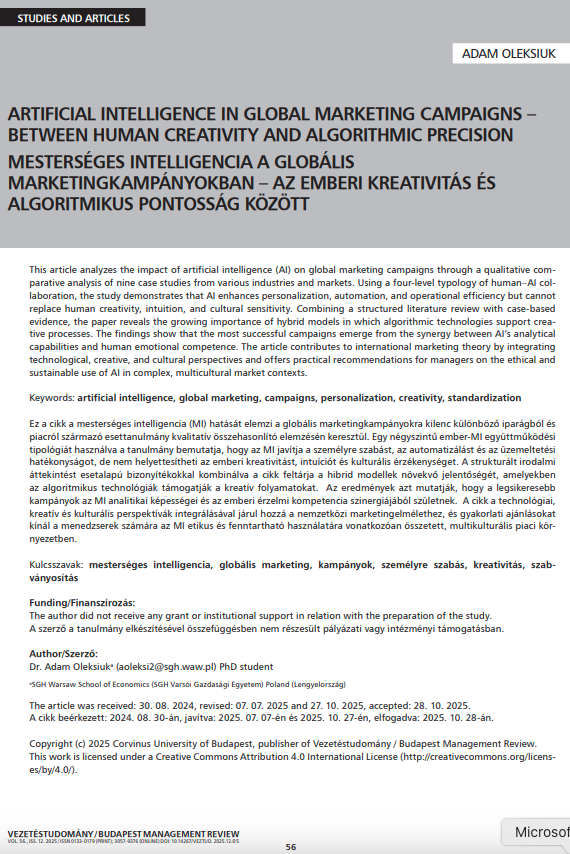
Mesterséges intelligencia a globális marketingkampányokban
Az emberi kreativitás és algoritmikus pontosság között
DOI:
https://doi.org/10.14267/VEZTUD.2025.12.05Kulcsszavak:
mesterséges intelligencia, globális marketing, kampányok, személyre szabás, kreativitás, szabványosításAbsztrakt
Ez a cikk a mesterséges intelligencia (MI) hatását elemzi a globális marketingkampányokra kilenc különböző iparágból és piacról származó esettanulmány kvalitatív összehasonlító elemzésén keresztül. Egy négyszintű ember-MI együttműködési tipológiát használva a tanulmány bemutatja, hogy az MI javítja a személyre szabást, az automatizálást és az üzemeltetési hatékonyságot, de nem helyettesítheti az emberi kreativitást, intuíciót és kulturális érzékenységet. A strukturált irodalmi áttekintést esetalapú bizonyítékokkal kombinálva a cikk feltárja a hibrid modellek növekvő jelentőségét, amelyekben az algoritmikus technológiák támogatják a kreatív folyamatokat. Az eredmények azt mutatják, hogy a legsikeresebb kampányok az MI analitikai képességei és az emberi érzelmi kompetencia szinergiájából születnek. A cikk a technológiai, kreatív és kulturális perspektívák integrálásával járul hozzá a nemzetközi marketingelmélethez, és gyakorlati ajánlásokat kínál a menedzserek számára az MI etikus és fenntartható használatára vonatkozóan összetett, multikulturális piaci környezetben.
Downloads
Hivatkozások
Act-On. (2023a). Marketing Automation and AI: How Will the Industry Look 3 Years from Now? How will marketing automation and AI work together to make life easier for marketing teams? https://act-on.com/learn/blog/marketing-automation-and-ai-how-will-the-industry-look-3-years-from-now/
Act-On. (2023b). The Power of AI Marketing Automation: Act-On Interviews ChatGPT. https://act-on.com/learn/blog/the-power-of-ai-marketing-automation-act-on-interviews-chatgpt/
Adobe. (2024). The 14th annual Adobe 2024 Digital Trends. https://business.adobe.com/resources/digital-trends-report.html#get-the-adobe-2024-digital-trends-report
Alexa, L., Pîslaru, M., Nistor, G.C., & Alexa, M. (2024). Artificial Intelligence in Marketing. Current Status and Future Research Agenda. In Cioca, L.I., Ivascu, L., Filip, F.G., & Doina, B. (Eds.), Digital Transformation. Intelligent Systems Reference Library (pp. 39-51). Springer. https://doi.org/10.1007/978-3-031-55952-5_3
Anacecilia.digital (2022). The Voice of Art – IBM Watson Artificial Intelligence at a Brazilian Museum. https://anacecilia.digital/en/the-voice-of-art-ibm-watson-artificial-intelligence-at-a-brazilian-museum/
Arbo Blog (2023). Kampania Share a Coke Coca-Cola, czyli historie udziału w marketingowej rewolucji 2011. https://arboblog.pl/kampania-share-a-coke-coca-cola-czyli-historie-udzialu-w-marketingowej-rewolucji-2011/
Arvinth, K., Chopra, K., & Arora, D. (2024). Artificial Intelligence in Marketing–Customer Perspective and Future Research Direction. In Divekar, R., Chopra, K., Chitranshi, J., & Mehendale, S. (Eds.), Pandemic to Endemic. Propositions for the Future (pp. 296-305). Routledge.
Campaigns of the World (2021). Alibaba Olympics Campaign – The Greatness of Small. https://campaignsoftheworld.com/digital/alibaba-olympics-campaign-the-greatness-of-small/
Chandra, A. (2020). Customer experience is catalyst to innovative marketing strategy in the era of artificial intelligence and machine learning. Economic Challenger, 87, 53-60.
Chandra, B. & Rahman, Z. (2024). Artificial intelligence and value co-creation: a review, conceptual framework and directions for future research. Journal of Service Theory and Practice, 34(1), 7-32. https://doi.org/10.1108/JSTP-03-2023-009
Chintalapati, S., & Pandey, S.K. (2022). Artificial intelligence in marketing: A systematic literature review. International Journal of Market Research, 64(1), 38-68. https://doi.org/10.1177/14707853211018428Początek formularza
Chui, M., Manyika, J., & Miremadi, M. (2018). What AI can and can’t do (yet) for your business. McKinsey & Company. https://www.mckinsey.com/business-functions/mckinsey-digital/our-insights/what-ai-can-andcant-do-yet-for-your-business
Davenport, T., Guha, A., Grewal, D., & Bressgott, T (2020). How artificial intelligence will change the future of marketing. Journal of the Academy of Marketing Science, 48, 24-42.
Davis, F.D. (1989). Perceived usefulness, perceived ease of use, and user acceptance of information technology. MIS Quarterly, 13(3), 319-340. https://doi.org/10.2307/249008
De Bruyn, A., Viswanathan, V., Beh, Y.S., Brock, J.K.U., & Von Wangenheim, F. (2020). Artificial Intelligence and Marketing: Pitfalls and Opportunities. Journal of Interactive Marketing, 51(1), 91-105. https://doi.org/10.1016/j.intmar.2020.04.007
Dimitrieska, S., Stankovska, A., Efremova, T. (2018). Artificial intelligence and marketing. Enterprenuership, 6, 298-304.
Eriksson, T., Bigi, A., & Bonera, M. (2020). Think with me, or think for me? On the future role of artificial intelligence in marketing strategy formulation. The TQM Journal, 32(4), 795-814. https://doi.org/10.1108/TQM-12-2019-0303
Escalas, J.E. & Bettman, J.R. (2005). Self-construal, Reference Groups, and Brand Meaning. Journal of Consumer Research, 32(3), 378-389. https://doi.org/10.1086/497549
Feng, C.M., Park, A., Pitt, L., Kietzmann, J., & Northey, G. (2021). Artificial intelligence in marketing: A bibliographic perspective. Australasian Marketing Journal, 29(3), 252-263. https://doi.org/10.1016/j.ausmj.2020.07.006
Grandinetti, R. (2020). How artificial intelligence can change the core of marketing theory. Innovative Marketing, 16(2), 91-103. https://doi.org/10.21511/IM.16(2)
Hildebrand, C. (2019). The machine age of marketing: How artificial intelligence changes the way people think, act, and decide. NIM Marketing Intelligence Review, 11(2), 10-17. https://doi.org/10.2478/nimmir-2019-0010
Holt, D.B. (2004). How Brands Become Icons: The Principles of Cultural Branding. Harvard Business Press. Huang, M.H., & Rust, R.T. (2021). A strategic framework for artificial intelligence in marketing. Journal of the Academy of Marketing Science, 49, 30-50. https://doi.org/10.1007/s11747-020-00749-9
Jain, V., Rai, J., Parvathy, P., & Mogaji, E. (2023). The Prospects and Challenges of ChatGPT on Marketing Research and Practices. SSRN. http://dx.doi.org/10.2139/ssrn.4398033
Jarek, K., & Mazurek, G. (2019). Marketing and artificial intelligence. Central European Business Review, 8, 46-55. https://doi.org/10.18267/j.cebr.213
Labib, E. (2024). Artificial intelligence in marketing: exploring current and future trends. Cogent Business & Management, 11(1), 2348728. https://doi.org/10.1080/23311975.2024.2348728
Macminik (2016). Think Different – blog o kampanii Apple. DobreProgramy.pl. https://www.dobreprogramy.pl/@macminik/think-different,blog,73838
Marketing Trendsetters (2023). Burger King Whopper Detour Campaign. https://marketingtrendsetters.com/2023/08/24/burger-king-whopper-detour-campaign/
Martindale, C. (1999). Biological bases of creativity. In R.J. Sternberg (Ed.), Handbook of Creativity (pp. 137- 152). Cambridge University Press.
Netflix Research (2024). Marketing and Growth. https://research.netflix.com/business-area/marketing-and-growth
Ratten, V. (2024). Artificial Intelligence, Digital Trends and Globalization: Future Research Trends. FIIB Business Review, 13(3), 283-293. https://doi.org/10.1177/23197145231222774
Rerkpichai, C., & Santhuenkaew, T. (2024). Artificial Intelligence for Marketing. RICE Journal of Creative Entrepreneurship and Management, 5(1), 65-73. https://doi.org/10.14456/rjcm.2024.5
Shaik, M. (2023). Impact of artificial intelligence on marketing. East Asian Journal of Multidisciplinary Research, 2(3), 993-1004. https://doi.org/10.55927/eajmr.v2i3.3112
Stern, B.B. (2006). What Does Brand Mean? Historical- Analysis Method and Construct Definition. Journal of the Academy of Marketing Science, 34(2), 216- 223. https://doi.org/10.1177/0092070305284991
Teece, D.J. (2007). Explicating dynamic capabilities: the nature and microfoundations of (sustainable) enterprise performance. Strategic Management Journal, 28(13), 1319-1350. https://doi.org/10.1002/smj.640
The Wall Street Experience (2022). Everything to know about the Fearless Girl statue. https://www.thewallstreetexperience.com/blog/everything-toknow-about-the-fearless-girl-statue/
Um, T.W., Kim, J., Lim, S., & Lee, G.M. (2022). Trust Management for Artificial Intelligence: A Standardization Perspective. Applied Sciences, 12(12), 6022. https://doi.org/10.3390/app12126022
Vargo, S.L., & Lusch, R.F. (2004). Evolving to a new dominant logic for marketing. Journal of Marketing, 68(1), 1-17. https://doi.org/10.1509/jmkg.68.1.1.24036
Vishnoi, S.K., & Bagga, T. (2019). Artificial intelligence enabled marketing solutions: A review. Indian Journal of Economics and Business, 17(4), 167-177.
Wieden+Kennedy (2010). Old Spice – Smell Like a Man, Man. https://www.wk.com/work/old-spice-smell-likea-man-man/
Wirth, N. (2018). Hello marketing, what can artificial intelligence help you with? International Journal of Market Research, 60, 435-438. https://doi.org/10.1177/1470785318776841
Yin, R.K. (2018). Case Study Research and Applications: Design and Methods (6th ed.). SAGE Publications.
Letöltések
Megjelent
Folyóirat szám
Rovat
License
Copyright (c) 2025 Corvinus University of Budapest, publisher of Vezetéstudomány / Budapest Management Review

This work is licensed under a Creative Commons Attribution 4.0 International License.
Authors assign copyright to Vezetéstudomány / Budapest Management Review. Authors are responsible for permission to reproduce copyright material from other sources.
Hogyan kell idézni