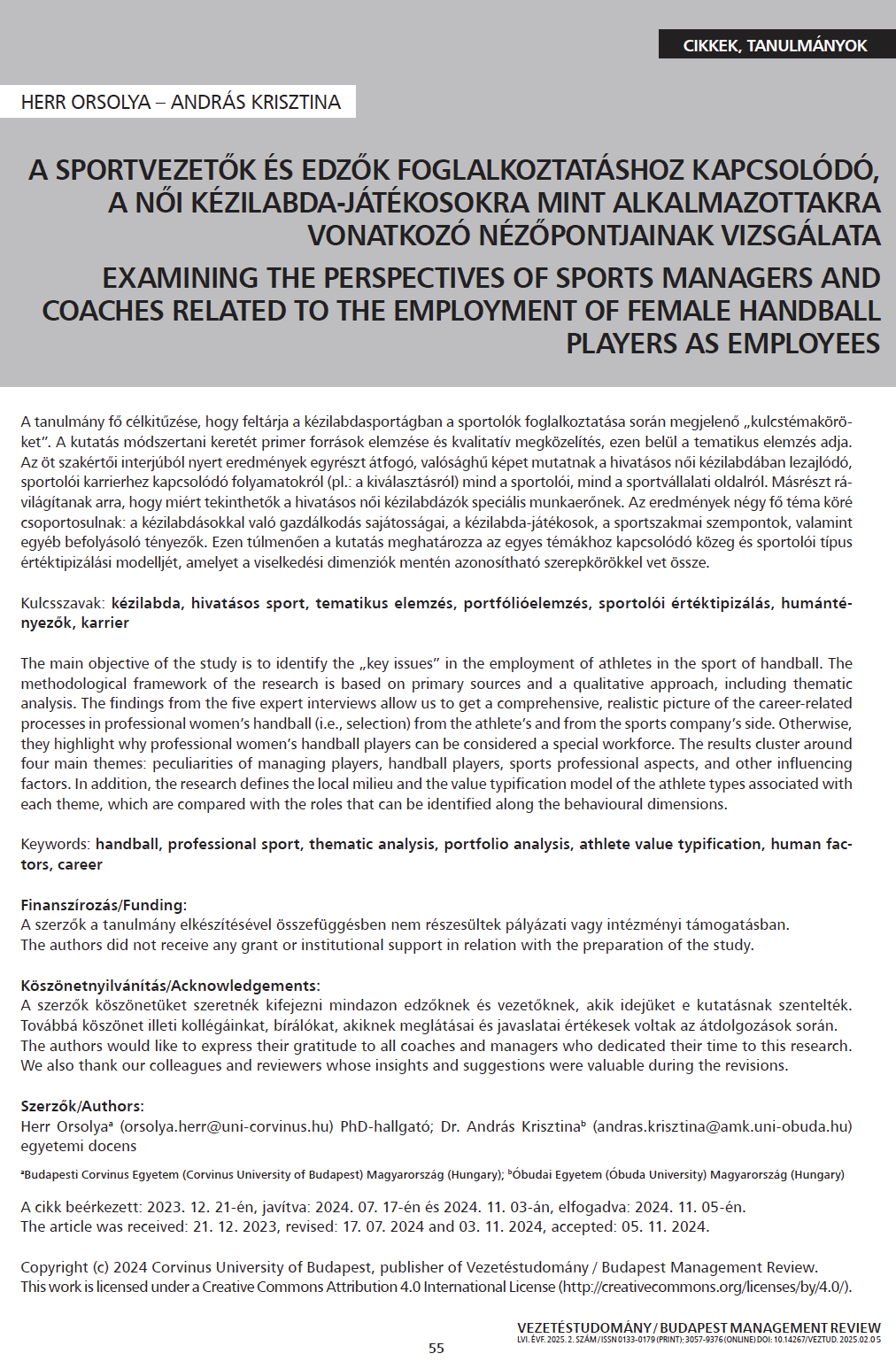
A sportvezetők és edzők foglalkoztatáshoz kapcsolódó, a női kézilabda-játékosokra mint alkalmazottakra vonatkozó nézőpontjainak vizsgálata
DOI:
https://doi.org/10.14267/VEZTUD.2025.02.05Kulcsszavak:
kézilabda, hivatásos sport, tematikus elemzés, portfólióelemzés, sportolói értéktipizálás, humántényezők, karrierAbsztrakt
A tanulmány fő célkitűzése, hogy feltárja a kézilabdasportágban a sportolók foglalkoztatása során megjelenő „kulcstémaköröket”. A kutatás módszertani keretét primer források elemzése és kvalitatív megközelítés, ezen belül a tematikus elemzés adja. Az öt szakértői interjúból nyert eredmények egyrészt átfogó, valósághű képet mutatnak a hivatásos női kézilabdában lezajlódó, sportolói karrierhez kapcsolódó folyamatokról (pl.: a kiválasztásról) mind a sportolói, mind a sportvállalati oldalról. Másrészt rávilágítanak arra, hogy miért tekinthetők a hivatásos női kézilabdázók speciális munkaerőnek. Az eredmények négy fő téma köré csoportosulnak: a kézilabdásokkal való gazdálkodás sajátosságai, a kézilabda-játékosok, a sportszakmai szempontok, valamint egyéb befolyásoló tényezők. Ezen túlmenően a kutatás meghatározza az egyes témákhoz kapcsolódó közeg és sportolói típus értéktipizálási modelljét, amelyet a viselkedési dimenziók mentén azonosítható szerepkörökkel vet össze.
Downloads
Hivatkozások
Alajmi, A.S., & Arabiat, K.M. (2021). The Effect of Strategic Management on Organizational Performance: The Mediating Role of Knowledge Sharing in Private Universities in Kuwait. Journal of University of Shanghai for Science and Technology, 23(2), 65-77. http://doi.org/10.51201/Jusst12591
András, K. (2003). A sport és az üzlet kapcsolata – elméleti alapok. 34. sz. Műhelytanulmány. Budapesti Közgazdaságtudományi és Államigazgatási Egyetem. https://edok.lib.uni-corvinus.hu/61/
András, K. (2004). A hivatásos labdarúgás piacai. Vezetéstudomány, 35(klnsz), 40-57. https://unipub.lib.uni-corvinus.hu/4521/
András, K., & Havran, Z. (2015). New business strategies of football clubs. APSTRACT-Applied Studies in Agribusiness and Commerce, 9(1-2), 67-74. https://doi.org/10.19041/APSTRACT/2015/1-2/13
András, K., Havran, Z., Kajos, A., Kozma, M., Máté, T., & Szabó, Á. (2019). A sportgazdaságtani kutatások nemzetközi és hazai fejlődése. Vezetéstudomány, 50(12), 136-148. https://doi.org/10.14267/VEZTUD.2019.12.12
Babbie, E. (2001): A társadalomtudományi kutatás gyakorlata (Hatodik, átdolgozott kiadás). Balassi Kiadó.
Bakacsi, G. (2015). A szervezeti magatartás alapjai: alaptankönyv Bachelor hallgatók számára. Semmelweis Kiadó.
Bakacsi, G., Bokor, A., Császár, C., Gelei, A., Kováts, K., & Takács, S. (2006). Stratégiai emberi erőforrás menedzsment. Akadémiai Kiadó.
Bar-Eli, M., Lidor, R., Lath, F., & Schorer, J. (2023). The feudal glove of talent-selection decisions in sport– Strengthening the link between subjective and objective assessments. Asian Journal of Sport and Exercise Psychology, 4(1), 1-6. https://doi.org/10.1016/j.ajsep.2023.09.003
Barney, J. (1991). Firm resources and sustained competitive advantage. Journal of Management, 17(1), 99-120. https://doi.org/10.1177/014920639101700108
Barney, J.B. (1997). Gaining and Sustaining Competitive Advantage. Addison Wesley.
Batizi, D. (2023). A karrierút és a személyiségjegyek kapcsolata: Szisztematikus szakirodalmi áttekintés. Vezetéstudomány, 54(4), 18-27. https://doi.org/10.14267/VEZTUD.2023.04.02
Baum, J.R., Locke, E.A., & Smith, K.G. (2001). A multidimensional model of venture growth. Academy of Management Journal, 44(2), 292-303. https://doi.org/10.2307/3069456
BCG. (1970). https://www.bcg.com/publications/1970/strategy-the-product-portfolio
Blackstone, A. (2012). Principles of sociological inquiry: Qualitative and quantitative methods. Flatword. http://catalog.flatworldknowledge.com/catalog/editions/blackstone-principles-of-sociological-inquiry-qualitative-and-quantitative-methods-1-0
Boyatzis, R.E. (1998). Transforming qualitative information: Thematic analysis and code development. Sage.
Braun, V., & Clarke, V. (2006). Using thematic analysis in psychology. Qualitative Research in Psychology, 3(2), 77-101. https://doi.org/10.1191/1478088706qp063oa
Campbell, J.P., & Wiernik, B. (2015). The Modeling and Assessment of Work Performance. Annual Review of Organizational Psychology and Organizational Behavior, 2(1), 47-74. https://doi.org/10.1146/annurev-orgpsych-032414-111427
Chang, H. (2008). Autoethnography as method. Routledge.
Chikán, A. (2021). Vállalatgazdaságtan (6. átdolgozott, bővített kiadás). Akadémiai Kiadó.
Creswell, J.W., & Plano Clark, V.L. (2007). Designing and conducting mixed methods research. Sage.
Csath, M. (2023). A szellemi tőkeberuházások és vagyon szerepe a versenyképesség javításában. Hitelintézeti Szemle, 22(2), 126-144. https://doi.org/10.25201/HSZ.22.2.126
Dajnoki, K., Becsky, A., & Szabados, G.N. (2015). Sportszervezetek HR sajátosságai. Campus Kiadó.
Driskell, T., Driskell, J.E., Burke, C.S., & Salas, E. (2017). Team roles: A review and integration. Small Group Research, 48(4), 482-511. https://doi.org/10.1177/1046496417711529
Ekengren, J., Stambulova, N., Johnson, U., & Carlsson, I.M. (2020b). Exploring career experiences of Swedish professional handball players: Consolidating firsthand information into an empirical career model. International Journal of Sport and Exercise Psychology, 18(2), 156-175. https://doi.org/10.1080/1612197X.2018.1486872
Ekengren, J., Stambulova, N.B., Johnson, U., Carlsson, M., & Ryba, T.V. (2020a). Composite vignettes of Swedish male and female professional handball players’ career paths. Sport in Society, 23(4), 595-612. https://doi.org/10.1080/17430437.2019.1599201
Ericsson, K.A., Krampe, R.T., & Tesch-Römer, C. (1993). The role of deliberate practice in the acquisition of expert performance. Psychological Review, 100(3), 363- 406. https://doi.org/10.1037//0033-295X.100.3.363
Foster, G., & O’Reilly, N. (2023). Sporting club stakeholder alignment: Key stakeholder relationships and their association with on-the-field and off-the-field performance. Journal of Global Sport Management, 8(1), 183-202. https://doi.org/10.1080/24704067.2020.1805213
Freeman, R.E., & Gilbert,.R.Jr. (1987). Managing Stakeholder Relationship. In Settin, S.P., & Falbe, C. M. (Eds.), Business and Society (pp. 397-423). Lexinton Books
Frith, H., & Gleeson, K. (2004). Clothing and embodiment: Men managing body image and appearance. Psychology of Men & Masculinity, 5(1), 40-48. https://doi.org/10.1037/1524-9220.5.1.40
Grossmann, B., & Lames, M. (2013). Relative Age Effect (RAE) in football talents – the role of youth academies in transition to professional status in Germany. International Journal of Performance Analysis in Sport, 13(1), 120-134. https://doi.org/10.1080/24748668.2013.11868636
Hankinson, A., Bartlett, D., & Ducheneaut, B. (1997). The key factors in the small profiles of small‐medium enterprise owner‐managers that influence business performance: The UK (Rennes) SME survey 1995‐1997 An international research project UK survey. International Journal of Entrepreneurial Behavior & Research, 3(3), 168-175. https://doi.org/10.1108/13552559710190421
Hanton, S., Fletcher, D., & Coughlan, G. (2005). Stress in elite sport performers: A comparative study of competitive and organizational stressors. Journal of Sports Sciences, 23(10), 1129-1141. https://doi.org/10.1080/02640410500131480
Henriksen, K., Stambulova, N., & Roessler, K.K. (2010). Holistic approach to athletic talent development environments: A successful sailing milieu. Psychology of Sport and Exercise, 11(3), 212-222. https://doi.org/10.1016/j.psychsport.2009.10.005
Herr, O., & Köves, A. (2024). Achieving while looking forward: variables influencing performance in the transitory career phases of professional women’s handball. International Journal of Performance Analysis in Sport, 1-19. https://doi.org/10.1080/24748668.2024.2323372
Herron, L.A., & Robinson Jr, R.B. (1993). Entrepreneurial skills: An empirical study of the missing link connecting the entrepreneur with venture performance. National Academy of Management Meeting.
Keesing, R.M. (1974). Theories of culture. Annual Review of Anthropology, 3, 73-97. https://doi.org/10.1146/annurev.an.03.100174.000445
Koopmann, T., Faber, I., Baker, J., & Schorer, J. (2020). Assessing technical skills in talented youth athletes: a systematic review. Sports Medicine, 50, 1593-1611. https://doi.org/10.1007/s40279-020-01299-4
Kozma, M., & Kazaine, A.O. (2015). Applying the Public Sector ScoreCard in Professional Sports. In Karlovitz, J.T. (Eds.), Some Current Issues in Economics (pp. 303-316). International Research Institute sro. https://www.irisro.org/economics2015january/76Kozma-Kazai.pdf
Kroeber, A.L., & Kluckhohn, C. (1966). Culture: A critical review of concepts and definitions. Random House.
Kynsburg, Z. (1998). A sztárok mint frontemberek. Marketing & Menedzsment, 32(3), 18-19. https://journals.lib.pte.hu/index.php/mm/article/view/2047
Lath, F., Koopmann, T., Faber, I., Baker, J., & Schorer, J. (2021). Focusing on the coach’s eye; towards a working model of coach decision-making in talent selection. Psychology of Sport and Exercise, 56, 102011. https://doi.org/10.1016/j.psychsport.2021.102011
Li, P., De Bosscher, V., & Weissensteiner, J.R. (2018). The journey to elite success: a thirty-year longitudinal study of the career trajectories of top professional tennis players. International Journal of Performance Analysis in Sport, 18(6), 961-972. https://doi.org/10.1080/24748668.2018.1534197
Markowitz, H. (1952). Portfolio selection: The Journal of Finance, 7(1), 77-91. https://doi.org/10.2307/2975974
Massuça, L.M., Fragoso, I., & Teles, J. (2014). Attributes of top elite team-handball players. The Journal of Strength & Conditioning Research, 28(1), 178-186. https://doi.org/10.1519/JSC.0b013e318295d50e
Máté, T. (2022). Bevonódás és értékelés – Egy nemzetközi sportrendezvény, a Győri Európai Ifjúsági Olimpiai Fesztivál (EYOF) a lakosság szemszögéből. Vezetéstudomány, 53(6), 65-81. https://doi.org/10.14267/VEZTUD.2022.06.06
Mathieu, J.E., Tannenbaum, S.I., Donsbach, J.S., & Alliger, G.M. (2014). A review and integration of team composition models: Moving toward a dynamic and temporal framework. Journal of Management, 40(1), 130-160. https://doi.org/10.1177/0149206313503014
MKSZ. (2021). A Magyar Kézilabda Szövetség sportági stratégiája 2022-2028.
Ofoghi, B., Zeleznikow, J., MacMahon, C., & Dwyer, D. (2013). Supporting athlete selection and strategic planning in track cycling omnium: A statistical and machine learning approach. Information Sciences, 233, 200-213. https://doi.org/10.1016/j.ins.2012.12.050
Oliver, C. (1997). Sustainable competitive advantage: combining institutional and resource based views. Strategic Management Journal, 18(9), 697-713. https://www.jstor.org/stable/3088134
Penrose, E. (1959). The theory of the Growth of the Firm. Wiley.
Ramawickrama, J., Opatha, H.H.D.N.P., & PushpaKumari, M.D. (2017). A synthesis towards the construct of job performance. International Business Research, 10(10), 66-81. https://doi.org/10.5539/ibr.v10n10p66
Roberts, A.H., Greenwood, D.A., Stanley, M., Humberstone, C., Iredale, F., & Raynor, A. (2019). Coach knowledge in talent identification: A systematic review and meta-synthesis. Journal of Science and Medicine in Sport, 22(10), 1163-1172. https://doi.org/10.1016/j.jsams.2019.05.008
Roulston, K. (2001). Data analysis and ‘theorizing as ideology’. Qualitative Research, 1(3), 279-302. https://doi.org/10.1177/146879410100100302
Salleh, N.F.M., & Sukadarin, E.H. (2018). Defining human factor and ergonomic and its related issues in Malaysia Pineapple Plantations. In MATEC Web of Conferences (Vol. 150), (p. 05047). EDP Sciences. https://doi.org/10.1051/matecconf/201815005047
Sambasivan, M., Abdul, M., & Yusop, Y. (2009). Impact of personal qualities and management skills of entrepreneurs on venture performance in Malaysia: Opportunity recognition skills as a mediating factor. Technovation, 29(11), 798-805. https://doi.org/10.1016/j.technovation.2009.04.002
Schein, E.H. (2010). Organizational culture and leadership (Third edition). John Wiley & Sons.
Schmidt, M.B. (2021). Risk and uncertainty in team building: Evidence from a professional basketball market. Journal of Economic Behavior & Organization, 186, 735-753. https://doi.org/10.1016/j.jebo.2020.11.001
Sotiriadou, P., Brouwers, J., & Le, T.A. (2014). Choosing a qualitative data analysis tool: A comparison of NVivo and Leximancer. Annals of Leisure Research, 17(2), 218-234. https://doi.org/10.1080/11745398.2014.902292
Sparkes, A.C., & Smith, B. (2013). Qualitative research methods in sport, exercise and health: From process to product. Routledge.
Stambulova, N.B., & Wylleman, P. (2015). Dual career development and transitions. Psychology of Sport and Exercise, 21, 1-3. http://doi.org/10.1016/j.psychsport.2015.05.003
Szabados, G. (2003). Labdarúgóklubok stratégiái. Vezetéstudomány, 34(9), 32-43. https://unipub.lib.uni-corvinus.hu/4667/1/VT_2003n9p32.pdf
Szabó, T. (2007). Sportolók kiválasztása – Helyzetkép Magyarországon (vitaindító előadás). ELTE
Szathmári, A. (2021). „I wouldn’t do anything differently... Although I won’t let my child go in that direction”: Successful Hungarian Olympians’ understandings and experiences at the close of elite sport careers. Vezetéstudomány/ Budapest Management Review, 52(5), 68-78. https://doi.org/10.14267/VEZTUD.2021.05.06
Von Krogh, G., Ichijo, K., & Nonaka, I. (2000). Enabling knowledge creation: How to unlock the mystery of tacit knowledge and release the power of innovation. Oxford University Press. https://doi.org/10.1093/acprof:oso/9780195126167.001.0001
Woratschek, H., Horbel, C., & Popp, B. (2014). The sport value framework–a new fundamental logic for analyses in sport management. European Sport Management Quarterly, 14(1), 6-24. https://doi.org/10.1080/16184742.2013.865776
Letöltések
Megjelent
Folyóirat szám
Rovat
License
Copyright (c) 2025 Corvinus University of Budapest, publisher of Vezetéstudomány / Budapest Management Review

This work is licensed under a Creative Commons Attribution 4.0 International License.
Authors assign copyright to Vezetéstudomány / Budapest Management Review. Authors are responsible for permission to reproduce copyright material from other sources.
Hogyan kell idézni