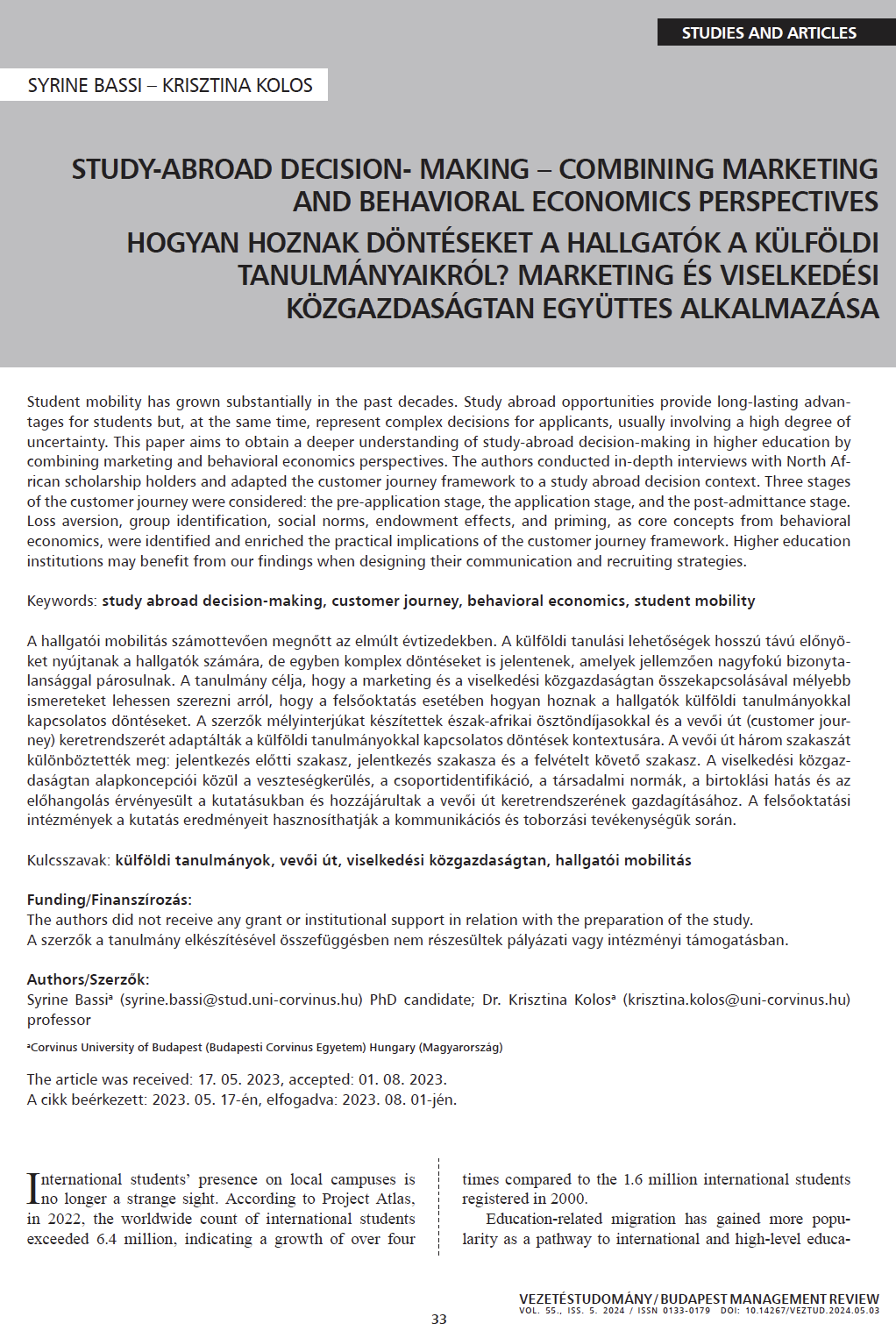
Study-abroad decision-making
Combining marketing and behavioral economics perspectives
DOI:
https://doi.org/10.14267/VEZTUD.2024.05.03Keywords:
study abroad decision-making, customer journey, behavioral economics, student mobilityAbstract
Student mobility has grown substantially in the past decades. Study abroad opportunities provide long-lasting advantages for students but, at the same time, represent complex decisions for applicants, usually involving a high degree of uncertainty. This paper aims to obtain a deeper understanding of study-abroad decision-making in higher education by combining marketing and behavioral economics perspectives. The authors conducted in-depth interviews with North African scholarship holders and adapted the customer journey framework to a study abroad decision context. Three stages of the customer journey were considered: the pre-application stage, the application stage, and the post-admittance stage. Loss aversion, group identification, social norms, endowment effects, and priming, as core concepts from behavioral economics, were identified and enriched the practical implications of the customer journey framework. Higher education institutions may benefit from our findings when designing their communication and recruiting strategies.
Downloads
References
Albien, A.J., & Mashatola, N.J. (2021). A systematic review and conceptual model of international student mobility decision-making. Social Inclusion, 9(1), 288- 298. https://doi.org/10.17645/si.v9i1.3769
Beine, M., Noël, R., & Ragot, L. (2013). Determinants of International Migration of Students. Economics of Education Review, (41), 40-54. https://doi.org/10.1016/j.econedurev.2014.03.003
Berry, J.W. (2005). Acculturation: Living successfully in two cultures. International Journal of Intercultural Relations, 29(6), 697–712. https://doi.org/10.1016/j.ijintrel.2005.07.013
Bertrand, M., Mullainathan, S., & Shafir, E. (2006). Behavioral economics and marketing in aid of decision making among the poor. Journal of Public Policy & Marketing, 25(1), 8-23. https://doi.org/10.1509/jppm.25.1.8
Böhm, A., Follari, M., Hewett, A., Jones, S., Kemp, N., Meares, D., ... & Van Cauter, K. (2004). Vision 2020: Forecasting international student mobility: A UK perspective. London: British Council. https://www.britishcouncil.org/education/he-science/knowledge-centre/transnational-education/vision-2020
Chuah, S.H., & Devlin, J. (2011). Behavioural economics and financial services marketing: a review. International Journal of Bank Marketing, 29(6), 456-469. https://doi.org/10.1108/02652321111165257
Corr, P., & Plagnol, A. (2018). Behavioral economics: The basics. Routledge. https://doi.org/10.4324/9781315391229
Dowling, K., Guhl, D., Klapper, D., Spann, M., Stich, L., & Yegoryan, N. (2020). Behavioral biases in marketing. Journal of the Academy of Marketing Science, 48(3), 449–477. https://doi.org/10.1007/s11747-019-00699-x
Dowling-Hetherington, L. (2020). Transnational higher education and the factors influencing student decision- making: The experience of an Irish university. Journal of Studies in International Education, 24(3), 291-313. https://doi.org/10.1177/1028315319826320
Engel J.F., Kollat D.T. & Blackwell R.D. (1968). Consumer Behaviour. Holt, Rinehart, & Winston.
Fang, W., & Wang, S. (2014). Chinese students’ choice of transnational higher education in a globalized higher education market: A case study of W University. Journal of Studies in International Education, 18(5), 475-494. https://doi.org/10.1177/1028315314523989
Foxall, G.R. (2017). Behavioral economics in consumer behavior analysis. The Behavior Analyst, 40, 309-313. https://doi.org/10.1007/s40614-017-0127-4
Foxall, G.R., & Sigurdsson, V. (2013). Consumer behavior analysis: behavioral economics meets the marketplace. The Psychological Record, 63(2), 231-238. https://doi.org/10.11133/j.tpr.2013.63.2.001
Fuller, R., Stocchi, L., Gruber, T. & Romaniuk, J. (2023). Advancing the understanding of the pre-purchase stage of the customer journey for service brands. European Journal of Marketing, 57(2), 360-386. https://doi.org/10.1108/ejm-10-2021-0792
Furnham, A., & Alibhai, N. (1985). The friendship networks of foreign students: A replication and extension of the functional model. International Journal of Psychology, 20(3-4), 709-722. https://doi.org/10.1080/00207598508247565
Hamilton, R., Ferraro, R., Haws, K.L., & Mukhopadhyay, A. (2021). Traveling with companions: The social customer journey. Journal of Marketing, 85(1), 68–92. https://doi.org/10.1177/0022242920908227
Hou, C., & Du, D. (2022). The changing patterns of international student mobility: A network perspective. Journal of Ethnic and Migration Studies, 48(1), 248-272. https://doi.org/10.1080/1369183x.2020.1797476
Howard, J.A., & Jagdish, S. (1969). The theory of buyer behavior. John Wiley & Sons. https://doi.org/10.1017/s0770451800031079
Institute of International Education. (2011). Open Doors 2011 Report on International Educational Exchange. Open Doors Data. 59. https://scholarship.shu.edu/opendoors-data/59
Krajnović, A., Sikirić, D., & Bosna, J. (2018). Digital marketing and behavioral economics. CroDiM: International Journal of Marketing Science, 1(1), 33-46. https://doi.org/10.21511/im.14(1).2018.04
Kahneman, D. (2011). Thinking, Fast and Slow. Allen Lane. https://doi.org/10.1332/251569211x15665367493742
Kahneman, D., & Tversky, A. (1979). Prospect theory: an analysis of decision under risk. Econometrica, 47(2), 263–291. https://doi.org/10.2307/1914185
Kahneman, D., & Frederick, S. (2002). Representativeness revisited: attribute substitution in intuitive judgment. In Gilovich, T., Griffin, D., & Kahneman, D. (eds.), Heuristics of Intuitive Judgment: Extensions and Applications (pp. 49–81). Cambridge University Press. https://doi.org/10.1017/cbo9780511808098.004
Leiser, D., & Azar, O.H. (2008). Behavioral economics and decision making: Applying insights from psychology to understand how people make economic decisions. Journal of Economic Psychology, 29(5), 613-618. https://doi.org/10.1016/j.joep.2008.08.001
Lemon, K.N., & Verhoef, P.C. (2016). Understanding customer experience throughout the customer journey. Journal of Marketing, 80(6), 69–96. https://doi.org/10.1509/jm.15.0420
Lipura, S.J., & Collins, F.L. (2020). Towards an integrative understanding of contemporary educational mobilities: A critical agenda for international student mobilities research. Globalisation. Societies and Education, 18(3), 343-359. https://doi.org/10.1080/14767724.2020.1711710
Mazzarol, T., & Soutar, G.N. (2002). “Push‐pull” factors influencing international student destination choice. International Journal of Educational Management, 16(2), 82-90. https://doi.org/10.1108/09513540210418403
McMahon, M.E. (1992). Higher education in a world market: An historical look at the global context of international study. Higher Education, 24(4), 465-82. https://doi.org/10.1007/bf00137243
Mucsi, A., Malota, E., & Török, A. (2020). Kulturális sokk és pozitív szájreklám – a felsőoktatásban tanuló külföldi hallgatók körében [Culture shock and positive word of mouth – Among international students in higher education]. Vezetéstudomány – Budapest Management Review, 51(2), 23-31. https://doi.org/10.14267/veztud.2020.02.02
Molden, D.C. (2014). Understanding priming effects in social psychology: What is “social priming” and how does it occur? Social Cognition, 32(Supplement), 1-11. https://doi.org/10.1521/soco.2014.32.supp.1
Mullainathan, S., & Thaler, R.H. (2000). Behavioral economics. National Bureau of Economic Research. https://doi.org/10.3386/w7948
Nyborg, K., Anderies, J.M., Dannenberg, A., Lindahl, T., Schill, C., Schlüter, M., ... & De Zeeuw, A. (2016). Social norms as solutions. Science, 354(6308), 42-43. https://doi.org/10.1126/science.aaf8317
Pizzutti, C., Gonçalves, R., & Ferreira, M. (2022). Information search behavior at the post-purchase stage of the customer journey. Journal of the Academy of Marketing Science, 50(5), 981-1010. https://doi.org/10.1007/s11747-022-00864-9
Prazeres, L. (2013). International and intra‐national student mobility: Trends, motivations and identity. Geography Compass, 7(11), 804-820. https://doi.org/10.1111/gec3.12080
Schultz, P.W., Nolan, J.M., Cialdini, R.B., Goldstein, N.J., & Griskevicius, V. (2007). The constructive, destructive, and reconstructive power of social norms. Psychological Science, 18(5), 429-434. https://doi.org/10.1111/j.1467-9280.2007.01917.x
Souto-Otero, M., Huisman, J., Beerkens, M., De Wit, H., & Vujić, S. (2013). Barriers to international student mobility: Evidence from the Erasmus program. Educational Researcher, 42(2), 70-77. https://doi.org/10.3102/0013189x12466696
Stankevich, A. (2017). Explaining the consumer decision- making process: critical literature review. Journal of International Business Research and Marketing, 2(6), 7-14. https://doi.org/10.18775/jibrm.1849-8558.2015.26.3001
Thaler, R. (1980). Toward a positive theory of consumer choice. Journal of Economic Behavior & Organization, 1(1), 39-60. https://doi.org/10.1016/0167-2681(80)90051-7
Trujillo, J.P.C., Mohammed, P.J., & Saleh, S.T. (2020). Students’ motivations to study abroad: The case of international students at the university of Debrecen. Central European Journal of Educational Research, 2(1), 76-81. https://doi.org/10.37441/cejer/2020/2/1/5760
Turner, J.C., Hogg, M.A., Oakes, P.J., Reicher, S.D., & Wetherell, M.S. (1987). Rediscovering the social group: A self-categorization theory. Basil Blackwell.
Vander Schee, B.A. (2009). Predictably irrational: the hidden forces that shape our decisions. Journal of Consumer Marketing, 26(1), 57-58. https://doi.org/10.1108/07363760910927064
Verbik, L., & Lasanowski, V. (2007). International student mobility: Patterns and trends. World Education News and Reviews, 20(10), 1-16. https://wenr.wes.org/2007/10/wenr-october-2007-feature
Wilkins, S., & Huisman, J. (2011). International student destination choice: The influence of home campus experience on the decision to consider branch campuses. Journal of Marketing for Higher education, 21(1), 61-83. https://doi.org/10.1080/08841241.2011.573592
Xian, H. (2008). Lost in translation? Language, culture and the roles of translator in cross‐cultural management research. Qualitative Research in Organizations and Management, 3(3), 231-245. https://doi.org/10.1108/17465640810920304
Yakhina, Z.S., Yakovlev, S.A., Kozhevnikova, N.V., Nuretdinova, Y.V., & Solovyeva, N.A. (2016). Practical Recommendations for University Graduates’ Readiness Formation to Occupational Mobility. International Journal of Environmental and Science Education, 11(15), 7358-7367. https://eric.ed.gov/?id=EJ1117414
Downloads
Published
Issue
Section
License
Copyright (c) 2024 Vezetéstudomány / Budapest Management Review

This work is licensed under a Creative Commons Attribution 4.0 International License.
Authors assign copyright to Vezetéstudomány / Budapest Management Review. Authors are responsible for permission to reproduce copyright material from other sources.
How to Cite