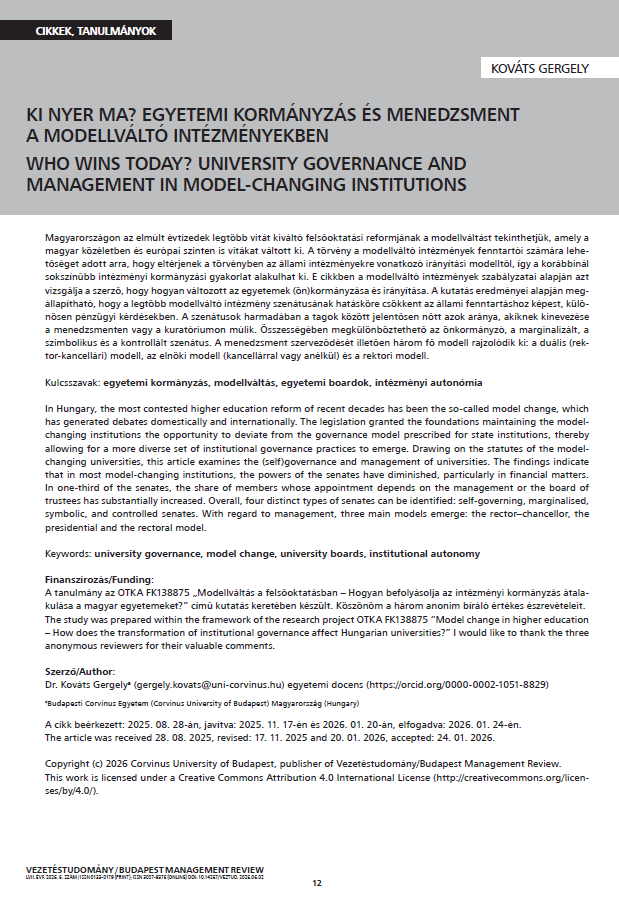
Who wins today? University governance and management in model-changing institutions
DOI:
https://doi.org/10.14267/VEZTUD.2026.06.02Keywords:
university governance, model change, university boards, institutional autonomyAbstract
In Hungary, the most contested higher education reform of recent decades has been the so-called model change, which has generated debates domestically and internationally. The legislation granted the foundations maintaining the modelchanging institutions the opportunity to deviate from the governance model prescribed for state institutions, thereby allowing for a more diverse set of institutional governance practices to emerge. Drawing on the statutes of the modelchanging universities, this article examines the (self)governance and management of universities. The findings indicate that in most model-changing institutions, the powers of the senates have diminished, particularly in financial matters. In one-third of the senates, the share of members whose appointment depends on the management or the board of trustees has substantially increased. Overall, four distinct types of senates can be identified: self-governing, marginalised, symbolic, and controlled senates. With regard to management, three main models emerge: the rector–chancellor, the presidential and the rectoral model.
Downloads
References
Austin, I., & Jones, G.A. (2025). Governance of higher education: Global perspectives, theories, and practices (Second edition). Routledge, Taylor & Francis Group.
Antonowicz, D., Rónay, Z., & Jaworska, M. (2022). The power of policy translators: New university governing bodies in Hungary and Poland. European Educational Research Journal, 22(5), 741-757. https://doi.org/10.1177/14749041221095275
Barakonyi K. (2009). Megtorpant intézményirányítási reform. Új Pedagógiai Szemle, 59(12), 3–42. https://matarka.hu/klikk.php?cikkmutat=855443&mutat=http://epa.oszk.hu/00000/00035/00138/pdf/EPA00035_upsz_200912_001-042.pdf
Barakonyi K. (2010). A felsőoktatás versenyképességéről. Vezetéstudomány, 41(12), 4-19. https://doi.org/10.14267/VEZTUD.2010.12.01
Bevins, F., Law, J., Sanghvi, S., & Valentino, R. (2020). Shaping university boards for 21st century higher education in the US. McKinsey & Company. https://www.mckinsey.com/industries/education/our-insights/shaping-university-boards-for-21st-century-higher-education-in-the-us
Bühner, R., Dobák, M., & Tari, E. (2002). Vállalatcsoportok. Konszern szervezetek, holding-struktúrák. Aula kiadó.
Clark, B.R. (1983). The higher education system: Academic organization in cross-national perspective. University of California Press.
Csurgó, D. (2023. december 21). Az utolsó utáni pillanatban cserélte le a MOME a többkörös szavazással kiválasztott rektorjelöltet. Telex.hu. https://telex.hu/belfold/2023/12/21/mome-rektorvalasztas-szenatus-kuratorium
De Boer, H., & Denters, B. (1999). Analysis of institutions of university governance: A classification scheme applied to postwar changes in Dutch higher education. In B. Jongbloed, P. Maassen, & G. Neave (Eds.), From the Eye of the Storm (pp. 211–233). Springer Netherlands. https://doi.org/10.1007/978-94-015-9263-5_10
De Boer, H.F., & Huisman, J. (2020). Governance Trends in European Higher Education. In G. Capano, & D.S.L. Jarvis (Eds.), Convergence and Diversity in the Governance of Higher Education (pp. 333–354). Cambridge University Press. https://doi.org/10.1017/9781108669429.013
De Boer, H., Jongbloed, B., Enders, J., & File, J. (2008). Progress in higher education reform across Europe. Governance Reform Volume 1: Executive Summary main report. CHEPS, Twente. https://op.europa.eu/en/publication-detail/-/publication/6945068f-e05b-4094-a1b4-5f8430f3016c
Eriksson-Zetterquist, U., & Sahlin, K. (2023). Introduction: Revitalizing Collegiality: Restoring Faculty Authority in Universities. In K. Sahlin, & U. Eriksson- Zetterquist (Eds.), Revitalizing Collegiality: Restoring Faculty Authority in Universities (pp. 1–26). Emerald Publishing Limited. https://doi.org/10.1108/S0733-558X20230000087001
EUA (2023). The evolution of university autonomy in Hungary. A complementary analysis to University Autonomy in Europe IV: The Scorecard 2023. European University Association.
HVG (2013. április 26.). Debreceni rektorválasztás: Balog nem a szenátus sorrendje szerint döntött. https://hvg.hu/itthon/20130426_debreceni_rektorvalasztas_balog
Keczer, G., Kováts, G., & Rónay Z. (2022). Innovációk a felsőoktatásmenedzsmentben. Az egyetemvezetés trendjei és a hazai megoldások. In Fazekas Á., Horváth L., Kálmán O., & Rónay Z. (Eds.), Keresni az újat szüntelen... : Tanulmánykötet Halász Gábor tiszteletére (pp. 153–180). L’Harmattan Kiadó.
Kováts G. (2019). A bizalom szerepe egy felsőoktatási reform megvalósulásában: A fenntartói megállapodások esete. Vezetéstudomány, 50(6), 2–13. https://doi.org/10.14267/VEZTUD.2019.06.01
Kováts, G. (2023). University Governance Reform in an Illiberal Democracy. In B. Broucker, C. Milsom, J. Calleja, & M. O’Hara (Eds.), Accelerating the Future of Higher Education (pp. 186–204). BRILL. https://doi.org/10.1163/9789004680371
Kováts, G. (2024a). Felsőoktatási rendszerek és kormányzásuk. In Kováts G. (Eds.), Felsőoktatás-menedzsment kézikönyv (pp. 167–197). BCE.
Kováts, G. (2024b). Felsőoktatási intézmények kormányzása. In Kováts G. (Eds.), Felsőoktatás-menedzsment kézikönyv (pp. 199–231). BCE.
Kováts, G., Derényi, A., Keczer, G., & Rónay, Z. (2023). The role of boards in Hungarian public interest foundation universities. Studies in Higher Education, 49(2), 368–381. https://doi.org/10.1080/03075079.2023.2234941
Kováts, G., & Golovics, J. (2025). The Two Faces of Autonomy of Hungarian Foundation Universities. Higher Education Quarterly, 79(2), e70023. https://doi.org/10.1111/hequ.70023
Kováts, G., Heidrich, B., & Chandler, N. (2017). The pendulum strikes back? An analysis of the evolution of Hungarian higher education governance and organisational structures since the 1980s. European Educational Research Journal, 16(5), 568–587. https://doi.org/10.1177/1474904117697716
Kovats, G., & Rónay, Z. (2023). How academic freedom is monitored: Overview of methods and procedures. European Parliament. Directorate General for Parliamentary Research Services. Publications Office. https://data.europa.eu/doi/10.2861/45892
Kretek, P.M., Dragšić, Ž., & Kehm, B.M. (2013). Transformation of university governance: On the role of university board members. Higher Education, 65(1), 39–58. https://doi.org/10.1007/s10734-012-9580-x
Mintzberg, H. (1993). Structure in fives: Designing effective organizations (Repr.). Prentice Hall.
Pruvot, B.E., & Estermann, T. (2018). University Governance: Autonomy, Structures and Inclusiveness. In A. Curaj, L. Deca, & R. Pricopie (Eds.), European Higher Education Area: The Impact of Past and Future Policies (pp. 619–638). Springer International Publishing. https://doi.org/10.1007/978-3-319-77407-7_37
Regini, M. (2020). Institutional Governance Factors, Actors, and Consequences of Attempting to Converge on the Anglo–American Model. In G. Capano, & D.S.L. Jarvis (Eds.), Convergence and Diversity in the Governance of Higher Education: Comparative Perspectives (pp. 103–137). Cambridge University Press. https://doi.org/10.1017/9781108669429
Rónay, Z. (2019a). Consistory – the obscure subject of state control. In G. Kováts & Z. Rónay (Eds.), In search of excellence in higher education (pp. 71–87). Corvinus Universy of Budapest Digital Press.
Rónay Z. (2019b). Vezetők, testületek, felelősség a felsőoktatási intézményekben, különös tekintettel az állami egyetemekre. L’Harmattan Kiadó, ELTE PPK. https://doi.org/10.56037/978-963-414-587-5
Rowlands, J. (2020). Towards New Models of Decision Making within University Governance in Anglophone Nations. In G. Capano & D.S.L. Jarvis (Eds.), Convergence and Diversity in the Governance of Higher Education: Comparative Perspectives (pp. 246–267). Cambridge University Press. https://doi.org/10.1017/9781108669429
Seeber, M., Lepori, B., Montauti, M., Enders, J., De Boer, H., & Weyer, E. (2015). European Universities as Complete Organizations? Understanding Identity, Hierarchy and Rationality in Public Organizations. Public Management Review, 17(10), 1444–1474. https://doi.org/10.1080/14719037.2014.943268
Szabó T., & Velencei J. (2009). A honi állami egyetem mint tudásalkotó szervezet egyes szervezeti tulajdonságai. Vezetéstudomány, 40(ksz), 43–49. https://doi.org/10.14267/VEZTUD.2009.ksz.07
Tierney, W.G. (2008). The impact of culture on organizational decision-making: Theory and practice in higher education. Stylus Pub. UNESCO. (1997). Recommendation Concerning the Status of Higher Education Teaching Personnel. UNESCO. https://www.unesco.org/en/legal-affairs/recommendation-concerning-status-higher-education-teaching-personnel
Unilife (2021. március 11.). Még mindig kétségeid vannak, hogyan biztosítja a modellváltás az egyetemek versenyképességét? Hankó Balázs beavat a részletekbe! Unilife. https://unilife.hu/egyetem/20210311-modellvaltas-es-egyetemek-autonomiaja-hanko-balazs-interju.html
Veiga, A., Magalhães, A., & Amaral, A. (2015). From Collegial Governance to Boardism: Reconfiguring Governance in Higher Education. In J. Huisman, H. De Boer, D.D. Dill, & M. Souto-Otero (Eds.), The Palgrave International Handbook of Higher Education Policy and Governance (pp. 398–416). Palgrave Macmillan UK. https://doi.org/10.1007/978-1-137-45617-5_22
Vught, F. van (Ed.). (1989). Governmental strategies and innovation in higher education. Kingsley.
Weick, K.E. (1976). Educational Organizations as Loosely Coupled Systems. Administrative Science Quarterly, 21(1), 1-19. https://doi.org/10.2307/2391875
Downloads
Published
Issue
Section
License
Copyright (c) 2026 Corvinus University of Budapest, publisher of Vezetéstudomány / Budapest Management Review

This work is licensed under a Creative Commons Attribution 4.0 International License.
Authors assign copyright to Vezetéstudomány / Budapest Management Review. Authors are responsible for permission to reproduce copyright material from other sources.
How to Cite