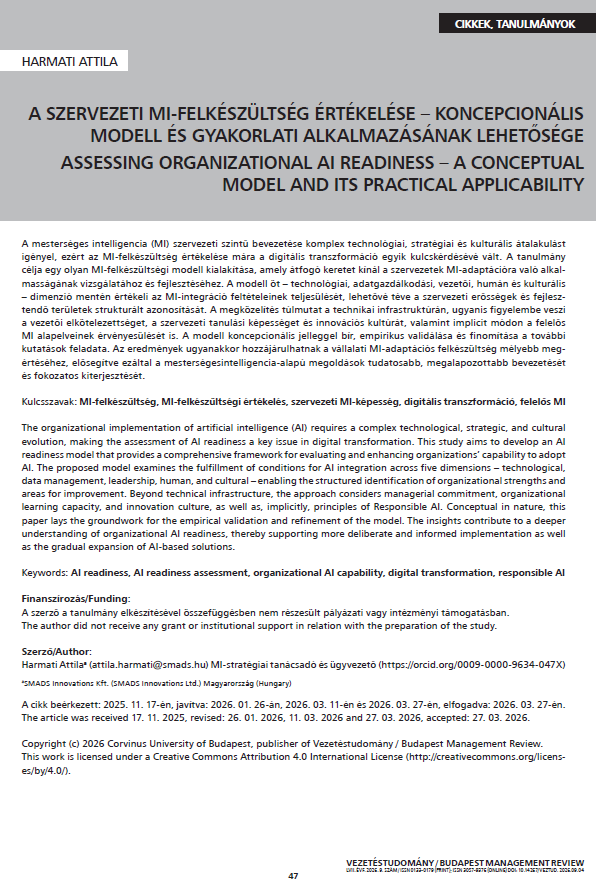
Assessing organizational AI readiness
A conceptual model and its practical applicability
DOI:
https://doi.org/10.14267/VEZTUD.2026.09.04Keywords:
AI readiness, AI readiness assessment, organizational AI capability, digital transformation, responsible AIAbstract
The organizational implementation of artificial intelligence (AI) requires a complex technological, strategic, and cultural evolution, making the assessment of AI readiness a key issue in digital transformation. This study aims to develop an AI readiness model that provides a comprehensive framework for evaluating and enhancing organizations’ capability to adopt AI. The proposed model examines the fulfillment of conditions for AI integration across five dimensions – technological, data management, leadership, human, and cultural – enabling the structured identification of organizational strengths and areas for improvement. Beyond technical infrastructure, the approach considers managerial commitment, organizational learning capacity, and innovation culture, as well as, implicitly, principles of Responsible AI. Conceptual in nature, this paper lays the groundwork for the empirical validation and refinement of the model. The insights contribute to a deeper understanding of organizational AI readiness, thereby supporting more deliberate and informed implementation as well as the gradual expansion of AI-based solutions.
Downloads
References
Akbarighatar, P. (2022). Maturity and readiness models for responsible artificial intelligence (RAI): A systematic literature review. In Proceedings of the 14th Mediterranean Conference on Information Systems (MCIS 2022) (Paper 12). Association for Information Systems. https://aisel.aisnet.org/mcis2022/12
Amershi, S., Begel, A., Bird, C., DeLine, R., Gall, H., Kamar, E., Nagappan, N., Nushi, B., & Zimmermann, T. (2019). Software engineering for machine learning: A case study. In Proceedings of the 2019 IEEE/ACM 41st International Conference on Software Engineering (pp. 291–300). IEEE. https://doi.org/10.1109/ICSE-SEIP.2019.00042
Argyris, C., & Schön, D. A. (1978). Organizational learning: A theory of action perspective. Addison-Wesley. Ashmore, R., Calinescu, R., & Paterson, C. (2021). Assuring the machine learning lifecycle: Desiderata, methods, and challenges. ACM Computing Surveys, 54(5), 1–39. https://doi.org/10.1145/3453444
Becker, J., Knackstedt, R., & Pöppelbuß, J. (2009). Developing maturity models for IT management: A procedure model and its application. Business & Information Systems Engineering, 1(3), 213–222. https://doi.org/10.1007/s12599-009-0044-5
Bryman, A., & Bell, E. (2015). Business research methods (4th ed.). Oxford University Press.
Bughin, J., Seong, J., Manyika, J., Chui, M., & Joshi, R. (2018). Notes from the AI frontier: Modeling the impact of AI on the world economy. McKinsey Global Institute. https://www.mckinsey.com/featured-insights/artificial-intelligence/notes-from-the-ai-frontier-modeling-the-impact-of-ai-on-the-world-economy
Camp, R.C. (1989). Benchmarking: The search for industry best practices that lead to superior performance. ASQC Quality Press.
Creswell, J.W., & Plano Clark, V.L. (2018). Designing and conducting mixed methods research (3rd ed.). SAGE.
Davenport, T.H. (2018). The AI advantage: How to put the artificial intelligence revolution to work. MIT Press.
Davenport, T.H., & Ronanki, R. (2018). Artificial intelligence for the real world. Harvard Business Review, 96(1), 108–116. https://hbr.org/2018/01/artificial-intelligence-for-the-real-world
Davenport, T.H., & Westerman, G. (2018). Why so many high-profile digital transformations fail. Harvard Business Review. https://hbr.org/2018/03/why-somany-high-profile-digital-transformations-fail
Davenport, T.H., & Miller, S. (2022). Working with AI: Real stories of human-machine collaboration. MIT Press.
Davenport, T.H., & Mittal, N. (2023). All in on AI: How smart companies win big with artificial intelligence. Harvard Business Review Press.
Deloitte Magyarország. (2025). Magyar MI Körkép 2025. https://www.deloitte.com/hu/hu/what-we-do/deloittemagyar-mi-korkep-2025.html DeVellis, R.F. (2016). Scale development: Theory and applications (4th ed.). SAGE.
Digiméter. (2024). Hazai digitalizáció 2024: Kutatás a kis- és középvállalkozások körében. Digiméter. https://digimeter.hu/wp-content/uploads/2024/04/Digimeter_2024_tavasz_tanulmany_20240418.pdf
Dignum, V. (2017). Responsible artificial intelligence: Designing AI for human values. ITU Journal: ICT Discoveries, Special Issue No. 1, 1–8. https://www.itu.int/dms_pub/itu-s/opb/journal/S-JOURNAL-ICTS.V1I1-2017-1-PDF-E.pdf
Dignum, V. (2019). Responsible artificial intelligence: How to develop and use AI in a responsible way. Springer. https://doi.org/10.1007/978-3-030-30371-6
Edmondson, A.C. (2018). The fearless organization: Creating psychological safety in the workplace for learning, innovation, and growth. Wiley.
European Commission. (2024). Artificial Intelligence Act: Regulation (EU) 2024/1689 of the European Parliament and of the Council. Official Journal of the European Union. https://eur-lex.europa.eu/eli/reg/2024/1689/oj
Floridi, L., Cowls, J., Beltrametti, M., Chatila, R., Chazerand, P., Dignum, V., Luetge, C., Madelin, R., Pagallo, U., Rossi, F., Schafer, B., Valcke, P., & Vayena, E. (2018). AI4People – An ethical framework for a good AI society: Opportunities, risks, principles, and recommendations. Minds and Machines, 28(4), 689–707. https://doi.org/10.1007/s11023-018-9482-5
Floridi, L. (2023). The ethics of artificial intelligence: Principles, challenges, and opportunities. Oxford University Press. https://doi.org/10.1093/oso/9780198883098.001.0001
Hair, J.F., Black, W.C., Babin, B.J., & Anderson, R.E. (2019). Multivariate data analysis (8th ed.). Cengage Learning.
Hansen, H.F., Lillesund, E., Mikalef, P., & Altwaijry, N. (2024). Understanding artificial intelligence diffusion through an AI capability maturity model. Information Systems Frontiers, 26, 2147–2163. https://doi.org/10.1007/s10796-024-10528-4
Homburg, C., Klarmann, M., Reimann, M., & Schilke, O. (2012). What drives key informant accuracy? Journal of Marketing Research, 49(4), 594–608. https://doi.org/10.1509/jmr.09.0174
Horváth, J. Gy. (2025). A digitális bizalom szerepe a digitális érettségi modellekben. Vezetéstudomány, 56(9), 67–81. https://doi.org/10.14267/VEZTUD.2025.09.05
Jöhnk, J., Weißert, M., & Wyrtki, K. (2021). Ready or not, AI comes – An interview study of organizational AI readiness factors. Business & Information Systems Engineering, 63(1), 5–20. https://doi.org/10.1007/s12599-020-00676-7
Joshi, A., Kale, S., Chandel, S., & Pal, D.K. (2015). Likert scale: Explored and explained. British Journal of Applied Science & Technology, 7(4), 396–403. https://doi.org/10.9734/BJAST/2015/14975
Kaplan, R.S., & Norton, D.P. (1996). The balanced scorecard: Translating strategy into action. Harvard Business School Press.
Kumar, N., Stern, L.W., & Anderson, J.C. (1993). Conducting interorganizational research using key informants. Academy of Management Journal, 36(6), 1633–1651.
Lichtenthaler, U. (2020). Five maturity levels of managing AI: From isolated ignorance to integrated intelligence. Journal of Innovation Management, 8(1), 39–50. https://doi.org/10.24840/2183-0606_008.001_0005
Long, D., & Magerko, B. (2020). What is AI literacy? Competencies and design considerations. In Proceedings of the 2020 CHI Conference on Human Factors in Computing Systems (pp. 1–16). Association for Computing Machinery. https://doi.org/10.1145/3313831.3376727
Magyarország Kormánya. (2025). Magyarország Mesterséges Intelligencia Stratégiája (2025-2030). https://cdn.kormany.hu/uploads/document/c/c0/c0d/c0dfdbd37cfa520ae37361a168d244c85e7295af.pdf
McAfee, A., Brynjolfsson, E., Davenport, T.H., Patil, D.J., & Barton, D. (2012). Big data: The management revolution. Harvard Business Review, 90(10), 60–68. https://hbr.org/2012/10/big-data-the-management-revolution
McAfee, A., & Brynjolfsson, E. (2017). Machine, platform, crowd: Harnessing our digital future. W. W. Norton & Company.
Mikalef, P., Pappas, I.O., Krogstie, J., & Giannakos, M. (2018). Big data analytics capabilities: A systematic literature review and research agenda. Information Systems and e-Business Management, 16(3), 547–578. https://doi.org/10.1007/s10257-017-0362-y
Miniszterelnöki Kabinetiroda. (2022). Nemzeti Digitalizációs Stratégia 2022-2030. https://cdn.kormany.hu/uploads/document/6/60/602/60242669c9f12756a2b-104f8295b866a8bb8f684.pdf
Organisation for Economic Co-operation and Development (OECD). (2022). SME policy index: Western Balkans and Turkey 2022: Assessing the implementation of the Small Business Act for Europe. OECD Publishing. https://doi.org/10.1787/b47d15f0-en
O’Toole, C., Schneider, J., Smaje, K., & LaBerge, L. (2020). How COVID-19 has pushed companies over the technology tipping point—and transformed business forever. McKinsey Digital. https://www.mckinsey.com/capabilities/mckinsey-digital/our-insights/howcovid-19-has-pushed-companies-over-the-technologytipping-point-and-transformed-business-forever
Oxford Insights. (2024). Government AI Readiness Index 2024. Oxford Insights. https://oxfordinsights.com/wp-content/uploads/2024/12/2024-Government-AI-Readiness-Index-2.pdf
Phillips, L.W. (1981). Assessing measurement error in key informant reports: A methodological note on organizational analysis in marketing. Journal of Marketing Research, 18(4), 395–415. https://doi.org/10.2307/3151333
Pintér, R. (2023a). A magyar kis- és középvállalkozások digitális érettsége – A Digiméter index: az eredmények ismertetése. Vezetéstudomány, 54(10), 66–75. https://doi.org/10.14267/VEZTUD.2023.10.06
Pintér, R. (2023b). A magyar kis- és középvállalkozások digitális érettsége – A Digiméter index: elméleti megalapozás. Vezetéstudomány, 54(9), 16–26. https://doi.org/10.14267/VEZTUD.2023.09.02
Podsakoff, P.M., MacKenzie, S.B., Lee, J.Y., & Podsakoff, N.P. (2003). Common method biases in behavioral research: A critical review of the literature and recommended remedies. Journal of Applied Psychology, 88(5), 879–903. https://doi.org/10.1037/0021-9010.88.5.879
Polyportis, A. (2024). A longitudinal study on artificial intelligence adoption: Understanding the drivers of ChatGPT usage behavior change in higher education. Frontiers in Artificial Intelligence, 6, 1324398. https://doi.org/10.3389/frai.2023.1324398
Publicis Groupe Hungary & PwC Magyarország. (2025). AI Readiness Index – Hungary (2025). Publicis Groupe Hungary. https://www.publicisgroupe.hu/news/ai-readiness-2025/
Ransbotham, S., Khodabandeh, S., Kiron, D., Candelon, F., Chu, M., & LaFountain, B. (2020). Expanding AI’s impact with organizational learning. MIT Sloan Management Review & Boston Consulting Group. https://sloanreview.mit.edu/projects/expanding-ais-impact-with-organizational-learning
Ransbotham, S., Candelon, F., Kiron, D., LaFountain, B., & Khodabandeh, S. (2021). The cultural benefits of artificial intelligence in the enterprise. MIT Sloan Management Review & Boston Consulting Group. https://sloanreview.mit.edu/projects/the-cultural-benefits-of-artificial-intelligence-in-the-enterprise
Sadiq, R.B., Safie, N., Rahman, A.H.A., & Goudarzi, S. (2021). Artificial intelligence maturity model: A systematic literature review. PeerJ Computer Science, 7, e661. https://doi.org/10.7717/peerj-cs.661
Sculley, D., Holt, G., Golovin, D., Davydov, E., Phillips, T., Ebner, D., Chaudhary, V., Young, M., Crespo, J.F., & Dennison, D. (2015). Hidden technical debt in machine learning systems. In Proceedings of the 28th International Conference on Neural Information Processing Systems (NIPS’15) (Vol. 2, pp. 2503–2511). MIT Press.
Vial, G. (2019). Understanding digital transformation: A review and a research agenda. The Journal of Strategic Information Systems, 28(2), 118–144. https://doi.org/10.1016/j.jsis.2019.01.003
Wamba, S.F., Dubey, R., Gunasekaran, A., & Akter, S. (2020). The performance effects of big data analytics and supply chain ambidexterity: The moderating effect of environmental dynamism. International Journal of Production Economics, 222, 107498. https://doi.org/10.1016/j.ijpe.2019.09.019
Wilson, H.J., & Daugherty, P.R. (2018). Human + machine: Reimagining work in the age of AI. Harvard Business Review Press.
Downloads
Published
Issue
Section
License
Copyright (c) 2026 Corvinus University of Budapest, publisher of Vezetéstudomány / Budapest Management Review

This work is licensed under a Creative Commons Attribution 4.0 International License.
Authors assign copyright to Vezetéstudomány / Budapest Management Review. Authors are responsible for permission to reproduce copyright material from other sources.
How to Cite