Female diversity and sexuality in underwear advertisements
Examining the attitude among Generation Z women
DOI:
https://doi.org/10.14267/VEZTUD.2024.02.02Keywords:
femvertising, advertising, diversity, sexuality, Generation ZAbstract
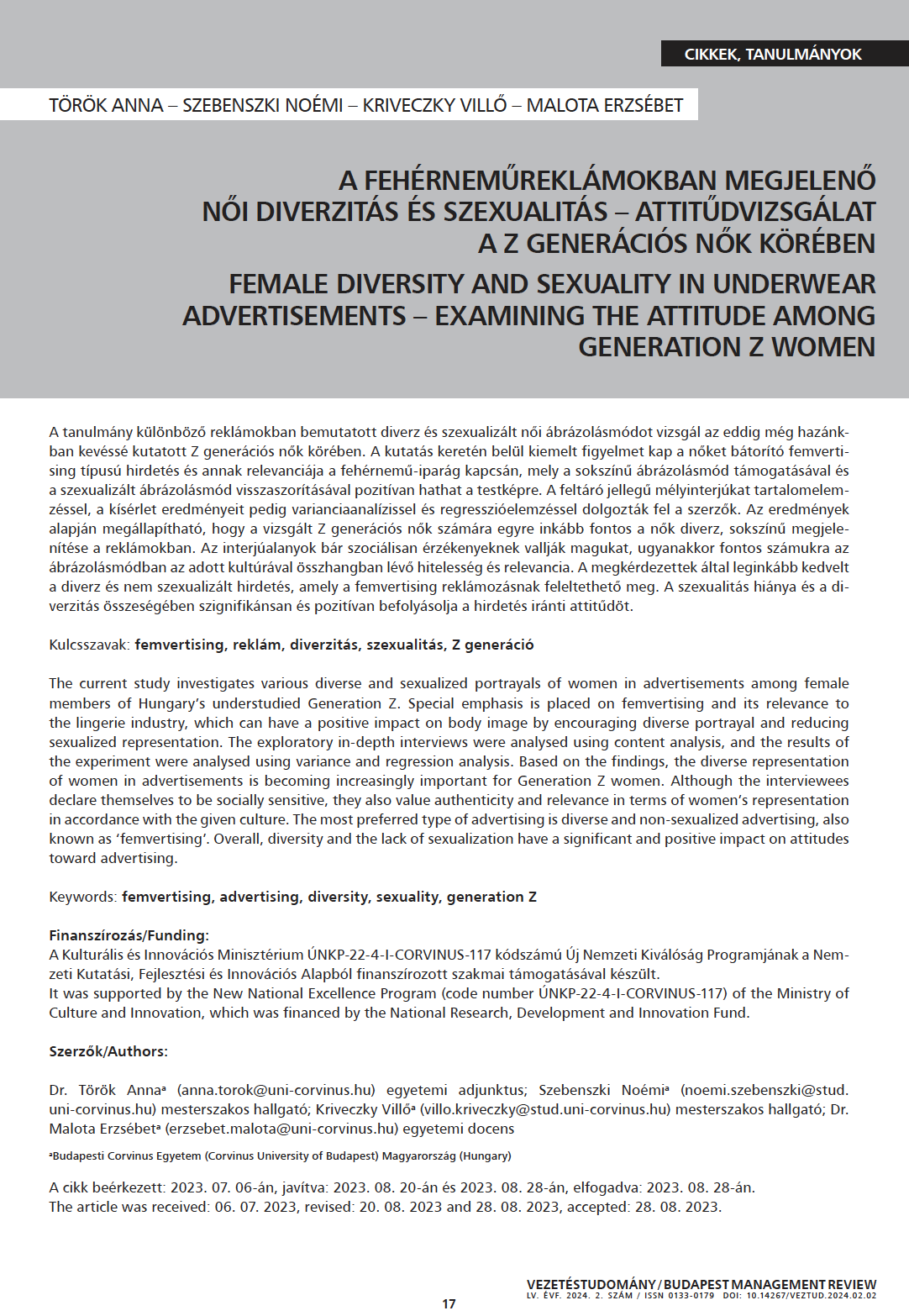
The current study investigates various diverse and sexualized portrayals of women in advertisements among female members of Hungary’s understudied Generation Z. Special emphasis is placed on femvertising and its relevance to the lingerie industry, which can have a positive impact on body image by encouraging diverse portrayal and reducing sexualized representation. The exploratory in-depth interviews were analysed using content analysis, and the results of the experiment were analysed using variance and regression analysis. Based on the findings, the diverse representation of women in advertisements is becoming increasingly important for Generation Z women. Although the interviewees declare themselves to be socially sensitive, they also value authenticity and relevance in terms of women’s representation in accordance with the given culture. The most preferred type of advertising is diverse and non-sexualized advertising, also known as ‘femvertising’. Overall, diversity and the lack of sexualization have a significant and positive impact on attitudes toward advertising.
Downloads
References
Aagerup, U., & Scharf, E.R. (2018). Obese models’ effect on fashion brand attractiveness. Journal of Fashion Marketing and Management: An International Journal, 22(4), 557–570. https://doi.org/10.1108/JFMM-07-2017-0065
Åkestam, N., Rosengren, S., & Dahlen, M. (2017). Advertising „like a girl”: Toward a better understanding of „femvertising” and its effects. Psychology and Marketing, 34(8), 795–806. https://doi.org/10.1002/mar.21023
Åkestam, N., Rosengren, S., Dahlén, M., Liljedal, K.T., & Berg, H. (2021). Gender stereotypes in advertising have negative cross-gender effects. European Journal of Marketing, 55(13), 63–93. https://doi.org/10.1108/EJM-02-2019-0125
Becker–Herby, E. (2016). The rise of femvertising: authentically reaching female consumers (Thesis). University of Minnesota, School of Journalism and Mass Communication. https://conservancy.umn.edu/bitstream/handle/11299/181494/BeckerHerby_%20Final%20Capstone_2016.pdf?sequence=1
Bernstein, R.S., Bulger, M., Salipante, P., & Weisinger, J.Y. (2020). From diversity to inclusion to equity: A theory of generative interactions. Journal of Business Ethics, 167, 395-410. https://doi.org/10.1007/s10551-019-04180-1
Champlin, S., Sterbenk, Y., Windels, K., & Poteet, M. (2019). How brand-cause fit shapes real world advertising messages: a qualitative exploration of ‘femvertising.’ International Journal of Advertising, 38(8), 1240–1263. https://doi.org/10.1080/02650487.2019.1615294
Choi, H., Yoo, K., Reichert, T., & LaTour, M.S. (2018). Do feminists still respond negatively to female nudity in advertising? Investigating the influence of feminist attitudes on reactions to sexual appeals. In Current Research on Gender Issues in Advertising (pp. 41-63). Routledge.
Choi, H., Yoo, K., Reichert, T., & Northup, T. (2020). Feminism and advertising: Responses to sexual ads featuring women: How the differential influence of feminist perspectives can inform targeting strategies. Journal of Advertising Research, 60(2), 163-178. https://doi.org/10.2501/JAR-2020-010
Cohen, R., Newton-John, T., & Slater, A. (2021). The case for body positivity on social media: Perspectives on current advances and future directions. Journal of Health Psychology, 26(13), 2365–2373. https://doi.org/10.1177/1359105320912450
Couture Bue, A.C., & Harrison, K. (2019). Empowerment sold separately: two experiments examine the effects of ostensibly empowering beauty advertisements on women’s empowerment and self-objectification. Sex Roles, 81(9–10), 627–642. https://doi.org/10.1007/s11199-019-01020-4
Csobanka, Z.E. (2016). The Z Generation. Acta Technologica Dubnicae, 6(2), 63–76. https://doi.org/10.1515/atd-2016-0012
Diedrichs, P.C., & Lee, C. (2011). Waif goodbye! Average- size female models promote positive body image and appeal to consumers. Psychology & Health, 26(10), 1273–1291. https://doi.org/10.1080/08870446.2010.515308
Drake, V.E. (2017). The impact of female empowerment in advertising (femvertising). Journal of Research in Marketing, 7(3), 593-599. https://core.ac.uk/download/pdf/229163714.pdf
Eisend, M., Muldrow, A.F., & Rosengren, S. (2023). Diversity and inclusion in advertising research. International Journal of Advertising, 42(1), 52-59. https://doi.org/10.1080/02650487.2022.2122252
Elhajjar, S. (2021). Attitudes toward femvertising in the Middle East: the case of Lebanon. Journal of Islamic Marketing, 13(5), 1111-1124. https://doi.org/10.1108/JIMA-04-2020-0108
Francis, T., & Hoefel, F. (2018). True Gen’: Generation Z and its implications for companies. McKinsey & Company.
Fredrickson, B.L., & Roberts, T.A. (1997). Objectification theory: Toward understanding women’s lived experiences andmental health risks. Psychology of Women Quarterly, 21(2), 173–206. https://doi.org/10.1111/j.1471-6402.1997.tb00108.x
Gan, C., & Chen, H.T. (2023). Sex, race, and femininity: young Chinese females’ responses to lingerie advertising. International Journal of Advertising. https://doi.org/10.1080/02650487.2023.2179283
Gill, R. (2007). Postfeminist media culture: Elements of a sensibility. European Journal of Cultural Studies, 10(2), 147–166. https://doi.org/10.1177/1367549407075898
Gopaldas, A., & DeRoy, G. (2015). An intersectional approach to diversity research. Consumption Markets & Culture, 18(4), 333-364. https://doi.org/10.1080/10253866.2015.1019872
Gramazio, S., Cadinu, M., Guizzo, F., & Carnaghi, A. (2021). Does sex really sell? paradoxical effects of sexualization in advertising on product attractiveness and purchase intentions. Sex Roles, 84(11–12), 701–719. https://doi.org/10.1007/s11199-020-01190-6
Griffin, M., Bailey, K.A., & Lopez, K.J. (2022). #Body- Positive? A critical exploration of the body positive movement within physical cultures taking an intersectionality approach. Frontiers in Sports and Active Living, 4, 908580. https://doi.org/10.3389/fspor.2022.908580
Gyulavári, T., Mitev, A.Z., Neulinger Á., Neumann-Bódi E., Simon J., Szűcs K. (2017). A marketingkutatás alapjai. Akadémiai Kiadó. https://doi.org/10.1556/9789630598880
Hainneville, V., Guèvremont, A., & Robinot, É. (2022). Femvertising or femwashing? Women’s perceptions of authenticity. Journal of Consumer Behaviour, 22(4), 933-941. https://doi.org/10.1002/cb.2020
Hall, J. A. (1984). Nonverbal sex differences: Communication accuracy and expressive style. Johns Hopkins University Press.
Hoffmann, S., Liebermann, S.C., & Schwarz, U. (2012). Ads for mature consumers: the importance of addressing the changing self-view between the age groups 50+ and 60+. Journal of Promotion Management, 18(1), 60–82. https://doi.org/10.1080/10496491.2012.646220
Hofmeister-Tóth, Á. (2017). A fogyasztói magatartás alapjai. Akadémiai Kiadó. https://mersz.hu/dokumentum/dj241afma_1/
Hofmeister-Tóth, Á. & Malota, E. (1999). Női/férfi szerepek ábrázolása a reklámokban. Marketing & Menedzsment, 33(2), 53-58. https://journals.lib.pte.hu/index.php/mm/article/view/1973
Hsieh, H.F., & Shannon, S.E. (2005). Three approaches to qualitative content analysis. Qualitative Health Research, 15(9), 1277-1288. https://doi.org/10.1177/1049732305276687
Kapoor, D., & Munjal, A. (2019). Self-consciousness and emotions driving femvertising: A path analysis of women’s attitude towards femvertising, forwarding intention and purchase intention. Journal of Marketing Communications, 25(2), 137–157. https://doi.org/10.1080/13527266.2017.1338611
Kovács, G., Aczél, P. & Bokor, T. (2020). The portrayal of elderly men and women in Hungarian television news programmes, Ageing & Society, 41(9), 2099-2117. https://doi.org/10.1017/S0144686X20000227
KSH (2011). Népszámlálási adatok. Központi Statisztikai Hivatal. https://www.ksh.hu/nepszamlalas/tablak_demografia
Lavine, H., Sweeney, D., & Wagner, S.H. (1999). Depicting women as sex objects in television advertising: Effects on body dissatisfaction. Personality and Social Psychology Bulletin, 25(8), 1049-1058. https://doi.org/10.1177/01461672992511012
Lima, A.M., & Casais, B. (2021). Consumer reactions towards femvertising: A netnographic study. Corporate Communications: An International Journal, 26(3), 605–621. https://doi.org/10.1108/CCIJ-02-2021-0018
Lou, C., & Tse, C.H. (2021). Which model looks most like me? Explicating the impact of body image advertisements on female consumer well-being and consumption behaviour across brand categories. International Journal of Advertising, 40(4), 602–628. https://doi.org/10.1080/02650487.2020.1822059
Maclaran, P. (2012). Marketing and feminism in historic perspective. Journal of Historical Research in Marketing, 4(3), 462–469. https://doi.org/10.1108/17557501211252998
Maclaran, P. (2015). Feminism’s fourth wave: A research agenda for marketing and consumer research. Journal of Marketing Management, 31(15–16), 1732–1738. https://doi.org/10.1080/0267257X.2015.1076497
Mager, J., & Helgeson, J.G. (2011). Fifty years of advertising images: some changing perspectives on role portrayals along with enduring consistencies. Sex Roles, 64(3–4), 238–252. https://doi.org/10.1007/s11199-010-9782-6
Malhotra, N.K. & Simon, J. közreműködésével (2017). Marketingkutatás. Akadémiai Kiadó.
Nagy, B., & Primecz, H. (2010). Nők és férfiak a szervezetben. Kísérlet a mítoszok feloszlatására. Vezetéstudomány, 61(1), 2-17. https://doi.org/10.14267/VEZTUD.2010.01.01.
Németh, A.R., Jambrik, M., Franczia, N., John, B., Horváth, J., Hámornik, B.P., Illés, E., Pintér, G.M.A., Szirtes, L., Tóth, Á., Zákányi, Zs., & Csenki, L. (2021). Ideálok testközelből – A fehérneműreklámok megítélése a saját testtel való elégedettség és az életkor tükrében. Mentálhigiéné és Pszichoszomatika, 22(1), 1–49. https://doi.org/10.1556/0406.22.2021.001
Nölke, A.I. (2018). Making diversity conform? An intersectional, longitudinal analysis of LGBT-specific mainstream media advertisements. Journal of Homosexuality, 65(2), 224-255. https://doi.org/10.1080/00918369.2017.1314163
O’Donnell, N., Jerin, S.I., & Mu, D. (2023). Using TikTok to educate, influence, or inspire? A content analysis of health-related EduTok videos. Journal of Health Communication, 28(8), 539-551. https://doi.org/10.1080/10810730.2023.2234866
Orehóczki, Zs., & Török, A. (2022). A femvertising és a hagyományos reklám attitűdre és vásárlási hajlandóságra gyakorolt hatásának vizsgálata. Vezetéstudomány, 53(4), 17-27. https://doi.org/10.14267/VEZTUD.2022.04.02
Patton, M.Q. (2002). Qualitative research and evaluation methods (3rd ed.). Sage.
Pelyhe, V., & Primecz, H. (2022). Nemi szerepek a munkaerőpiacon és a szervezetekben a transznemű emberek szemszögéből. Vezetéstudomány, 53(8-9), 176-187. https://doi.org/10.14267/VEZTUD.2022.08-09.13
Ratnadewi, Z.A., Aprilianty, F., Qastharin, A.R., & Hidayanti, N. (2022). The influence of Victoria’s Secret new brand image in generating brand trust, brand prestige, brand love, and brand loyalty. Diponegoro International Journal of Business, 5(2), 119–134. https://doi.org/10.14710/dijb.5.2.2022.119-134
Rossiter, J.R. & Bergkvist, L. (2009). The importance of choosing one good item for single-item measures of attitude towards the ad and attitude towards the brand and its generalization to all measures. Transfer: Werbeforschung & Praxis, 55, 8-18.
Ruckel, L., & Hill, M. (2017). Look @ Me 2.0: Self-Sexualization in Facebook Photographs, Body Surveillance and Body Image. Sexuality & Culture, 21(1), 15–35. https://doi.org/10.1007/s12119-016-9376-8
Ryan, T. (2022). Is Victoria’s Secret’s inclusivity messaging resonating? RetailWire. https://retailwire.com/discussion/is-victorias-secrets-inclusivity-messaging-resonating/
Sastre, A. (2014). Towards a Radical Body Positive. Feminist Media Studies, 14(6), 929–943. https://doi.org/10.1080/14680777.2014.883420.
Schilling, J. (2006). On the pragmatics of qualitative assessment: Designing the process for content analysis. European Journal of Psychological Assessment, 22(1), 28-37. https://doi.org/10.1027/1015-5759.22.1.28
Silver-Greenberg, J., Rosman, K., Maheshwari, S. & Stewart, J.B. (2020. 02.01.). Angels’ in Hell: The Culture of Misogyny Inside Victoria’s Secret. The New York Times. https://www.nytimes.com/2020/02/01/business/victorias-secret-razek-harassment.html
Singer, J. (2021). TikTok’s That Girl is meant to promote wellness, but some say it does the opposite. CBC News. https://www.cbc.ca/news/entertainment/that-girl-tiktok-trend-wellness-1.6139284
Sterbenk, Y., Champlin, S., Windels, K., & Shelton, S. (2022). Is Femvertising the New Greenwashing? Examining Corporate Commitment to Gender Equality. Journal of Business Ethics, 177(3), 491–505. https://doi.org/10.1007/s10551-021-04755-x
Sternadori, M., & Abitbol, A. (2019). Support for women’s rights and feminist self-identification as antecedents of attitude toward femvertising, Journal of Consumer Marketing, 36(6), 740-750, https://doi.org/10.1108/JCM-05-2018-2661
Teng, F., Hu, J., Chen, Z., Poon, K.T., & Bai, Y. (2021). Sexism and the effectiveness of femvertising in China: A corporate social responsibility perspective. Sex Roles, 84(5), 253-270. https://doi.org/10.1007/s11199-020-01164-8
Török, A., & Malota, E. (2021). Femvertising: A nők társadalmi szerepének megerősödése és a reklámokkal való kapcsolata. JEL-KÉP: Kommunikáció Közvélemény Média, 2, 103-117. https://doi.org/10.20520/JEL-KEP.2021.2.103
Török, A., Malota, E., & Horváth, A. (2022). Mi a titkuk? Nemi egyenlőség és a nőket megerősítő, femvertising reklámok Magyarországon és Izlandon. Magyar Tudomány, 183(12) 13-26. https://doi.org/10.1556/2065.183.2022.12.2
Török A., Malota E., & Mucsi A. (2021). A nők attitűdje a tradicionális és a femvertising reklámokban megjelenő női sztereotípiákkal szemben. Marketing & Menedzsment, 55(4), 5–14. https://doi.org/10.15170/MM.2021.55.04.01
Törőcsik, M., & Szűcs, K. (2021). Fogyasztói magatartás – Mintázatok, trendek, alkalmazkodás. Akadémiai Kiadó. Vajkai, É.K., & Zsóka, Á. (2020). Brand avoidance behaviour of Gen Z towards fast fashion brands. Vezetéstudomány, 51(5), 39-50. https://doi.org/10.14267/VEZTUD.2020.05.04
Varghese, N., & Kumar, N. (2020). Feminism in advertising: Irony or revolution? A critical review of femvertising. Feminist Media Studies, 22(2), 441–459. https://doi.org/10.1080/14680777.2020.1825510
Veres Z., Hoffmann M., & Kozák Á. (szerk.) (2017). Bevezetés a piackutatásba. Akadémiai Kiadó. https://doi.org/10.1556/9789634540038
Victoria’s Secret (2023). VSNow. https://www.victoriassecret.com/us/vs/vsnow
Windels, K., Champlin, S., Shelton, S., Sterbenk, Y., & Poteet, M. (2020). Selling feminism: How female empowerment campaigns employ postfeminist discourses. Journal of Advertising, 49(1), 18-33. https://doi.org/10.1080/00913367.2019.1681035
Zimmerman, A., & Dahlberg, J. (2008). The sexual objectification of women in advertising: a contemporary cultural perspective. Journal of Advertising Research, 48(1), 71–79. https://doi.org/10.2501/S0021849908080094
Downloads
Published
Issue
Section
License
Copyright (c) 2024 Vezetéstudomány / Budapest Management Review

This work is licensed under a Creative Commons Attribution 4.0 International License.
Authors assign copyright to Vezetéstudomány / Budapest Management Review. Authors are responsible for permission to reproduce copyright material from other sources.
How to Cite