Transparency matters
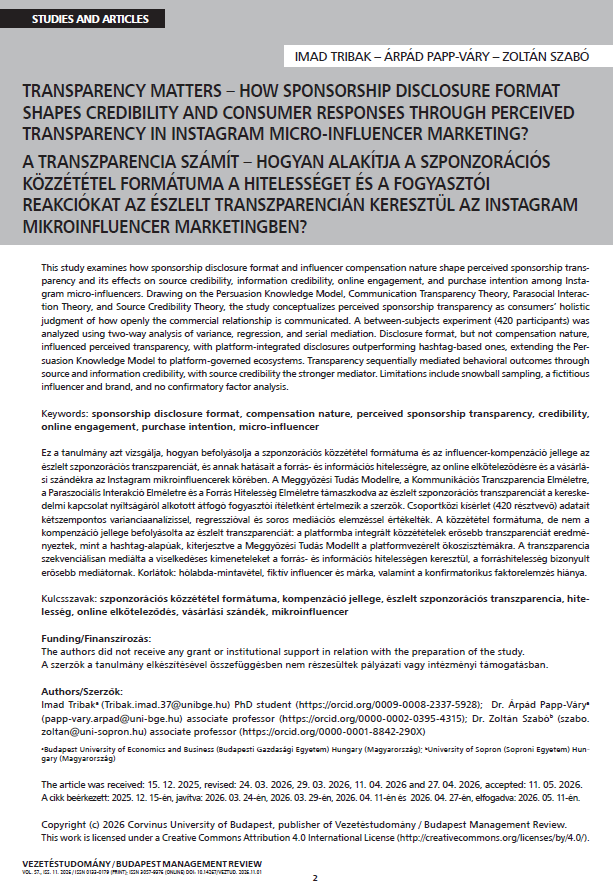
How sponsorship disclosure format shapes credibility and consumer responses through perceived transparency in Instagram micro-influencer marketing?
DOI:
https://doi.org/10.14267/VEZTUD.2026.11.01Keywords:
sponsorship disclosure format, compensation nature, perceived sponsorship transparency, credibility, online engagement, purchase intention, micro-influencerAbstract
This study examines how sponsorship disclosure format and influencer compensation nature shape perceived sponsorship transparency and its effects on source credibility, information credibility, online engagement, and purchase intention among Instagram micro-influencers. Drawing on the Persuasion Knowledge Model, Communication Transparency Theory, Parasocial Interaction Theory, and Source Credibility Theory, the study conceptualizes perceived sponsorship transparency as consumers’ holistic judgment of how openly the commercial relationship is communicated. A between-subjects experiment (420 participants) was analyzed using two-way analysis of variance, regression, and serial mediation. Disclosure format, but not compensation nature, influenced perceived transparency, with platform-integrated disclosures outperforming hashtag-based ones, extending the Persuasion Knowledge Model to platform-governed ecosystems. Transparency sequentially mediated behavioral outcomes through source and information credibility, with source credibility the stronger mediator. Limitations include snowball sampling, a fictitious influencer and brand, and no confirmatory factor analysis.
Downloads
References
Aldlimi, T., Priporas, C., & Chang, S. (2025). Engagement in influencer marketing: A systematic review of key drivers, behaviors, and future research directions. Journal of Consumer Behaviour, 24(3), 1541-1566. https://doi.org/10.1002/cb.2485
Audrezet, A., de Kerviler, G., & Guidry Moulard, J. (2020). Authenticity under threat: When social media influencers need to go beyond self-presentation. Journal of Business Research, 117, 557-569. https://doi.org/10.1016/j.jbusres.2018.07.008
Baghel, D. (2023). The role of influencer authenticity and brand trust in shaping consumer behavior: Strategies to engage Generation Z. ShodhKosh: Journal of Visual and Performing Arts, 4(1), 1259-1271. https://doi.org/10.29121/shodhkosh.v4.i1.2023.3327
Balaban, D.C., Szambolics, J., & Chirică, M. (2022). Parasocial relations and social media influencers’ persuasive power: Exploring the moderating role of product involvement. Acta Psychologica, 230, 103731. https://doi.org/10.1016/j.actpsy.2022.103731
Boerman, S.C. (2020). The effects of the standardized Instagram disclosure for micro- and meso-influencers. Computers in Human Behavior, 103, 199-207. https://doi.org/10.1016/j.chb.2019.09.015
Boerman, S.C., & Müller, C.M. (2022). Understanding which cues people use to identify influencer marketing on Instagram: An eye-tracking study and experiment. International Journal of Advertising, 41(1), 6-29. https://doi.org/10.1080/02650487.2021.1986256
Boerman, S.C., Willemsen, L.M., & van der Aa, E.P. (2017). “This post is sponsored”: Effects of sponsorship disclosure on persuasion knowledge and electronic word of mouth in the context of Facebook. Journal of Interactive Marketing, 38, 82-92. https://doi.org/10.1016/j.intmar.2016.12.002
Breves, P., Amrehn, J., Heidenreich, A., Liebers, N., & Schramm, H. (2021). Blind trust? The importance and interplay of parasocial relationships and advertising disclosures in explaining influencers’ persuasive effects on their followers. International Journal of Advertising, 40(7), 1209-1229. https://doi.org/10.1080/02650487.2021.1881237
Bu, Y., Parkinson, J., & Thaichon, P. (2022). Influencer marketing: Sponsorship disclosure and value co-creation behaviour. Marketing Intelligence & Planning, 40(7), 854–870. https://doi.org/10.1108/MIP-09-2021-0310
Campbell, C., & Farrell, J.R. (2020). More than meets the eye: The functional components underlying influencer marketing. Business Horizons, 63(4), 469-479. https://doi.org/10.1016/j.bushor.2020.03.003
Cao, Z., & Belo, R. (2024). Effects of explicit sponsorship disclosure on user engagement in social media influencer marketing. MIS Quarterly, 48(1), 375-392. https://doi.org/10.25300/MISQ/2023/17944
Carpenter, C.C., & Bonin II, M. (2021). To win friends and influence people: Regulation and enforcement of influencer marketing after ten years of the Endorsement Guides. Vanderbilt Journal of Entertainment and Technology Law, 23(2), 253-312. https://scholarship.law.vanderbilt.edu/jetlaw/vol23/iss2/1
Carr, C.T., & Hayes, R.A. (2014). The effect of disclosure of third-party influence on an opinion leader’s credibility and electronic word of mouth in two-step flow. Journal of Interactive Advertising, 14(1), 38-50. https://doi.org/10.1080/15252019.2014.909296
Chen, J., Zhang, Y., Cai, H., Liu, L., Liao, M., & Fang, J. (2024). A comprehensive overview of micro-influencer marketing: Decoding the current landscape, impacts, and trends. Behavioral Sciences, 14(3), 243. https://doi.org/10.3390/bs14030243
Conde, R., & Casais, B. (2023). Micro, macro and mega- influencers on Instagram: The power of persuasion via the parasocial relationship. Journal of Business Research, 158, 113708. https://doi.org/10.1016/j.jbusres.2023.113708
Dabholkar, P.A., & Sheng, X. (2012). Consumer participation in using online recommendation agents: Effects on satisfaction, trust, and purchase intentions. The Service Industries Journal, 32(9), 1433-1449. https://doi.org/10.1080/02642069.2011.624596
De Cicco, R., Iacobucci, S., & Pagliaro, S. (2021). The effect of influencer-product fit on advertising recognition and the role of an enhanced disclosure in increasing sponsorship transparency. International Journal of Advertising, 40(5), 733-759. https://doi.org/10.1080/02650487.2020.1801198
De Jans, S., Cauberghe, V., & Hudders, L. (2018). How an advertising disclosure alerts young adolescents to sponsored vlogs: The moderating role of a peer-based advertising literacy intervention through an informational vlog. Journal of Advertising, 47(4), 309-325. https://doi.org/10.1080/00913367.2018.1539363
Demand Sage. (2026). Instagram statistics 2026: How many people use Instagram? Demand Sage. https://www.demandsage.com/instagram-statistics/
De Veirman, M., & Hudders, L. (2020). Disclosing sponsored Instagram posts: The role of material connection with the brand and message-sidedness when disclosing covert advertising. International Journal of Advertising, 39(1), 94-130. https://doi.org/10.1080/02650487.2019.1575108
Eisend, M., van Reijmersdal, E.A., Boerman, S.C., & Tarrahi, F. (2020). A meta-analysis of the effects of disclosing sponsored content. Journal of Advertising, 49(3), 344-366. https://doi.org/10.1080/00913367.2020.1765909
Eisend, M., & Tarrahi, F. (2022). Persuasion knowledge in the marketplace: A meta-analysis. Journal of Consumer Psychology, 32(1), 3-22. https://doi.org/10.1002/jcpy.1258
European Parliament. (2025). Report on the Protection of Minors Online, A10-0213/2025. European Parliament. https://www.europarl.europa.eu/doceo/document/A-10-2025-0213_EN.html
Evans, N.J., Phua, J., Lim, J., & Jun, H. (2017). Disclosing Instagram influencer advertising: The effects of disclosure language on advertising recognition, attitudes, and behavioural intent. Journal of Interactive Advertising, 17(2), 138-149. https://doi.org/10.1080/15252019.2017.1366885
Evans, N.J., Wojdynski, B.W., & Hoy, M.G. (2019). Sponsorship transparency as a mediator of negative effects of covert ad recognition. International Journal of Advertising, 38(3), 364-382. https://doi.org/10.1080/02650487.2018.1474998
Friestad, M., & Wright, P. (1994). The persuasion knowledge model: How people cope with persuasion attempts. Journal of Consumer Research, 21(1), 1-31. https://doi.org/10.1086/209380
Giuffredi-Kähr, A., Petrova, A., & Malär, L. (2022). Sponsorship disclosure of influencers: A curse or a blessing? Journal of Interactive Marketing, 57(1), 18-34. https://doi.org/10.1177/10949968221075686
Hayes, A.F. (2022). Introduction to mediation, moderation, and conditional process analysis: A regression- based approach (3rd ed.). Guilford Press. https://www.guilford.com/books/Introduction-to-Mediation-Moderation-and-Conditional-Process-Analysis/Andrew-Hayes/9781462549030
Hernán, M.A., & Robins, J.M. (2020). Causal inference: What if. Chapman & Hall/CRC. https://www.miguelhernan.org/whatifbook/
Horton, D., & Wohl, R.R. (1956). Mass communication and para-social interaction: Observations on intimacy at a distance. Psychiatry, 19(3), 215–229. https://doi.org/10.1080/00332747.1956.11023049
Hovland, C.I., Janis, I.L., & Kelley, H.H. (1954). Communication and persuasion. Journal of Consulting Psychology, 18(2), 152. https://doi.org/10.1037/h0053111
Influencer Marketing Hub. (2025). Influencer Marketing Benchmark Report 2025. https://influencermarketinghub.com/influencer-marketing-benchmark-report/
Jamal, F.N., Othman, N.A., Saleh, R.C., Nurhanay, A.H., & Rohmah, W. (2021). Evaluating information credibility toward green marketing in Indonesia. The Journal of Asian Finance, Economics and Business, 8(2), 427-438. https://doi.org/10.13106/JAFEB.2021.VOL8.NO2.0427
Jhawar, V., Varshney, S., & Kumar, A. (2025). How does advertising disclosure on social media impact influencer avoidance, influencer switching and brand avoidance? Journal of Consumer Marketing, 42(1), 24-36. https://doi.org/10.1108/JCM-11-2023-6426
Jin, S.V., Muqaddam, A., & Ryu, E. (2019). Instafamous and social media influencer marketing. Marketing Intelligence & Planning, 37(5), 567-579. https://doi.org/10.1108/MIP-09-2018-0375
Johnson, T.J., & Kaye, B.K. (2015). Reasons to believe: Influence of credibility on motivations for using social networking sites. Computers in Human Behavior, 50, 544-555. https://doi.org/10.1016/j.chb.2015.04.002
Kay, S., Mulcahy, R., & Parkinson, J. (2020). When less is more: The impact of macro and micro social media influencers’ disclosure. Journal of Marketing Management, 36(3-4), 248-278. https://doi.org/10.1080/0267257X.2020.1718740
Karagür, Z., Becker, J.M., Klein, K., & Edeling, A. (2022). How, why, and when disclosure type matters for influencer marketing. International Journal of Research in Marketing, 39, 313-335. https://doi.org/10.1016/j.ijresmar.2021.09.006
Lee, S.S., Vollmer, B.T., Yue, C.A., & Johnson, B.K. (2021). Impartial endorsements: Influencer and celebrity declarations of non-sponsorship and honesty. Computers in Human Behavior, 122, 106858. https://doi.org/10.1016/j.chb.2021.106858
Liu, X., & Zheng, X. (2024). The persuasive power of social media influencers in brand credibility and purchase intention. Humanities and Social Sciences Communications, 11, 15. https://doi.org/10.1057/s41599-023-02512-1
Lou, C., & Yuan, S. (2019). Influencer marketing: How message value and credibility affect consumer trust of branded content on social media. Journal of Interactive Advertising, 19(1), 58-73. https://doi.org/10.1080/15252019.2018.1533501
Lou, C., Ma, W., & Feng, Y. (2021). A sponsorship disclosure is not enough? How advertising literacy intervention affects consumer reactions to sponsored influencer posts. Journal of Promotion Management, 27(2), 278-305. https://doi.org/10.1080/10496491.2020.1829771
Martínez-López, F.J., Anaya-Sánchez, R., Esteban-Millat, I., Torrez-Meruvia, H., D’Alessandro, S., & Miles, M. (2020). Influencer marketing: Brand control, commercial orientation and post credibility. Journal of Marketing Management, 36(17-18), 1805-1831. https://doi.org/10.1080/0267257X.2020.1806906
Men, L.R., Ping, H., & Yue, C.A. (2020). Examining the effects of organizational transparency on employee– organization relationships: The mediating role of trust. Public Relations Review, 46(2), 101880. https://doi.org/10.1016/j.pubrev.2020.101880
Metzger, M.J., & Flanagin, A.J. (2013). Credibility and trust of information in online environments: The use of cognitive heuristics. Journal of Pragmatics, 59, 210- 220. https://doi.org/10.1016/j.pragma.2013.07.012
Munnukka, J., Uusitalo, O., & Toivonen, H. (2016). Credibility of a peer endorser and advertising effectiveness. Journal of Consumer Marketing, 33(3), 182-192. https://doi.org/10.1108/JCM-11-2014-1221
Ohanian, R. (1990). Construction and validation of a scale to measure celebrity endorsers’ perceived expertise, trustworthiness, and attractiveness. Journal of Advertising, 19(3), 39-52. https://doi.org/10.1080/00913367.1990.10673191
Ou, M., & Ho, S.S. (2024). Factors associated with information credibility perceptions: A meta-analysis. Journalism & Mass Communication Quarterly, 101(2), 346-372. https://doi.org/10.1177/10776990231222556
Petty, R.E., & Cacioppo, J.T. (1986). Communication and persuasion: Central and peripheral routes to attitude change. Springer-Verlag. https://doi.org/10.1007/978-1-4612-4964-1
Rawlins, B.L. (2008). Measuring the relationship between organizational transparency and employee trust. Public Relations Journal, 2(2), 1-21. https://scholarsarchive.byu.edu/facpub/885/
Rubin, A.M., Perse, E.M., & Powell, R.A. (1985). Loneliness, parasocial interaction, and local television news viewing. Human Communication Research, 12(2), 155-180. https://doi.org/10.1111/j.1468-2958.1985.tb00071.x
Sárközi, D., & Szabó, Z. (2024). Evaluating the effectiveness of differentiated branding strategies for sustainable products utilizing recycled plastics in Hungary. Journal of Entrepreneurship, Business and Economics, 12(2), 109-135. https://scientificia.com/index.php/JEBE/article/view/2313731
Schouten, A.P., Janssen, L., & Verspaget, M. (2020). Celebrity vs. micro-influencer endorsements in advertising: The role of source credibility and perceived authenticity. International Journal of Advertising, 39(2), 258-281. https://doi.org/10.1080/02650487.2019.1634898
Sheng, J., Lee, Y.H., & Lan, H. (2023). Parasocial relationships with micro-influencers: Do sponsorship disclosure and electronic word-of-mouth disrupt? Internet Research, 34(3), 849-867. https://doi.org/10.1108/INTR-12-2021-0903
Statista. (2026). Global influencer marketing platform market size (Stat. No. 1036560). Statista. https://www.statista.com/statistics/1036560/global-influencer-marketing-platform-market-size/
Szabó, Z., Komáromi Gergely, A., & Széles, Z. (2014). The role of event marketing in case of the Buda Castle Wine Festival. In Proceedings of the 8th International Conference of the Academy of Wine Business Research (pp. 883–894). https://m2.mtmt.hu/gui2/?mode=browse¶ms=publication%3B2790336
Van Reijmersdal, E.A., Fransen, M.L., van Noort, G., Opree, S.J., Vandeberg, L., Reusch, S., van Lieshout, F., & Boerman, S.C. (2016). Effects of disclosing sponsored content in blogs: How the use of resistance strategies mediates effects on persuasion. American Behavioral Scientist, 60(12), 1458-1474. https://doi.org/10.1177/0002764216660141
Van Reijmersdal, E.A., Brussee, E., Evans, N.J., & Wojdynski, B.W. (2023). Disclosure-driven recognition of native advertising: A test of two competing mechanisms. Journal of Interactive Advertising, 23(1), 1-15. https://doi.org/10.1080/15252019.2022.2146991
Van Reijmersdal, E.A., Walet, M., & Gudmundsdóttir, A. (2024). Influencer marketing: Explaining the effects of influencer self-presentation strategies on brand responses through source credibility. Marketing Intelligence & Planning, 42(7), 1214-1233. https://doi.org/10.1108/MIP-03-2023-0125
Wojdynski, B.W., & Evans, N.J. (2016). Going native: Effects of disclosure position and language on the recognition and evaluation of online native advertising. Journal of Advertising, 45(2), 157-168. http://dx.doi.org/10.1080/00913367.2015.1115380
Wojdynski, B.W., Evans, N.J., & Hoy, M. G. (2018). Measuring sponsorship transparency in the age of native advertising. Journal of Consumer Affairs, 52(1), 115-137. https://doi.org/10.1111/joca.12144
Woodroof, P.J., Howie, K.M., Syrdal, H.A., & VanMeter, R. (2020). What’s done in the dark will be brought to the light: Effects of influencer transparency on product efficacy and purchase intentions. Journal of Product & Brand Management, 29(5), 675-688. https://doi.org/10.1108/JPBM-05-2019-2362
Xiao, M., Wang, R., & Chan-Olmsted, S. (2018). Factors affecting YouTube influencer marketing credibility: A heuristic-systematic model. Journal of Media Business Studies, 15(3), 188-213. https://doi.org/10.1080/16522354.2018.1501146
Xie, Q., & Feng, Y. (2023). How to strategically disclose sponsored content on Instagram? The synergy effects of two types of sponsorship disclosures in influencer marketing. International Journal of Advertising, 42(2), 317-343. https://doi.org/10.1080/02650487.2022.2071393
Yin, C., Sun, Y., Fang, Y., & Lim, K. (2018). Exploring the dual role of cognitive heuristics and the moderating effect of gender in microblog information credibility evaluation. Information Technology & People, 31(3), 741-769. https://doi.org/10.1108/ITP-12-2016-0300
Zhang, Y., & Szabó, Z. (2024). Digital transformation in the tourism industry: A comparative literature review. Advances in Economics, Management and Political Sciences, 72(1), 166-179. http://doi.org/10.54254/2754-1169/72/20240667
Downloads
Published
Issue
Section
License
Copyright (c) 2026 Corvinus University of Budapest, publisher of Vezetéstudomány / Budapest Management Review

This work is licensed under a Creative Commons Attribution 4.0 International License.
Authors assign copyright to Vezetéstudomány / Budapest Management Review. Authors are responsible for permission to reproduce copyright material from other sources.
How to Cite