Stakeholder-focused evaluation of a gamified educational platform
DOI:
https://doi.org/10.14267/VEZTUD.2026.07-08.03Keywords:
gamification, learning motivation, user experience, stakeholder-focused evaluationAbstract
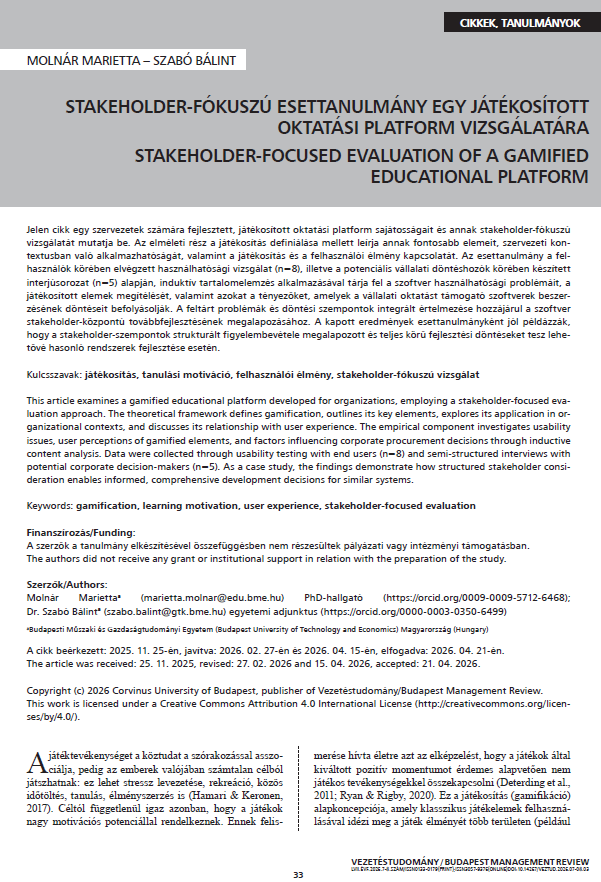
This article examines a gamified educational platform developed for organizations, employing a stakeholder-focused evaluation approach. The theoretical framework defines gamification, outlines its key elements, explores its application in organizational contexts, and discusses its relationship with user experience. The empirical component investigates usability issues, user perceptions of gamified elements, and factors influencing corporate procurement decisions through inductive content analysis. Data were collected through usability testing with end users (n=8) and semi-structured interviews with potential corporate decision-makers (n=5). As a case study, the findings demonstrate how structured stakeholder consideration enables informed, comprehensive development decisions for similar systems.
Downloads
References
Alroobaea, R., & Mayhew, P.J. (2014). How many participants are really enough for usability studies? In 2014 Science and Information Conference (pp. 48-56). IEE Xplore. https://doi.org/10.1109/SAI.2014.6918171
Andrade, F.R.H., Mizoguchi, R., & Isotani, S. (2016). The bright and dark sides of gamification. In A. Micarelli, J. Stamper, & K. Panourgia (Eds.), Intelligent Tutoring Systems: 13th International Conference, ITS 2016, Zagreb, Croatia, June 7-10, 2016. Proceedings 13 (Vol. 9684, pp. 176-186). Springer. https://doi.org/10.1007/978-3-319-39583-8_17
Bangor, A., Kortum, P.T., & Miller, J.T. (2008). An empirical evaluation of the System Usability Scale. International Journal of Human-Computer Interaction, 24(6), 574-594. https://doi.org/10.1080/10447310802205776
Barnum, C.M. (2020). Usability testing essentials: Ready, set... test! Morgan Kaufmann.
Braun, V., & Clarke, V. (2006). Using thematic analysis in psychology. Qualitative Research in Psychology, 3(2), 77-101. https://doi.org/10.1191/1478088706qp063oa
Brooke, J. (1996). SUS – A quick and dirty usability scale. In P.W. Jordan, B. Thomas, B.A. Weerdmeester, & I.L. McClelland (Eds.), Usability Evaluation in Industry (pp. 189–194). Taylor & Francis.
Czeily, T., Czine, P., & Dajnoki, K. (2024). Játékosítás a toborzásban: Egy diszkrét választási kísérlet eredményei. Vezetéstudomány, 55(4), 2-16. https://doi.org/10.14267/VEZTUD.2024.04.01
Coulston, F., Lynch, F., & Vears, D.F. (2025). Collaborative coding in inductive content analysis: Why, when, and how to do it. Journal of Genetic Counseling, 34(3), e70030. https://doi.org/10.1002/jgc4.70030
Croucher, S.M., & Cronn-Mills, D. (2024). Understanding communication research methods. Routledge. https://doi.org/10.4324/9781003432173
Dahlstrøm, M.F. (2012). The role of interest in gamified persuasion: Examining the role of interest in effectiveness of gamified health campaigns. In M. Bang & E.L. Ragnemalm (Eds.), Persuasive Technology: Design for Health and Safety (pp. 180-192). Springer. https://doi.org/10.1007/978-3-642-31037-9_16
Dale, S. (2014). Gamification: Making work fun, or making fun of work? Business Information Review, 31(2), 82-90. https://doi.org/10.1177/0266382114538350
Deci, E.L., & Ryan, R.M. (2000). The „what” and „why” of goal pursuits: Human needs and the self-determination of behavior. Psychological Inquiry, 11(4), 227-268. https://doi.org/10.1207/S15327965PLI1104_01
Deterding, S. (2015). The lens of intrinsic skill atoms: A method for gameful design. Human-Computer Interaction, 30(3-4), 294-335. https://doi.org/10.1080/07370024.2014.993471
Deterding, S., Dixon, D., Khaled, R., & Nacke, L. (2011). From game design elements to gamefulness. In Proceedings of the 15th International Academic MindTrek Conference: Envisioning Future Media Environments (pp. 9-15). ACM. https://doi.org/10.1145/2181037.2181040
Ferreira, A.T., Araújo, A.M., Fernandes, S., & Miguel, I.C. (2017). Gamification in the workplace: A systematic literature review. In Á. Rocha, A.M. Correia, H. Adeli, L.P. Reis, & S. Costanzo (Eds.), Recent advances in information systems and technologies (pp. 283-292). Springer. https://doi.org/10.1007/978-3-319-56541-5_29
Freeman, R.E. (1984). Strategic management: A stakeholder approach. Pitman Publishing.
Gawer, A., & Cusumano, M.A. (2014). Industry platforms and ecosystem innovation. Journal of Product Innovation Management, 31(3), 417-433. https://doi.org/10.1111/jpim.12105
Hamari, J., & Keronen, L. (2017). Why do people play games? A meta-analysis. International Journal of Information Management, 37(3), 125-141. https://doi.org/10.1016/j.ijinfomgt.2017.01.006
Hamari, J., Koivisto, J., & Sarsa, H. (2014). Does gamification work? A literature review of empirical studies on gamification. In Proceedings of the Annual Hawaii International Conference on System Sciences (pp. 3025- 3034). IEEE Xplore. https://doi.org/10.1109/HICSS.2014.377
Herzig, P., Ameling, M., & Schill, A. (2015). Workplace psychology and gamification: Theory and application. In T. Reiners & L.C. Wood (Eds.), Gamification in education and business (pp. 451–471). Springer. https://doi.org/10.1007/978-3-319-10208-5_23
Hsu, C.L., & Chen, M.C. (2018). How does gamification improve user experience? An empirical investigation on the antecedences and consequences of user experience and its mediating role. Technological Forecasting and Social Change, 132, 118-129. https://doi.org/10.1016/j.techfore.2018.01.023
ISO. (2018). ISO 9241-11:2018 Ergonomics of human-system interaction — Part 11: Usability: Definitions and concepts. International Organization for Standardization. Koivisto, J., & Hamari, J. (2019). The rise of motivational information systems: A review of gamification research. International Journal of Information Management, 45, 191-210. https://doi.org/10.1016/j.ijinfomgt.2018.10.013
Kolbeinsson, A., Palmquist, A., Lindblom, J., & Jiménez Sánchez, J.L. (2021). To what extent is gamification an effective tool for onboarding users into a DHM tool? In A. Marcus & E. Rosenzweig (Eds.), Design, user experience, and usability: UX research and design (pp. 48-66). Springer. https://doi.org/10.1007/978-3-030-78221-4_4
Krath, J., Schürmann, L., & von Korflesch, H.F.O. (2021). Revealing the theoretical basis of gamification: A systematic review and analysis of theory in research on gamification, serious games and game-based learning. Computers in Human Behavior, 125, 106963. https://doi.org/10.1016/j.chb.2021.106963
Larson, K. (2020). Serious games and gamification in the corporate training environment: A literature review. TechTrends, 64(2), 319-328. https://doi.org/10.1007/s11528-019-00446-7
Law, E.L.C., Roto, V., Hassenzahl, M., Vermeeren, A.P.O.S., & Kort, J. (2009). Understanding, scoping and defining user experience. In Proceedings of the SIGCHI Conference on Human Factors in Computing Systems (pp. 719-728). ACM. https://doi.org/10.1145/1518701.1518813
Malaby, T.M. (2007). Beyond play: A new approach to games. Games and Culture, 2(2), 95-113. https://doi.org/10.1177/1555412007299434
Mitchell, R.K., Agle, B.R., & Wood, D.J. (1997). Toward a theory of stakeholder identification and salience: Defining the principle of who and what really counts. Academy of Management Review, 22(4), 853-886. https://doi.org/10.5465/amr.1997.9711022105
Nielsen, J. (1994). Severity ratings for usability problems. https://www.nngroup.com/articles/how-to-rate-the-severity-of-usability-problems/
Nielsen, J., & Loranger, H. (2006). Prioritizing web usability. New Riders.
Oravec, J.A. (2015). Gamification and multigamification in the workplace: Expanding the ludic dimensions of work and challenging the work/play dichotomy. Cyberpsychology, 9(3), Article 6. https://doi.org/10.5817/CP2015-3-6
Parker, G.G., Van Alstyne, M.W., & Choudary, S.P. (2016). Platform revolution: How networked markets are transforming the economy and how to make them work for you. W. W. Norton & Company.
Ryan, R.M., & Deci, E.L. (2000). When rewards compete with nature. In C. Sansone & J. M. Harackiewicz (Eds.), Intrinsic and extrinsic motivation: The search for optimal motivation and performance (pp. 13-54). Academic Press. https://doi.org/10.1016/B978-012619070-0/50024-6
Ryan, R.M., & Rigby, C.S. (2020). Motivational foundations of game-based learning. In J.L. Plass, R.E. Mayer, & B.D. Homer (Eds.), Handbook of game-based learning (pp. 153-176). MIT Press.
Sailer, M., Hense, J.U., Mayr, S.K., & Mandl, H. (2017). How gamification motivates: An experimental study of the effects of specific game design elements on psychological need satisfaction. Computers in Human Behavior, 69, 371-380. https://doi.org/10.1016/j.chb.2016.12.033
Sailer, M., & Homner, L. (2020). The gamification of learning: A meta-analysis. Educational Psychology Review, 32(1), 77-112. https://doi.org/10.1007/s10648-019-09498-w
Shneiderman, B., Plaisant, C., Cohen, M., Jacobs, S., Elmqvist, N., & Diakopoulos, N. (2009). Designing the user interface: Strategies for effective human-computer interaction (5th ed.). Pearson.
Spanellis, A., Pyrko, I., & Dörfler, V. (2022). Gamifying situated learning in organisations. Management Learning, 53(3), 525-546. https://doi.org/10.1177/13505076211038812
Steers, R.M., Mowday, R.T., & Shapiro, D.L. (2004). The future of work motivation theory. Academy of Management Review, 29(3), 379-387. https://doi.org/10.5465/amr.2004.13670978
Suh, A., Cheung, C.M.K., Ahuja, M., & Wagner, C. (2017). Gamification in the workplace: The central role of the aesthetic experience. Journal of Management Information Systems, 34(1), 268–305. https://doi.org/10.1080/07421222.2017.1297642
Sullivan, P., & Brown, K. (2024). B2B edtech purchasing decisions: The role of measurable outcomes. Journal of Business Research, 172, 114421. https://doi.org/10.1016/j.jbusres.2023.114421
Tarpataki, E., & Mikáczó, É. I. (2022). Lépések az élményalapú oktatás irányába: A játékosítás határmezsgyéjén a számvitel alapjai tárgy oktatásában. Vezetéstudomány, 53(12), 45-55. https://doi.org/10.14267/VEZTUD.2022.12.04
Thomas, D.R. (2006). A general inductive approach for analyzing qualitative evaluation data. American Journal of Evaluation, 27(2), 237-246. https://doi.org/10.1177/1098214005283748
Werbach, K., & Hunter, D. (2012). For the win: How game thinking can revolutionize your business. Wharton Digital Press.
Yu, T., & Wu, N. (2009). A review of study on the competing values framework. International Journal of Business and Management, 4(7), 37-42. https://doi.org/10.5539/ijbm.v4n7p37
Downloads
Published
Issue
Section
License
Copyright (c) 2026 Corvinus University of Budapest, publisher of Vezetéstudomány / Budapest Management Review

This work is licensed under a Creative Commons Attribution 4.0 International License.
Authors assign copyright to Vezetéstudomány / Budapest Management Review. Authors are responsible for permission to reproduce copyright material from other sources.
How to Cite