The university as an innovation ecosystem orchestrator
International examples and Hungarian case studies
DOI:
https://doi.org/10.14267/VEZTUD.2026.07-08.05Keywords:
innovation ecosystem, orchestrator, technology transfer, multiple case study designAbstract
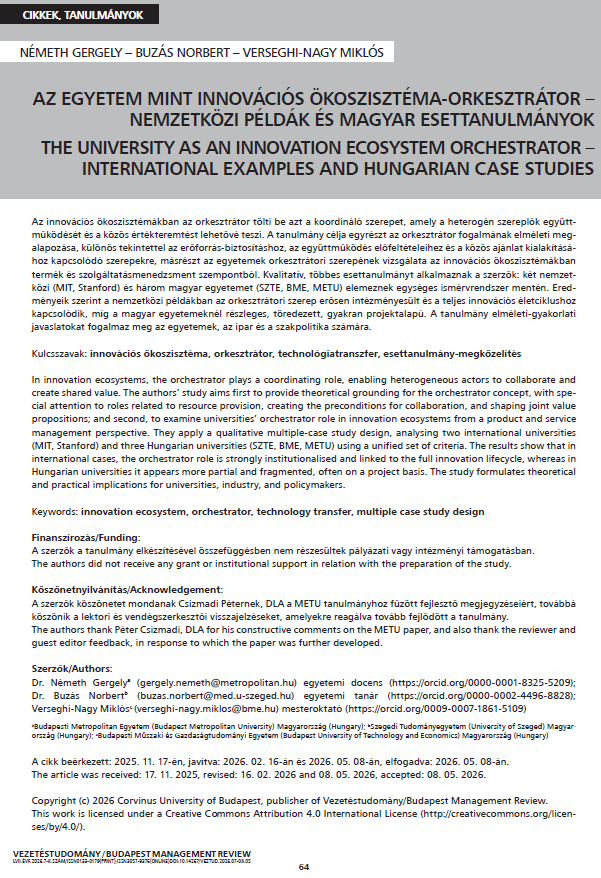
In innovation ecosystems, the orchestrator plays a coordinating role, enabling heterogeneous actors to collaborate and create shared value. The authors’ study aims first to provide theoretical grounding for the orchestrator concept, with special attention to roles related to resource provision, creating the preconditions for collaboration, and shaping joint value propositions; and second, to examine universities’ orchestrator role in innovation ecosystems from a product and service management perspective. They apply a qualitative multiple-case study design, analysing two international universities (MIT, Stanford) and three Hungarian universities (SZTE, BME, METU) using a unified set of criteria. The results show that in international cases, the orchestrator role is strongly institutionalised and linked to the full innovation lifecycle, whereas in Hungarian universities it appears more partial and fragmented, often on a project basis. The study formulates theoretical and practical implications for universities, industry, and policymakers.
Downloads
References
Abramo, G., & D’Angelo, C.A. (2022). Drivers of academic engagement in public–private research collaboration: An empirical study. The Journal of Technology Transfer, 47(6), 1861–1884. https://doi.org/10.1007/s10961-021-09884-z
Audretsch, D.B. (2014). From the entrepreneurial university to the university for the entrepreneurial society. The Journal of Technology Transfer, 39(3), 313–321. https://doi.org/10.1007/s10961-012-9288-1
Autio, E. (2022). Orchestrating ecosystems: A multi-layered framework. Innovation, 24(1), 96–109. https://doi.org/10.1080/14479338.2021.1919120
Baldwin, C.Y., Bogers, M.L., Kapoor, R., & West, J. (2024). Focusing the ecosystem lens on innovation studies. Research Policy, 53(3), 104949. https://doi.org/10.1016/j.respol.2023.104949
Batterink, M.H., Wubben, E.F.M., Klerkx, L., & Omta, S.W.F. (Onno). (2010). Orchestrating innovation networks: The case of innovation brokers in the agri-food sector. Entrepreneurship & Regional Development, 22(1), 47–76. https://doi.org/10.1080/08985620903220512
Belitski, M., & Sikorski, J. (2024). Three steps for universities to become entrepreneurial: A case study of entrepreneurial process and dynamic capabilities. The Journal of Technology Transfer, 49(6), 2035–2055. https://doi.org/10.1007/s10961-024-10099-1
Callaert, J., Landoni, P., Van Looy, B., & Verganti, R. (2015). Scientific yield from collaboration with industry: The relevance of researchers’ strategic approaches. Research Policy, 44(4), 990–998. https://doi.org/10.1016/j.respol.2015.02.003
Carayannis, E.G., & Campbell, D.F. (2010). Triple Helix, Quadruple Helix and Quintuple Helix and how do knowledge, innovation and the environment relate to each other? A proposed framework for a trans-disciplinary analysis of sustainable development and social ecology. International Journal of Social Ecology and Sustainable Development (IJSESD), 1(1), 41–69. https://doi.org/10.4018/978-1-4666-1586-1.ch004
Carayannis, E.G., Grigoroudis, E., Campbell, D.F.J., Meissner, D., & Stamati, D. (2018). ‘Mode 3’ universities and academic firms: Thinking beyond the box trans-disciplinarity and nonlinear innovation dynamics within coopetitive entrepreneurial ecosystems. International Journal of Technology Management, 77(1/2/3), 145. https://doi.org/10.1504/IJTM.2018.091714
Chesbrough, H., Vanhaverbeke, W., & West, J. (2006). Open innovation: Researching a new paradigm. Oxford University Press. Cobben, D., Ooms, W., Roijakkers, N., & Radziwon, A. (2022). Ecosystem types: A systematic review on boundaries and goals. Journal of Business Research, 142, 138–164. https://doi.org/10.1016/j.jbusres.2021.12.046
Eisenhardt, K.M., & Martin, J.A. (2017). Dynamic Capabilities: What Are They? In C. E. Helfat (Ed.), The SMS Blackwell Handbook of Organizational Capabilities (pp. 341–363). Wiley. https://doi.org/10.1002/9781405164054.ch21
Etzkowitz, H., & Leydesdorff, L. (2000). The dynamics of innovation: From National Systems and “Mode 2” to a Triple Helix of university–industry–government relations. Research Policy, 29(2), 109–123. https://doi.org/10.1016/S0048-7333(99)00055-4
Feld, B., & Hathaway, I. (2020). The startup community way: Evolving an entrepreneurial ecosystem. John Wiley & Sons.
Felin, T., & Foss, N. (2023). Microfoundations of ecosystems: The theory-led firm and capability growth. Strategic Organization, 21(2), 476–488. https://doi.org/10.1177/14761270231159391
Frølund, L., Murray, F., & Riedel, M. (2017). Engaging in regional innovation ecosystems: Six questions to get your university partnerships right. Working Paper. MIT Lab for Innovation Science and Policy. Furr, N., & Shipilov, A. (2018). Building the right ecosystem for innovation. MIT Sloan Management Review, 59(4), 59–64.
Gastaldi, L., & Corso, M. (2016). Academics as Orchestrators of Innovation Ecosystems: The Role of Knowledge Management. International Journal of Innovation and Technology Management, 13(05), 1640009. https://doi.org/10.1142/S0219877016400095
Granovetter, M. (1985). Economic Action and Social Structure: The Problem of Embeddedness. American Journal of Sociology, 91(3), 481–510. https://doi.org/10.1086/228311
Granstrand, O., & Holgersson, M. (2020). Innovation ecosystems: A conceptual review and a new definition. Technovation, 90, 102098. https://doi.org/10.1016/j.technovation.2019.102098
Gulati, R., Nohria, N., & Zaheer, A. (2000). Strategic networks. Strategic Management Journal, 21(3), 203–215. https://doi.org/10.1002/(SICI)1097-0266(200003)21:3%25253C203::AID-SMJ102%25253E3.0.CO;2-K
Gyurkovics, J., & Juhász, S. (2018). A szegedi biotechnológiai vállalkozások tudáshálózata–a Biopolisz jelene. Tér és Társadalom, 32(4), 167–184. https://doi.org/10.17649/TET.32.4.3033
Hambrick, D.C., Cho, T.S., & Chen, M.J. (1996). The influence of top management team heterogeneity on firms’ competitive moves. Administrative Science Quarterly, 41(4), 659–684. https://doi.org/10.2307/2393871
Heaton, S., Siegel, D.S., & Teece, D.J. (2019). Universities and innovation ecosystems: A dynamic capabilities perspective. Industrial and Corporate Change, 28(4), 921–939. https://doi.org/10.1093/icc/dtz038
Hurmelinna-Laukkanen, P., Möller, K., & Nätti, S. (2022). Orchestrating innovation networks: Alignment and orchestration profile approach. Journal of Business Research, 140, 170–188. https://doi.org/10.1016/j.jbusres.2021.11.084
Hurmelinna-Laukkanen, P., & Nätti, S. (2018). Orchestrator types, roles and capabilities–A framework for innovation networks. Industrial Marketing Management, 74, 65–78. https://doi.org/10.1016/j.indmarman.2017.09.020
Jacobides, M.G., Cennamo, C., & Gawer, A. (2018). Towards a theory of ecosystems. Strategic Management Journal, 39(8), 2255–2276. https://doi.org/10.1002/smj.2904
Kapoor, R. (2018). Ecosystems: Broadening the locus of value creation. Journal of Organization Design, 7(1), 12. https://doi.org/10.1186/s41469-018-0035-4
Kiss, M. (2000). BME Milleneumi Évkönyv. A Műegyetem rövid története 1782–2000. BME.
Lawler, E.E. (1988). Choosing an Involvement Strategy. Academy of Management Perspectives, 2(3), 197–204. https://doi.org/10.5465/ame.1988.4277254
Leon, G., & Martinez, R. (2016). Q&A. How Can a University Drive an Open Innovation Ecosystem? Technology Innovation Management Review, 6(7), 48–51. https://doi.org/ 10.22215/timreview/1004
Leslie, S.W., & Kargon, R.H. (1996). Selling Silicon Valley: Frederick Terman’s model for regional advantage. Business History Review, 70(4), 435–472. https://doi.org/10.2307/3117312
Lütjen, H., Schultz, C., Tietze, F., & Urmetzer, F. (2019). Managing ecosystems for service innovation: A dynamic capability view. Journal of Business Research, 104, 506–519. https://doi.org/10.1016/j.jbusres.2019.06.001
Machado, L., Faccin, K., & Bittencourt, B. A. (2025). Orchestration competence in innovation ecosystem. Innovation & Management Review, 22(3), 202–219. https://doi.org/10.1108/INMR-12-2023-0233
Mbitse, Y., Salomo, S., & Zu Knyphausen-Aufseß, D. (2024). Universities as Keystone Orchestrators during Innovation Ecosystem Nascence. Academy of Management Perspectives, 38(4), 512–533. https://doi.org/10.5465/amp.2023.0047
Michel, J.G., & Hambrick, D.C. (1992). Diversification Posture and Top Management Team Characteristics. Academy of Management Journal, 35(1), 9–37. https://doi.org/10.2307/256471
Miller, K., McAdam, R., & McAdam, M. (2018). A systematic literature review of university technology transfer from a quadruple helix perspective: Toward a research agenda. R&D Management, 48(1), 7–24. https://doi.org/10.1111/radm.12228
Moore, J. F. (1993). Predators and prey: A new ecology of competition. Harvard Business Review, 71(3), 75–86. https://hbr.org/1993/05/predators-and-prey-a-newecology-of-competition
Most Innovative Schools National Universities. (2025). https://www.usnews.com/best-colleges/rankings/national-universities/innovative?_sort=rank&_sortDirection=asc
Nambisan, S., & Sawhney, M. (2011). Orchestration Processes in Network-Centric Innovation: Evidence From the Field. Academy of Management Perspectives, 25(3), 40–57. https://doi.org/10.5465/amp.25.3.zol40
Németh, G., & Pintér, É. (2022). Az innováció természetrajza. In T. Stukovszky & P. Illyés (Eds.), A kis- és középvállalkozások innovációja (pp. 81–96). Akadémiai Kiadó.
Nohria, N., & Eccles, R.G. (1992). Networks and organizations: Structure, form, and action. Harvard School Press. https://cir.nii.ac.jp/crid/1130000794339745792
Powell, W. (2003). Neither market nor hierarchy. The Sociology of Organizations: Classic, Contemporary, and Critical Readings, 315(0), 104–117. https://web.stanford.edu/~woodyp/powell_neither.pdf
Pushpananthan, G., & Elmquist, M. (2022). Joining forces to create value: The emergence of an innovation ecosystem. Technovation, 115, 102453. https://doi.org/10.1016/j.technovation.2021.102453
Roehrich, J.K., Kalra, J., Squire, B., & Davies, A. (2023). Network orchestration in a large inter‐organizational project. Journal of Operations Management, 69(7), 1078–1099. https://doi.org/10.1002/joom.1237
Shipilov, A., & Gawer, A. (2020). Integrating Research on Interorganizational Networks and Ecosystems. Academy of Management Annals, 14(1), 92–121. https://doi.org/10.5465/annals.2018.0121
Tabas, A.M., Nätti, S., & Komulainen, H. (2023). Orchestrating in the entrepreneurial ecosystem–orchestrator roles and role-specific capabilities in the regional health technology ecosystem. Journal of Business & Industrial Marketing, 38(1), 223–234. https://doi.org/10.1108/JBIM-05-2021-0257
Tomassini, M., & Pestelacci, E. (2010). Coordination games on dynamical networks. Games, 1(3), 242–261. https://doi.org/10.3390/g1030242
Van Der Borgh, M., Cloodt, M., & Romme, A. G. L. (2012). Value creation by knowledge‐based ecosystems: Evidence from a field study. R&D Management, 42(2), 150–169. https://doi.org/10.1111/j.1467-9310.2011.00673.x
Downloads
Published
Issue
Section
License
Copyright (c) 2026 Corvinus University of Budapest, publisher of Vezetéstudomány / Budapest Management Review

This work is licensed under a Creative Commons Attribution 4.0 International License.
Authors assign copyright to Vezetéstudomány / Budapest Management Review. Authors are responsible for permission to reproduce copyright material from other sources.
How to Cite