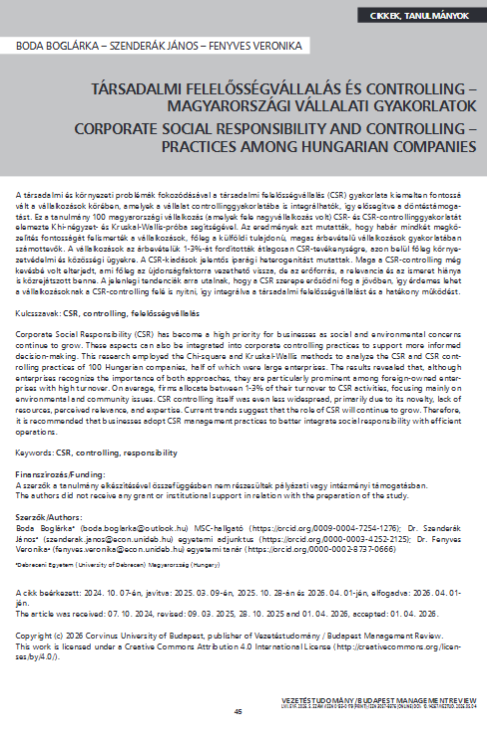
Corporate social responsibility and controlling
Practices among Hungarian companies
DOI:
https://doi.org/10.14267/VEZTUD.2026.05.04Keywords:
CSR, controlling, responsibilityAbstract
Corporate Social Responsibility (CSR) has become a high priority for businesses as social and environmental concerns continue to grow. These aspects can also be integrated into corporate controlling practices to support more informed decision-making. This research employed the Chi-square and Kruskal-Wallis methods to analyze the CSR and CSR controlling practices of 100 Hungarian companies, half of which were large enterprises. The results revealed that, although enterprises recognize the importance of both approaches, they are particularly prominent among foreign-owned enterprises with high turnover. On average, firms allocate between 1-3% of their turnover to CSR activities, focusing mainly on environmental and community issues. CSR controlling itself was even less widespread, primarily due to its novelty, lack of resources, perceived relevance, and expertise. Current trends suggest that the role of CSR will continue to grow. Therefore, it is recommended that businesses adopt CSR management practices to better integrate social responsibility with efficient operations.
Downloads
References
Adams, C.A., & Frost, G.R. (2008). Integrating sustainability reporting into management practices. Accounting Forum, 32(4), 288-302. https://doi.org/10.1016/j.accfor.2008.05.002
Biró, K., & Szalmáné Csete, M. (2021). Corporate social responsibility in agribusiness: climate-related empirical findings from Hungary. Environment, Development and Sustainability, 23(4), 5674-5694. https://doi.org/10.1007/s10668-020-00838-3
Bowen, H.R. (2013). Social Responsibilities of the Businessman. University of Iowa Press. https://doi.org/10.2307/j.ctt20q1w8f
Busch, T., Barnett, M.L., Burritt, R.L., Cashore, B.W., Freeman, R.E., Henriques, I., . . . York, J. (2024). Moving beyond “the” business case: How to make corporate sustainability work. Business Strategy and the Environment, 33(2), 776-787. https://doi.org/https://doi.org/10.1002/bse.3514
Carroll, A.B. (1991). The pyramid of corporate social responsibility: Toward the moral management of organizational stakeholders. Business Horizons, 34(4), 39-48. https://doi.org/https://doi.org/10.1016/0007-6813(91)90005-G
Carroll, A.B. (2016). Carroll’s pyramid of CSR: taking another look. International Journal of Corporate Social Responsibility, 1(1), 3. https://doi.org/10.1186/s40991-016-0004-6
Cho, S.J., Chung, C.Y., & Young, J. (2019). Study on the Relationship between CSR and Financial Performance. Sustainability, 11(2), 343. https://www.mdpi.com/2071-1050/11/2/343
Deutsch, N., & Pintér, É. (2018). A társadalmi felelősségvállalás és a pénzügyi teljesítmény közötti kapcsolat a magyar bankszektorban a globális válságot követő években. Hitelintézeti Szemle/Financial and Economic Review, 17(2), 124-145. http://doi.org/10.25201/HSZ.17.2.124145
Dunn, O.J. (1964). Multiple Comparisons Using Rank Sums. Technometrics, 6(3), 241-252. https://doi.org/10.2307/1266041
Endrikat, J., Guenther, E., & Hoppe, H. (2014). Making sense of conflicting empirical findings: A meta-analytic review of the relationship between corporate environmental and financial performance. European Management Journal, 32(5), 735-751. https://doi.org/10.1016/j.emj.2013.12.004
European Commission. (2001). Green Paper – Promoting a European framework for Corporate Social Responsibility. Brussels, COM (2001) 366 E. Commission. https://eur-lex.europa.eu/LexUriServ/LexUriServ.do?uri=COM:2001:0366:FIN:en:PDF
Fain, M. (2020). A vállalati társadalmi teljesítmény rövid távú hatásai a pénzügyi jövedelmezőségre. Köz-gazdaság, 15(2), 163-179. https://doi.org/10.14267/RETP2020.02.20
Fekete-Berzsenyi, H., Bosnyák-Simon, N., & Molnár, T. (2024). Current and expected level of development of environmental strategies: A survey of Hungarian companies. Vezetéstudomány/Budapest Management Review, 55(10), 19-32. https://doi.org/10.14267/VEZTUD.2024.10.02
Fekete-Berzsenyi, H., & Kozma, D.E. (2023). Green Controlling methods in Hungarian corporate practices. In J. Dyczkowska (Ed.), Sustainable performance in business organisations and institutions: Measurements, reporting and management (pp. 229-243). Publishing House of Wroclaw University of Economics and Business. https://doi.org/10.15611/2023.83.1
Field, A. (2013). Discovering statistics using IBM SPSS statistics. SAGE Publications Ltd
Görgényi-Hegyes, É., Nathan, R.J., & Fekete-Farkas, M. (2021). Workplace Health Promotion, Employee Wellbeing and Loyalty during Covid-19 Pandemic—Large Scale Empirical Evidence from Hungary. Economies, 9(2), 55. https://www.mdpi.com/2227-7099/9/2/55
Günther, E., Endrikat, J., & Günther, T. (2016). CSR im Controlling. In E. Günther & K.H. Steinke (Eds.), CSR und Controlling: Unternehmerische Verantwortung als Gestaltungsaufgabe des Controlling (pp. 3-21). Springer Berlin Heidelberg. https://doi.org/10.1007/978-3-662-47702-1_1
Győri, Z., Madarasiné Szirmai, A., Csillag, S., & Bánhegyi, M. (2021). Corporate Social Responsibility in Hungary: The Current State of CSR in Hungary. In Current Global Practices of Corporate Social Responsibility: In the Era of Sustainable Development Goals (pp. 193-211). Springer.
Harangozó, G. (2025). A környezeti motivációk, a környezeti teljesítmény és a versenyképesség láncolata: Egy PLS-SEM alapú megközelítés a hazai vállalatok körében. Statisztikai Szemle, 103(10), 954-979. https://doi.org/10.20311/stat2025.10.hu0954
Horváth, P. (2018). „Green“ Controlling - Umweltorientierung in der Unternehmenssteuerung. In P. Velte, S. Müller, S.C. Weber, R. Sassen, & A. Mammen (Eds.), Rechnungslegung, Steuern, Corporate Governance, Wirtschaftsprüfung und Controlling: Beiträge aus Wissenschaft und Praxis (pp. 611-621). Springer Fachmedien Wiesbaden. https://doi.org/10.1007/978-3-658-21634-4_35
Horváth, P., & Berlin, S. (2016). Green-Controlling- Roadmap – Ansätze in der Unternehmenspraxis. In E. Günther & K.-H. Steinke (Eds.), CSR und Controlling: Unternehmerische Verantwortung als Gestaltungsaufgabe des Controlling (pp. 23-39). Springer Berlin Heidelberg. https://doi.org/10.1007/978-3-662-47702-1_2
ISO. (2010). Guidance on social responsibility In ISO 26000:2010(E) (pp. 14). Switzerland.
Kiessling, T., Isaksson, L., & Yasar, B. (2016). Market Orientation and CSR: Performance Implications. Journal of Business Ethics, 137(2), 269-284. https://doi.org/10.1007/s10551-015-2555-y
Kruskal, W.H., & Wallis, W.A. (1952). Use of Ranks in One-Criterion Variance Analysis. Journal of the American Statistical Association, 47(260), 583-621. https://doi.org/10.2307/2280779
Kuttner, M. (2022). Corporate Social Responsibility-Controlling: Eine instrumentelle Perspektive. In B. Feldbauer- Durstmüller & S. Mayr (Eds.), Controlling – Aktuelle Entwicklungen und Herausforderungen: Digitalisierung, Nachhaltigkeit und Spezialaspekte (pp. 221-233). Springer Fachmedien Wiesbaden. https://doi.org/10.1007/978-3-658-35169-4_12
Malik, M. (2015). Value-Enhancing Capabilities of CSR: A Brief Review of Contemporary Literature. Journal of Business Ethics, 127(2), 419-438. https://doi.org/10.1007/s10551-014-2051-9
Marolt, M., Pucihar, A., Kljajić Borštnar, M., Lenart, G., Vidmar, D., Szabó, I., . . . Szabó, Z. (2024). Impact of COVID-19 pandemic on SMEs digital transformation journey–Slovenian and Hungarian experiences. Vezetéstudomány/ Budapest Management Review, 55(11), 29-40. https://doi.org/10.14267/VEZTUD.2024.11.03
Mayr, S. (2016). Strategische Perspektive bei der Integration der CSR in das Controlling unter besonderer Berücksichtigung von KMU. In E. Günther & K.-H. Steinke (Eds.), CSR und Controlling: Unternehmerische Verantwortung als Gestaltungsaufgabe des Controlling (pp. 117-131). Springer Berlin Heidelberg. https://doi.org/10.1007/978-3-662-47702-1_8
Mayr, S., & Ausweger, M. (2013). CSR-Strategien mittels CSR-Scorecard erfolgreich umsetzen. Controlling & Management Review, 57(4), 36-44. https://doi.org/10.1365/s12176-013-0779-1
Metzker, Z., & Suler, P. (2022). CSR conception and its prospective implementation in the SMEs business of Visegrad countries. Transformations in Business & Economics, 21(1) 55, 274-289. https://www.researchgate.net/publication/359399601_CSR_Conception_and_its_Prospective_Implementation_in_the_SMEs_Business_of_Visegrad_Countries
Pataki, G., Szántó, R., & Matolay, R. (2015). CSR Online and in Real Terms: A Critical Analysis of Controversial Sectors in Hungary. In Corporate Social Responsibility in the Digital Age (Vol. 7, pp. 241-264). Emerald Group Publishing Limited. https://doi.org/10.1108/S2043-052320150000007019
Reisinger, A. (2023). Challenges in the CSR–Competitiveness Relationship Based on the Literature. Financial and Economic Review, 22(1), 104-125. https://en-hitelintezetiszemle.mnb.hu/letoltes/fer-22-1-st4-reisinger.pdf
Reizingerné Ducsai, A., & Hajdu, T.Z. (2024). Pénzügyi teljesítmény és fenntarthatóság: az ESG-minősítés hatása a társaságok számviteli értékelésére. Magyar Tudomány, 185(2), 171-183. https://doi.org/10.1556/2065.185.2024.2.2
Saáry, R., & Csiszárik-Kocsir, Á. (2021). A biztonsághoz köthető vállalati felelősségvállalás vizsgálata. Polgári Szemle, 17(4-6), 182-200. https://real.mtak.hu/138183/1/psz_2021._1-4.szam_13.pdf
Schaltegger, S., & Synnestvedt, T. (2002). The link between ‘green’ and economic success: environmental management as the crucial trigger between environmental and economic performance. Journal of Environmental Management, 65(4), 339-346. https://doi.org/10.1006/jema.2002.0555
Sheehy, B. (2015). Defining CSR: Problems and Solutions. Journal of Business Ethics, 131(3), 625-648. https://doi.org/10.1007/s10551-014-2281-x
Surman, V., & Böcskei, E. (2023). Sustainability in the Hungarian small and medium-sized enterprise sector. Vezetéstudomány/ Budapest Management Review, 54(10), 15-28. https://doi.org/10.14267/VEZTUD.2023.10.02
Takács, A. (2024). Empirikus bizonyítékok a vállalatok társadalmi felelősségvállalásának pozitív befektetői és fogyasztói megítélésére. Statisztikai Szemle, 102(9), 879-895.
Velte, P. (2022). Meta-analyses on Corporate Social Responsibility (CSR): a literature review. Management Review Quarterly, 72(3), 627-675. https://doi.org/10.1007/s11301-021-00211-2
Vishwanathan, P., van Oosterhout, H., Heugens, P.P.M.A.R., Duran, P., & van Essen, M. (2020). Strategic CSR: A Concept Building Meta-Analysis. Journal of Management Studies, 57(2), 314-350. https://doi.org/10.1111/joms.12514
Wagenhofer, A. (2024). Sustainability Reporting: A Financial Reporting Perspective. Accounting in Europe, 21(1), 1-13. https://doi.org/10.1080/17449480.2023.2218398
Downloads
Published
Issue
Section
License
Copyright (c) 2026 Corvinus University of Budapest, publisher of Vezetéstudomány / Budapest Management Review

This work is licensed under a Creative Commons Attribution 4.0 International License.
Authors assign copyright to Vezetéstudomány / Budapest Management Review. Authors are responsible for permission to reproduce copyright material from other sources.
How to Cite