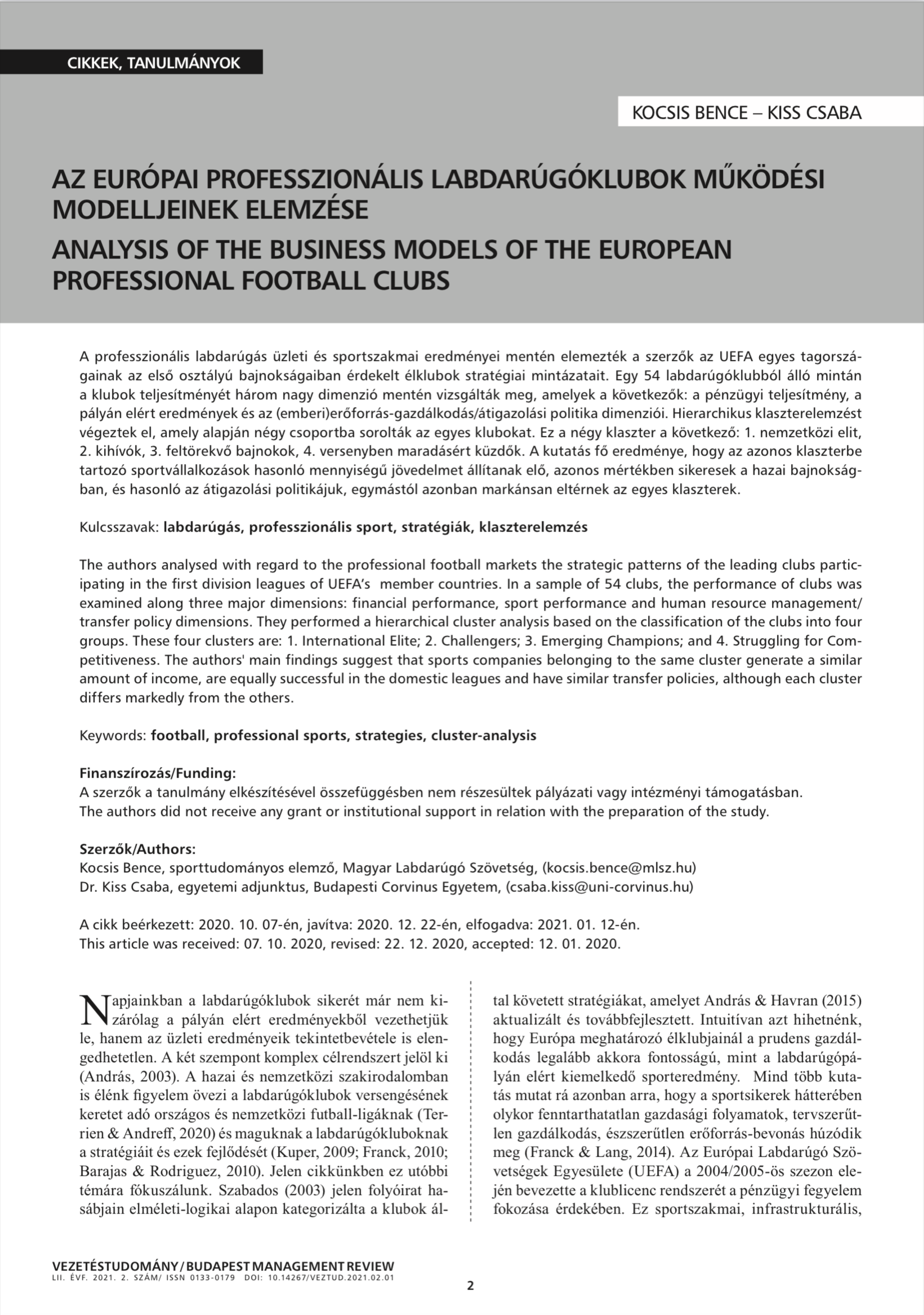
Az európai professzionális labdarúgóklubok működési modelljeinek elemzése
DOI:
https://doi.org/10.14267/VEZTUD.2021.02.01Kulcsszavak:
labdarúgás, professzionális sport, stratégiák, klaszterelemzésAbsztrakt
A professzionális labdarúgás üzleti és sportszakmai eredményei mentén elemezték a szerzők az UEFA egyes tagországainak az első osztályú bajnokságaiban érdekelt élklubok stratégiai mintázatait. Egy 54 labdarúgóklubból álló mintán a klubok teljesítményét három nagy dimenzió mentén vizsgálták meg, amelyek a következők: a pénzügyi teljesítmény, a pályán elért eredmények és az (emberi)erőforrás-gazdálkodás/átigazolási politika dimenziói. Hierarchikus klaszterelemzést végeztek el, amely alapján négy csoportba sorolták az egyes klubokat. Ez a négy klaszter a következő: 1. nemzetközi elit, 2. kihívók, 3. feltörekvő bajnokok, 4. versenyben maradásért küzdők. A kutatás fő eredménye, hogy az azonos klaszterbe tartozó sportvállalkozások hasonló mennyiségű jövedelmet állítanak elő, azonos mértékben sikeresek a hazai bajnokságban, és hasonló az átigazolási politikájuk, egymástól azonban markánsan eltérnek az egyes klaszterek.
Downloads
Hivatkozások
Alaminos, D., & Fernández, M. Á. (2019). Why do football clubs fail financially? A financial distress prediction model for European professional football industry. PLoS One, 14(12), e0225989. https://doi.org/10.1371/journal.pone.0225989
András, K. (2003). Üzleti elemek a sportban, a labdarúgás példáján (PhD-értekezés). Budapest: Budapesti Közgazdaságtudományi és Államigazgatási Egyetem, Gazdálkodástani PhDprogram.
András, K., & Havran, Z. (2015). New Business Strategies of Football Clubs. Applied Studies in Agribusiness and Commerce, 9(1-2), 67-74. https://doi.org/10.19041/APSTRACT/2015/1-2/13
András, K., & Havran, Z. (2016). Examination of Central and Eastern European Professional Football Clubs’ Sport Success, Financial Position and Business Strategy in International Environment. In P. Trapczynski, L. Puslecki, & M. Jarosinski (eds.), Competitiveness of CEE Economies and Businesses (pp. 197-211). Cham, Switzerland: Springer International Publishing.
Barajas, A., & Rodriguez, P. (2010). Spanish Football Clubs Finances: Crisis and Player Salaries. International Journal of Sport Finance, 5(1), 52-66.
Franck, E. (2010). Private firm, public corporation or member’s association – Governance structures in European football. International Journal of Sport Finance, 5(2), 108-127. https://doi.org/10.5167/uzh-35150
Franck, E. (2014). Financial fair play in European club football – what is it all about? (UZH Business Working Paper, (328). kiad.). Zürich, Switzerland: University of Zurich, Department of Business Administration. https://doi.org/10.2139/ssrn.2284615
Franck, E., & Lang, M. (2014). A theoretical analysis of the influence of money injections on risk taking in football clubs. Scottish Journal of Political Economy, 61(4), 430-454. https://doi.org/10.1111/sjpe.12052
Garcia-del-Barrio, P., & Rossi, G. (2020). How the UEFA Financial Fair Play regulations affect to football clubs’ priorities and leagues’ competitive balance? European Journal of Government and Economics, 9(2), 119-142. https://doi.org/10.17979/ejge.2020.9.2.5842
Grossmann, M. (2015). Evolutionarily stable strategies in sports contests. Journal of Sports Economics, 16(1), 108-121. https://doi.org/10.1177/1527002512470957
Kuper, S. (2009). Football Abandons the Fantasy that it Is a Business. Retrieved from https://www.ft.com/ content/fd77a01c-aa07-11de-a3ce-00144feabdc0
Lang, M., Grossmann, M., & Theiler, P. (2011). The sugar daddy game: how wealthy investors change competition in professional team sports. Journal of Institutional and Theoretical Economics, 167(4), 557-577. https://doi.org/10.2139/ssrn.1606043
Peeters, T., & Szymanski, S. (2014). Financial fair play in European football. Economic Policy, 29(78), 343-390. https://doi.org/10.1111/1468-0327.12031
Reich , B., & Szabados, G. (2000). Játékostranszferek Európában. Budapest: Vállalatgazdasági Tudományos és Oktatási Alapítvány.
Rohde, M., & Breuer, C. (2016). The financial impact of (foreign) private investors on team investments and profits in professional football: Empirical evidence from the premier league. Applied Economics and Finance, 3(2), 243-255. https://doi.org/10.11114/aef.v3i2.1366
Rohde, M., & Breuer, C. (2017). The market for football club investors: a review of theory and empirical evidence from professional European football. European Sport Management Quarterly, 17(3), 265-289. https://doi.org/10.1080/16184742.2017.1279203
Schubert, M., & Hamil, S. (2018). Financial Doping and Financial Fair Play in European Club Football Competitions. In M. Breuer, & D. Forrest (eds.), The Palgrave Handbook on the Economics of Manipulation in Sport (Vol. 10) (pp. 135-157). Cham, Switzerland: Palgrave Macmillan.
Sener, İ., & Karapolatgil, A. A. (2015). Rules of the game: Strategy in football industry. Procedia-Social and Behavioral Sciences, 207, 10-19. https://doi.org/10.1016/j.sbspro.2015.10.143
Storm, R. K., & Nielsen, K. (2012). Soft budget constraints in professional football. Sport Management Quarterly, 12(2), 183-201. https://doi.org/10.1080/16184742.2012.670660
Szabados, G. (2003). Labdarúgóklubok stratégiái. Vezetéstudomány, 34(9), 32-42.
Terrien, M., & Andreff, W. (2020). Organisational efficiency of national football leagues in Europe. European Sport Management Quarterly, 20(2), 205224. https://doi.org/10.1080/16184742.2019.1598455
Union of European Football Associations. (2018). Club Licensing and Financial Fair Play Regulations. Retrieved from https://documents.uefa.com/viewer/document/MFxeqLNKelkYyh5JSafuhg
Union of European Football Associations. (2018). Club Licensing Benchmarking Report. Retrieved from https://www.uefa.com/MultimediaFiles/Download/ OfficialDocument/uefaorg/Clubl icensing/02/53/00/22/ 2530022_DOWNLOAD.pdf
Union of European Football Associations. (2019a). Club Licensing Benchmarking Report. Retrieved from https://www.uefa.com/insideuefa/protecting-thegame/club-licensing-and-financial-fair-play/news/ newsid=2589785.html
Union of European Football Associations. (2019b). Club Ranking. Retrieved from https://www.uefa. com/memberassociations/uefarankings/index. html
Wilson, R., Ramchandani, G., & Plumley, D. (2018). Parachute payments in English football: Softening the landing or distorting the balance? Journal of Global Sport Management, 3(4), 351-368. https://doi.org/10.1080/24704067.2018.1441740
Letöltések
Megjelent
Folyóirat szám
Rovat
License
Copyright (c) 2021 Vezetéstudomány / Budapest Management Review

This work is licensed under a Creative Commons Attribution 4.0 International License.
Authors assign copyright to Vezetéstudomány / Budapest Management Review. Authors are responsible for permission to reproduce copyright material from other sources.
Hogyan kell idézni