A machiavellizmus munkahelyi jelenléte
DOI:
https://doi.org/10.14267/VEZTUD.2026.06.01Kulcsszavak:
machiavellizmus, MPS, vezetői beosztás, életkor, nem, regresszióanalízisAbsztrakt
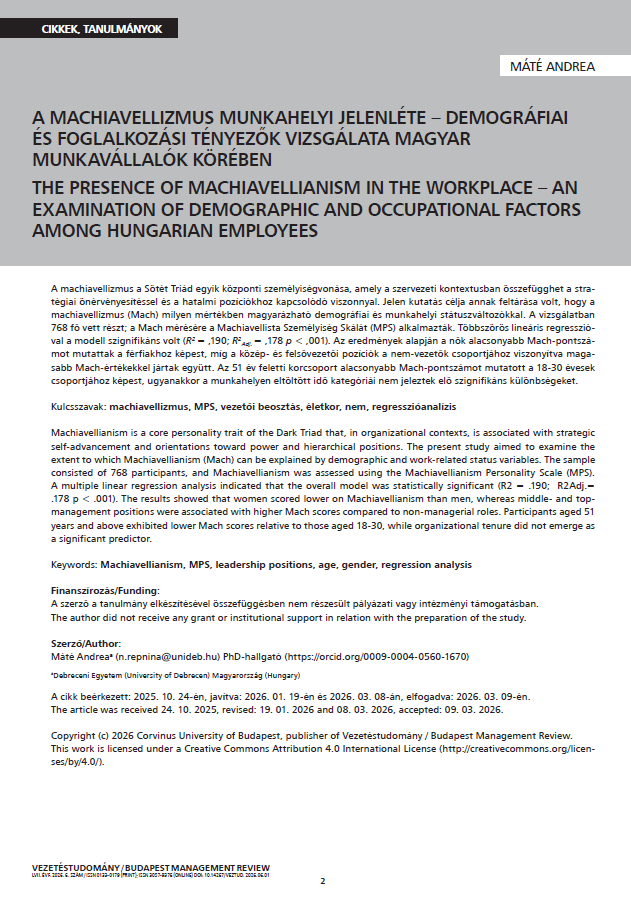
A machiavellizmus a Sötét Triád egyik központi személyiségvonása, amely a szervezeti kontextusban összefügghet a stratégiai önérvényesítéssel és a hatalmi pozíciókhoz kapcsolódó viszonnyal. Jelen kutatás célja annak feltárása volt, hogy a machiavellizmus (Mach) milyen mértékben magyarázható demográfiai és munkahelyi státuszváltozókkal. A vizsgálatban 768 fő vett részt; a Mach mérésére a Machiavellista Személyiség Skálát (MPS) alkalmazták. Többszörös lineáris regresszióval a modell szignifikáns volt (R2 = ,190; R2 Adj. = ,178 p < ,001). Az eredmények alapján a nők alacsonyabb Mach-pontszámot mutattak a férfiakhoz képest, míg a közép- és felsővezetői pozíciók a nem-vezetők csoportjához viszonyítva magasabb Mach-értékekkel jártak együtt. Az 51 év feletti korcsoport alacsonyabb Mach-pontszámot mutatott a 18-30 évesek csoportjához képest, ugyanakkor a munkahelyen eltöltött idő kategóriái nem jeleztek elő szignifikáns különbségeket.
Downloads
Hivatkozások
Aksu, N., Çoban, M.S., & Gümüş. A. (2025). Banka çalişanlarinin karanlik üçlü kişilik özelliklerinin demografik değişkenler açisindan gösterdiği farkliliklarin incelenmesi. Dicle Akademi Dergisi, 5(1) 38–58. https://doi.org/10.61964/dade.1619043.
Amir, T.S. & Malik, A.A. (2016). Machiavellianism and counterproductive behaviors at workplace. Journal of Education & Social Sciences, 4(1), 12–27. https://doi.org/10.20547/jess0411604102
Aydoğan, E., & Serbest, S. (2016). İş yerinde karanlık üçlü: bir kamu kuruluşunun iç denetim biriminde araştırma. Sayıştay dergisi, (101), 97–121. https://dergipark.org.tr/en/download/article-file/1713969#page=104
Baktash, M. & Jirjahn, U. (2023). Are Managers More Machiavellian than Other Employees? IZA Discussion Papers 16361, Institute of Labor Economics (IZA). https://doi.org/10.2139/ssrn.4538025
Bratton, V.K., & Kacmar, K.M. (2004). Extreme careerism: The dark side of impression management. In R.W. Griffin & A.M. OfLeary-Kelly (Eds.) The dark side of organizational behavior (pp. 291-308). Jossey-Bass.
Cai, H., Wang, L., & Jin, X. (2024). Leaderfs Machiavellianism and employeesf counterproductive work behavior: testing a moderated mediation model. Frontiers in psychology, 14, 1283509. https://doi.org/10.3389/fpsyg.2023.1283509
Christie, R., & Geis, F.L. (1970). Studies in Machiavellianism. Academic Press.
Confino, D., Ghisletta, P., Stoet, G. & Falomir-Pichastor, J.M. (2024). National gender equality and sex differences in Machiavellianism across countries. International Journal of Personality Psychology, 10, 105.115. https://doi.org/10.21827/ijpp.10.41854
Czibor, A., Szabo, Zs.P., & Restas, P. (2019). Sotet vonasok a szervezetekben: tapasztalatok magyar munkavallalok koreben. Replika, (111), 105.117. https://doi.org/10.32564/111.7
Dahling, G.J., Whitaker, B.G., & Levy, P.E. (2009). The development and validation of a new machiavellianism scale. Journal of Management,20(10), 219-257. https://doi.org/10.1177/0149206308318618
De Clercq, D., & Pereira, R. (2024). Perceived organizational politics, organizational disidentification and counterproductive work behaviour: moderating role of external crisis threats to work. International Journal of Organizational Analysis, 32(1), 183.205. https://doi.org/10.1108/IJOA-10-2022-3442
Demirta., O., & Bickes, M. (2014). Makyavelizmfin olumsuz durumlar. if.a etme niyeti uzerindeki etkisi: bir alan cal..mas.. ISGUC The Journal of Industrial Relations and Human Resources 16(2), 98.112. https://doi.org/10.4026/1303-2860.2014.0249.x.
Diller, S.J., Czibor, A., Szabo, Z.P., Restas, P., Jonas, E. & Frey, D. (2021). The positive connection between dark triad traits and leadership levels in self- and other-ratings. Leadership, Education, Personality: An Interdisciplinary Journal, 35(2), 117.131. https://doi.org/10.1365/s42681-021-00025-6
Eagly, A.H., & Karau, S.J. (2002). Role congruity theory of prejudice toward female leaders. Psychological Review, 109(3), 573.598. https://doi.org/10.1037/0033-295X.109.3.573
Ellen, B.P., III, Maher, L.P., Hochwarter, W.A., Ferris, G.R., & Kiewitz, C. (2021). Perceptions of organizational politics: A restricted nonlinearity perspective of its effects on job satisfaction and performance. Applied Psychology, 71(4), 1224.1247. https://doi.org/10.1111/apps.12347
Filiz, M. (2022). Turkiyefde sa.l.k cal..anlar.n.n karanl.k uclu ki.ilik ozelliklerinin Demografik de.i.kenler ac.s.ndan incelenmesi. Eurasian Journal of Health Technology Assessment, 6(1), 1.11. https://doi.org/10.52148/ehta.1079174.
French Jr., J.R.P., & Raven, B.H. (1959). The bases of social power. In D. Cartwright (Ed.), Studies in social power (pp. 150-167). Institute for Social Research. Genau, H.A., Blickle, G., Schutte, N., & Meurs, J.A. (2021). Machiavellian Leader Effectiveness: The Moderating Role of Political Skill. Journal of Personnel Psychology, 21(1), 1.10. https://doi.org/10.1027/1866-5888/a000284
Gotz, F.M., Bleidorn, W., & Rentfrow, P.J. (2020). Age differences in Machiavellianism across the life span: Evidence from a large]scale cross]sectional study. Journal of Personality, 88(5), 978.992. https://doi.org/10.1111/jopy.12545
Greenbaum, R.L., Hill, A., Mawritz, M.B., & Quade, M.J. (2014): Employee Machiavellianism to unethical behavior: The role of abusive supervison as a trait activator. Journal of Management, 20(10), 1.25. https://doi.org/10.1177/0149206314535434
Gruda, D., & McCleskey, J.A. (2024). I keep my mind on my money and my money on my mind: trait Machiavellianism in business majors. Acta Psychologica, 250, 104567. https://doi.org/10.1016/j.actpsy.2024.104567.
Hartung, J., Bader, M., Moshagen, M., & Wilhelm, O. (2021). Age and gender differences in socially aversive (gdarkh) personality traits. European Journal of Personality, 36(1), 3.23. https://doi.org/10.1177/0890207020988435
Jonason, P.K., Wee, S., Li, N.P., & Jackson, C. (2014). Occupational niches and the Dark Triad traits. Personality and Individual Differences, 69, 119.123. https://doi.org/10.1016/j.paid.2014.05.024
Jones, D.N., & Paulhus, D.L. (2009). Machiavellianism. In Leary, M.R., & Hoyle, R.H. (Eds.), Individual differences in social behavior (pp. 93.108).Guilford.
Judge, T.A., & Zapata, C.P. (2015). The person-situation debate revisited: Effect of situation strength and trait activation on the validity of the big five personality traits in predicting job performance. Academy of Management Journal, 58(4), 1149.1170. https://doi.org/10.5465/amj.2010.0837
Kacmar, K.M., & Ferris, G.R. (1991). Perceptions of Organizational Politics Scale (POPS): Development and construct validation. Educational and Psychological Measurement, 51(1), 193.205. https://doi.org/10.1177/0013164491511019
Kawamoto, T., Shimotsukasa, T., & Oshio, A. (2020). Cross-sectional age differences in the Dark Triad traits in two Japanese samples. Psychology and Aging, 35(1), 91.96. https://doi.org/10.1037/pag0000399
Keltner, D., Gruenfeld, D.H., & Anderson, C. (2003). Power, approach, and inhibition. Psychological Review, 110(2), 265.284. https://doi.org/10.1037/0033-295X.110.2.265
Klimstra, T.A., Jeronimus, B.F., Sijtsema, J.J., & Denissen, J.J.A. (2020). The unfolding dark side: Age trends in dark personality features. Journal of Research in Personality, 85, 103915. https://doi.org/10.1016/j.jrp.2020.103915
Kessler, S.R., Bandelli, A.C., Spector, P.E., Borman, W.C., Nelson, C.E., & Penney, L.M. (2010). Re-examining Machiavelli: A three-dimensional model of Machiavellianism in the workplace. Journal of Applied Social Psychology, 40(8), 1868–1896. https://doi.org/10.1111/j.1559-1816.2010.00643.x
Kish-Gephart, J.J., Harrison, D.A., & Treviño, L.K. (2010). Bad apples, bad cases, and bad barrels: Meta- analytic evidence about sources of unethical decisions at work. Journal of Applied Psychology, 95(1), 1–31. https://doi.org/10.1037/a0017103
Kückelhaus, B.P., Meurs, J.A., & Blickle, G. (2024). Resolving the equivocal relationship of Machiavellianism and job performance: A socioanalytic perspective employing reputation, political skill, and five-factor Machiavellianism. Personality and Individual Differences, 228, 112728. https://doi.org/10.1016/j.paid.2024.112728
Machiavelli, N. (2022). A fejedelem. Trubadúr Kiadó. Marbut, A., Harms, P., & Credé, M. (2025). In the Service of the Prince: A Meta-Analytic Review of Machiavellian Leadership. Journal of Organizational Behavior, 46(6), 939–969. https://doi.org/10.1002/job.2877
O’Boyle, E.H., Forsyth, D.R., Banks, G.C., & McDaniel, M.A. (2012). A meta-analysis of the Dark Triad and work behavior: a social exchange perspective. The Journal of Applied Psychology, 97(3), 557–579. https://doi.org/10.1037/a0025679
Özer, Ö., Uğurluoğlu, Ö., Kahraman, G., & Avcı, K. (2016). Hemşirelerin karanlik kişilik özelliklerinin sosyo-demografik değişkenler açisindan incelenmesi. Celal Bayar Üniversitesi Sosyal Bilimler Dergisi, 14(3), 203–216. https://doi.org/10.18026/cbusos.00288.
Paulhus, D.L., & Williams, K.M. (2002). The Dark Triad of Personality: Narcissism, Machiavellianism and Psychopathy. Journal of Research in Personality, 36(6), 556–563. https://doi.org/10.1016/S0092-6566(02)00505-6
Rauthmann, J.F., & Will, T. (2011). Proposing a multidimensional Machiavellianism conceptualization. Social Behavior and Personality: An International Journal, 39(3), 391–404. https://doi.org/10.2224/sbp.2011.39.3.391
Rudman, L.A., & Glick, P. (1999). Feminized management and backlash toward agentic women: The hidden costs to women of a kinder, gentler image of middle managers. Journal of Personality and Social Psychology, 77(5), 1004–1010. https://doi.org/10.1037/0022-3514.77.5.1004
Spain, S.M., Harms, P., & LeBreton, J.M. (2013). The dark side of personality at work. Journal of Organizational Behavior, 35(S1), S41–S60. https://doi.org/10.1002/job.1894
Spurk, D., Keller, A.C., & Hirschi, A. (2016). Do Bad Guys Get Ahead or Fall Behind? Relationships of the Dark Triad of Personality With Objective and Subjective Career Success. Social Psychological and Personality Science, 7(2), 113-121. https://doi.org/10.1177/1948550615609735
Talmácsi, Gy., Orosz, G., Birkás, B., & Bereczkei, T. (2012). A Dahling-féle Machiavellizmus Skála validálása. Alkalmazott Pszichológia, 3, 63–82. http://ap.elte. hu/wp-content/uploads/2013/07/AP_2012_3_Talmacsi_Orosz_Birkas_Bereczkei.pdf
Tekin, Z. (2017). Pazarlama etiğinde Makyavelizm. Journal of International Social Research 10(50), 814–821. https://doi.org/10.17719/jisr.2017.1714
Tett, R.P., & Burnett, D.D. (2003). A personality traitbased interactionist model of job performance. Journal of Applied Psychology, 88(3), 500–517. https://doi.org/10.1037/0021-9010.88.3.500
Tett, R.P., Toich, M.J., & Ozkum, S.B. (2021). Trait activation theory: A review of the literature and applications to five lines of personality dynamics research. Annual Review of Organizational Psychology and Organizational Behavior, 8, 199–233. https://doi.org/10.1146/annurev-orgpsych-012420-062228
Tremmel, M., & Wahl, I. (2023). Gender stereotypes in leadership: Analyzing the content and evaluation of stereotypes about typical, male, and female leaders. Frontiers in Psychology, 14, 1034258. https://doi.org/10.3389/fpsyg.2023.1034258
Triana, M.d.C., Song, R., Um, C.T., & Huang, L. (2024). Stereotypical Perception in Management: A Review and Expansion of Role Congruity Theory. Journal of Management, 50(1), 188–215. https://doi.org/10.1177/01492063231180836
Veríssimo, A.C., Conrado, G.A.M., Barbosa, J., Gomes, S.F., Severo, M., Oliveira, P., & Ribeiro, L. (2022). Machiavellian medical students report more academic misconduct: a cocktail fuelled by psychological and contextual factors. Psychology Research and Behavior Management, 15, 2097–2105. https://doi.org/10.2147/PRBM.S370402
Wolff, C., & Wetzel, E. (2023). The Development of Machiavellianism, Psychopathy, and Narcissism in Young Adulthood. Collabra: Psychology, 3, 9(1), 77870. https://doi.org/10.1525/collabra.77870
Yücel, E. (2020). Kişiliğin karanlık üçlüsü: turizm sektöründe demografik değişkenler açısından bir inceleme. Seyahat ve Otel İşletmeciliği Dergisi, 17(1), 71–86. https://doi.org/10.24010/soid.639924.
Letöltések
Megjelent
Folyóirat szám
Rovat
License
Copyright (c) 2026 Corvinus University of Budapest, publisher of Vezetéstudomány / Budapest Management Review

This work is licensed under a Creative Commons Attribution 4.0 International License.
Authors assign copyright to Vezetéstudomány / Budapest Management Review. Authors are responsible for permission to reproduce copyright material from other sources.
Hogyan kell idézni