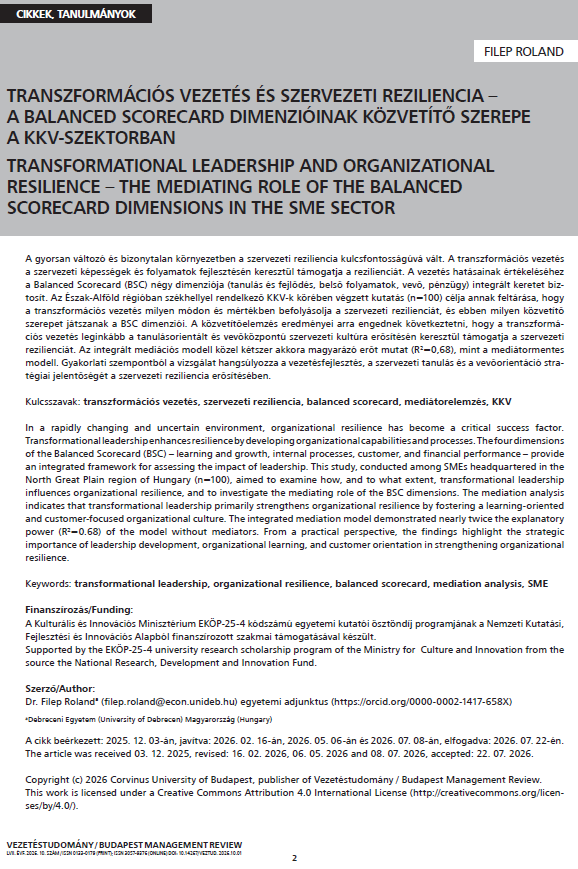
Transzformációs vezetés és szervezeti reziliencia
A balanced scorecard dimenzióinak közvetítő szerepe a KKV-szektorban
DOI:
https://doi.org/10.14267/VEZTUD.2026.10.01Kulcsszavak:
transzformációs vezetés, szervezeti reziliencia, balanced scorecard, mediátorelemzés, KKVAbsztrakt
A gyorsan változó és bizonytalan környezetben a szervezeti reziliencia kulcsfontosságúvá vált. A transzformációs vezetés a szervezeti képességek és folyamatok fejlesztésén keresztül támogatja a rezilienciát. A vezetés hatásainak értékeléséhez a Balanced Scorecard (BSC) négy dimenziója (tanulás és fejlődés, belső folyamatok, vevő, pénzügy) integrált keretet biztosít. Az Észak-Alföld régióban székhellyel rendelkező KKV-k körében végzett kutatás (n=100) célja annak feltárása, hogy a transzformációs vezetés milyen módon és mértékben befolyásolja a szervezeti rezilienciát, és ebben milyen közvetítő szerepet játszanak a BSC dimenziói. A közvetítőelemzés eredményei arra engednek következtetni, hogy a transzformációs vezetés leginkább a tanulásorientált és vevőközpontú szervezeti kultúra erősítésén keresztül támogatja a szervezeti rezilienciát. Az integrált mediációs modell közel kétszer akkora magyarázó erőt mutat (R2=0,68), mint a mediátormentes modell. Gyakorlati szempontból a vizsgálat hangsúlyozza a vezetésfejlesztés, a szervezeti tanulás és a vevőorientáció stratégiai jelentőségét a szervezeti reziliencia erősítésében.
Downloads
Hivatkozások
Ahsan, M.J. (2024). Unlocking sustainable success: exploring the impact of transformational leadership, organizational culture, and CSR performance on financial performance in the Italian manufacturing sector. Social Responsibility Journal, 20(4), 783–803. https://doi.org/10.1108/SRJ-06-2023-0332/FULL/PDF
Anderson, L.B., & Guo, J. (2020). Paradoxical Timelines in Wells Fargo’s Crisis Discourse: Expanding the Discourse of Renewal Theory. International Journal of Business Communication, 57(2), 212–226. https://doi.org/10.1177/2329488419882761
Andersson, T., Cäker, M., Tengblad, S., & Wickelgren, M. (2019). Building traits for organizational resilience through balancing organizational structures. Scandinavian Journal of Management, 35(1), 36–45. https://doi.org/10.1016/J.SCAMAN.2019.01.001
Avolio, B.J., & Bass, B.M. (1991). The full range of leadership development: Basic and advanced manuals. Bass, Avolio Associates.
Babbie, E., & Roberts, L.W. (2018). Fundamentals of Social Research. Nelson Education.
Bai, Y. (2025). Transformation Leadership with Knowledge Sharing and Employee Career Growth: The Role of Self-efficacy and Psychological Capital. Frontiers in Psychology, 16, 1624245. https://doi.org/10.3389/FPSYG.2025.1624245
Bai, Y., You, X., & Sun, Y. (2025). Transformational leadership, dual innovation, and organizational resilience. Current Psychology, 44(21), 17455–17473. https://doi.org/10.1007/s12144-025-08478-4
Boisot, M., & Child, J. (1999). Organizations as Adaptive Systems in Complex Environments: The Case of China. Organization Science, 10(3), 237–252. https://doi.org/10.1287/ORSC.10.3.237
Branicki, L.J., Sullivan-Taylor, B., & Livschitz, S.R. (2018). How entrepreneurial resilience generates resilient SMEs. International Journal of Entrepreneurial Behaviour and Research, 24(7), 1244–1263. https://doi.org/10.1108/IJEBR-11-2016-0396
Budur, T., & Poturak, M. (2021). Transformational leadership and its impact on customer satisfaction. Measuring mediating effects of organisational citizenship behaviours. Middle East Journal of Management, 8(1), 67-91. https://doi.org/10.1504/MEJM.2021.111997
Carless, S.A., Wearing, A.J., & Mann, L. (2000). A short measure of transformational leadership. Journal of Business and Psychology, 14(3), 389–405. https://doi.org/10.1023/A:1022991115523
Cavazotte, F., Moreno, V., & Lasmar, L.C.C. (2020). Enabling customer satisfaction in call center teams: the role of transformational leadership in the service-profit chain. The Service Industries Journal, 40(5), 380–393. https://doi.org/10.1080/02642069.2018.1481955
Charoensukmongkol, P., & Pandey, A. (2023). The flexibility of salespeople and management teams: How they interact and influence performance during the COVID-19 pandemic. Asia Pacific Management Review, 28(2), 99–109. https://doi.org/10.1016/J.APMRV.2022.07.001
Chen, W., Zhang, L., Shi, L., Shao, Y., & Zhou, K. (2022). Carbon emissions trading system and investment efficiency: Evidence from China. Journal of Cleaner Production, 358, 131782. https://doi.org/10.1016/J.JCLEPRO.2022.131782
Czucka-Varga, V. (2025a). A vezetési stílus hatása a KKV-k teljesítményére. Vezetéstudomány, 56(10), 31–46. https://doi.org/10.14267/VEZTUD.2025.10.03
Czucka-Varga, V. (2025b). A vezető innovációs képességének hatása a vállalkozás teljesítményére. Tér-Gazdaság- Ember/Journal of Region, Economy and Society, 13(2), 5–17. https://doi.org/10.14513/TGE-JRES.00445
Dajnoki, K., & Héder, M. (2017). „Új szelek fújnak” – a HR válasza a globalizáció és a változás kihívásaira. Hadtudomány: A Magyar Hadtudományi Társaság Folyóirata, 27(E-szám), 84–93. https://doi.org/10.17047/HADTUD.2017.27.E.84
Darnai, B., Kotsis, Á., & Dajnoki, K. (2025). Ezüstlakodalom vagy válás: Hogy áll a Balanced Scorecard és a megújult EFQM 2020 modell kapcsolata. Új Munkaügyi Szemle, 6(2), 2-16. https://doi.org/10.58269/umsz.2025.2.1
Fang, S. (Echo), Prayag, G., Ozanne, L.K., & de Vries, H. (2020). Psychological capital, coping mechanisms and organizational resilience: Insights from the 2016 Kaikoura earthquake, New Zealand. Tourism Management Perspectives, 34, 100637. https://doi.org/10.1016/J.TMP.2020.100637
Fehér, J. (2010). Kortárs személyes vezetési elméletek. Vezetéstudomány, 41(3), 2–13. https://doi.org/10.14267/VEZTUD.2010.03.01
Flores-Hernández, A., Olavarría-Jaraba, A., Valera-Blanes, G., & Vázquez-Carrasco, R. (2020). Sustainability and Branding in Retail: A Model of Chain of Effects. Sustainability, 12(14), 5800. https://doi.org/10.3390/SU12145800
Freeman, S.F. (2004). Beyond Traditional Systems Thinking: Resilience as a Strategy for Security and Sustainability. University of Pennsylvania. http://cpor.org/rt/BeyondTraditionalSysThinking-ResilienceForSafety,Sustainability.pdf
García-Morales, V.J., Jiménez-Barrionuevo, M.M., & Gutiérrez-Gutiérrez, L. (2012). Transformational leadership influence on organizational performance through organizational learning and innovation. Journal of Business Research, 65(7), 1040–1050. https://doi.org/10.1016/J.JBUSRES.2011.03.005
Ghemawat, P., & Del Sol, P. (1998). Commitment versus flexibility? California Management Review, 40(4), 26–42. https://doi.org/10.2307/41165963
Gittell, J.H., Cameron, K., Lim, S., & Rivas, V. (2006). Relationships, Layoffs, and Organizational Resilience. The Journal of Applied Behavioral Science, 42(3), 300–329. https://doi.org/10.1177/0021886306286466
Gover, L., & Duxbury, L. (2018). Inside the Onion: Understanding What Enhances and Inhibits Organizational Resilience. The Journal of Applied Behavioral Science, 54(4), 477–501. https://doi.org/10.1177/0021886318797597
Gumusluoglu, L., & Ilsev, A. (2009). Transformational leadership, creativity, and organizational innovation. Journal of Business Research, 62(4), 461–473. https://doi.org/10.1016/J.JBUSRES.2007.07.032
Hair, J.F., Black, W.C., Babin, B.J., & Anderson, R.E. (2014). Multivariate Data Analysis (7th Edition). Pearson.
Hasija, K.G., Hyde, A.M., & Kushwaha, V.S. (2019). A Study of Inspirational Motivation by Leader on Employee Engagement. International Bulletin of Management and Economics, 11(September), 109–119.
Hayes, A.F. (2018). Introduction to mediation – A regression based approach. Guilford Publications.
Herbane, B. (2019). Rethinking organizational resilience and strategic renewal in SMEs. Entrepreneurship & Regional Development, 31(5–6), 476–495. https://doi.org/10.1080/08985626.2018.1541594
Islam, M.R., Prieto, L., & Talukder, M.F. (2025). From Influence to Impact: How Transformational Leadership Shapes Employee Behavior Through Psychological Activation. Administrative Sciences, 15(9), 344. https://doi.org/10.3390/admsci15090344
Ismail, H.S., Poolton, J., & Sharifi, H. (2011). The Role of Agile Strategic Capabilities in Achieving Resilience in Manufacturing-based Small Companies. International Journal of Production Research, 49(18), 5469–5487. https://doi.org/10.1080/00207543.2011.563833
ISO. (2017). Security and resilience - Organizational resilience - Principles and attributes. https://www.iso.org/obp/ui/#iso:std:iso:22316:ed-1:v1:en
Kaplan, R.S. (2010). Conceptual Foundations of the Balanced Scorecard. In C.S. Chapman, A.G. Hopwood, & M.D. Shields (Eds.), Handbooks of Management Accounting Research vol.3 (pp. 1253–1269). Elsevier.
Kaplan, R.S., & Norton, D.P. (1996). Translating Strategy into Action – The Balanced Scorecard. Harvard Business Review Press.
Karman, A. (2020). An examination of factors influencing the application of mechanisms of organizations’ resilience to weather extremes. Business Strategy and the Environment, 29(1), 276–290. https://doi.org/10.1002/BSE.2364
Keller, S., & Price, C. (2015). Beyond Performance: How Great Organizations Build Ultimate Competitive Advantage . Wiley. https://doi.org/10.1002/9781119202455
Keshavarznia, H., Wallace, M., Keshavarznia, H., & Wallace, M. (2023). Applying the Balanced Scorecard and the Delphi Method to Determine the Key Performance Factors for the Banking Industry in Iran. Open Journal of Business and Management, 11(3), 821–838. https://doi.org/10.4236/OJBM.2023.113044
Khan, H., Ozkan, K.S.L., Deligonul, S., & Cavusgil, E. (2024). Redefining the organizational resilience construct using a frame based methodology: A new perspective from the ecology based approach. Journal of Business Research, 172, 114397. https://doi.org/10.1016/J.JBUSRES.2023.114397
Khin Khin Oo, N.C., & Rakthin, S. (2025). Knowledge- oriented leadership and organizational resilience in SMEs during a crisis: The mediation role of innovation quality. Journal of Innovation & Knowledge, 10(5), 100775. https://doi.org/10.1016/J.JIK.2025.100775
Kim, E.J., & Park, S. (2020). Transformational leadership, knowledge sharing, organizational climate and learning: an empirical study. Leadership & Organization Development Journal, 41(6), 761–775. https://doi.org/10.1108/LODJ-12-2018-0455
Kotter, J.P. (1996). Leading change. Harvard Business School Press.
Labaka, L., Hernantes, J., & Sarriegi, J.M. (2016). A holistic framework for building critical infrastructure resilience. Technological Forecasting and Social Change, 103, 21–33. https://doi.org/10.1016/J.TECHFORE.2015.11.005
Langat, G.K., Linge, T.K., & Sikalieh, D. (2019). Influence of idealized influence on employee job performance in the insurance industry in Kenya. International Journal of Research in Business and Social Science, 8(5), 266–273. https://doi.org/10.20525/IJRBS.V8I5.486
Linnenluecke, M., & Griffiths, A. (2010). Beyond Adaptation: Resilience for Business in Light of Climate Change and Weather Extremes. Business & Society, 49(3), 477–511. https://doi.org/10.1177/0007650310368814
Maswanto, Husainah, N., & Risyadi, I.I. (2024). The Effects of Organizational Culture and Transformational Leadership on Worker Performance at the Lebak Regency Ministry of Religious Affairs Office with Job Satisfaction as an Intervening Variable. European Journal of Business and Management Research, 9(4), 15–22. https://doi.org/10.24018/EJBMR.2024.9.4.2213
McManus, S., Seville, E., Vargo, J., & Brunsdon, D. (2008). Facilitated Process for Improving Organizational Resilience. Natural Hazards Review, 9(2), 81–90. https://doi.org/10.1061/(ASCE)1527-6988(2008)9:2(81)
Morkevičiūtė, M., Endriulaitienė, A., & Jočienė, E. (2019). Do dimensions of transformational leadership have an effect on workaholism? Baltic Journal of Management, 14(2), 312–329. https://doi.org/10.1108/BJM-06-2018-0240
Ngwiri, B.K., Ciriaka, G., & Mule, P.W. (2025). The Influence of Individualized Consideration on the Institutional Performance of Tvet Colleges in the Nairobi Metropolis, Kenya. Strategic Journal of Business & Change Management, 12(2). https://doi.org/10.61426/SJBCM.V12I2.3278
Northouse, P.G. (2001). Leadership. Theory and Practice, Second Edition. Sage Publications.
Northouse, P.G. (2018). Leadership (8th Edition). Sage Publications.
Pal, R., Torstensson, H., & Mattila, H. (2014). Antecedents of organizational resilience in economic crises—an empirical study of Swedish textile and clothing SMEs. International Journal of Production Economics, 147(PART B), 410–428. https://doi.org/10.1016/J.IJPE.2013.02.031
Pelyák, L. (2025). Regionális eltérések a munkahelyi motiváció megítélésében. Régiókutatás Szemle, 9(2), 35–46. https://doi.org/10.30716/RSZ/24/2/4
Roscoe, J.T. (1975). Fundamental research statistics for the behavioural sciences. Holt, Rinehart and Winston. Schoorman, F.D., Mayer, R.C., & Davis, J.H. (2007). An integrative model of organizational trust: Past, present, and future. Academy of Management Review, 32(2), 344–354). https://doi.org/10.5465/AMR.2007.24348410
Sharma, R., Prajapati, B., & Khanal, K. (2025). Leadership Style and Resilience: Mediating Role of Learning Culture in Nepalese Organizations. Interdisciplinary Journal of Innovation in Nepalese Academia, 4(1), 110–134. https://doi.org/10.32674/87XPEN10
Sheffi, Y. (2007). The Resilient Enterprise. MIT Press. Son, T.T., Phong, L.B., & Loan, B.T.T. (2020). Transformational Leadership and Knowledge Sharing: Determinants of Firm’s Operational and Financial Performance. SAGE Open, 10(2). https://doi.org/10.1177/2158244020927426;ISSUE:ISSUE:DOI
Sullivan-Taylor, B., & Branicki, L. (2011). Creating resilient SMEs: Why one size might not fit all. International Journal of Production Research, 49(18), 5565–5579. https://doi.org/10.1080/00207543.2011.563837
Sutcliffe, K.M., & Vogus, T. (2003). Organising for resilience. In K.S. Cameron; J.E Dutton; & R.E Quinn (Eds.), Positive Organisational Scholarship: Foundations of a New Discipline (pp. 94–110). Berrett- Koehler.
Szintay, I. (1995). Tendenciák az átalakító vezetés eszközrendszerében. Publications of the University of Miskolc, Series F Economic Sciences, 2, 5–21.
Teoh, B.E.W., Wider, W., Saad, A., Sam, T.H., Vasudevan, A., & Lajuma, S. (2022). The effects of transformational leadership dimensions on employee performance in the hospitality industry in Malaysia. Frontiers in Psychology, 13, 913773. https://doi.org/10.3389/FPSYG.2022.913773/BIBTEX
Vakilzadeh, K., & Haase, A. (2021). The building blocks of organizational resilience: a review of the empirical literature. Continuity & Resilience Review, 3(1), 1–21. https://doi.org/10.1108/CRR-04-2020-0002
Véghné, M.V., & Barizsné, H.E. (2024). Munkafüggőség kutatása a menedzsment területén. Jelenkori Társadalmi és Gazdasági Folyamatok, 19(3–4), 47–62. https://doi.org/10.14232/JTGF.2024.3-4.47-62
Veresné, S.M. (2013). Teljesítményalapú szervezetátalakítás elmélete és módszertana. Miskolci Egyetemi Kiadó.
Vossen, R.W. (1998). Relative Strengths and Weaknesses of Small Firms in Innovation. International Small Business Journal, 16(3), 88–94. https://doi.org/10.1177/0266242698163005
Weick, K., Sutcliffe, K., & Obstfeld, D. (1999). Organizing for high reliability: Processes of collective mindfulness. JAI Press.
Yanamala, P., & Deshpande, A. (2025). Impact of Transformational Leadership Style on Customer Satisfaction During the COVID-19 Pandemic with Organizational Citizenship Behaviour as a Mediator in India’s Pharmaceutical Industry. Journal of the Knowledge Economy, 16(3), 13146–13165. https://doi.org/10.1007/s13132-024-02443-5
Zhao, W., & Huang, L. (2022). The impact of green transformational leadership, green HRM, green innovation and organizational support on the sustainable business performance: evidence from China. Economic Research- Ekonomska Istrazivanja, 35(1), 6121–6141. https://doi.org/10.1080/1331677X.2022.2047086
Letöltések
Megjelent
Folyóirat szám
Rovat
License
Copyright (c) 2026 Corvinus University of Budapest, publisher of Vezetéstudomány / Budapest Management Review

This work is licensed under a Creative Commons Attribution 4.0 International License.
Authors assign copyright to Vezetéstudomány / Budapest Management Review. Authors are responsible for permission to reproduce copyright material from other sources.
Hogyan kell idézni