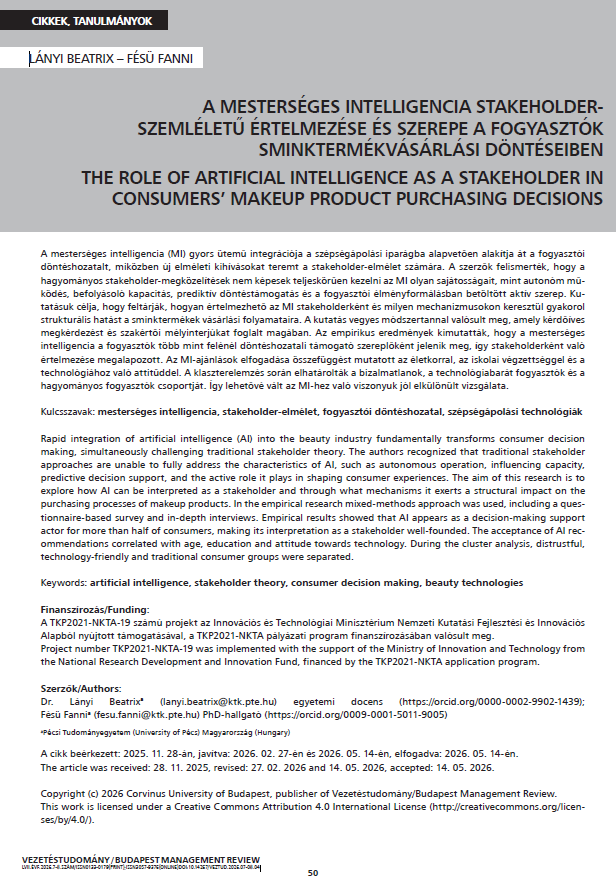
A mesterséges intelligencia stakeholder-szemléletű értelmezése és szerepe a fogyasztók sminktermékvásárlási döntéseiben
DOI:
https://doi.org/10.14267/VEZTUD.2026.07-08.04Kulcsszavak:
mesterséges intelligencia, stakeholder-elmélet, fogyasztói döntéshozatal, szépségápolási technológiákAbsztrakt
A mesterséges intelligencia (MI) gyors ütemű integrációja a szépségápolási iparágba alapvetően alakítja át a fogyasztói döntéshozatalt, miközben új elméleti kihívásokat teremt a stakeholder-elmélet számára. A szerzők felismerték, hogy a hagyományos stakeholder-megközelítések nem képesek teljeskörűen kezelni az MI olyan sajátosságait, mint autonóm működés, befolyásoló kapacitás, prediktív döntéstámogatás és a fogyasztói élményformálásban betöltött aktív szerep. Kutatásuk célja, hogy feltárják, hogyan értelmezhető az MI stakeholderként és milyen mechanizmusokon keresztül gyakorol strukturális hatást a sminktermékek vásárlási folyamataira. A kutatás vegyes módszertannal valósult meg, amely kérdőíves megkérdezést és szakértői mélyinterjúkat foglalt magában. Az empirikus eredmények kimutatták, hogy a mesterséges intelligencia a fogyasztók több mint felénél döntéshozatali támogató szereplőként jelenik meg, így stakeholderként való értelmezése megalapozott. Az MI-ajánlások elfogadása összefüggést mutatott az életkorral, az iskolai végzettséggel és a technológiához való attitűddel. A klaszterelemzés során elhatárolták a bizalmatlanok, a technológiabarát fogyasztók és a hagyományos fogyasztók csoportját. Így lehetővé vált az MI-hez való viszonyuk jól elkülönült vizsgálata.
Downloads
Hivatkozások
Benlian, A., Titah, R. & Hess, T. (2012). Differential ef fects of provider recommendations and consumer re views in e-commerce transactions: An experimental study. Journal of Management Information Systems, 29(1), 237-272. https://doi.org/10.2753/MIS0742-1222290107
Bosse, D.A., Phillips, R.A. & Harrison, J.S. (2009). Stake holders, reciprocity, and firm performance. Strategic Management Journal, 30(4), 447-456. https://doi.org/10.1002/smj.743
Bosse, D.A., Thompson, S., & Ekman, P. (2023). In con silium apparatus: Artificial intelligence, stakeholder reciprocity, and firm performance. Journal of Business Research, 155, 113402. https://doi.org/10.1016/j.jbusres.2022.113402
Bouhlal, H., & Belahcen, N. (2025). The influence of con versational AI on consumer behavior and counterfac tual thinking: A systematic review. European Scientif ic Journal, 21(4), 69-82. https://doi.org/10.19044/esj.2025.v21n4p69
Chaudhuri, A., & Holbrook M.B. (2001). The chain effects from brand trust and brand affect to brand perfor mance: The role of brand loyalty. Journal of Market ing, 65(2), 81-93. https://doi.org/10.1509/jmkg.65.2.81.18255
Chen, D., Esperança, J.P., & Wang, S. (2022). The impact of artificial intelligence on firm performance: An app lication of the resource-based view to e-commerce fir ms. Frontiers in Psychology, 13, 884830. https://doi.org/10.3389/fpsyg.2022.884830
Cloarec, J. (2020). The personalization–privacy paradox in the attention economy. Technological Forecasting and Social Change, 161, 120299.
Cornell, B., & Shapiro, A.C. (1987). Corporate stakehold ers and corporate finance. Financial Management, 16(1), 5-14. https://doi.org/10.2307/3665543
da Costa, R.L., Gonçalves, R., & Montez, A. (2023). Ar tificial intelligence applied to stakeholder theory. In Pereira, R., Bianchi, I., & Rocha, Á. (Eds.), Digital technologies and transformation in business, industry and organizations: Studies in Systems, decision and control, vol 2. (pp. 101-125). Springer. https://doi.org/10.1007/978-3-031-40710-9_6
Dang, Q. & Li, G. (2025). Unveiling trust in AI: The in terplay of antecedents, consequences, and cultural dy namics. AI & Society, 41, 669-692. https://doi.org/10.1007/s00146-025-02477-6
Delgado-Ballester, E., Munuera-Aleman, J.L. & Yague-Guillen, M.J. (2003). Development and vali dation of a brand trust scale. International Journal of Market Research, 45(1), 35-54. https://doi.org/10.1177/147078530304500103
Dhianita, S., & Rufaidah, P. (2024). The role of virtual try on augmented reality of cosmetic products on purchase intention mediated by brand trust. Jurnal Manajemen Bisnis, 11(2), 1111-1123. https://doi.org/10.33096/jmb.v11i2.797
Donaldson, T., & Preston, L. (1995). The stakeholder the ory of the corporation: Concepts, evidence, and impli cations. Academy of Management Review, 20(1), 65-91. https://doi.org/10.2307/258887
Fang, Y., Liu, S., Wei, K.K., & Zhang, P. (2014). Trust, sat isfaction, and online repurchase intention: The moder ating role of perceived effectiveness of e-Commerce in stitutional mechanisms. MIS Quaterly, 38(2), 407-428. https://doi.org/10.25300/MISQ/2014/38.2.04
Fazi, L., Zaniboni, S., & Wang, M. (2025). Age differences in the adoption of technology at work: A review and recommendations for managerial practice. Journal of Organizational Change Management, 38(8), 138-175. https://doi.org/10.1108/JOCM-12-2024-0767
Figueiredo, J.M.P.C. (2024). The Impact of Artificial Intel ligence on the Stakeholder Theory. ISCTE, University Institute of Lisbon. https://www.proquest.com/open view/913810be54e6ebc98a56253d943d6c41/1?pq-orig site=gscholar&cbl=2026366&diss=y
Freeman, R.E. (1984). Strategic management: A stake holder approach. Pitman Publishing.
Gera, R., & Kumar, A. (2023). Artificial intelligence in consumer behaviour: A systematic literature review of empirical research papers published in marketing journals (2000–2021). Academy of Marketing Studies Journal, 27(S1), 1-15. https://doi.org/10.21203/rs.3.rs-7410830/v1
Hair, J.F., Black, W.C., Babin, B.J., & Anderson, R.E. (2019). Multivariate Data Analysis (8th ed.). Cengage Learning. Hari, H. (2025). Exploring ethical frontiers of artificial in telligence in marketing. Journal of Responsible Tech nology, 15, 100123. https://doi.org/10.1016/j.jrt.2024.100103
Ipsos (2025). Navigating Through Turbulence: Reputation Resilience in Uncertain Times. Ipsos Corporate Rep utation. https://www.ipsos.com/sites/default/files/ct/ publication/documents/2025-05/Ipsos-Reputation-Re silience-In-Uncertain-Times-May2025.pdf
Jan, I.U., Ji, S. & Kim, C. (2023). What (de)motivates customers to use AI-powered conversational agents for shopping? The extended behavioral reasoning per spective. Journal of Retailing and Consumer Services, 75, 103440. https://doi.org/10.1016/j.jretconser.2023.103440
Kelemen-Erdős, A., & Szórát, D.C. (2025). A vállalkozói lehetőségek és a mesterséges intelligencia összefüg gései szisztematikus szakirodalmi áttekintés alapján. Vezetéstudomány, 56(2), 30-44. https://doi.org/10.14267/VEZTUD. 2025.02.03
Li, L., Ali, A., & Guo, M. (2024). Impact of data-based boosting on user click-through intention under AI per sonalized recommendations. Frontiers in Artificial In telligence and Applications, 380, 858-867. https://doi.org/10.3233/ATDE231342
Lavoye, V., Tarkiainen, A., Sipilä, J., & Mero, J. (2023). More than skin-deep: The influence of presence di mensions on purchase intentions in augmented re ality shopping. Journal of Business Research, 169, 114247. https://doi.org/10.1016/j.jbusres.2023.114247
Logg, J.M., Minson, J.A., & Moore, D.A. (2019). Algo rithm appreciation: People prefer algorithmic to hu man judgment. Organizational Behavior and Human Decision Processes, 151, 90-103. https://doi.org/10.1016/j.obhdp.2018.12.005
Matthews, M.J., Su, R., Yonish, L., McClean, S., Koop man, J., & Yam, K.C. (2025). A review of artificial intelligence, algorithms, and robots through the lens of stakeholder theory. Journal of Management, 51(6), 2627-2676. https://doi.org/10.1177/01492063241311855
Micheletto, V., Accardi, S., Fici, A., Piccoli, F., Rossi, C., Bilucaglia, M., Russo, V., & Zito, M. (2025). En joy it! Cosmetic try-on apps and augmented reality, the impact of enjoyment, informativeness and ease of use. Frontiers in Virtual Reality, 6, 1515937. https://doi.org/10.3389/frvir.2025.1515937
Mishra, S., Ewing, M.T., & Cooper, H.B. (2022). Artifi cial intelligence focus and firm performance. Journal of the Academy of Marketing Science, 50(6), 1176 1197. https://doi.org/10.1007/s11747-022-00876-5
Naz, H., & Kashif, M. (2025). Artificial intelligence and predictive marketing: an ethical framework from man agers’ perspective. Spanish Journal of Marketing-ES IC, 29(1), 22-45. https://doi.org/10.1108/SJME-06-2023-0154
Papagiannidis, E., Mikalef, P., & Conboy, K. (2025). Re sponsible artificial intelligence governance: A review and research framework. The Journal of Strategic In formation Systems, 34(2), 101885. https://doi.org/10.1016/j.jsis.2024.101885
Pouloudi, A., & Whitley, E.A. (2000). Representing hu man and non-human stakeholders: On speaking with authority. In Baskerville, R., Stage, J., & DeGross, J.I. (Eds.), Organizational and social perspectives on in formation technology (pp. 339-354). Springer. https://doi.org/10.1007/978-0-387-35505-4_20.
Rai, A., Constantinides, P., & Sarker, S. (2019). Editor’s comments: Next-generation digital platforms: To ward human–AI hybrids. MIS Quarterly, 43(1), iii-ix. https://misq.umn.edu/misq/article-pdf/43/1/iii/6315/0_ edcomments_v43_i1.pdf
Reisinger, D., Reisinger, V., & Nagy, J. (2022). A mestersé ges intelligencia és a digitalizáció hatása a logisztikai munkakörökre: Veszélyben vannak-e a munkahelyek? Vezetéstudomány, 53(8-9), 103-114. https://doi.org/10.14267/VEZTUD.2022.08-09.08
Riandhi, A.N. (2025). AI and consumer behavior: Trends, technologies and implications. Cogent Business & Management, 12(1), 2544984, https://doi.org/10.1080/23311975.2025.2544984
Saári, R. (2016). A stakeholder-kapcsolatok jellemzőinek vizsgálata kis- és középvállalati környezetben. In Ta nulmánykötet – Vállalkozásfejlesztés a XXI. század ban, VI. (pp. 283-296). Óbuda University, Keleti Fa culty of Business and Management.
Sekri, K., Bouzaabia, O., Rzem, H., & Juárez-Varón, D. (2025). Effects of virtual try-on technology as an in novative e-commerce tool on consumers’ online pur chase intentions. European Journal of Innovation Management, 28(8), 4041-4060. https://doi.org/10.1108/EJIM-05-2024-0516
Schindler, D., Maiberger, T., Koschate-Fischer, N., & Hoy er, W. (2024). How speaking versus writing to conver sational agents shapes consumers’ choice and choice satisfaction. Journal of the Academy of Marketing Sci ence, 52(3), 634-652. https://doi.org/10.1007/s11747-023-00987-7
Sikó, B. (2025). Az online viselkedésalapú hirdetések át fogó szisztematikus szakirodalmi áttekintése. Vezetés tudomány, 56(5), 41-56. https://doi.org/10.14267/VEZTUD. 2025.05.04
Statista.com. (2025). Beauty and personal care market value worldwide from 2020 to 2030, by category (in billion U.S. dollars). https://www.statista.com/mar kets/415/topic/467/cosmetics-personal-care/?srslti d=AfmBOordOdkPEciADvrtdZB_Tt0-tSpoGTlPV f9OcFIvb-oX14YKUlHj#statistic1
Thakur, C. (2025). Exploring the influence of generative AI on consumer experiences and behavioral respons es: A systematic literature review and future research agenda. Academy of Marketing Studies Journal, 29(6), 1-41.
Tungkhang, K., & Rroy, A. D. (2025). AI in consumer de cision making: A study on impact of AI on cosmetic products. International Journal for Multidisciplinary Research, 7(5), 1-16. https://doi.org/10.36948/ijfmr.2025.v07i05.56143
Younger, R. (2024). AI is not just a technology. It has be come a stakeholder. Oxford Answers, Said Business School, University of Oxford. https://www.sbs.ox.ac. uk/oxford-answers/ai-not-just-technology-it-has-be come-stakeholder
Wamba-Taguimdje, S. L., Fosso Wamba, S., Kala Kam djoug, J. R., & Tchatchouang Wanko, C. E. (2020). Influence of artificial intelligence (AI) on firm per formance: the business value of AI-based transforma tion projects. Business Process Management Journal, 26(7), 1893-1924. https://doi.org/10.1108/BPMJ-10-2019-0411
Winarto, L., & Wisesa, A. (2025). Analyzing the impact of artificial intelligence and sustainability on Gen Z consumer purchase intentions: A case study of L’Oréal cosmetics Indonesia, 2024. European Journal of Busi ness and Management Research, 9(5), 16-30. https://doi.org/10.24018/ejbmr.2024.9.5.2241
Wu, C.W., & Monfort, A. (2023). Role of artificial intelli gence in marketing strategies and performance. Psy chology and Marketing, 40(3), 484-496. https://doi.org/10.1002/mar.21737
Letöltések
Megjelent
Folyóirat szám
Rovat
License
Copyright (c) 2026 Corvinus University of Budapest, publisher of Vezetéstudomány / Budapest Management Review

This work is licensed under a Creative Commons Attribution 4.0 International License.
Authors assign copyright to Vezetéstudomány / Budapest Management Review. Authors are responsible for permission to reproduce copyright material from other sources.
Hogyan kell idézni