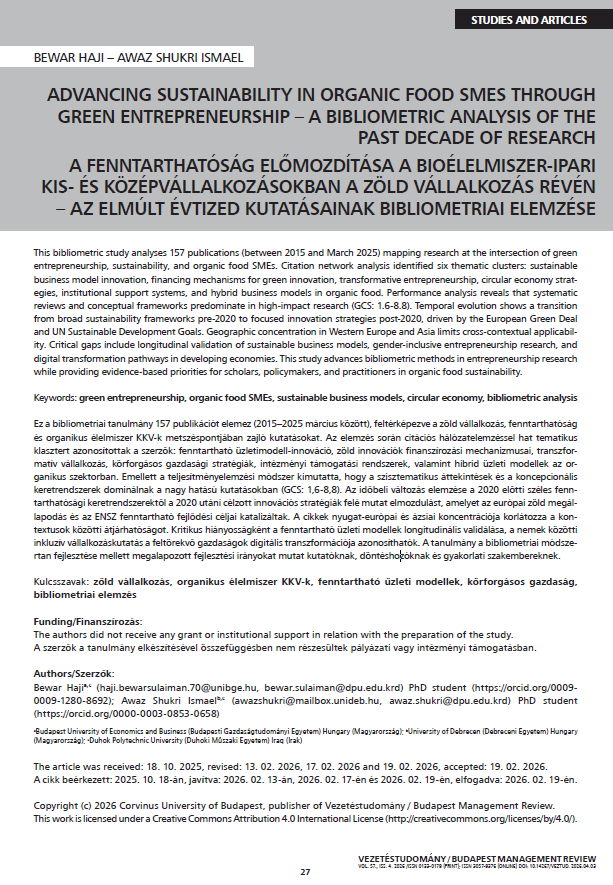
A fenntarthatóság előmozdítása a bioélelmiszer-ipari kis- és középvállalkozásokban a zöld vállalkozás révén
Az elmúlt évtized kutatásainak bibliometriai elemzése
DOI:
https://doi.org/10.14267/VEZTUD.2026.04.03Kulcsszavak:
zöld vállalkozás, organikus élelmiszer KKV-k, fenntartható üzleti modellek, körforgásos gazdaság, bibliometriai elemzésAbsztrakt
Ez a bibliometriai tanulmány 157 publikációt elemez (2015–2025 március között), feltérképezve a zöld vállalkozás, fenntarthatóság és organikus élelmiszer KKV-k metszéspontjában zajló kutatásokat. Az elemzés során citációs hálózatelemzéssel hat tematikus klasztert azonosítottak a szerzők: fenntartható üzletimodell-innováció, zöld innovációk finanszírozási mechanizmusai, transzformatív vállalkozás, körforgásos gazdasági stratégiák, intézményi támogatási rendszerek, valamint hibrid üzleti modellek az organikus szektorban. Emellett a teljesítményelemzési módszer kimutatta, hogy a szisztematikus áttekintések és a koncepcionális keretrendszerek dominálnak a nagy hatású kutatásokban (GCS: 1,6-8,8). Az időbeli változás elemzése a 2020 előtti széles fenntarthatósági keretrendszerektől a 2020 utáni célzott innovációs stratégiák felé mutat elmozdulást, amelyet az európai zöld megállapodás és az ENSZ fenntartható fejlődési céljai katalizáltak. A cikkek nyugat-európai és ázsiai koncentrációja korlátozza a kontextusok közötti átjárhatóságot. Kritikus hiányosságként a fenntartható üzleti modellek longitudinális validálása, a nemek közötti inkluzív vállalkozáskutatás a feltörekvő gazdaságok digitális transzformációja azonosíthatók. A tanulmány a bibliometriai módszertan fejlesztése mellett megalapozott fejlesztési irányokat mutat kutatóknak, döntéshozóknak és gyakorlati szakembereknek.Downloads
Hivatkozások
Alshebami, A.S. (2023). Green Innovation, Self-Efficacy, Entrepreneurial Orientation and Economic Performance: Interactions among Saudi Small Enterprises. Sustainability, 15(3), 1961. https://doi.org/10.3390/su15031961
Alshebami, A.S., Seraj, A.H.A., Elshaer, I.A., Shammre, A.S.A., Al Marri, S.H., Lutfi, A., Salem, M.A., & Zaher, A.M.N. (2023). Improving social performance through innovative small green businesses: Knowledge sharing and green entrepreneurial intention as antecedents. Sustainability, 15(10), 8232. https://doi.org/10.3390/su15108232
Alvarez-Ochoa, C.P., Acevedo, J.A.R., & Tuesta, Y.N. (2024). Sustainability strategy in agribusiness: a bibliometric and systematic analysis of the literature. Discover Sustainability, 5(1). https://doi.org/10.1007/s43621-024-00530-w
Aria, M., & Cuccurullo, C. (2017). Bibliometrix: An R tool for comprehensive science mapping analysis. Journal of Informetrics, 11(4), 959–975. https://doi.org/10.1016/j.joi.2017.08.007
Bhardwaj, S., Nair, K., Tariq, M.U., Ahmad, A., & Chitnis, A. (2023). The State of Research in Green Marketing: A Bibliometric Review from 2005 to 2022. Sustainability, 15(4), 2988. https://doi.org/10.3390/su15042988
Borsellino, V., Schimmenti, E., & El Bilali, H. (2020). Agri-food markets towards sustainable patterns. Sustainability, 12(6), 2193. https://doi.org/10.3390/su12062193
Bossle, M.B., de Barcellos, M.D., & Vieira, L.M. (2016). Why do food companies go green? The determining factors to adopt eco-innovations. British Food Journal, 118(9), 2107–2123. https://doi.org/10.1108/BFJ-10-2015-0388
Briguglio, M., Llorente-González, L.J., Meilak, C., Pereira, Á., Spiteri, J., & Vence, X. (2021). Born or grown: Enablers and barriers to circular business in Europe. Sustainability, 13(24), 13670. https://doi.org/10.3390/su132413670
D’Angelo, C.A., & Van Eck, N.J. (2020). Collecting large-scale publication data at the level of individual researchers: A practical proposal for author name disambiguation. Scientometrics, 123(2), 883-907. https://doi.org/10.1007/s11192-020-03410-y
Dahiya, S., Panghal, A., Sindhu, S., & Siwach, P. (2020). Organic food women entrepreneurs – TISM approach for challenges. Journal of Enterprising Communities, 15(1), 114–136. https://doi.org/10.1108/JEC-04-2020-0068
Donthu, N., Kumar, S., Mukherjee, D., Pandey, N., & Lim, W.M. (2021). How to conduct a bibliometric analysis: An overview and guidelines. Journal of Business Research, 133, 285–296. https://doi.org/10.1016/j.jbusres.2021.04.070
Ersoy, P., Börühan, G., Kumar Mangla, S., Hormazabal, J.H., Kazancoglu, Y., & Lafcı, Ç. (2022). Impact of information technology and knowledge sharing on circular food supply chains for green business growth. Business Strategy and the Environment, 31(5), 1875-1904. https://doi.org/10.1002/bse.2988
European Commission. (2019). The European Green Deal. COM (2019) 640 final. https://eur-lex.europa.eu/legal-content/EN/TXT/?uri=COM:2019:640:FIN
Evans, S., Vladimirova, D., Holgado, M., Van Fossen, K., Yang, M., Silva, E.A., & Barlow, C.Y. (2017). Business model innovation for sustainability: Towards a unified perspective for creation of sustainable business models. Business Strategy and the Environment, 26(5), 597–608. https://doi.org/10.1002/bse.1939
Franceschelli, M.V., Santoro, G., & Candelo, E. (2018). Business model innovation for sustainability: A food startup case study. British Food Journal, 120(6), 1187–1202. https://doi.org/10.1108/BFJ-01-2018-0049
Frederick, H.H. (2018). The emergence of biosphere entrepreneurship: Are social and business entrepreneurship obsolete? International Journal of Entrepreneurship and Small Business, 34(3), 381–419. https://doi.org/10.1504/IJESB.2018.092785
Gibbs, D. (2006). Sustainability entrepreneurs, ecopreneurs and the development of a sustainable economy. Greener Management International, (55), 63-78. https://www.jstor.org/stable/greemanainte.55.63
Hinderer, S., & Kuckertz, A. (2022). The bioeconomy transformation as an external enabler of sustainable entrepreneurship. Business Strategy and the Environment, 31(7), 2947–2963. https://doi.org/10.1002/bse.3056
Iqbal, S., Tian, H., Akhtar, S., & Javed, H. (2025). Effects of green entrepreneurship and digital transformation on eco-efficient e-commerce. International Entrepreneurship and Management Journal, 21(1). https://doi.org/10.1007/s11365-024-01024-x
Jolink, A., & Niesten, E. (2015). Sustainable development and business models of entrepreneurs in the organic food industry. Business Strategy and the Environment, 24(6), 386–401. https://doi.org/10.1002/bse.1826
Kirkwood, J., & Walton, S. (2010). What motivates ecopreneurs to start businesses? International Journal of Entrepreneurial Behavior & Research, 16(3), 204-228. https://doi.org/10.1108/13552551011042799
Kouam, J. C., & Asongu, S. A. (2022). Effects of taxation on social innovation and implications for achieving sustainable development goals in developing countries: A literature review. International Journal of Innovation Studies, 6(4), 259–275. https://doi.org/10.1016/j.ijis.2022.08.002
Kumar, R., & Pathak, G.S. (2022). Corporate entrepreneurship in the pursuit of sustainable development: Creating a more sustainable future. Problemy Ekorozwoju, 17(2), 166–177. https://doi.org/10.35784/pe.2022.2.18
Kumari, P., & Jaiswal, J.K. (2023). Sustainability and finance in developing nations: current state and future directions. International Journal of Accounting, Business and Finance, 2(2), 40-62. https://doi.org/10.55429/ijabf.v2i2.119
Leendertse, J., van Rijnsoever, F.J., & Eveleens, C.P. (2021). The sustainable start-up paradox: Predicting the business and climate performance of start-ups. Business Strategy and the Environment, 30(2), 1019– 1036. https://doi.org/10.1002/bse.2667
Lüdeke-Freund, F., Froese, T., Dembek, K., Rosati, F., & Massa, L. (2024). What Makes a Business Model Sustainable? Activities, Design Themes, and Value Functions. Organization & Environment, 37(2), 194-220. https://doi.org/10.1177/10860266241235212
Majeed, M.U., Aslam, S., Murtaza, S.A., Attila, S., & Molnár, E. (2022). Green marketing approaches and their impact on green purchase intentions: Mediating role of green brand image and consumer beliefs towards the environment. Sustainability, 14(18), 11703. https://doi.org/10.3390/su141811703
Máté, D., Estiyanti, N. M., & Novotny, A. (2024). How to support innovative small firms? Bibliometric analysis and visualization of start-up incubation. Journal of Innovation and Entrepreneurship, 13(1), 5. https://doi.org/10.1186/s13731-024-00361-z
Moher, D., Liberati, A., Tetzlaff, J., & Altman, D.G. (2009). Preferred reporting items for systematic reviews and meta-analyses: The PRISMA statement. PLoS Medicine, 6(7), e1000097. https://doi.org/10.1371/journal.pmed.1000097
Mondal, S., Singh, S., & Gupta, H. (2022). A meta-analysis of green and sustainable business models: A comprehensive approach. Journal of Cleaner Production, 371, 133623. https://doi.org/10.1016/j.jclepro.2022.133623
Naguit, M.C.G. (2018). Sustainable entrepreneurship: The triple bottom line and business performance approach. International Journal of Sustainability in Economic, Social, and Cultural Context, 14(3), 51–64. https://doi.org/10.18848/2325-1115/CGP/V14I03/51-64
O’Neill, K., & Gibbs, D. (2016). Rethinking green entrepreneurship – Fluid narratives of the green economy. Environment and Planning A: Economy and Space, 48(9), 1727-1749. https://doi.org/10.1177/0308518X16650453
Olteanu, Y., & Fichter, K. (2022). Startups as sustainability transformers: A new empirically derived taxonomy and its policy implications. Business Strategy and the Environment, 31(7), 3083-3099. https://doi.org/10.1002/bse.3065
Page, M.J., McKenzie, J.E., Bossuyt, P.M., Boutron, I., Hoffmann, T.C., Mulrow, C.D., Shamseer, L., Tetzlaff, J.M., Akl, E.A., Brennan, S.E., Chou, R., Glanville, J., Grimshaw, J.M., Hróbjartsson, A., Lalu, M.M., Li, T., Loder, E.W., Mayo-Wilson, E., McDonald, S., McGuinness, L.A., Stewart, L.A., Thomas, J., Tricco, A.C., Welch, V.A., Whiting, P., & Moher, D. (2021). The PRISMA 2020 statement: An updated guideline for reporting systematic reviews. BMJ, 372, n71. https://doi.org/10.1136/bmj.n71
Pérez, M.H., & Muñoz, P. (2021). Reformists, decouplists, and activists: A typology of ecocentric management. Organization & Environment, 34(1), 37–65. https://doi.org/10.1177/1086026621993204
Petrolo, D., Fakhar Manesh, M., Pellegrini, M.M., & Flamini, G. (2022). Agri-food entrepreneurship. Harvesting, growing and reseeding the orchard through a bibliometric study. British Food Journal, 124(7), 2396–2426. https://doi.org/10.1108/BFJ-08-2021-0954
Preghenella, N., & Battistella, C. (2021). Exploring business models for sustainability: A bibliographic investigation of the literature and future research directions. Business Strategy and the Environment, 30(5), 2505–2522. https://doi.org/10.1002/bse.2760
Provasnek, A.K., Schmid, E., Geissler, B., & Steiner, G. (2017). Sustainable corporate entrepreneurship: Performance and strategies toward innovation. Business Strategy and the Environment, 26(4), 521–535. https://doi.org/10.1002/bse.1934
Reynolds, N.S., & Holt, D. (2021). Sustainable development and profit? A sensemaking perspective on hybrid organisations and their founders. Business Strategy and the Environment, 30(4), 2147–2159. https://doi.org/10.1002/bse.2737
Rodríguez-Espíndola, O., Cuevas-Romo, A., Chowdhury, S., Díaz-Acevedo, N., Albores, P., Despoudi, S., Malesios, C., & Dey, P.K. (2022). The role of circular economy principles and sustainable-oriented innovation to enhance social, economic and environmental performance: Evidence from Mexican SMEs. International Journal of Production Economics, 248, 108495. https://doi.org/10.1016/j.ijpe.2022.108495
Rodríguez-García, M., Guijarro-García, M., & Carrilero- Castillo, A. (2019). An Overview of Ecopreneurship, Eco-Innovation, and the Ecological Sector. Sustainability, 11(10), 2909. https://doi.org/10.3390/su11102909
Rok, B., & Kulik, M. (2021). Circular start-up development: The case of positive impact entrepreneurship in Poland. Corporate Governance (Bingley), 21(2), 339–358. https://doi.org/10.1108/CG-01-2020-0043
Santini, C. (2017). Ecopreneurship and ecopreneurs: Limits, trends and characteristics. Sustainability, 9(4), Article 492. https://doi.org/10.3390/su9040492
Schaltegger, S., Beckmann, M., & Hockerts, K. (2018). Collaborative entrepreneurship for sustainability: Creating solutions in light of the UN sustainable development goals. International Journal of Entrepreneurial Venturing, 10(2), 131–152. https://doi.org/10.1504/IJEV.2018.092709
Schaltegger, S., Lüdeke-Freund, F., & Hansen, E.G. (2016). Business models for sustainability: A co-evolutionary analysis of sustainable entrepreneurship, innovation, and transformation. Organization & Environment, 29(3), 264–289. https://doi.org/10.1177/1086026616633272
Stöhr, J., & Herzig, C. (2022). Organic pioneers and the sustainability transformation of the German food market: A politically structuring actor perspective. British Food Journal, 124(7), 2321–2342. https://doi.org/10.1108/BFJ-08-2021-0953
Stubbs, W. (2019). Strategies, practices, and tensions in managing business model innovation for sustainability: The case of an Australian BCorp. Corporate Social Responsibility and Environmental Management, 26(5), 1063–1072. https://doi.org/10.1002/csr.1786
Takalo, S.K., & Tooranloo, H.S. (2021). Green innovation: A systematic literature review. Journal of Cleaner Production, 279, 122474. https://doi.org/10.1016/j.jclepro.2020.122474
Testa, S., Roma, P., Vasi, M., & Cincotti, S. (2020). Crowdfunding as a tool to support sustainability-oriented initiatives: Preliminary insights into the role of product/ service attributes. Business Strategy and the Environment, 29(2), 530–546. https://doi.org/10.1002/bse.2385
Troise, C., Tani, M., Dinsmore, J., & Schiuma, G. (2021). Understanding the implications of equity crowdfunding on sustainability-oriented innovation and changes in agri-food systems: Insights into an open innovation approach. Technological Forecasting and Social Change, 171, 120959. https://doi.org/10.1016/j.techfore.2021.120959
Urbaniec, M., Sołtysik, M., Prusak, A., Kułakowski, K., & Wojnarowska, M. (2022). Fostering sustainable entrepreneurship by business strategies: An explorative approach in the bioeconomy. Business Strategy and the Environment, 31(1), 251-267. https://doi.org/10.1002%2Fbse.2885
Van Eck, N.J., & Waltman, L. (2010). Software survey: VOSviewer, a computer program for bibliometric mapping. Scientometrics, 84(2), 523-538. https://doi.org/10.1007/s11192-009-0146-3
Viciunaite, V. (2022). Communicating sustainable business models to consumers: A translation theory perspective. Organization & Environment, 35(2), 233–251. https://doi.org/10.1177/1086026620953448
Yi, G. (2021). From green entrepreneurial intentions to green entrepreneurial behaviors: The role of university entrepreneurial support and external institutional support. International Entrepreneurship and Management Journal, 17(2), 963–979. https://doi.org/10.1007/s11365-020-00649-y
Zameer, H., & Yasmeen, H. (2022). Green innovation and environmental awareness driven green purchase intentions. Marketing Intelligence & Planning, 40(5), 624–638. https://doi.org/10.1108/MIP-12-2021-0457
Zupic, I., & Čater, T. (2015). Bibliometric methods in management and organization. Organizational Research Methods, 18(3), 429–472. https://doi.org/10.1177/1094428114562629
Letöltések
Megjelent
Folyóirat szám
Rovat
License
Copyright (c) 2026 Corvinus University of Budapest, publisher of Vezetéstudomány / Budapest Management Review

This work is licensed under a Creative Commons Attribution 4.0 International License.
Authors assign copyright to Vezetéstudomány / Budapest Management Review. Authors are responsible for permission to reproduce copyright material from other sources.
Hogyan kell idézni