A vezetési stílus hatása a KKV-k teljesítményére
DOI:
https://doi.org/10.14267/VEZTUD.2025.10.03Kulcsszavak:
KKV, vezetési stílus, teljesítmény, szisztematikus irodalomkutatás, empirikus kutatásAbsztrakt
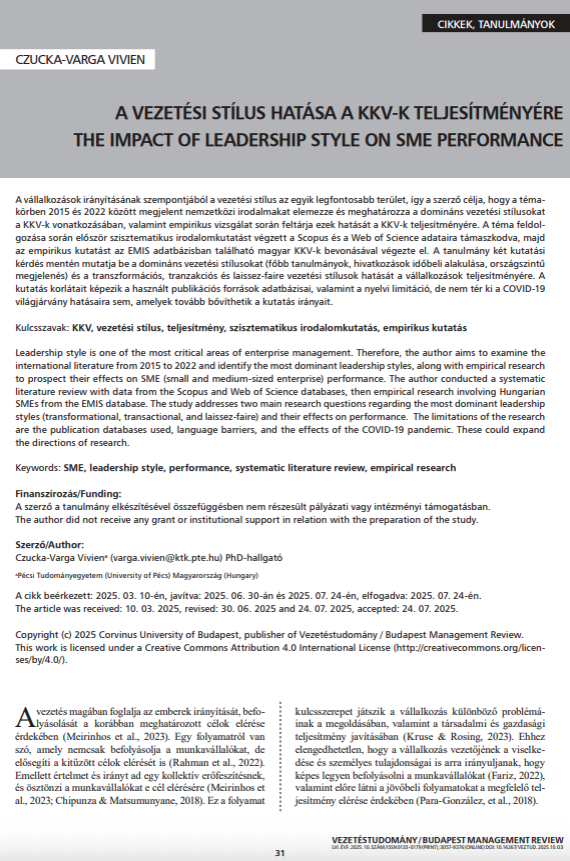
A vállalkozások irányításának szempontjából a vezetési stílus az egyik legfontosabb terület, így a szerző célja, hogy a témakörben 2015 és 2022 között megjelent nemzetközi irodalmakat elemezze és meghatározza a domináns vezetési stílusokat a KKV-k vonatkozásában, valamint empirikus vizsgálat során feltárja ezek hatását a KKV-k teljesítményére. A téma feldolgozása során először szisztematikus irodalomkutatást végzett a Scopus és a Web of Science adataira támaszkodva, majd az empirikus kutatást az EMIS adatbázisban található magyar KKV-k bevonásával végezte el. A tanulmány két kutatási kérdés mentén mutatja be a domináns vezetési stílusokat (főbb tanulmányok, hivatkozások időbeli alakulása, országszintű megjelenés) és a transzformációs, tranzakciós és laissez-faire vezetési stílusok hatását a vállalkozások teljesítményére. A kutatás korlátait képezik a használt publikációs források adatbázisai, valamint a nyelvi limitáció, de nem tér ki a COVID-19 világjárvány hatásaira sem, amelyek tovább bővíthetik a kutatás irányait.
Downloads
Hivatkozások
Al-Subaie, A.A., Faisal, M.N., Aouni, B., & Jabeen, F. (2021). Investigating the role of leadership styles and governance on project performance in megaprojects. Polish Journal of Management Studies, 23(1), 45-58. http://dx.doi.org/10.17512/pjms.2021.23.1.03
Amoah, J., Belás, J., Khan, K.A., & Metzker, Z. (2021). Antecedents of sustainable SMEs in the social media space: A partial least square-structural equation modeling (PLS-SEM) approach. Management & Marketing-Challenges for the Knowledge Society, 16(1), 26-46. http://dx.doi.org/10.2478/mmcks-2021-0003
Avolio, B.J., & Bass, B.M. (2002). Developing potential across a full range of leadership. Lawrence Erlbaum Associates.
Avolio, B.J., & Gardner, W.L. (2005). Authentic leadership development: Getting to the root of positive forms of leadership. The Leadership Quarterly, 16(3), 315-338. http://dx.doi.org/10.1016/j.leaqua.2005.03.001
Bass, B.M., & Avolio, B.J. (1997). Revised manual for the Multifactor Leadership Questionnaire. Mind Garden.
Bányai, E., & Sipos, N. (2019). Aktualitások a felsővezetői kiválóság területén. Vezetéstudomány, 50(1), 63-69. http://dx.doi.org/10.14267/VEZTUD.2019.01.06
Beltrame, F., Floreani, J., Grassetti, L., Mason, M.C., & Miani, S. (2018). Collateral, mutual guarantees and the entrepreneurial orientation of SMEs. Management Decision, 57(1), 168-192. http://dx.doi.org/10.1108/MD-11-2017-1077
Bencsik, A. (2021). Vezetői felkészültség felmérése a digitális kor kihívásaira: Nemzetközi összehasonlítás. Vezetéstudomány, 52(4), 93–108. https://doi.org/10.14267/VEZTUD.2021.04.08
Burns, J.M. (1978). Leadership. Harper & Row.
Cantermi, B.D.A., & Lizote, S.A. (2022). Leadership and organizational culture in small companies. Revista de Administração da UFSM, 15(4), 634-656. http://dx.doi.org/10.5902/1983465970384
Carrión, I.A.D., Ramírez, M.C.L., & Flores, J.C.M. (2018). Transformational leadership and gender in 4 and 5 star hotels in Tijuana (Mexico). Cuadernos de Turismo, 42, 137-160. https://revistas.um.es/turismo/article/view/353431/252811
Chammas, C.B., & Hernandez, J.M.D.C. (2019). Comparing transformational and instrumental leadership: The influence of different leadership styles on individual employee and financial performance in Brazilian startups. Innovation & Management Review, 16(2), 143-160. http://dx.doi.org/10.1108/INMR-08-2018-0064
Chipunza, C., & Matsumunyane, L.L. (2018). Motivation sources and leadership styles among middle managers at a South African university. SA Journal of Human Resource Management, 16(1), 1-13. http://dx.doi.org/10.4102/sajhrm.v16i0.985
Deshwal, V., & Ali, M.A. (2020). A systematic review of various leadership theories. Shanlax International Journal of Commerce, 8(1), 38-43. http://dx.doi.org/10.34293/commerce.v8i1.916
Dobák, M., & Antal, Zs. (2016). Vezetés és szervezés: Szervezetek kialakítása és működtetése. Akadémia Kiadó.
Doeleman, H.J., van Dun, D.H., & Wilderom, C.P. (2022). Leading open strategizing practices for effective strategy implementation. Journal of Strategy and Management, 15(1), 54-75. http://dx.doi.org/10.1108/JSMA-09-2020-0253
Dvorsky, J., Belas, J., Gavurova, B., & Brabenec, T. (2021). Business risk management in the context of small and medium-sized enterprises. Economic Research-Ekonomska Istraživanja, 34(1), 1690-1708. http://dx.doi.org/10.1080/1331677X.2020.1844588
Erat, S., Kitapçı, H., & Akçin, K. (2020). Managerial perception and organizational identity: a comparative analysis. Sustainability, 12(6), 2278. http://dx.doi.org/10.3390/su12062278
Fariz, F. (2022). The effect of supplier integration, manager transformational leadership on supply chain performance. Uncertain Supply Chain Management, 10(3), 993-998. http://dx.doi.org/10.5267/j.uscm.2022.2.014
Filep, R. (2018). Vezetési stílus vizsgálata MLQ segítségével a Szabolcs-Szatmár-Bereg megyei kisvállalkozások körében. International Journal of Engineering and Management Sciences, 3(4), 36-47. http://dx.doi.org/10.21791/IJEMS.2018.4.5.
Fischer, H., Heidler, P., Coco, L., & Albanese, V. (2022). Leadership theories and the veterinary health care system. Veterinary Sciences, 9(10), 538. http://dx.doi.org/10.3390/vetsci9100538
Freihat, S. (2020). The role of transformational leadership in reengineering of marketing strategies within organizations. Problems and Perspectives in Management, 18(4), 364-375. http://dx.doi.org/10.21511/ppm.18(4).2020.29
Gerő, H.E.J., Kincses, Á., & Tóth, G. (2021). A hazai mikro-, kis- és középvállalkozások térbeli jellegzetességei. Területi Statisztika, 61(6), 769-796. https://doi.org/10.15196/TS610604
Goleman, D. (1995). Emotional intelligence: Why it can matter more than IQ. Bantam Books.
Győri, Á., Lengyel, G., & Perpék, É. (2020). Preferált vezetési stílus, vezetői és vállalkozói hajlandóság az egyetemi hallgatók körében. Metszetek-Társadalomtudományi folyóirat, 9(1), 3-26. https://doi.org/10.18392/metsz/2020/1/1
Hamza, K.A., Alshaabani, A., Salameh, N., & Rudnak, I. (2022). Impact of transformational leadership on employees’ reactions to change and mediating role of organizational trust: Evidence from service companies in Hungary. Problems and Perspectives in Management, 20(2), 522-535. http://dx.doi.org/10.21511/ppm.20(2).2022.43
Hansen, J.A., & Pihl-Thingvad, S. (2019). Managing employee innovative behaviour through transformational and transactional leadership styles. Public Management Review, 21(6), 918-944. http://dx.doi.org/10.1080/14719037.2018.1544272
Hargreaves, A., & Fink, D. (2004). The seven principles of sustainable leadership. Educational Leadership, 61(7), 8-13. https://jotamac.typepad.com/jotamacs_weblog/files/seven_principles.pdf
Hussain, S.T., Lei, S., Akram, T., Haider, M.J., Hussain, S.H., & Ali, M. (2018). Kurt Lewin’s change model: A critical review of the role of leadership and employee involvement in organizational change. Journal of Innovation & Knowledge, 3(3) 123-127. http://dx.doi.org/10.1016/j.jik.2016.07.002
Ishii, K., Takemura, Y., & Ichikawa, N. (2021). Relationships between the components of nurse managers’ transformational leadership and organisational learning subprocesses in a hospital ward: A cross‐sectional study. Journal of Nursing Management, 29(4), 672-680. http://dx.doi.org/10.1111/jonm.13203
Jarjabka, Á., Köő, N., Varga, V., & Kuráth, G. (2022). Menedzsmentkihívások az újranyitás után a felsőoktatásban a Pécsi Tudományegyetem gyakorlati példája alapján. In Kőműves, Zs.S., Dajnoki, K., Pató, G.Sz.B., Poór, J., Szabó, K., Szabó-Szentágotai, G., & Szabó, Sz. (Eds.), Kilábalás – Újranyitás – Növekedés Poszt-COVID-szindróma és bizonytalan helyzet menedzsment szempontjai. Akadémia Kiadó.
Joiner, B., Josephs, S. (2007). Leadership Agility; Five Levels of Mastery for Anticipating and Initiating Change. Wiley & Sons.
Kispál-Vitai, Zs., (2013). Szervezeti viselkedés. Pearson.
Központi Statisztikai Hivatal (2024). 9.1.1.17. Összefoglaló tábla. A vállalkozások teljesítménymutatói kis- és középvállalkozási kategória szerint. https://www.ksh.hu/stadat_files/gsz/hu/gsz0018.html
Kruse, P., & Rosing, F. (2023). An experimental investigation of perceived differences in personality and leadership attributes of social entrepreneurs compared to for profit entrepreneurs and non-profit organisations leaders. The Journal of Entrepreneurship, 32(1), 75-110. http://dx.doi.org/10.1177/09713557231160332
Kumar, S. (2018). Servant Leadership: A Review of Literature. Pacific Business Review International, 11(1), 43-50. https://opensiuc.lib.siu.edu/context/ojwed/article/1008/viewcontent/Servant_Leadership.pdf
Kuráth, G., & Bányai, E. (2024). Vezetőfejlesztés a 21. században. Akadémia Kiadó.
Kusa, R., Duda, J., & Suder, M. (2021). Explaining SME performance with fsQCA: The role of entrepreneurial orientation, entrepreneur motivation, and opportunity perception. Journal of Innovation & Knowledge, 6(4), 234-245. http://dx.doi.org/10.1016/j.jik.2021.06.001
Lewin, K., Lippit, R., & White, R.K. (1975). Agresszív viselkedési sémák kísérletileg kialakított társas légkörben, In Csoportdinamika (pp. 159-191). Közgazdasági és Jogi Könyvkiadó.
Machi, L.A., & McEvoy, B.T. (2012). The literature review: Six steps to success. Corwin Press.
Meekaewkunchorn, N., Szczepańska-Woszczyna, K., Muangmee, C., Kassakorn, N., & Khalid, B. (2021). Entrepreneurial orientation and SME performance: The mediating role of learning orientation. Economics & Sociology, 14(2), 294-312. http://dx.doi.org/10.14254/2071-789X.2021/14-2/16
Meirinhos, G., Cardoso, A., Neves, M., Silva, R., & Rêgo, R. (2023). Leadership styles, motivation, communication and reward systems in business performance. Journal of Risk and Financial Management, 16(2), 70. http://dx.doi.org/10.3390/jrfm16020070
Messmann, G., Evers, A., & Kreijns, K. (2022). The role of basic psychological needs satisfaction in the relationship between transformational leadership and innovative work behavior. Human Resource Development Quarterly, 33(1), 29-45. http://dx.doi.org/10.1002/hrdq.21451
Obaid, S., Ahmad, S.F., & Mumtaz, F. (2022). Ability-motivation- opportunity framework: An analysis of interrelated effects of HRM practice and leadership style on organizational outcomes. International Journal of Asian Business and Information Management (IJABIM), 13(1), 1-26. http://dx.doi.org/10.4018/IJABIM.309105
OECD. (2016). Financing SMEs and Entrepreneurs 2016: An OECD Scoreboard. OECD Publishing. https://doi.org/10.1787/fin_sme_ent-2016-en
Page, M.J., McKenzie, J.E., & Bossuyt, P.M. (2021). The PRISMA 2020 statement: an updated guideline for reporting systematic reviews. BMJ, 372, http://dx.doi.org/10.1136/bmj.n71
Para-González, L., Jiménez-Jiménez, D., & Martínez-Lorente, A.R. (2018). Exploring the mediating effects between transformational leadership and organizational performance. Employee Relations, 40(2), 412-432. http://dx.doi.org/10.1108/ER-10-2016-0190
Paul, J., Lim , W.M., O’Cass, A., Hao, A.W., & Bresciani, S. (2021). Scientific procedures and rationales for systematic literature reviews (SPAR‐4‐SLR). International Journal of Consumer Studies, 45(4), O1-O16. http://dx.doi.org/10.1111/ijcs.12695
Pintér, R. (2023). The digital maturity of Hungarian small and medium sized enterprises: The Digimeter index: research results. Vezetéstudomány/Budapest Management Review, 54(10), 66–75. https://doi.org/10.14267/VEZTUD.2023.10.06
Rahman, S., Islam, M.Z., Hossain, M., Abdullah, D.A., & Jasimuddin, S.M. (2022). Organizational Factors, ICT Support, and Affective Commitment: The Case of Bangladesh-Based Service Organizations. Journal of Global Information Management (JGIM), 30(1), 1-18. http://dx.doi.org/10.4018/JGIM.302914
Rao-Nicholson, R., Khan, Z., Akhtar, P., & Merchant, H. (2016). The impact of leadership on organizational ambidexterity and employee psychological safety in the global acquisitions of emerging market multinationals. The International Journal of Human Resource Management, 27(20), 2461-2487. http://dx.doi.org/10.1080/09585192.2016.1204557
Szerb, L., & Hornyák, M., (2016). A magyar kisvállalatok versenyképességének vizsgálata regionális összehasonlításban. In Lengyel, I. & Nagy, B. (Eds.), Térségek versenyképessége, intelligens szakosodása és újraiparosodása (pp. 307-325). JATEPress.
Szerb, L., Rideg, A., Kruzslicz, F., & Márkus, G. (2020). Kompetencia-alapú versenyképesség-mérés és-elemzés a magyar kisvállalati (mKKV) szektorban. PTEKTK Regionális Innováció és Vállalkozáskutató Központ (RIERC).
Szigeti, T., & Hornyák, M. (2024). Digitális transzformáció a projektmenedzsmentben – rendszerező irodalomkutatás. Marketing & Menedzsment, 58(2), 5-15, http://dx.doi.org/10.15170/MM.2024.58.02.01
Turaeva, G. (2023). The value of leadership in small enterprises from their employees’ perspective. Vezetéstudomány/ Budapest Management Review, 54(5), 41–50. https://doi.org/10.14267/VEZTUD.2023.05.04
Whitmore, J. (2009). Coaching for Performance: Growing Human Potential and Purpose—The Principles and Practice of Coaching and Leadership (4th Edition). Nicholas Brealey Publishing.
Zeike, S., Bradbury, K., Lindert, L., & Pfaff, H. (2019). Digital leadership skills and associations with psychological well-being. International Journal of Environmental Research and Public Health, 16(14), 2628. http://dx.doi.org/10.3390/ijerph16142628
Letöltések
Megjelent
Folyóirat szám
Rovat
License
Copyright (c) 2025 Corvinus University of Budapest, publisher of Vezetéstudomány / Budapest Management Review

This work is licensed under a Creative Commons Attribution 4.0 International License.
Authors assign copyright to Vezetéstudomány / Budapest Management Review. Authors are responsible for permission to reproduce copyright material from other sources.
Hogyan kell idézni