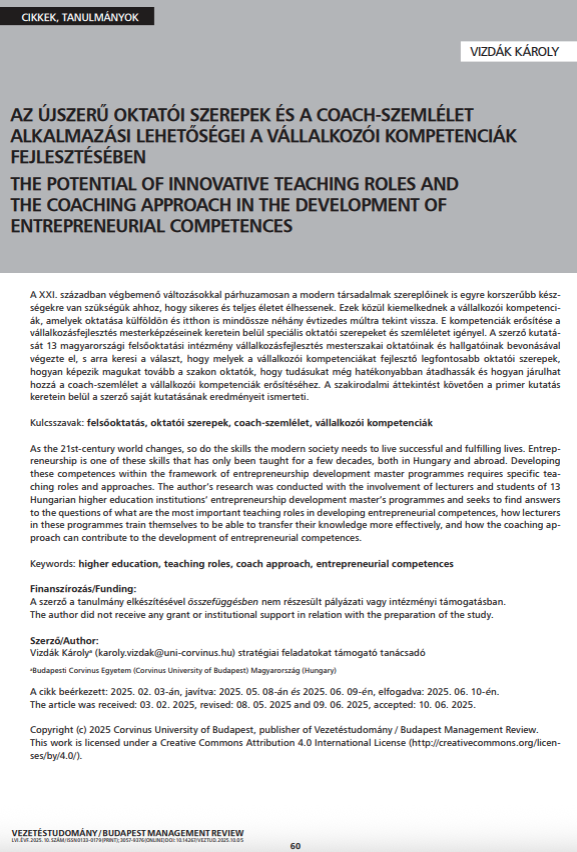
Az újszerű oktatói szerepek és a coach-szemlélet alkalmazási lehetőségei a vállalkozói kompetenciák fejlesztésében
DOI:
https://doi.org/10.14267/VEZTUD.2025.10.05Kulcsszavak:
felsőoktatás, oktatói szerepek, coach-szemlélet, vállalkozói kompetenciákAbsztrakt
A XXI. században végbemenő változásokkal párhuzamosan a modern társadalmak szereplőinek is egyre korszerűbb készségekre van szükségük ahhoz, hogy sikeres és teljes életet élhessenek. Ezek közül kiemelkednek a vállalkozói kompetenciák, amelyek oktatása külföldön és itthon is mindössze néhány évtizedes múltra tekint vissza. E kompetenciák erősítése a vállalkozásfejlesztés mesterképzéseinek keretein belül speciális oktatói szerepeket és szemléletet igényel. A szerző kutatását 13 magyarországi felsőoktatási intézmény vállalkozásfejlesztés mesterszakai oktatóinak és hallgatóinak bevonásával végezte el, s arra keresi a választ, hogy melyek a vállalkozói kompetenciákat fejlesztő legfontosabb oktatói szerepek, hogyan képezik magukat tovább a szakon oktatók, hogy tudásukat még hatékonyabban átadhassák és hogyan járulhat hozzá a coach-szemlélet a vállalkozói kompetenciák erősítéséhez. A szakirodalmi áttekintést követően a primer kutatás keretein belül a szerző saját kutatásának eredményeit ismerteti.
Downloads
Hivatkozások
Árváné Ványi G., Katonáné Kovács J., & Gál T. (2017). A vállalkozásfejlesztés oktatásának vizsgálata a magyar felsőoktatásban. Vezetéstudomány, 48(6-7), 49-56. https://doi.org/10.14267/VEZTUD.2017.06.06
Babbie, E. (2020). A társadalomtudományi kutatás gyakorlata. Balassi Kiadó.
Babson College. (2014). History – The Arthur M. Blank Center for Entrepreneurship. https://www.babson.edu/entrepreneurship-center/about/history/
Bacigalupo, M., Kampylis, P., Punie, Y., & Van den Brande, G. (2016). EntreComp: The Entrepreneurship Competence Framework. Publication Office of the European Union. https://publications.jrc.ec.europa.eu/repository/handle/JRC101581
Banu, R., & Ravanan, R. (2014). Implementation of success pattern assessment (SPA) for Indian teachers using data mining technique. International Journal of Applied Engineering Research, 9(24), 30199-30204. https://www.researchgate.net/publication/291902357_Implementation_of_success_patternassessment_SPA_for_Indian_teachers_using_data_mining_technique
Barbato, G., Moscati, R., & Turri, M. (2019). Is the role of academics as teachers changing? An exploratory analysis in Italian universities. Tuning Journal for Higher Education, 6(2), 97-126. https://doi.org/10.18543/tjhe-6(2)-2019pp97-126
Brunswick, S., & Tennin, K.L. (2023). Shaping the Future of Female Entrepreneurship. Proceedings of the International Astronautical Congress, October. bhttps://www.scopus.com/inward/record.uri?eid=2-s2.0-85187992583&partne-rID=40&md5=b901cccc5e206e02a93c3f0c0b077989
Bryman, A., & Bell, E. (2015). Business Research Methods. Oxford University Press.
Bulatov, A., & Kheifets, B. (2023). World Economy Major Trends: New Normal, The Fourth Industrial Revolution, Globalization, Sustainable Development. In Bulatov, A. (Eds.), World Economy and International Business. Contributions to Economics (pp. 57-77). Springer. https://doi.org/10.1007/978-3-031-20328-2_4
Creswell, J.W., & Plano Clark, V.L. (2018). Designing and Conducting Mixed Methods Research (3rd ed.). SAGE Publications.
Csapó K. (2008). Amerikai vállalkozásoktatási példák adaptációjának lehetősége Magyarországon. Vezetéstudomány, 39(1), 43–54. https://doi.org/10.14267/VEZTUD.2008.01.05
D’Amico Pawlewicz, D., & Guiden, A. (2020). Teachers and the Question of Profession. In Springer International Handbooks of Education (pp. 373 – 386), Springer. https://doi.org/10.1007/978-981-10-2362-0_24
David, T., & Schaufelbuehl J.M. (2015). Transatlantic influence in the shaping of business education: The origins of IMD, 1946-1990. Business History Review, 89(1), 75-97. https://doi.org/10.1017/S0007680515000069
Debreceni Egyetem Gazdálkodástudományi Kar (2024). Vállalkozásfejlesztés mesterképzési szak honlapja. https://econ.unideb.hu/vallalkozasfejlesztesmesterkepzesi-szak
Deutsch, N., Berényi, L., & Nagy–Borsy, V. (2025). A vállalkozási ismereteket fejlesztő mesterképzések kompetenciafókuszú nemzetközi összehasonlítása. Vezetéstudomány, 56(4), 15-29. https://doi.org/10.14267/VEZTUD.2025.04.02
de Wit, H., & Deca, L. (2020). Internationalization of higher education, challenges and opportunities for the next decade. In European Higher Education Area: Challenges for a New Decade (pp. 3-11). Springer. https://doi.org/10.1007/978-3-030-56316-5_1
Eastcott, D. (2016). Coaching and mentoring in academic development. In Advancing Practice in Academic Development (pp. 86-102). Routledge. https://doi.org/10.4324/9781315720890
Fahnert, B. (2015). Teaching matters-academic professional development in the early 21st century. FEMS Microbiology Letters, 362(20), art. no. fnv156. https://doi.org/10.1093/femsle/fnv156
FELVI (2023). Felvételi ponthatárok (2023). https://www.felvi.hu
Ghauri, P., & Gronhaug, K. (2011). Kutatásmódszertan az üzleti tanulmányokban. Akadémiai Kiadó.
GEM (2024). Global Entrepreneurship Monitor Nemzeti Jelentés 2023-2024 – Magyarország. https://www.gemconsortium.org/report/gem-20232024-hungary-national-report
Guttieres, D. (2019). An Intra- and Inter-generational Lens into Rapid Technological Change. Development, 62(1- 4), 37-42. https://doi.org/10.1057/s41301-019-00220-5
Imreh-Tóth, M., Imreh-Tóth, Sz., Prónay, Sz., Vilmányi, M., Lukovics, M., & Kovács, P. (2012). Vállalkozásoktatás a felsőoktatásban: lehetőségek és remények. In Bajmócy, Z., Lengyel, I., & Málovics, Gy. (Eds.), Regionális innovációs képesség, versenyképesség és fenntarthatóság (pp. 239-250). JATEPress.
International Association of Facilitators (IAF) & Rosanna von Sacken (2016). Coaching and facilitation – Overlap, cross-over or completely different? https://www.iaf-world.org/site/global-flipchart/6/coaching-vs-facilitation
International Coaching Federation (ICF) (2024). ICF Coaching Kompetenciák. https://coachingfederation.hu/coaching-kompetenciak-minositesek-kepzesek/minositesek/coach-minosites/icf-coaching-kompetenciak/
Kano, Y. (2015). Higher education policy and the academic profession. In The Changing Academic Profession in Japan (pp. 27-40). Springer. https://doi.org/10.1007/978-3-319-09468-7_2
Lai, M., & Jung, J. (2024). Master’s programmes at Sino- foreign cooperative universities in China: An analysis of the neoliberal practices. Higher Education Quarterly, 78(1), 236-253. https://doi.org/10.1111/hequ.12456
Lee, K.M., Krauss, S., Suandi, T., & Hamzah, A. (2016). Exploring the contribution of mentoring practices to mentee learning in a Malaysian youth development programme. International Journal of Adolescence and Youth, 21(4), 419-432. https://doi.org/10.1080/02673843.2013.862732
Lobos, M.Q., Lillo, P.S., & Pérez, J.M. (2022). What skills should a future teacher develop during their time at university? Perception of student teachers on entering their initial teacher training programmes. Human Review: International Humanities Review, 11(3), 1-10. https://www.historicoeagora.net/revHUMAN/articleview/3836
Madinabeitia Ezkurra, A., & Fernández Fernández, I. (2017). Faculty development of university teachers: Analysis and systematization of the concept [El desarrollo docente del profesorado universitario: Análisis y sistematización del concepto]. Teoria de la Educacion, 29(2), 87-108. https://doi.org/10.14201/teoredu29287108
Magyarországi Facilitátorok Egyesülete. (2024). Facilitálás, facilitátor. https://facilitacio.hu/tudastar/facilitalas-facilitator/
Malhotra, S., & Griffiths, R. (2023). Workplace coaching and mentoring. In Mapping Manager Development: Current and Upcoming Trends (pp. 179-212). Peter Lang.
Martín, P.A. (2019). Student perceptions of a good university lecturer. Educacao e Pesquisa, 45, art. no. e196029. https://doi.org/10.1590/S1678-4634201945196029
McQuade, S., Davis, L., & Nash, C. (2015). Positioning Mentoring as a Coach Development Tool: Recommendations for Future Practice and Research. Quest, 67(3), 317-329. https://doi.org/10.1080/00336297.2015.1048810
Mihalkovné Szakács, K. (2014). Vállalkozási ismeretek oktatása vs. vállalkozói kompetenciák fejlesztése. Vezetéstudomány, 45(10), 49-57. https://doi.org/10.14267/VEZTUD.2014.10.05
MIT Management Executive Education (2024). Entrepreneurship Development Program. https://executive.mit.edu/course/entrepreneurship-developmentprogram/a056g00000URaMsAAL.html
Moloi, T., & Marwala, T. (2020). Synopsis: artificial intelligence in economics and finance theories. In Advanced Information and Knowledge Processing (pp. 115-123). Springer. https://doi.org/10.1007/978-3-030-42962-1_13
Narasimhan, A. (2024). Research Impact at an Unusual Academic Institution: IMD’S Journey. In Business School Research: Excellence, Academic Quality and Positive Impact (pp. 33-39). Routledge. https://doi.org/10.4324/9781003467410-6
Németh, G. (2018). Vállalkozók egyes magatartásmintázatainak kognitív megközelítése (Doktori értekezés). Budapesti Metropolitan Egyetem. https://real-phd.mtak.hu/1551/
Oktatási Hivatal. (2024). Oktatási Hivatal hivatalos weboldala. https://www.oktatas.hu/
Penn State University (2023). Definition of Teaching Excellence. https://www.schreyerinstitute.psu.edu/definition
Perjés, I., & Vass, V. (2009). A kompetenciák tantervesítése. Aula Kiadó.
Pietrobelli, C. (2018). Technology transfer for developing countries. In Technology Transfer (pp. 209-234). Routledge. https://doi.org/10.4324/9781315202037
Popovics, P., Árváné Ványi, G., Katonáné Kovács, J., & Gál, T. (2016). Vállalkozói képzés a 21. században a felsőoktatásban – lehetőségek, módszerek, jó gyakorlatok. International Journal of Engineering and Management Sciences, 1(1), 1-18. https://doi.org/10.21791/IJEMS.2016.1.1
Rudduck, J. (2014). Universities in partnership with schools and school systems: Les liaisons dangereuses? In Teacher Development and Educational Change (pp. 194-212). Routledge. https://doi.org/10.4324/9781315870700
Salter, T., & Gannon, J.M. (2015). Exploring shared and distinctive aspects of coaching and mentoring approaches through six disciplines. European Journal of Training and Development, 39(5), 373-392. https://doi.org/10.1108/EJTD-02-2015-0014
Scrum.org (2024). Comparing Facilitation, Coaching, Mentoring and Teaching: When to use Facilitation, Coaching, Mentoring or Teaching. https://www.scrum.org/resources/comparing-facilitation-coaching-mentoring-and-teaching
Shaffer, L.S., & Zalewski, J.M. (2011). Career Advising in a VUCA Environment. NACADA Journal, 31(1), 64-74. https://doi.org/10.12930/0271-9517-31.1.64
Simon, G. (2006). Kompetencia alapú oktatás, kompetencia alapú tanítási, tanulási programok. (Előadásvázlat). Pedagógiai Mentálhigiénés Konferencia, 2006. március 10–11. http://www.legitim.hu/
Smith, R., & Lynch, D. (2014). Coaching and Mentoring: A review of literature as it relates to teacher professional development. International Journal of Innovation, Creativity and Change, 1(4), 91-103. https://ijicc.net/images/Vol1iss4/Smith_and_Lynch_Nov2014.pdf
Spender, J.C. (2008). The Business School in America: A Century Goes By. In Scenarios for Business Schools in Europe 2020 (pp. 1-12). Palgrave. https://www.researchgate.net/publication/236624393_The_Business_School_in_America_A_ Century_Goes_By
Stanford Graduate School of Business. (2024). Entrepreneurship Path, 37. https://www.gsb.stanford.edu/programs/msx/curriculum/entrepreneurship
Stokes, P., Fatien Diochon, P., & Otter, K. (2021). “Two sides of the same coin?” Coaching and mentoring and the agentic role of context. Annals of the New York Academy of Sciences, 1483(1), 142-152. https://doi.org/10.1111/nyas.14316
Szabó, K., Aranyossy, M., & Bárczy, D. (2022). Egyetemi hallgatóból vállalkozó – Vállalkozásfejlesztés mesterszakos hallgatók vállalkozói szándékát támogató és gátló tényezők. Hitelintézeti Szemle, 21(2), 125-151. https://doi.org/10.25201/HSZ.21.2.125
Terjéki, J., & Nagy-Földi, Z. (2024). A BANI világban hogyan támogassuk és fejlesszük a szívközpontú vezetőket? Magyar Coachszemle, 2024. január 6. https://coachszemle.hu/2024/01/06/na-bani-vilagban-hogyan-tamogassuk-es-fejlesszuk-a-szivkozpontu-vezetoket/
Tiernan, P., & Deveci, İ. (2021). Irish and Turkish pre-service teachers understanding and perceptions of enterprise education. Heliyon, 7(7), art. no. e07591. https://doi.org/10.1016/j.heliyon.2021.e07591
Wbitty, G., Barton, L.,& Pollard, A. (2018). Ideology and control in teacher education: A review of recent experience in England. In Critical Studies in Teacher Education: Its Folklore, Theory and Practice (pp. 161- 183). Routledge. https://doi.org/10.4324/9780429450150-6
Whitmore, J. (2017). Coaching for Performance: The Principles and Practice of Coaching and Leadership (5th ed.). Nicholas Brealey Publishing.
Wilson, K.E., Vyakarnam, S., Volkmann, C., Mariotti, S., Rabuzzi, D.A.,& Sepulveda, A. (2009). Educating the Next Wave of Entrepreneurs. Unlocking entrepreneurial capabilities to meet the global challenges of the 21st Century. A Report of the Global Education Initiative. World Economic Forum, Switzerland. https://members.weforum.org/pdf/GEI/2009/Entrepreneurship_Education_Report.pdf
Letöltések
Megjelent
Folyóirat szám
Rovat
License
Copyright (c) 2025 Corvinus University of Budapest, publisher of Vezetéstudomány / Budapest Management Review

This work is licensed under a Creative Commons Attribution 4.0 International License.
Authors assign copyright to Vezetéstudomány / Budapest Management Review. Authors are responsible for permission to reproduce copyright material from other sources.
Hogyan kell idézni