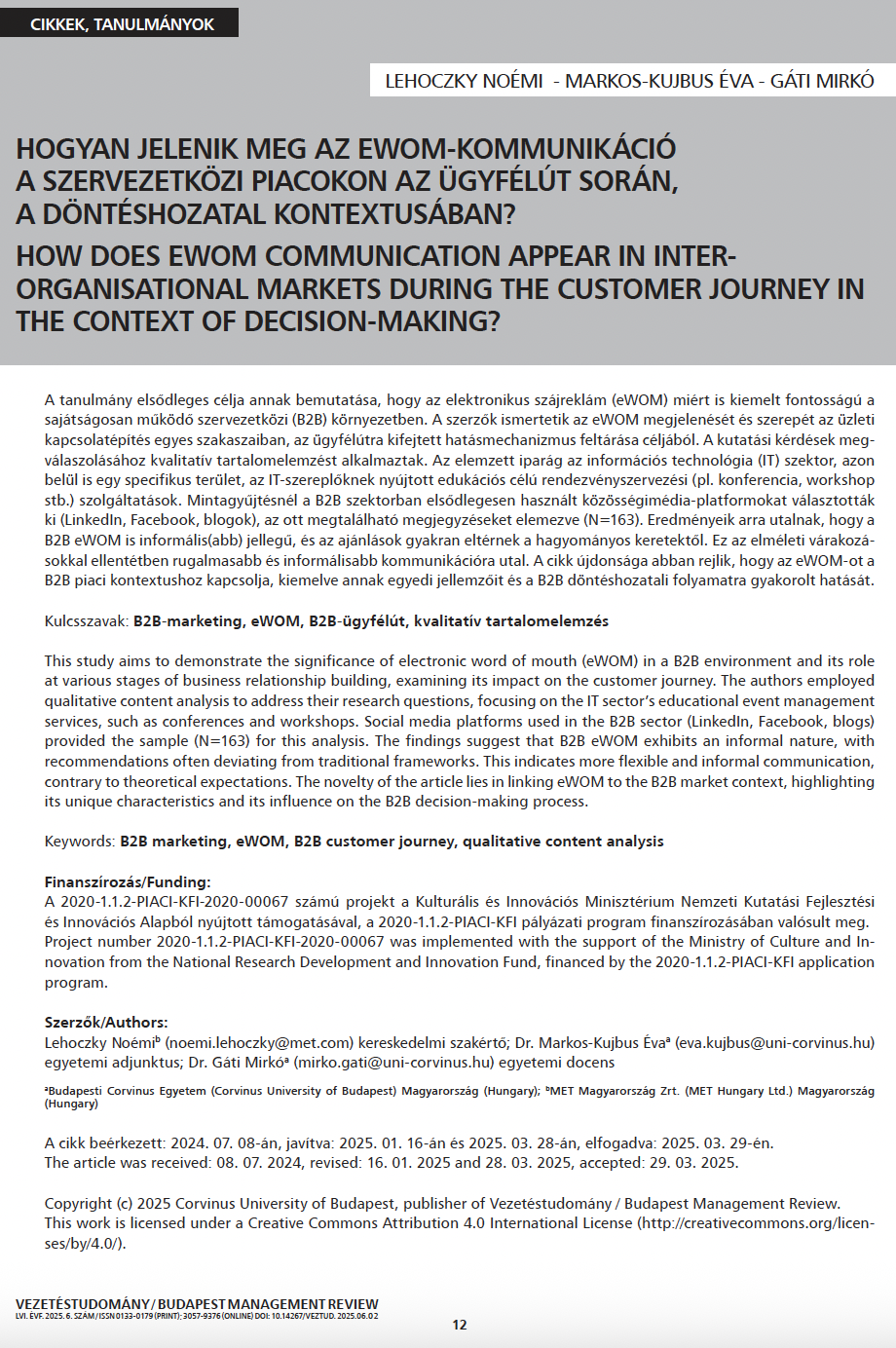
Hogyan jelenik meg az eWOM-kommunikáció a szervezetközi piacokon az ügyfélút során, a döntéshozatal kontextusában?
DOI:
https://doi.org/10.14267/VEZTUD.2025.06.02Kulcsszavak:
B2B-marketing, eWOM, B2B-ügyfélút, kvalitatív tartalomelemzésAbsztrakt
A tanulmány elsődleges célja annak bemutatása, hogy az elektronikus szájreklám (eWOM) miért is kiemelt fontosságú a sajátságosan működő szervezetközi (B2B) környezetben. A szerzők ismertetik az eWOM megjelenését és szerepét az üzleti kapcsolatépítés egyes szakaszaiban, az ügyfélútra kifejtett hatásmechanizmus feltárása céljából. A kutatási kérdések megválaszolásához kvalitatív tartalomelemzést alkalmaztak. Az elemzett iparág az információs technológia (IT) szektor, azon belül is egy specifikus terület, az IT-szereplőknek nyújtott edukációs célú rendezvényszervezési (pl. konferencia, workshop stb.) szolgáltatások. Mintagyűjtésnél a B2B szektorban elsődlegesen használt közösségimédia-platformokat választották ki (LinkedIn, Facebook, blogok), az ott megtalálható megjegyzéseket elemezve (N=163). Eredményeik arra utalnak, hogy a B2B eWOM is informális(abb) jellegű, és az ajánlások gyakran eltérnek a hagyományos keretektől. Ez az elméleti várakozásokkal ellentétben rugalmasabb és informálisabb kommunikációra utal. A cikk újdonsága abban rejlik, hogy az eWOM-ot a B2B piaci kontextushoz kapcsolja, kiemelve annak egyedi jellemzőit és a B2B döntéshozatali folyamatra gyakorolt hatását.
Downloads
Hivatkozások
Anaza, A.N., & Rutherford, B. (2014). Increasing business- to-business buyer word-of-mouth and share- of-purchase. Journal of Business & Industrial Marketing, 29(5), 427–437. https://doi.org/10.1108/JBIM-10-2011-0143
Babbie, E. (2003). A társadalomtudományi kutatás gyakorlata. Balassi Kiadó.
Baer, J. (2021) Why word of mouth is more important for B2B than for B2C. Demandbase. https://www.demandbase.com/b2b-marketing-blog/word-of-mouth-talktriggers/
Banerjee, A., Ries, J.M., & Wiertz, C. (2020). The impact of social media signals on supplier selection: insights from two experiments. International Journal of Operations & Production Management, 40(5), 531–552. https://doi.org/10.1108/IJOPM-05-2019-0413
Bennett, R., McColl-Kennedy, J., & Coote, L.V. (2000). Trust, commitment and attitudinal brand loyalty: key constructs in business-to-business relationships. Proceedings of ANZMAC 2000 Conference: Visionary Marketing for the 21st Century: Facing the Challenge, 21(1), 88–92. https://www.researchgate.net/publication/43474088_Trust_commitment_and_attitudinal_brand_loyalty_Key_constructs_in_business-to-business_relationships
Buratti, N., Parola, F., & Satta, G. (2018). Insights on the adoption of social media marketing in B2B services. The TQM Journal, 30(5), 490–529. https://doi.org/10.1108/TQM-11-2017-0136
Chatzipanagiotou, K., Azer, J., & Ranaweera, C. (2023). E-WOM in the B2B context: Conceptual domain, forms, and implications for research. Journal of Business Research, 164, 113957. https://doi.org/10.1016/j.jbusres.2023.113957
Chenet, P., Dagger, T.S., & O’Sullivan, D. (2010). Service quality, trust, commitment and service differentiation in business relationships. Journal of Services Marketing, 24(5), 336-346. https://doi.org/ 10.1108/08876041011060440
Chevalier, J.A., & Mayzlin, D. (2006). The effect of word of mouth on sales: online book reviews. Journal of Marketing Research, 43(3), 345–354. https://doi.org/10.1509/jmkr.43.3.345
Dibb, S., & Simkin, L. (1993). Strategy and tactics: marketing leisure facilities. The Service Industries Journal, 13(3), 110–124. https://doi.org/10.1080/02642069300000053
Gáti, M. (2016). Kis- és középvállalatok marketingtevékenységének befolyásoló tényezői – Különös tekintettel az online marketingtevékenységekre (Doktori értekezés). Budapesti Corvinus Egyetem, Gazdálkodástani Doktori Iskola. https://doi.org/10.14267/phd.2016044
Gáti, M., & Bauer, A. (2019). Marketing decision-making in Hungarian SMEs. Market-Tržište, 31(1), 39-59. https://doi.org/10.22598/mt/2019.31.1.39
Godes, D., & Mayzlin, D. (2004). Using online conversations to study word-of-mouth communication. Marketing Science, 23(4), 545–560. https://doi.org/10.1287/mksc.1040.0071
Habibi, M.R., Davidson, A., & Laroche, M. (2017). What managers should know about the sharing economy. Business Horizons, 60(1), 113–121. https://doi.org/10.1016/j.bushor.2016.09.007
Halchak, M. (2017). B2B buyer’s survey: risk-averse buyers adding stakeholders and peer checkpoints. Industry Insights. https://www.demandgenreport.com/features/industry-insights/2017-b2b-buyer-s-survey-risk-aversebuyers-adding-stakeholders-peer-checkpoints
Hartmann, E., & de Grahl, A. (2012). Logistics outsourcing interfaces: the role of customer partnering behavior. International Journal of Physical Distribution & Logistics Management, 42(6), 526-543. https://doi.org/ 10.1108/09600031211250578
Hartmann, N.N., Wieland, H., & Vargo, S. L. (2018). Converging on a new theoretical foundation for selling. Journal of Marketing, 82(2), 1–18. https://doi.org/10.1509/jm.16.0268
Hennig-Thurau, T., Walsh, G., & Walsh, G. (2003). Electronic word-of-mouth: Motives for and consequences of reading customer articulations on the Internet. International Journal of Electronic Commerce, 8(2), 51-74. https://doi.org/10.1080/10864415.2003.11044293
Herhausen, D., Miočević, D., Morgan, R.E., & Kleijnen, M.H.P. (2020). The digital marketing capabilities gap. Industrial Marketing Management, 90, 276–290. https://doi.org/10.1016/j.indmarman.2020.07.022
Hubert, J., Gyulavári, T., & Malota, E. (2012). Marketingmérés. In Piskóti, I. (Eds.), „Coopetition”: verseny és együttműködés a marketingben: a Magyar Marketing Szövetség Marketing Oktatók Klubja 18. Országos Konferencia (pp. 73). Miskolci Egyetem, Miskolc.
Ishii, R., & Kikumori, M. (2023). Word-of-mouth in business- to-business marketing: a systematic review and future research directions. Journal of Business & Industrial Marketing, 38(13), 45–62. https://doi.org/10.1108/JBIM-02-2022-0099
Kim, H. (2014). The role of WOM and dynamic capability in B2B transactions. Journal of Research in Interactive Marketing, 8(2), 84–101. https://doi.org/10.1108/JRIM-12-2013-0082
Kim, H., & Hanssens, D.M. (2017). Advertising and Word-of-Mouth Effects on Pre-launch Consumer Interest and Initial Sales of Experience Products. Journal of Interactive Marketing, 37, 57–74. https://doi.org/10.1016/j.intmar.2016.08.001
Krippendorff, K. (2018). Content Analysis: An Introduction to Its Methodology. Sage Publications.
Kwon, J., Chan, K.W., Gu, W., & Septianto, F. (2022). The role of cool versus warm colors in B2B versus B2C firm-generated content for boosting positive eWOM. Industrial Marketing Management, 104, 212-225. https://doi.org/10.1016/j.indmarman.2022.03.011
Lipiäinen, H.S.M., & Karjaluoto, H. (2015). Industrial branding in the digital age. Journal of Business & Industrial Marketing, 30(6), 733–741. https://doi.org/10.1108/JBIM-04-2013-0089
Litvin, S.W., Goldsmith, R.E., & Pan, B. (2008). Electronic word-of-mouth in hospitality and tourism management. Tourism Management, 29(3), 458-468. https://doi.org/10.1016/j.tourman.2007.05.011
Liu, H., Jayawardhena, C., Shukla, P., Osburg, V.S., & Yoganathan, V. (2024). Electronic word of mouth 2.0 (eWOM 2.0) – The evolution of eWOM research in the new age. Journal of Business Research, 176, 114587. https://doi.org/10.1016/j.jbusres.2024.114587
Mai, E. (Shirley), & Liao, Y. (2022). The interplay of word-of-mouth and customer value on B2B sales performance in a digital platform: an expectancy value theory perspective. Journal of Business & Industrial Marketing, 37(7), 1389–1401. https://doi.org/10.1108/JBIM-05-2021-0269
Mangold, G.W., Miller, F., & Brockway, R.G. (1999). Word‐of‐mouth communication in the service marketplace. Journal of Services Marketing, 13(1), 73-89. http://dx.doi.org/10.1108/08876049910256186
Marder, B., Angell, R.J., Akarsu, T., & Erz, A. (2022). The contemporary face of word-of-mouth in B2B contexts: New technologies, practices and challenges. Industrial Marketing Management, 106, A7–A11. https://doi.org/10.1016/j.indmarman.2022.09.011
Markos-Kujbus, É. (2017). Az online szájreklám (e-WOM) mint marketingkommunikációs eszköz: Az online fogyasztói vélemények információs szerepe a TripAdvisor példáján keresztül (Doktori értekezés). Budapesti Corvinus Egyetem, Gazdálkodástani Doktori Iskola. https://doi.org/ 10.14267/phd.2017033
Markos-Kujbus, É. (2016). Az on-line szájreklám (electronic word-of-mouth) jellemzői a marketingkommunikáció szempontjából. Vezetéstudomány, 47(6), 52-63. https://doi.org/10.14267/VEZTUD.2016.06.05
Olaru, D., Purchase, S., & Peterson, N. (2008). From customer value to repurchase intentions and recommendations. Journal of Business & Industrial Marketing, 23(8), 554-565. https://doi.org/ 10.1108/08858620810913362
Pham, T.V.A., Nagy, Á., & Ngo, M.T. (2024). The effect of review quality on purchase intention in cross-border e-commerce: The case of Hungary. Society and Economy, 46(2), 120-146. https://doi.org/10.1556/204.2024.00003
Purmonen, A., Jaakkola, E., & Terho, H. (2023). B2B customer journeys: Conceptualization and an integrative framework. Industrial Marketing Management, 113, 74–87. https://doi.org/10.1016/j.indmarman.2023.05.020
Ross Brennan, D., Turnbull, P.W., & Wilson, D.T. (2003). Dyadic adaptation in business‐to‐business markets. European Journal of Marketing, 37(11/12), 1636–1665. https://doi.org/10.1108/03090560310495393
Roth, M.S., Money, R.B., & Madden, T.J. (2004). Purchasing processes and characteristics of industrial service buyers in the US and Japan. Journal of World Business, 39(2), 183-198. https://doi.org/10.1016/j.jwb.2003.08.008
Stahl, S. (2023). B2B content marketing benchmarks, budgets, and trends: Outlook for 2024, Content Marketing Intsitute. https://contentmarketinginstitute.com/articles/b2b-content-marketing-trends-research/
Surbhi, S. (2018). Difference between B2B and B2C. https://keydifferences.com/difference-between-b2b-and-b2c.html
Tóth, Z., Nieroda, M.E., & Koles, B. (2020). Becoming a more attractive supplier by managing references–The case of small and medium-sized enterprises in a digitally enhanced business environment. Industrial Marketing Management, 84, 312-327. https://doi.org/10.1016/j.indmarman.2019.07.010
Vieira, V.A., de Almeida, M.I.S., Agnihotri, R., da Silva, N.S.D.A.C., & Arunachalam, S. (2019). In pursuit of an effective B2B digital marketing strategy in an emerging market. Journal of the Academy of Marketing Science, 47(6), 1085–1108. https://doi.org/10.1007/s11747-019-00687-1
Witell, L., Kowalkowski, C., Perks, H., Raddats, C., Schwabe, M., Benedettini, O., & Burton, J. (2020). Characterizing customer experience management in business markets. Journal of Business Research, 116, 420–430. https://doi.org/10.1016/j.jbusres.2019.08.050
Zachary, R., David, T., Kim, C., & Sarah, T. (2013). The social behaviors of your B2B customers. https://www.forrester.com/The_Social_Behaviors_Of_Your_B2B_Customers/fulltext/-/E-RES99721
Zenn, J. (2019). We break down B2B vs. B2C marketing. https://blog.hubspot.com/agency/differences-b2c-b2b-marketing
Zhao, L., & Ke, C. (2023). Referral effect in B2B competitive marketing: the ceiling effect of referrals. Journal of Business-to-Business Marketing, 30(2), 149–165. https://doi.org/10.1080/1051712X.2023.2214545
Letöltések
Megjelent
Folyóirat szám
Rovat
License
Copyright (c) 2025 Corvinus University of Budapest, publisher of Vezetéstudomány / Budapest Management Review

This work is licensed under a Creative Commons Attribution 4.0 International License.
Authors assign copyright to Vezetéstudomány / Budapest Management Review. Authors are responsible for permission to reproduce copyright material from other sources.
Hogyan kell idézni