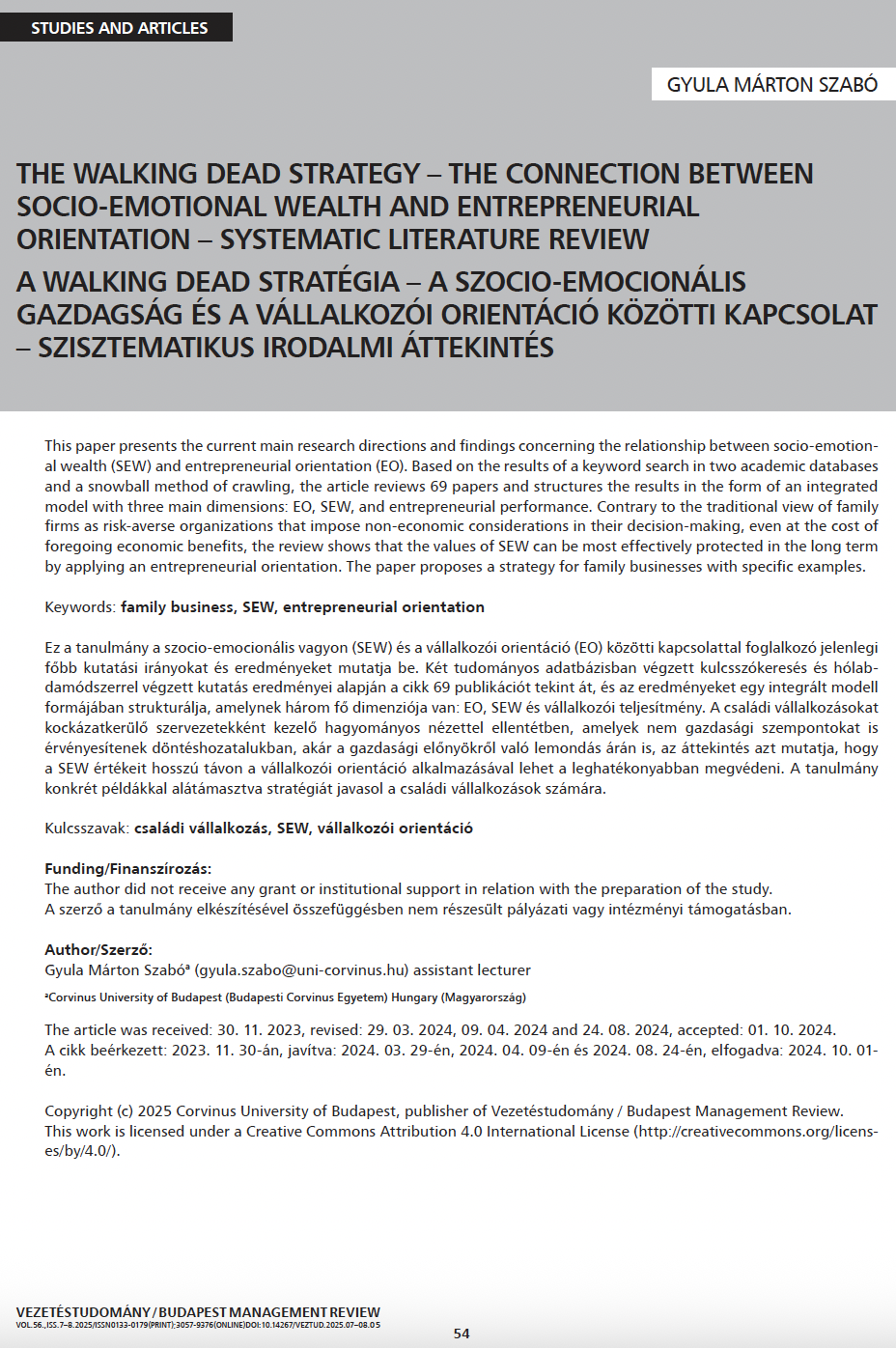
A Walking Dead stratégia – a szocio-emocionális gazdagság és a vállalkozói orientáció közötti kapcsolat
Szisztematikus irodalmi áttekintés
DOI:
https://doi.org/10.14267/VEZTUD.2025.07-08.05Kulcsszavak:
családi vállalkozás, SEW, vállalkozói orientációAbsztrakt
Ez a tanulmány a szocio-emocionális vagyon (SEW) és a vállalkozói orientáció (EO) közötti kapcsolattal foglalkozó jelenlegi főbb kutatási irányokat és eredményeket mutatja be. Két tudományos adatbázisban végzett kulcsszókeresés és hólabdamódszerrel végzett kutatás eredményei alapján a cikk 69 publikációt tekint át, és az eredményeket egy integrált modell formájában strukturálja, amelynek három fő dimenziója van: EO, SEW és vállalkozói teljesítmény. A családi vállalkozásokat kockázatkerülő szervezetekként kezelő hagyományos nézettel ellentétben, amelyek nem gazdasági szempontokat is érvényesítenek döntéshozatalukban, akár a gazdasági előnyökről való lemondás árán is, az áttekintés azt mutatja, hogy a SEW értékeit hosszú távon a vállalkozói orientáció alkalmazásával lehet a leghatékonyabban megvédeni. A tanulmány konkrét példákkal alátámasztva stratégiát javasol a családi vállalkozások számára.
Downloads
Hivatkozások
Abdelwahed, Y., & Basly, S. (2023). Entrepreneurial orientation, commitment to learning and family bussiness resilience – exploring the moderating effect of family firm identity fit. Journal of Enterprising Culture. 31(02), 179-209. https://doi.org/10.1142/S0218495823500061
Bauweraerts, J., & Colot, O. (2023). Is innovativeness always beneficial in family SMEs? The moderating role of generational stage. International Journal of Entrepreneurship and Small Business, 48(2), 101-127. https://doi.org/10.1504/IJESB.2023.128341
Berrone, P., Cruz, C. & Gomez-Meija, R. (2012). Socioemotional wealth in family firms: theoretical dimensions, assessment approaches, and agenda for future research. Family Business Review, 25(3), 258-279. https://doi.org/10.1177/0894486511435355
Brundin, E., McClatchey, I.S., & Melin, L. (2023). Leaving the family business: The dynamics of psychological ownership. Journal of Family Business Strategy, 14(2). 100555. https://doi.org/10.1016/j.jfbs.2023.100555
Bujan, I. (2020). Entrepreneurial orientation and socioemotional dimensions in small family hotels: do they impact business performance? Economic Research- Ekonomska Istraživanja, 33(1), 1925-1942. https://doi.org/10.1080/1331677X.2020.1763824
Calabrò, A., Torchia, M., Kallmuenzer, A., Yezza, H., & Feng, C. (2023). Transgenerational entrepreneurship in family firms: a configurational approach. Review of Managerial Science, 17(7), 2535-2554. https://doi.org/10.1007/s11846-022-00592-y
Casado-Belmonte, M.D.P., Capobianco-Uriarte, M.D.L.M., Martínez-Alonso, R., & Martínez-Romero, M.J. (2021). Delineating the path of family firm innovation: mapping the scientific structure. Review of Managerial Science, 15(8), 2455-2499. https://doi.org/10.1007/s11846-021-00442-3
Casillas, J.C., Moreno, A.M., & Barbero, J.L. (2011). Entrepreneurial orientation of family firms: Family and environmental dimensions. Journal of Family Business Strategy, 2(2), 90–100. https://doi.org/10.1016/j.jfbs.2011.03.002
Chandler, J.A., Zachary, M.A., Brigham, K.H., & Tyge, G. (2016). Long-Term Orientation: Reviewing the Past and Identifying Future Opportunities for Family Business Research. In Kellermanns, F., & Hoy, F. (Eds.), Routledge Companion to Family Business (pp. 70-89). Routledge.
Chen, S., Wu, B., Zhongju Liao, Z., & Chen, L. (2022): Does familial decision control affect the entrepreneurial orientation of family firms? The moderating role of family relationships. Journal of Business Research. 152(10), 60-69. https://doi.org/10.1016/j.jbusres.2022.07.014
Covin J.G., & Slevin D.P. (1989). Strategic management of small firms in hostile and benign environments. Strategic Management Journal, 10(1), 75–87. https://doi.org/10.1002/smj.4250100107
Csedő, Z. (2023). Sustainability change management in inter-organizational innovation networks. Society and Economy, 45(4), 355-371. https://doi.org/10.1556/204.2023.00011
D’Allura, G.M. (2019). The leading role of the top management team in understanding family firms: Past research and future directions. Journal of Family Business Strategy, 10(2), 87-104. https://doi.org/10.1016/j.jfbs.2018.12.001
Debicki, B.J., Kellermanns, F.W., Chrisman, J.J., Pearson, A.W., & Spencer, B.A. (2016). Development of a socioemotional wealth importance (SEWi) scale for family firm research. Journal of Family Business Strategy, 7(1), 47-57. https://doi.org/10.1002/smj.4250100107
Debiczki, B.J., Ramirez-Solís, E.R., Banos-Monroy, V.I., & Gutierrez-Patron, L.M. (2020). The impact of strategic focus on relational capital: A comparative study of family and non-family firms. Journal of Business Research, 119, 585-598. https://doi.org/10.1016/j.jbusres.2020.07.016
Denicolai, S., Hagen, B., & Pisoni, A. (2015). Be international or be innovative? Be both? The role of the entrepreneurial profile. Journal of International Entrepreneurship, 13, 390-417. https://doi.org/10.1007/s10843-015-0143-y
Ferreira, J.J., Fernandes, C.I., & Ratten, V. (2017). Entrepreneurship, innovation and competitiveness: what is the connection? International Journal of Business and Globalisation, 18(1), 73-95. https://doi.org/10.1504/IJBG.2017.081030
Garcés-Galdeano, L., Larraza-Kintana, M., García-Olaverri, C., & Makri, M. (2014). Entrepreneurial orientation in family firms: the moderating role of technological intensity and performance. International Entrepreneurship and Management Journal, 12(1), 27–45. https://doi.org/10.1007/s11365-014-0335-2
Gómez-Mejía, L.R., Haynes, K.T., Núñez-Nickel, M., Jacobson, K.J., & Moyano-Fuentes, J. (2007). Socioemotional wealth and business risks in family-controlled firms: Evidence from Spanish olive oil mills. Administrative Science Quarterly, 52(1), 106-137. https://doi.org/10.2189/asqu.52.1.106
Glowka, G., Kallmünzer, A., & Zehrer, A. (2021). Enterprise risk management in small and medium family enterprises: the role of family involvement and CEO tenure. International Entrepreneurship and Management Journal, 17, 1213-1231. https://doi.org/10.1007/s11365-020-00682-x
Haddoud, M.Y., Onjewu, A.K.E., Nowiński, W., & Jones, P. (2021). The determinants of SMEs’ export entry: A systematic review of the literature. Journal of Business Research, 125, 262-278. https://doi.org/10.1016/j.jbusres.2020.12.017
Hart, C. (2018). Doing a literature review: releasing the research imagination (SAGE Study Skills Series). Sage Publications.
Hauck, J., Suess-Reyes, J., Beck, S., Prügl, R., & Frank, H. (2016). Measuring socioemotional wealth in family-owned and -management firms: A validation and short form of the FIBER Scale. Journal of Familiy Business Strategy, 7(3), 133-148. https://doi.org/10.1016/j.jfbs.2016.08.001
Hernandes-Linares, R., & López-Fernandes, M.C. (2018). Entrepreneurial orientation and the family firm: mapping the field and tracing a path for future research. Family Business Review, 31(3) https://doi.org/10.1177/0894486518781940
Hernández-Linares, R., Kellermanns, F.W., López-Fernández, M.C., & Sarkar, S. (2020). The effect of socioemotional wealth on the relationship between entrepreneurial orientation and family business performance. Business Research Quarterly, 23(3) 174-192. https://doi.org/10.1177/2340944420941438
Hernández-Perlines, F., Covin, J.G., & Ribeiro-Soriano, D.E. (2021). Entrepreneurial orientation, concern for socioemotional wealth preservation, and family firm performance. Journal of Business Research, 126, 197- 208. https://doi.org/10.1016/j.jbusres.2020.12.050
Hofmeister-Tóth, Á., & Kisfürjesi, N. (2022). Fogyasztói magatartás a likvid modernitásban – szakirodalmi áttekintés a likvid fogyasztásról. Vezetéstudomány/Budapest Management Review, 53(8-9), 30-41. https://doi.org/10.14267/VEZTUD.2022.08-09.03
Hooda, A., Gupta, P., Jeyaraj, A., Giannakis, M., & Dwivedi, Y.K. (2022). The effects of trust on behavioral intention and use behavior within e-government contexts. International Journal of Information Management, 67, 102553. https://doi.org/10.1016/j.ijinfomgt.2022.102553
Ingram, T. & Bratnicka-Myśliwiec, K. (2021). Organizational resilience and family firm performance: the role of socioemotional wealth. European Research Studies Journal, 24(3), 523-540. https://doi.org/10.35808/ersj/2369
Jimenez-Jimenez, D., Sanz-Valle, R., & Perez-Caballero, A.P. (2020). Entrepreneurial orientation and innovation succes in family firms. Entrepreneurship and Small Businesses, 40(1), 114-127. https://doi.org/10.1504/IJESB.2020.106941
Johanson, J., & Wierdersheim-Paul, F. (1975). The internationalization of the firm – four Swedish cases. Journal of Management Studies, 12(3), 305-323. https://doi.org/10.1111/j.1467-6486.1975.tb00514.x
Kallmuenzer, A. (2015). Agency costs in family firms and their influence on the EO-performance relationship. Academy of Management, 1. https://doi.org/10.5465/ambpp.2015.16601abstract
Kallmuenzer, A., Strobl, A., & Peters, M. (2017). Tweaking the entrepreneurial orientation–performance relationship in family firms: the effect of control mechanisms and family-related goals. Review of Managerial Science, 12, 855-883. https://doi.org/10.1007/s11846-017-0231-6
Kallmuenzer, A., Hora, W., & Peters, M. (2018). Strategic decision-making in family firms: an explorative study. European Journal of International Management, 12(5-6), 655-675. https://doi.org/10.1504/EJIM.2018.094497
Kallmuenzer, A., Zach, F.J., Wachter, T., Kraus, S., & Salner, P. (2021). Antecedents of coopetition in small and medium-sized hospitality firms. International Journal of Hospitality Management, 99, 103076. https://doi.org/10.1016/j.ijhm.2021.103076
Kraus, S., Mensching, H., Calabrò, A., Cheng, C.F., & Filser, M. (2016). Family firm internationalization: A configurational approach. Journal of Business Research, 69(11), 5473-5478. https://doi.org/10.1016/j.jbusres.2016.04.158
Kumar, R.K. & Dubey, A.K. (2022). Family-owned enterprises and their role in entrepreneurial development: a bibliometric and content analysis of the literature. Journal of Asia Business Studies, 16(5), 802-832. https://doi.org/10.1108/JABS-02-2021-0062
Labaki, R., & Mustafa, M.J. (2023). The family effect: a compass for research on heterogeneity of family businesses in embedded contexts. Entrepreneurship Research Journal, 13(3), 533-548. https://doi.org/10.1515/erj-2023-0221
Le Breton-Miller, I., Miller, D., & Bares, F. (2015). Governance and entrepreneurship in family firms: Agency, behavioral agency and resource-based comparisons. Journal of Family Business Strategy, 6(1), 58–62. https://doi.org/10.1016/j.jfbs.2014.10.002
Le Breton-Miller, I., Miller, D. (2023). Contradiction and disaggregation for family firm research. Journal of Family Business Strategy, 14(1), 100533. https://doi.org/10.1016/j.jfbs.2022.100533
Lorti, J., Cox, K.C., & Sproul, C. (2021). Toward a theory of entrepreneurial differentiation: how entrepreneurial firms compete. International Entrepreneurship ad Management Journal, 17, 1291–1312. https://doi.org/10.1007/s11365-020-00716-4
Lumpkin, G.T., & Dess, G.G. (1996). Clarifying the entrepreneurial orientation construct and linking it to performance. Academy of Management Review, 21(1), 135-172. https://doi.org/10.5465/amr.1996.9602161568
Martínez-Alonso, R., Martínez-Romero, M.J., & Rojo-Ramírez, A.A. (2018). Technological innovation and socioemotional wealth in family firm research. Journal of the Iberoamerican Academy of Management, 16(3), 270-301. https://doi.org/10.1108/MRJIAM-01-2018-0803
Meneses, R., Coutinho, R., & Carlos Pinho, J. (2014). The impact of succession on family business internationalisation: The successors’ perspective. Journal of Family Business Management, 4(1), 24-45. https://doi.org/10.1108/JFBM-01-2013-0004
Miller, D. (1983). The collerates of entrepreneurship in three types of firms. Management Science, 29(7), 770– 792. https://doi.org/10.1287/mnsc.29.7.770
Moreno-Menéndez, A.M., Casillas, J.C. (2021). How do family businesses grow? Differences in growth patterns between family and non-family firms. Journal of Family Business Strategy, 12(3), 100420. https://doi.org/10.1016/j.jfbs.2021.100420
Moreno-Menéndez, A.M., Arzubiaga, U., Díaz-Moriana, V., & Casillas, J.C. (2022). The impact of a crisis on entrepreneurial orientation of family firms: The role of organisational decline and generational change. International Small Business Journal, 40(4), 425-452. https://doi.org/10.1177/02662426211036694
Ng, P.Y., Dayan, M., & Di Benedetto, A. (2019). Performance in family firm: Influences of socioemotional wealth and managerial capabilities. Journal of Business Research, 102, 178-190. https://doi.org/10.1016/j.jbusres.2019.05.026
Pistrui, B., & Harmat, V. (2022). Defining and applying service robots in business organisations – a systematic literature review. Vezetéstudomány/Budapest Management Review, 53(1), 58-68 https://doi.org/10.14267/VEZTUD.2022.01.05
Ramírez-Solís, E.R., Mojarro-Durán, B.I., & Banos-Monroy, V.I. (2023). Family social capital as a mediator between socioemotional wealth and entrepreneurial orientation: evidence from Mexican SMEs. Managemenet Research, 22(2), 159-177. https://doi.org/10.1108/MRJIAM-04-2023-1413
Reina, W., Pla-Barber, J., & Villar, C. (2022). Socioemotional wealth in family business research: A systematic literature review on its definition, roles and dimensions. European Management Journal, 41(6), 1000-1020. https://doi.org/10.1016/j.emj.2022.10.009
Rodrigues, P.P., Pai, P.K., Joshi, H.G., & Prabhu, K.P.N. (2022). Influence of socio-emotional wealth on entrepreneurial orientation in family firms: a bibliometric analysis and systematic review. Business Perspectives and Research, 13(2), 206-225. https://doi.org/10.1177/22785337221098484
Sallay, V., Wieszt, A., & Martos, T. (2023). A kapcsolatok szabályozási folyamatainak szerepe a családi vállalkozások utódlása során: Egy kvalitatív kutatás tapasztalatai. Vezetéstudomány/Budapest Management Review, 54(1), 27-37. https://doi.org/10.14267/VEZTUD.2023.01.03
Sanchez-Famoso, V., Cano-Rubio, M., & Fuentes-Lombardo, G. (2019). The role of cooperation agreements in the internationalization of Spanish winery and olive oil family firms. International Journal of Wine Business Research, 31(4), 555-577. https://doi.org/10.1108/IJWBR-08-2018-0042
Simmons, C., & Kalantaridis, C. (1996). Making garments in Southern Europe: Entrepreneurship and labour in rural Greece. Journal of Rural Studies, 12(2), 169–185. https://doi.org/10.1016/0743-0167(96)00007-1
Singal, M., & Batra, S. (2021). The role of socioemotional wealth and entrepreneurial orientation in family-managed hotels. Journal of Hospitality and Tourism Management, 49, 204-213. https://doi.org/10.1016/j.jhtm.2021.09.012
Singh, R., & Kota, H.B. (2017). A resource dependency framework for innovation and internationalization of family businesses: evidence from India. Journal of Entrepreneurship in Emerging Economies, 9(2), 207-231. https://doi.org/10.1108/JEEE-04-2016-0013
Stanley, J.L., Hernandes-Linares, R., López-Fernandez, M.C., & Kellermanns, F.W. (2019). A typology of family firms: an investigation of entrepreneurial orientation and performance. Family Business Review, 32(2), 174-194. https://doi.org/10.1177/0894486519838120
Szabó, G.M. (2023). Family firms in the maelstrom of international market entry and innovation – can socio- emotional wealth (SEW) and entrepreneurial orientation (EO) be reconsiled? Society and Economy, 45(4), 432-450. https://doi.org/10.1556/204.2023.00019
Tajeddini, K., Altinay, L., & Ratten, V. (2017). Service innovativeness and the structuring of organizations: The moderating roles of learning orientation and inter- functional coordination. International Journal of Hospitality Management, 65, 100-114. https://doi.org/10.1016/j.ijhm.2017.06.010
Transfield, D., Denyer, D., & Smart, P. (2003). Towards a methodology for development evidence-informed management knowledge by means of systematic review. British Journal of Management, 14(3), 207-222.
Tuirán-Álvarez, K.Y., Sanabria-Landazábal, N.J., & Acosta- Prado, J.C. (2019). Family businesses, risk and adverse selection in the agency relationship. Dimensión Empresarial, 17(3), 104-128. https://doi.org/10.15665/dem.v17i3.2041
Van Helvert, J., & Nordqvist, M. (2018). Entrepreneurship from a family business perspective. In Blackburn, R., De Clercq, D., & Heinonen, J. (Eds.), The Sage Handbook of Small Business and Entrepreneurship (pp. 107-123). SAGE Publications.
Ventel, E., & Farrington, S. (2021). Entrepreneurial orientation as a source f heterogeneity in African family businesses. In Re-Imagining Management Research (pp. 768-783). NWU.
Wang, L., Tang, Y., Chen, Y., & Wang, K. (2021). Be a better boss. Employee treatment, trust level and family business innovation: Evidence from China. Research in International Business and Finance, 58, 101503. https://doi.org/10.1016/j.ribaf.2021.101503
Webster, J., & Watson, R.T. (2002). Analyzing the past to prepare for the future: writing a literature review. MIS Quarterly, 26(2), 13-23. https://doi.org/10.2307/4132319
Wegapitiya, W.K.H (2021). Managing in the long run in family businesses: factors influencing trans-generational continuity. Sri Lankan Journal of Management, 26(2), 99-124. https://doi.org/10.33939/SLJM.27.02.04.2021
Wieszt, A., & Drótos, G. (2019). Családi vállalkozások Magyarországon. In Társadalmi Riport 2019 (pp. 233- 247). TÁRKI.
Wieszt, A. (2020). „Fontos, hogy mi családi cég vagyunk?” – családi vállalkozási identitás és teljesítmény. Vezetéstudomány/Budapest Management Review, 51(2), 60-73. https://doi.org/10.14267/VEZTUD.2020.02.05
Wieszt, A., Martos, T., & Sallay, V. (2021). Családi vállalatok utódlása Magyarországon. Kutatási jelentés összefoglalója. Budapesti Corvinus Egyetem. https://unipub.lib.uni-corvinus.hu/7093/1/ResearchReport_hu_short.pdf
Woldesenbet, K., & Murithi, W. (2019). Firms’ contribution to regional economic development: unravelling some explanatory and moderating variables. EURAM. https://www.academia.edu/69610767/Firms_Contribution_to_Regional_Economic_Development_Unravelling_Some_Explanatory_and_Moderating_Variables
Yildirim-Öktem, Ö., Erdogan, I., Calabrò, A., & Kiratli, O.S. (2023). Effect of environmental dynamism on entrepreneurial orientation in family firms: the moderating role of informal institutions. Journal of Family Business Management, 13(4), 1277-1305. https://doi.org/10.1108/JFBM-11-2022-0128
Zahra, S.A. (2018). Entrepreneurial risk taking in family firms: The wellspring of the regenerative capability. Family Business Review, 31(2), 216-226. https://doi.org/10.1177/0894486518776871
Zellweger, T.M., & Astrachan, J.H. (2008). On the emotional value of owning a firm. Family Business Review, 21(4), 347-363. https://doi.org/10.1111/j.1741-6248.2008.00129.x
Zellweger, T.M, Nason, R.S., & Nordquist, M. (2012). From longevity of firms to transgenerational entrepreneurship of families: introducing faily entrepreneurial orientation. Family Business Review, 25(2), 136-155. https://doi.org/10.1177/0894486511423531
Letöltések
Megjelent
Folyóirat szám
Rovat
License
Copyright (c) 2025 Corvinus University of Budapest, publisher of Vezetéstudomány / Budapest Management Review

This work is licensed under a Creative Commons Attribution 4.0 International License.
Authors assign copyright to Vezetéstudomány / Budapest Management Review. Authors are responsible for permission to reproduce copyright material from other sources.
Hogyan kell idézni