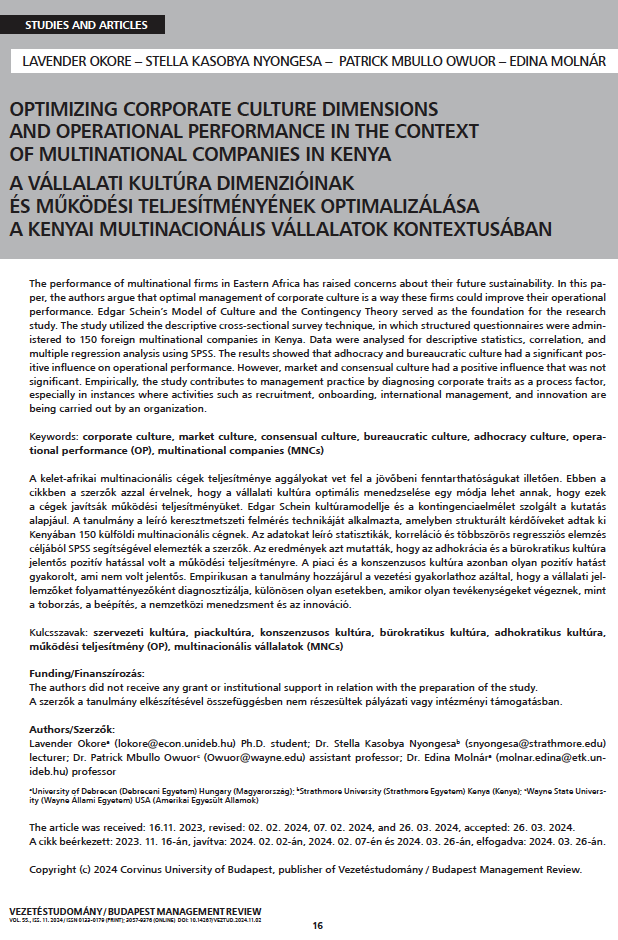
A vállalati kultúra dimenzióinak és működési teljesítményének optimalizálása a kenyai multinacionális vállalatok kontextusában
DOI:
https://doi.org/10.14267/VEZTUD.2024.11.02Kulcsszavak:
szervezeti kultúra, piackultúra, konszenzusos kultúra, bürokratikus kultúra, adhokratikus kultúra, működési teljesítmény (OP), multinacionális vállalatok (MNCs)Absztrakt
A kelet-afrikai multinacionális cégek teljesítménye aggályokat vet fel a jövőbeni fenntarthatóságukat illetően. Ebben a cikkben a szerzők azzal érvelnek, hogy a vállalati kultúra optimális menedzselése egy módja lehet annak, hogy ezek a cégek javítsák működési teljesítményüket. Edgar Schein kultúramodellje és a kontingenciaelmélet szolgált a kutatás alapjául. A tanulmány a leíró keresztmetszeti felmérés technikáját alkalmazta, amelyben strukturált kérdőíveket adtak ki Kenyában 150 külföldi multinacionális cégnek. Az adatokat leíró statisztikák, korreláció és többszörös regressziós elemzés céljából SPSS segítségével elemezték a szerzők. Az eredmények azt mutatták, hogy az adhokrácia és a bürokratikus kultúra jelentős pozitív hatással volt a működési teljesítményre. A piaci és a konszenzusos kultúra azonban olyan pozitív hatást gyakorolt, ami nem volt jelentős. Empirikusan a tanulmány hozzájárul a vezetési gyakorlathoz azáltal, hogy a vállalati jellemzőket folyamattényezőként diagnosztizálja, különösen olyan esetekben, amikor olyan tevékenységeket végeznek, mint a toborzás, a beépítés, a nemzetközi menedzsment és az innováció.
Downloads
Hivatkozások
Adam, A.M. (2020). Sample size determination in survey research. Journal of Scientific Research and Reports, 26(5), 90-97. https://doi.org/10.9734/jsrr/2020/v26i530263
Alatawi, I.A., Ntim, C.G., Zras, A., & Elmagrhi, M.H. (2023). CSR, financial and non-financial performance in the tourism sector: A systematic literature review and future research agenda. International Review of Financial Analysis, 89, 102734. https://doi.org/10.1016/j.irfa.2023.102734
Andreas, A., & Gumanti, T.A. (2022). Organizational culture and company values: a cross-sectional study on public companies in Indonesia. Jurnal Siasat Bisnis, 27(1), 76-85. https://doi.org/10.20885/jsb.vol27.iss1.art6
Annosi, M.C., Martini, A., Brunetta, F., & Marchegiani, L. (2020). Learning in an agile setting: A multilevel research study on the evolution of organizational routines. Journal of Business Research, 110, 554-566. https://doi.org/10.1016/j.jbusres.2018.05.011
Bagga, S.K., Gera, S., & Haque, S.N. (2023). The mediating role of organizational culture: Transformational leadership and change management in virtual teams. Asia Pacific Management Review, 28(2), 120- 131. https://doi.org/10.1016/j.apmrv.2022.07.003
Behie, S.W., Pasman, H.J., Khan, F.I., Shell, K., Alarfaj, A., El-Kady, A.H., & Hernandez, M. (2023). Leadership 4.0: The changing landscape of industry management in the smart digital era. Process Safety and Environmental Protection, 172, 317-328. https://doi.org/10.1016/j.psep.2023.02.014
Berson, Y., Oreg, S., & Dvir, T. (2008). CEO values, organizational culture and firm outcomes. Journal of Organizational Behavior: The International Journal of Industrial, Occupational and Organizational Psychology and Behavior, 29(5), 615-633. https://doi.org/10.1002/job.499
Berti, M., & Simpson, A.V. (2021). The dark side of organizational paradoxes: The dynamics of disempowerment. The Academy of Management Review, 46(2), 252-274. https://doi.org/10.5465/amr.2017.0208
Bhagwat, R., & Sharma, M.K. (2007). Performance measurement of supply chain management: A balanced scorecard approach. Computers & I ndustrial E ngineering, 53(1), 43-62. https://doi.org/10.1016/j.cie.2007.04.001
Billings, M.B., Klein, A., & Shi, Y.C. (2022). Investors’ response to the #MeToo movement: does corporate culture matter? Review of Accounting Studies, 27(3), 897-937. https://doi.org/10.1007/s11142-022-09695-z
Blumberg, B., Cooper, D., & Schindler, P. (2014). Business research methods. McGraw Hill.
Bukoye, O.T., & Abdulrahman, A.H. (2023). Organizational culture typologies and strategy implementation: Lessons from nigerian local government. Policy Studies, 44(3), 316-335. https://doi.org/10.1080/01442872.2022.2051467
Calciolari, S., & Prenestini, A. (2022). Values-based methods for measuring organizational culture: logic, evidence and critique. Edward Elgar Publishing Limited. http://dx.doi.org/10.4337/9781788976268
Carlos Pinho, J., Paula Rodrigues, A., & Dibb, S. (2014). The role of corporate culture, market orientation and organisational commitment in organisational performance: The case of non-profit organisations. Journal of Management Development, 33(4), 374-398. https://doi.org/10.1108/JMD-03-2013-0036
Carvalho, A.M., Sampaio, P., Rebentisch, E., McManus, H., Carvalho, J.Á, & Saraiva, P. (2023). Operational excellence, organizational culture, and agility: Bridging the gap between quality and adaptability. Total Quality Management & Business Excellence, 34(11- 12), 1598-1628. https://doi.org/10.1080/14783363.2023.2191844
Chao, M.M., Takeuchi, R., & Farh, J. (2017). Enhancing cultural intelligence: The roles of implicit culture beliefs and adjustment. Personnel Psychology, 70(1), 257-292. https://doi.org/10.1111/peps.12142
Chau, T.L.D., Thach, K.S.R., Nguyễn, Q.T., Nguyen, T.N.H., & Nguyen, P.T.A. (2021). Study on corporate culture of Vietnamese enterprises: An approach of denison’s model. Can Tho University Journal of Science, 13(2), 12-19. https://doi.org/10.22144/ctu.jen.2021.025
Cherian, J., Gaikar, V., Paul, R., & Pech, R. (2021). Corporate culture and its impact on employees’ attitude, performance, productivity, and behavior: An investigative analysis from selected organizations of the United Arab Emirates (UAE). Journal of Open Innovation, 7(1), 1-27. https://doi.org/10.3390/joitmc7010045
Dalton, D.R., Todor, W.D., Spendolini, M.J., Fielding, G.J., & Porter, L.W. (1980). Organization structure and performance: A critical review. Academy of Management Review, 5(1), 49-64. https://doi.org/10.5465/amr.1980.4288881
De Toni, A., & Tonchia, S. (2001). Performance measurement systems-models, characteristics and measures. International Journal of Operations & Production Management, 21(1/2), 46-71. https://doi.org/10.1108/01443570110358459
Deshpandé, R., Farley, J.U., & Webster Jr, F.E. (1993). Corporate culture, customer orientation, and innovativeness in Japanese firms: a quadrad analysis. Journal of Marketing, 57(1), 23-37. https://doi.org/10.1177/002224299305700102
Dosoglu-Guner, B. (2001). Can organizational behavior explain the export intention of firms? The effects of organizational culture and ownership type. International Business Review, 10(1), 71-89. https://doi.org/10.1016/S0969-5931(00)00040-8
Fang, Y., Fiordelisi, F., Hasan, I., Leung, W.S., & Wong, G. (2023). Corporate culture and firm value: Evidence from crisis. Journal of Banking & Finance, 146, 106710. https://doi.org/10.1016/j.jbankfin.2022.106710
Fiedler, F.E. (1964). A contingency model of leadership effectiveness. Advances in Experimental Social Psychology, 1, 149-190. https://doi.org/10.1016/S0065-2601(08)60051-9
Fiedler, F. (2015). Contingency theory of leadership. Routledge.
García‐Morales, V.J., Lloréns‐Montes, F.J., & Verdú‐Jover, A.J. (2008). The effects of transformational leadership on organizational performance through knowledge and innovation. British Journal of Management, 19(4), 299-319. https://doi.org/10.1111/j.1467-8551.2007.00547.x
Gorton, G.B., & Zentefis, A.K. (2023). Social progress and corporate culture. Industrial and Corporate Change, 32(3), 733-754. https://doi.org/10.1093/icc/dtac042
Graham, J.R., Grennan, J.A., Harvey, C.R., & Rajgopal, S. (2022). Corporate culture: The interview evidence. Journal of Applied Corporate Finance, 34(4), 22-41. https://doi.org/10.1111/jacf.12528
Guiso, L., Sapienza, P., & Zingales, L. (2015). The value of corporate culture. Journal of Financial Economics, 117(1), 60-76. https://doi.org/10.1016/j.jfineco.2014.05.010
Gupta, A.K., & Gupta, N. (2020). Effect of corporate environmental sustainability on dimensions of firm performance –Towards sustainable development: Evidence from India. Journal of Cleaner Production, 253, 119948. https://doi.org/10.1016/j.jclepro.2019.119948
Hameed, W.U., Nisar, Q.A., & Wu, H. (2021). Relationships between external knowledge, internal innovation, firms’ open innovation performance, service innovation and business performance in the pakistani hotel industry. International Journal of Hospitality Management, 92, 102745. https://doi.org/10.1016/j.ijhm.2020.102745
Hancock, D.R., Algozzine, B., & Lim, J.H. (2021). Doing case study research: A practical guide for beginning researchers. Teachers College Press.
Harris, L.C., & Ogbonna, E. (2011). Antecedents and consequences of management-espoused organizational cultural control. Journal of Business Research, 64(5), 437-445. https://doi.org/10.1016/j.jbusres.2010.03.002
Hetzner, S., Heid, H., & Gruber, H. (2012). Change at work and professional learning: How readiness to change, self-determination and personal initiative affect individual learning through reflection. European Journal of Psychology of Education, 27, 539-555. https://doi.org/10.1007/s10212-011-0094-1
Hofstede, G. (2011). Dimensionalizing cultures: The Hofstede model in context. Online Readings in Psychology and Culture, 2(1), 8. https://doi.org/10.9707/2307-0919.1014
Holub, R., Ignatieva, І, Serbenivska, A., & Sydorenko, T. (2021). Corporate culture of companies in the conditions of transformations. Fìnansovo-Kreditna Dìâlʹnìstʹ: Problemi Teorìì̈ Ta Praktiki (Online), 4(39), 541-549. https://doi.org/10.18371/fcaptp.v4i39.241441
Joseph, O.O., & Kibera, F. (2019). Organizational culture and performance: Evidence from microfinance institutions in Kenya. SAGE Open, 9(1), 2158244019835934. https://doi.org/10.1177/2158244019835934
Jung, J. (2022). The effect of authentic leadership of deans and directors on sustainable organizational commitment at universities: Mediated by organizational culture and trust. Sustainability, 14(17), 11051. https://doi.org/10.3390/su141711051
Kaplan, R.S., & Norton, D.P. (2001). Transforming the balanced scorecard from performance measurement to strategic management: Part I. Accounting Horizons, 15(1), 87-104. https://doi.org/10.2308/acch.2001.15.1.87
Kerr, J., & Slocum Jr, J.W. (2005). Managing corporate culture through reward systems. Academy of Management Perspectives, 19(4), 130-138. https://doi.org/10.5465/ame.2005.19417915
Khosravani, M., Khosravani, M., Borhani, F., & Mohsenpour, M. (2020). The relationship between moral intelligence and organizational commitment of nurses. Clinical Ethics, 15(3), 126-131. https://doi.org/10.1177/1477750920908008
Kosiciarova, I., Kadekova, Z., & Starchon, P. (2021). Leadership and motivation as important aspects of the international company’s corporate culture. Sustainability, 13(7), 3916. https://doi.org/10.3390/su13073916
Kotabe, M.M., & Helsen, K. (2022). Global marketing management. John Wiley & Sons.
Krizanova, A., & Michulek, J. (2022). Does corporate culture and leadership influence employee work performance? Evidence from the Slovak Republic. Economic and Managerial Spectrum, 16(2), 37-48. https://doi.org/10.26552/ems.2022.2.37-48
Lenz, R.T. (1981). ‘Determinants’ of organizational performance: An interdisciplinary review. Strategic Management Journal, 2(2), 131-154. https://doi.org/10.1002/smj.4250020204
Li, J., Lam, K., & Qian, G. (2001). Does culture affect behavior and performance of firms? The case of joint ventures in China. Journal of International Business Studies, 32, 115-131. https://doi.org/10.1057/palgrave.jibs.8490941
Lorincová, S., Miklošík, A., & Hitka, M. (2022). The role of corporate culture in economic development of small and medium-sized enterprises. Technological and Economic Development of Economy, 28(1), 220-238. https://doi.org/10.3846/tede.2021.15983
Low, J., & Siesfeld, T. (1998). Measures that matter: Nonfinancial performance. Strategy & Leadership, 26(2), 24-38. https://doi.org/10.1108/eb054615
Lund, D.B. (2003). Organizational culture and job satisfaction. Journal of Business & Industrial Marketing, 18(3), 219-236. https://doi.org/10.1108/0885862031047313
Michulek, J., Gajanova, L., Krizanova, A., & Nadanyiova, M. (2023). Determinants of improving the relationship between corporate culture and work performance: Illusion or reality of serial mediation of leadership and work engagement in a crisis period? Frontiers in Psychology, 14, 1135199. https://doi.org/10.3389/fpsyg.2023.1135199
Mihajlovski, G. (2023). Human resource management in unprofitable companies. International Journal of Scholarly Research and Reviews, 2(2), 118–121. https://doi.org/10.56781/ijsrr.2023.2.2.0050
Moonen, P. (2017). The impact of culture on the innovative strength of nations: A comprehensive review of the theories of Hofstede, Schwartz, Boisot and Cameron and Quinn. Journal of Organizational Change Management, 30(7), 1149-1183. https://doi.org/10.1108/JOCM-08-2017-0311
Nauffal, D., & Nader, J. (2022). Organizational cultures of higher education institutions operating amid turbulence and an unstable environment: The Lebanese case. Higher Education, 84(2), 343-371. https://doi.org/10.1007/s10734-021-00771-y
Newman, A., Prajogo, D., & Atherton, A. (2016). The influence of market orientation on innovation strategies. Journal of Service Theory and Practice, 26(1), 72-90. https://doi.org/10.1108/JSTP-02-2015-0044
Nguyen, T.H.H., Ntim, C.G., & Malagila, J.K. (2020). Women on corporate boards and corporate financial and non-financial performance: A systematic literature review and future research agenda. International Review of Financial Analysis, 71, 101554. https://doi.org/10.1016/j.irfa.2020.101554
Odhiambo, J.O. (2014). Organizational culture, marketing capabilities, market orientation, industry competition and performance of microfinance institutions in Kenya [Ph.D. Thesis]. University of Nairobi. http://erepository.uonbi.ac.ke/bitstream/handle/11295/76112/Odhiambo_Organizational%20culture,%20marketing%20capabilities.pdf?sequence=2
Odhiambo, O.J., Kibera, F., & Musyoka, R. (2015). Organizational culture, industry competition and performance of microfinance institutions in kenya. DBA Africa Management Review, 5(2). http://journals.uonbi.ac.ke/damr/article/view/1300/1099
Onyango, G., Ondiek, J.O. (2021). Digitalization and Integration of Sustainable Development Goals (SGDs) in Public Organizations in Kenya. Public Organization Review, 21, 511–526. https://doi.org/10.1007/s11115-020-00504-2
Opoku, E.O., Hongqin, C., & Aram, S.A. (2022). The influence of organizational culture on employee performance in the banking sector: Evidence from GCB Bank, Ghana. European Journal of Business and Management Research, 7(2), 168-175. https://doi.org/10.24018/ejbmr.2022.7.2.1345
Petheő, A., Szabó, K., & Nagy, K. Á. (2023). Second-round entrants and winners of the ‘Future Hungarian Multinationals’ in terms of financial, regional and organizational culture. Vezetéstudomány/Budapest Management Review, 54(12), 66–78. https://doi.org/10.14267/VEZTUD.2023.12.06
Quinn, R., & Cameron, K. (1999). Diagnosing and changing organizational culture. Wiley Online Library.
Rokicki, T., Bórawski, P., Bełdycka-Bórawska, A., Szeberényi, A., & Perkowska, A. (2022). Changes in logistics activities in poland as a result of the COVID-19 pandemic. Sustainability, 14(16), 10303. https://doi.org/10.3390/su141610303
Saini, S., & Singh, D. (2020). Impact of implementing lean practices on firm performance: a study of Northern India SMEs. International Journal of Lean Six Sigma, 11(6), 1005-1034. https://doi.org/10.1108/IJLSS-06-2019-0069
San Park, J., & Kim, T.H. (2009). Do types of organizational culture matter in nurse job satisfaction and turnover intention? Leadership in Health Services, 22(1), 20 38. https://doi.org/10.1108/17511870910928001
Schein, E. H. (2010). Organizational culture and leadership. John Wiley & Sons.
Scott, T., Mannion, R., Davies, H., & Marshall, M. (2003). The quantitative measurement of organizational culture in health care: a review of the available instruments. Health Services Research, 38(3), 923-945. https://doi.org/10.1111/1475-6773.00154
Soomro, B.A., & Shah, N. (2019). Determining the impact of entrepreneurial orientation and organizational culture on job satisfaction, organizational commitment, and employee’s performance. South Asian Journal of Business Studies, 8(3), 266-282. https://doi.org/10.1108/SAJBS-12-2018-0142
Striteska, M.K., & Zapletal, D. (2020). The role of corporate culture in performance measurement and management systems. International Journal of Financial Studies, 8(4), 1-12. https://doi.org/10.3390/ijfs8040075
Szabó, K., & Aranyossy, M. (2022). Nascent entrepreneurship: A bibliometric analysis and systematic literature review. Vezetéstudomány/Budapest Management Review, 53(11), 29–42. https://doi.org/10.14267/VEZTUD.2022.11.03
Szász, L., Demeter, K., Rácz, B., & Losonci, D. (2021). Industry 4.0: A review and analysis of contingency and performance effects. Journal of Manufacturing Technology Management, 32(3), 667-694. https://doi.org/10.1108/JMTM-10-2019-0371
Takeuchi, R., Lepak, D.P., Wang, H., & Takeuchi, K. (2007). An empirical examination of the mechanisms mediating between high-performance work systems and the performance of japanese organizations. Journal of Applied Psychology, 92(4), 1069. https://psycnet.apa.org/doi/10.1037/0021-9010.92.4.1069
Tuan, L.T. (2010). Organisational culture, leadership and performance measurement integratedness. International Journal of Management and Enterprise Development, 9(3), 251-275. https://doi.org/10.1504/IJMED.2010.037066
Van den Berg, P.T., & Wilderom, C.P. (2004). Defining, measuring, and comparing organisational cultures. Applied Psychology, 53(4), 570-582. https://doi.org/10.1111/j.1464-0597.2004.00189.x
Wadongo, B., & Abdel-Kader, M. (2014). Contingency theory, performance management and organisational effectiveness in the third sector: A theoretical framework. International Journal of Productivity and Performance Management, 63(6), 680-703. https://doi.org/10.1108/IJPPM-09-2013-0161
Wambugu, L.W. (2014). Effects of organizational culture on employee performance (case study of Wartsila-Kipevu Ii Power Plant). European Journal of Business and Management, 6(32), 80-92. https://citeseerx.ist.psu.edu/document?repid=rep1&type=pdf&doi=4c37b36f-225cdc99a34189d9a109989f14d95a4a
Wanjiku, N.A., & Agusioma, N.L. (2014). Effect of organisation culture on employee performance in non govermental organizations. International Journal of Scientific and Research Publications, 4(11), 1-12. https://www.ijsrp.org/research-paper-1114/ijsrp-p3503.pdf
Warrick, D.D. (2017). What leaders need to know about organizational culture. Business Horizons, 60(3), 395- 404. https://doi.org/10.1016/j.bushor.2017.01.011
Weech-Maldonado, R., Ghiasi, A., Lord, J., Davlyatov, G., Hearld, L., Zengul, F. D., & Rondeau, K. (2023). Organizational Culture, Human Resource Management Practices, and Blue and Gray Collar Workers’ Turnover: The Case of Underresourced Nursing Homes in the USA. In Paliszkiewicz, J. & Varoğlu, D. (Eds.), Management and Organizational Studies on Blue-and Gray-collar Workers: Diversity of Collars (pp. 181-195). Emerald Publishing Limited. https://doi.org/10.1108/S2051-233320230000008017
Wei, Y., Samiee, S., & Lee, R.P. (2014). The influence of organic organizational cultures, market responsiveness, and product strategy on firm performance in an emerging market. Journal of the Academy of Marketing Science, 42, 49-70. https://doi.org/10.1007/s11747-013-0337-6
Xie, J., Su, R.L.G., & Song, J. (2022). An analytical study of employee loyalty and corporate culture satisfaction assessment based on sentiment analysis. Frontiers in Psychology, 13, 971569. https://10.3389/fpsyg.2022.971569
Yousef, K. (2020). Four pillars of cross-cultural management: A systematic literature review. Vezetéstudomány/ Budapest Management Review, 51(5), 27–38. https://doi.org/10.14267/VEZTUD.2020.05.03
Zakari, M., Poku, K., & Owusu-Ansah, W. (2013). Organizational culture and organisational performance: Empirical evidence from the banking industry in Ghana. International Journal of Business, Humanities and Technology, 3(1), 95-107. https://www.ijbhtnet.com/journals/Vol_3_No_1_January_2013/12.pdf
Letöltések
Megjelent
Folyóirat szám
Rovat
License
Copyright (c) 2024 Corvinus University of Budapest, publisher of Vezetéstudomány / Budapest Management Review

This work is licensed under a Creative Commons Attribution 4.0 International License.
Authors assign copyright to Vezetéstudomány / Budapest Management Review. Authors are responsible for permission to reproduce copyright material from other sources.
Hogyan kell idézni