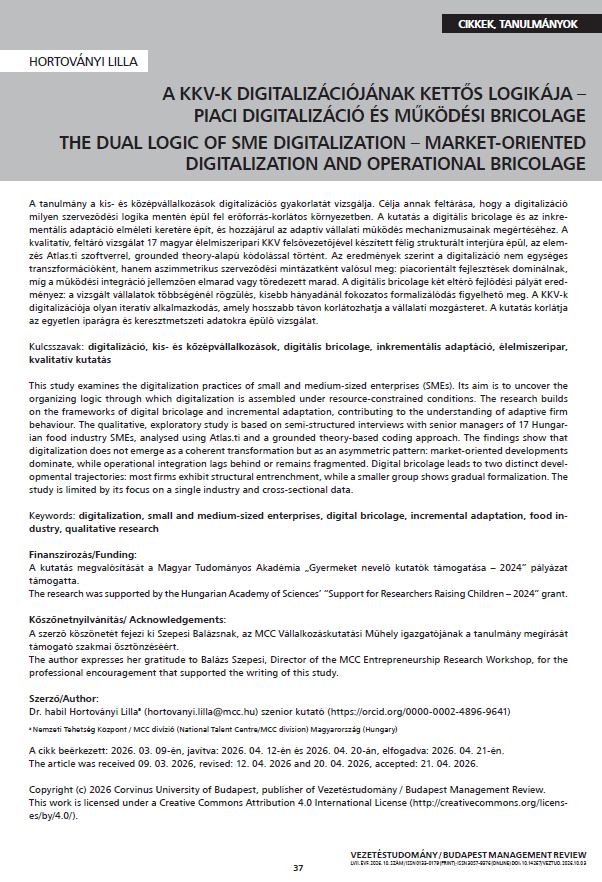
The dual logic of SME digitalization
Market-oriented digitalization and operational bricolage
DOI:
https://doi.org/10.14267/VEZTUD.2026.10.03Keywords:
digitalization, small and medium-sized enterprises, digital bricolage, incremental adaptation, food industry, qualitative researchAbstract
This study examines the digitalization practices of small and medium-sized enterprises (SMEs). Its aim is to uncover the organizing logic through which digitalization is assembled under resource-constrained conditions. The research builds on the frameworks of digital bricolage and incremental adaptation, contributing to the understanding of adaptive firm behaviour. The qualitative, exploratory study is based on semi-structured interviews with senior managers of 17 Hungarian food industry SMEs, analysed using Atlas.ti and a grounded theory-based coding approach. The findings show that digitalization does not emerge as a coherent transformation but as an asymmetric pattern: market-oriented developments dominate, while operational integration lags behind or remains fragmented. Digital bricolage leads to two distinct developmental trajectories: most firms exhibit structural entrenchment, while a smaller group shows gradual formalization. The study is limited by its focus on a single industry and cross-sectional data.
Downloads
References
Alford, P., & Jones, R. (2024). Digital entrepreneurial marketing bricolage: Shaping technology-in-practice. International Journal of Entrepreneurial Behavior & Research, 31(4), 1038–1061. https://doi.org/10.1108/IJEBR-07-2024-0746
Baker, T., & Nelson, R.E. (2005). Creating something from nothing: Resource construction through entrepreneurial bricolage. Administrative Science Quarterly, 50(3), 329–366. https://doi.org/10.2189/asqu.2005.50.3.329
Barann, B., Hermann, A., Cordes, A.K., & Chasin, F. (2019). Supporting digital transformation in small and medium-sized enterprises: A procedure model involving publicly funded support units. In Proceedings of the 52nd Hawaii International Conference on System Sciences (pp. 5155-5164). University of Hawaiʻi. https://doi.org/10.24251/HICSS.2019.619
Barney, J. (1991). Firm resources and sustained competitive advantage. Journal of Management, 17(1), 99–120. https://doi.org/10.1177/014920639101700108
Becker, W., & Schmid, O. (2020). The right digital strategy for your business: An empirical analysis of the design and implementation of digital strategies in SMEs and LSEs. Business Research, 13(3), 985–1005. https://doi.org/10.1007/s40685-020-00124-y
Ben Slimane, S., Coeurderoy, R., & Mhenni, H. (2022). Digital transformation of small and medium enterprises: A systematic literature review and an integrative framework. International Studies of Management & Organization, 52(2), 96–120. https://doi.org/10.1080/00208825.2022.2072067
Botos, S., Szilágyi, R., Tóth, M., Ráthonyi, G., & Felföldi, J. (2020). Digitalized business processes: Assessment and opportunities of Hungarian agri-food companies. Journal of Agricultural Informatics, 11(1), 34–44. https://doi.org/10.17700/JAI.2020.11.1.568
Bryman, A. (2016). Social research methods (5th ed.). Oxford University Press.
Cosovan, A.R., Horváth, D., & Mitev, A.Z. (2018). A designkommunikáció antropológiai megközelítése. Replika, (106–07), 233–245. https://doi.org/10.32564/106-107.14
Cunningham, W. (1992). The WyCash portfolio management system, experience report. Proceedings on Object- Oriented Programming Systems, Languages, and Applications (OOPSLA 1992), 4(2), 29-30. https://doi.org/10.1145/157710.157715
Dióssy, K., Losonci, D., Aranyossy, M., & Demeter, K. (2025). The role of leadership in digital transformation – a paradox way to improve operational performance. Journal of Manufacturing Technology Management, 36(9), 88–113. https://doi.org/10.1108/JMTM-07-2024-0386
He, T.H., Liu, W., Shao, X., & Tian, R.G. (2023). Exploring the digital innovation process and outcome in retail platform ecosystems: Disruptive transformation or incremental change. Electronic Commerce Research, 25(1), 465-494. https://doi.org/10.1007/s10660-023-09699-0
Hornyák, M., Csapi, V., & Putzer, P. (2025). A digitális érettség és a fenntarthatósági teljesítmény kapcsolata a hazai kkv-knál. Közgazdasági Szemle, 72(6), 545–565. https://doi.org/10.18414/KSZ.2025.6.545
Karanasios, S., Senyo, P.K., Zorina, A., & Effah, J. (2025). Digital bricolage and its limits: How microenterprises undertake digitalization in resource-constrained environments. Information Systems Research, 37(1), 526–548. https://doi.org/10.1287/isre.2023.0193
Keszey, T., Molnár, L., & Mursalzade, H. (2023). An examination of factors influencing the perception of customer information quality: The impact of trust, organizational changes, and turbulence. Vezetéstudomány/ Budapest Management Review, 54(12), 14–23. https://doi.org/10.14267/VEZTUD.2023.12.02
Kocaman, S., & Öztürk, G. (2021). E-commerce applications in the food and beverage sector during the COVID-19 pandemic and a model proposal. Journal of Tourism and Gastronomy Studies, 9(2), 840–852. https://doi.org/10.21325/JOTAGS.2021.840
Kraft, C., Lindeque, J.P., & Peter, M.K. (2022). The digital transformation of Swiss small and medium-sized enterprises: Insights from digital tool adoption. Journal of Strategy and Management, 15(3), 468–494. https://doi.org/10.1108/JSMA-02-2021-0063
Lincoln, Y.S., & Guba, E.G. (1985). Naturalistic inquiry. SAGE.
Marolt, M., Pucihar, A., Kljajić Borštnar, M., Lenart, G., Vidmar, D., Szabó, I., Fehér, P., Kovács, T., Kő, A., Szabó, Z., & Őri, D. (2024a). Impact of COVID-19 pandemic on SMEs’ digital transformation journey – Slovenian and Hungarian experiences. Vezetéstudomány/ Budapest Management Review, 55(11), 29–40. https://doi.org/10.14267/VEZTUD.2024.11.03
Marolt, M., Lenart, G., Kljajić Borštnar, M., & Pucihar, A. (2024b). Exploring digital transformation journey among micro, small-, and medium-sized enterprises. Systems, 13(1), Article 1. https://doi.org/10.3390/systems13010001
Nagy, J., Jámbor, Z., & Freund, A. (2020). Az Ipar 4.0 és a digitalizáció legjobb gyakorlatai a hazai élelmiszergazdaságban: Négy esettanulmány. Vezetéstudomány 51(6), 5–16. https://doi.org/10.14267/VEZTUD.2020.06.01
OECD. (2021). The digital transformation of SMEs. OECD Studies on SMEs and Entrepreneurship. OECD Publishing. https://doi.org/10.1787/bdb9256a-en
Patton, M.Q. (2015). Qualitative research and evaluation methods (4th ed.). SAGE.
Sándor, Á., & Gubán, Á. (2021). A digitális érettség életciklusmodellje KKV-k számára. Vezetéstudomány 52(11), 57–70. https://doi.org/10.14267/VEZTUD.2021.11.05
Szász, L., Demeter, K., Rácz, B., & Losonci, D. (2021). Industry 4.0: A review and analysis of contingency and performance effects. Journal of Manufacturing Technology Management, 32(3), 667–694. https://doi.org/10.1108/JMTM-10-2019-0371
Szegedi, Z., Ulechla, G., & Miskolczi-Gabriel, M. (2022). Digital transformation in food supply chains in central and eastern Europe. International Journal of Economics Business and Management Studies, 9(2), 171–182. https://doi.org/10.55284/ijebms.v9i2.813
Szegedi, Z., & Reicher, R.Z. (2022). A digitalizáció és annak hatása a stratégiai és szervezeti módosításokra a mikro-, kis- és középvállalkozásoknál. Tér-Gazdaság- Ember/Journal of Region, Economy and Society, 10(3-4), 37-51. https://tge.sze.hu/tge/article/view/349/203
Szűcs, K., Kemény, I., Prónay, S., & Keszey, T. (2022). Innovatív technológiák marketingkihívásai és lehetőségei. Vezetéstudomány 53(7), 2–3. https://doi.org/10.14267/VEZETESTUD.2022.07.01
Torabi, Z.A., & Hall, C.M. (2026). Digital bricolage in sanctioned tourism ecosystems. Annals of Tourism Research, 118, Article 104143. https://doi.org/10.1016/j.annals.2026.104143
Vitsentzatou, E., & Gikas, G. (2022). The digital transformation of the marketing mix in the food and beverage service supply chain: A grey DEMATEL approach. Sustainability, 14(22), Article 15228. https://doi.org/10.3390/su142215228
Yin, R.K. (2018). Case study research and applications: Design and methods (6th ed.). SAGE.
Downloads
Published
Issue
Section
License
Copyright (c) 2026 Corvinus University of Budapest, publisher of Vezetéstudomány / Budapest Management Review

This work is licensed under a Creative Commons Attribution 4.0 International License.
Authors assign copyright to Vezetéstudomány / Budapest Management Review. Authors are responsible for permission to reproduce copyright material from other sources.
How to Cite